On January 16, 2009, JPMorgan's CEO Jamie Dimon bought roughly $11 million of his own bank's stock on the open market, purchasing 500,000 shares the day after JPM reported a 76% drop in Q4 profit. The stock had fallen sharply during the early stages of the financial crisis. Anyone who had a Form 4 alert set on JPM that morning saw the purchase before it hit any news ticker. Over the next four years, JPM more than tripled.
Form 4 is the SEC document insiders must file within two business days of any transaction in their company's stock. It captures every buy, sell, option exercise, and grant by officers, directors, and 10% beneficial owners. The data is public, free, and machine-readable, and academic research has consistently found that clustered insider buying tends to precede above-market returns over the following months. The problem is that SEC EDGAR does not push notifications. You have to come and get the data, and by the time most retail investors find it, the move has already happened.
This guide covers how Form 4 filings work on EDGAR, the patterns worth watching for, and how to set up a continuous monitor that surfaces insider transactions for any company as soon as the next check picks up the filing, free.
Quick Setup
Enter a ticker symbol below and PageCrawl will set up monitoring on that company's Form 4 filings page. You will get notified whenever a new insider transaction is filed.
Why do Form 4 filings matter?
Form 4 filings matter because they are the one disclosure where insiders spend their own money. Insiders are already over-exposed to their employer through salary, restricted stock, and option grants. Every additional dollar they put into the same equity is a discretionary statement that the price is too low relative to the information they have. That is what makes Form 4 the highest-signal disclosure in the SEC system.
Open-Market Purchases Are Unusually Informative
Most insider compensation is non-cash. When a CEO writes a personal check to buy more shares, they are voluntarily increasing concentration in the position. Academic studies stretching back to Lakonishok and Lee's Are Insider Trades Informative? consistently find that insider purchases carry predictive power over the following 6-12 months, while sales have weak or no predictive value (most sales are tax or diversification driven).
Cluster Activity Is The Strongest Signal
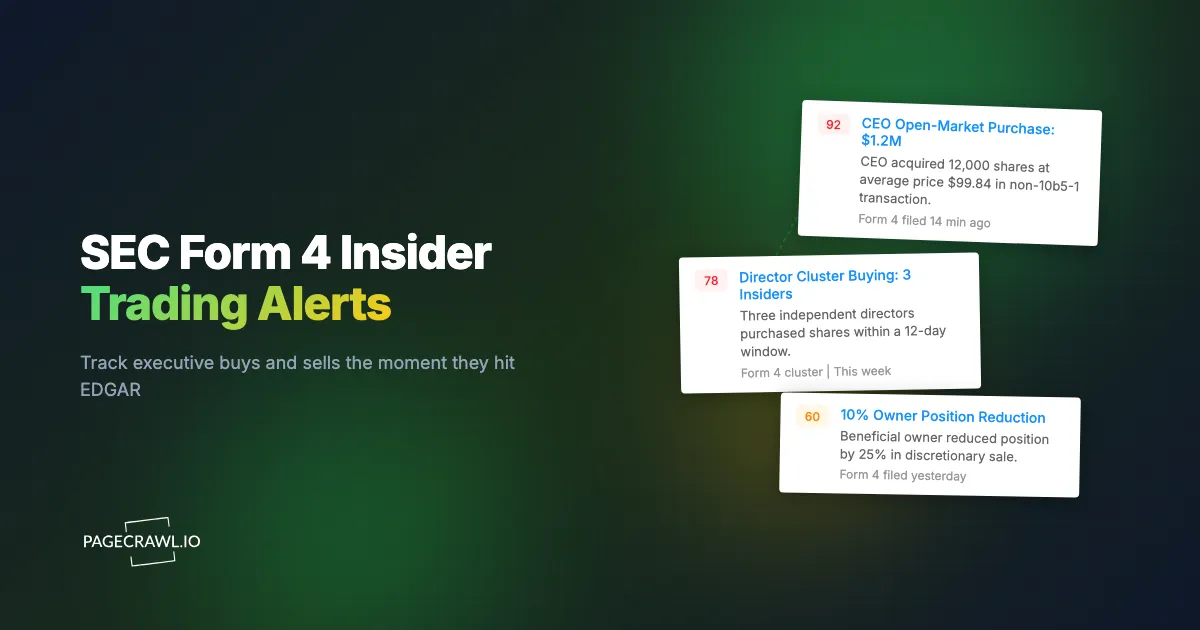
One director buying $50,000 is noise. Three independent directors buying within a 30-day window, especially when share price is depressed, has historically been one of the highest-confidence signals in the dataset. The Berkshire Hathaway form 4 filings during summer 2020 (Buffett buying Bank of America) are the textbook example.
Sales Outside 10b5-1 Plans Sometimes Telegraph Bad News
Rule 10b5-1 trading plans reduce the predictive power of insider selling by pre-committing to a sale schedule. The box on Form 4 indicating whether the trade was pursuant to a 10b5-1 plan is the key field. A spike in non-plan sales four to six weeks before earnings is the pattern that has repeatedly drawn SEC scrutiny, which is why the plan flag is worth reading on every sale.
Form 4 Activity Sometimes Front-Runs Activist Disclosures
A 13D filing requires beneficial ownership of more than 5%. Activists often build position through a mix of derivatives and open-market purchases that show up on Form 4 (when affiliated with an officer position) before the 13D threshold is crossed. Spotting the accumulation pattern in Form 4 sometimes gives you weeks of warning ahead of the activist announcement.
How do Form 4 filings appear on EDGAR?
Form 4 filings appear as rows on a company's EDGAR filing index page, and you can filter that page down to Form 4 only. Each public company has a filing index page keyed by its CIK (Central Index Key) number. You can filter that page to a specific form type using a URL parameter. The Form 4 filtered URL pattern is:
https://www.sec.gov/cgi-bin/browse-edgar?action=getcompany&CIK=AAPL&type=4&dateb=&owner=include&count=40Replace AAPL with the ticker or CIK of the company you want to track. The page returns a table of recent Form 4 filings with the filing date, the filer name, transaction type, and a link to the full document. Each new transaction creates a new row.
EDGAR also exposes a market-wide Form 4 feed, useful for cluster detection across an industry or full watchlist:
https://www.sec.gov/cgi-bin/browse-edgar?action=getcurrent&type=4&company=&dateb=&owner=include&count=40Each individual Form 4 contains structured tables for non-derivative transactions (open-market buys and sells), derivative transactions (option exercises, restricted stock vests), and a footnotes section that often contains the most useful context (10b5-1 plan adoption, gift transactions, beneficial ownership clarifications).
Comparing Monitoring Approaches
| Approach | Cost | Latency | Coverage | Best For |
|---|---|---|---|---|
| Manual EDGAR refresh | Free | Hours to days | Per-ticker | Casual checking on a single name |
| OpenInsider / InsiderMonkey | Free / Paid | 30-60 minutes | Broad | Browsing aggregated activity |
| Bloomberg Terminal IXAP | $30K/year | Seconds | Comprehensive | Institutional desks |
| Brokerage news alerts | Free with account | 30+ minutes | Holdings only | Retail investors with limited watchlists |
| PageCrawl on EDGAR | Free tier to $80/year | 2-15 minutes | Any ticker, full filing | Active investors building structured watchlists |
OpenInsider is the most popular free alternative but it polls EDGAR on its own schedule and aggregates into a daily digest. PageCrawl gives you per-ticker control with frequency you choose, plus webhook output that plugs into spreadsheets, Discord, or your own scripts.
Setting Up Form 4 Monitoring in PageCrawl
Step 1: Find the company's CIK
Search the SEC EDGAR company search by ticker or name. The CIK appears in the URL of the company's filing page. Save it.
Step 2: Build the filtered Form 4 URL
Use the pattern above with the CIK and type=4. This restricts the monitored page to Form 4 filings, so 10-K, 8-K, and other filings do not generate noise. If you want to include amendments, change type=4 to type=4%2C4%2FA (Form 4 plus Form 4/A).
Step 3: Add the URL as a content monitor
Sign in to PageCrawl, click Track New Page, and paste the URL. Choose content monitoring so the filings table is tracked. PageCrawl detects when a new row appears in the table, which means a new Form 4 was filed.
Step 4: Pick a check frequency
Insiders often file after market close. Below are reasonable defaults by use case:
- Buy-and-hold investor: 60-minute checks (Free plan). New filings reach you within an hour.
- Active investor: 15-minute checks (Standard plan). New filings reach you within 15 minutes.
- Event-driven strategy: 2-minute checks (Ultimate plan). Near real-time, important when filings drop within a minute of market open.
Step 5: Configure notifications
For active traders, Telegram or Discord push the alert to your phone as soon as a check detects the new filing. For longer-horizon investors, an email digest works fine. PageCrawl's AI change summaries describe which insider transacted and the rough transaction size, so you do not have to open EDGAR for every alert. See the email alerts setup guide, the Telegram alerts guide, and the help centre walkthrough on connecting a Telegram bot to a chat, group, or channel.
Step 6: Group multiple companies into a watchlist folder
In PageCrawl, create a folder named "Form 4 Watchlist" and add a monitor per ticker. The folder view shows all recent insider activity across your watchlist on one page, which is useful for visual cluster detection. If you run several strategies, the guide to organising monitors with labels, folders, and workspaces covers how to keep each watchlist separate.
Worked Example: Building a 20-Stock Insider Watchlist
Take a typical 20-stock long-only portfolio. The setup looks like this:
- Pull the CIK for each ticker from EDGAR (5 minutes for 20 companies).
- Build 20 filtered Form 4 URLs using the pattern above.
- Bulk-import the URLs into PageCrawl using the bulk-add feature.
- Tag all 20 monitors with
form-4-watchlist. - Set frequency to 15 minutes for the top 5 highest-conviction names, 60 minutes for the rest.
- Route all alerts to a single
#insider-activitySlack channel.
Total setup time: about 20 minutes. Total cost: free for the first 6 monitors, $80/year for the full 20. The Standard plan at 15-minute frequency gives same-day awareness on every filing that affects the portfolio.
Which insider trading patterns are worth watching for?
The patterns with the most historical signal are clustered director buying, CEO purchases worth a year or more of salary, and discretionary sales made outside a 10b5-1 plan. Each is visible in the Form 4 data itself, and each deserves a different follow-up.
Director buying clusters. Three or more independent directors buying within a 30-day window. The Lakonishok-Lee paper and follow-up studies all identify this as the highest-conviction insider signal.
CEO purchases of size. A CEO buying stock equal to one year or more of base salary is a strong conviction signal, especially when the share price is at a 52-week low. Salary data is in the proxy (DEF 14A); see our proxy statement monitoring guide for tracking those.
Sales outside 10b5-1 plans. Compare the filing's plan-flag field to recent activity. Discretionary sales near a price peak deserve a closer look at the next earnings cycle.
Pre-event sales. Heavy insider selling in the four to six weeks before earnings, restatements, or M&A announcements. This is the pattern most often referenced in SEC enforcement actions.
Section 16(b) short-swing recovery filings. When an insider buys and sells within six months, the profit is recoverable by the company under Section 16(b) of the Securities Exchange Act. These filings often signal sloppy compensation administration, sometimes a coverage opportunity for short-side analysts.
Advanced Patterns: Combining Form 4 With Other Signals
The full value of Form 4 monitoring shows up when you cross-reference it with other public data, the same approach behind a broader playbook for turning SEC filings into signals.
Combine with 10-Q risk-factor diffs. Pair a Form 4 monitor with our 10-K / 10-Q diff monitor. When new risk factors land in the same quarter as insider selling, the alignment is meaningful.
Combine with 13F new positions. Pair with our 13F holdings monitor. When a high-quality fund initiates a position and insiders are buying in the same quarter, the alignment is even more meaningful.
Combine with proxy compensation timing. Use the DEF 14A monitor to track vest dates and grant cycles. Some sales are pure liquidity around vest events and have no predictive value; filtering those out improves your signal.
Combine with press releases. Add the company's IR press page as a sibling monitor. When insider buying lands in the same week as a positive operational announcement, the signal is layered.
Use Cases
Individual investors. Build a Form 4 watchlist of every portfolio company, then widen it into a full investment intelligence feed of filings, IR pages, and earnings releases. Pair with price alerts to act on the full signal.
Equity research analysts. Per-name Form 4 monitors per coverage ticker, routed to a shared analyst Slack channel. Cluster detection becomes a daily morning review.
Activist funds. Form 4 activity at potential targets reveals whether existing management is doubling down or quietly exiting. A sustained pattern of insider selling at a target makes the activist thesis easier to sell.
Compliance officers. Brokerages, RIAs, and family offices monitor Form 4 filings for restricted securities lists, and reconcile against internal trade approvals.
Financial journalists. Beats covering specific sectors use Form 4 monitors as a continuous tip line. The Wall Street Journal and the FT regularly source stories from Form 4 data.
Quantitative strategies. Aggregate Form 4 flows across a universe (sector, market cap, factor) and use them as a feature in a multi-factor model. Net insider buying is a documented mid-frequency factor.
Frequently Asked Questions
How quickly do Form 4 filings appear on EDGAR after a transaction? Insiders have two business days from the transaction date to file. Most file the same day or the next business day. The filing appears on EDGAR within minutes of submission.
Can I filter by transaction type (buy vs sell) in the URL? No, EDGAR's Form 4 listing URL filters by form type, not by transaction direction. The transaction type appears in the body of each filing. PageCrawl's AI change summaries can be configured to distinguish buys from sells in the alert text.
Do option exercises count as insider buying? Option exercises are reported as derivative transactions on Form 4 and have less predictive power than open-market cash purchases. Most academic studies of insider signal explicitly exclude option-exercise transactions for this reason.
What about Form 144 and Form 5? Form 144 is filed before a planned restricted-stock sale by an affiliate; not a Form 4 substitute but worth watching for executives subject to volume limits. Form 5 captures end-of-year exempt transactions that were not reported on Form 4. Both are available on EDGAR with the same URL pattern by substituting the form type.
Is there a way to monitor all Form 4 filings across the entire market? Yes, use the getcurrent endpoint above. The volume is high (often 1,000+ filings per day), so AI summaries or a downstream filter is helpful.
Do I need a paid plan to monitor Form 4? No. The free plan supports 6 monitors at 60-minute checks, which is enough for a small watchlist. Standard at $80/year supports 100 monitors at 15-minute checks, which covers most active-investor needs.
Choosing your PageCrawl plan
PageCrawl's Free plan lets you monitor 6 pages with 220 checks per month, which is enough to validate the approach on your most critical pages. Most teams graduate to a paid plan once they see the value.
| Plan | Price | Pages | Checks / month | Frequency |
|---|---|---|---|---|
| Free | $0 | 6 | 220 | every 60 min |
| Standard | $8/mo or $80/yr | 100 | 15,000 | every 15 min |
| Enterprise | $30/mo or $300/yr | 500 | 100,000 | every 5 min |
| Ultimate | $99/mo or $999/yr | 1,000 | 100,000 | every 2 min |
Annual billing saves two months across every paid tier. Enterprise and Ultimate scale up to 100x if you need thousands of pages or multi-team access.
In event-driven strategies, minutes matter. One actionable signal surfaced before the broader market reacts can return more than a year of Ultimate. Standard at $80/year covers the core IR, press, and filings pages for a handful of positions. Enterprise at $300/year scales to a full watchlist. All plans include the PageCrawl MCP Server, so you can ask Claude to summarize every material change across a company's IR, press, and filings over any period you care about and get the evidence pulled straight from your monitoring archive. AI assistants can create monitors through conversation on every plan, including Free. Ultimate at $999/year adds 2-minute frequency and web archiving, which matters if you need provable timestamps for a thesis.
Getting Started
Start with three to five tickers from your existing portfolio. Pull their CIKs, build the filtered Form 4 URLs using the pattern above, and add them to PageCrawl. Form 4 data is public disclosure, not investment advice, so always confirm a transaction against the original filing on SEC EDGAR before you act on it. Create a free account, wire alerts to Telegram or email, and run the setup for two weeks. You will see the natural rhythm of insider activity in your names and develop a feel for what is noise (routine vests, small administrative trades) and what is signal (cluster buying, large discretionary sales).
Once you see the value, expand to a full 20-30 ticker watchlist. The Standard plan at $80/year is the right step up; it covers 100 monitors at 15-minute checks, which is enough for a serious watchlist with room for sibling monitors on IR pages, press rooms, and proxy filings. For investors who treat Form 4 as a real input to portfolio decisions, the cost recovers itself the first time a clustered buy alert leads to a position trim, add, or new entry.