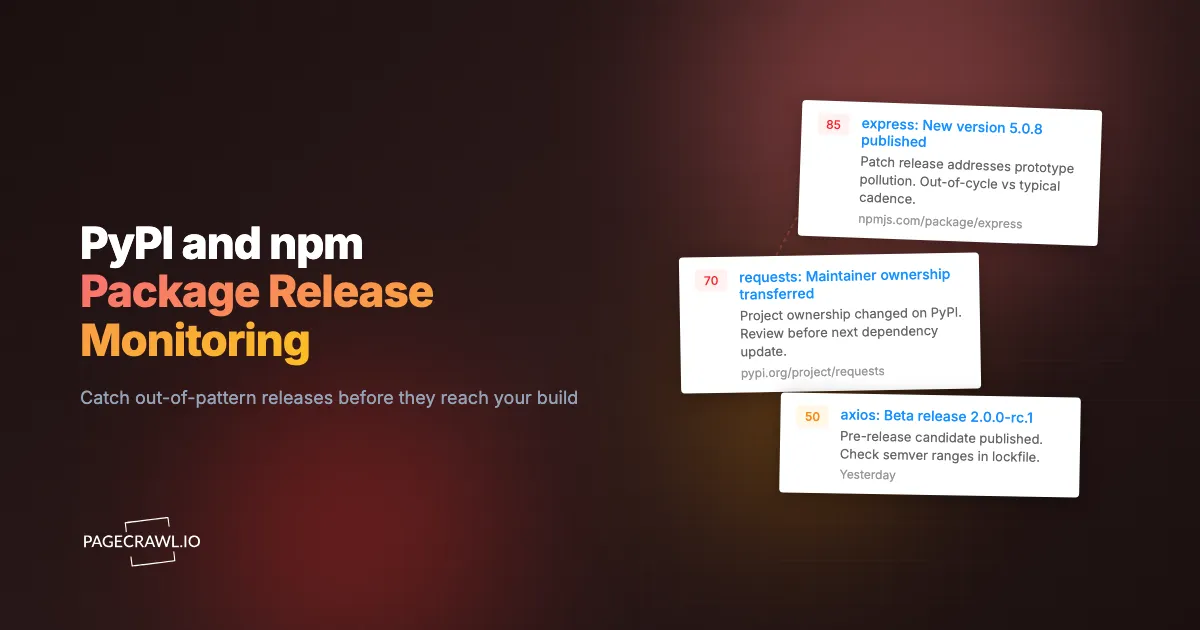
On March 29, 2024, Microsoft engineer Andres Freund publicly disclosed a backdoor that had been quietly inserted into xz-utils 5.6.0 and 5.6.1 by a maintainer over the preceding months, later tracked as CVE-2024-3094 in the National Vulnerability Database. Freund noticed unusual SSH login latency on a Debian unstable machine while benchmarking Postgres and traced it back. The malicious commits had been in the wild since February 2024. Similar incidents have hit npm (event-stream, ua-parser-js, node-ipc) and PyPI (ctx, phpass, dozens of typosquats). In every case, the malicious version landed on the registry page first, often hours before automated update jobs pulled it into builds.
The npm and PyPI ecosystems each ship a constant stream of new package versions every day. Most are routine. But the same channels are where supply chain attacks land. Compromised maintainer accounts, typosquatted packages, account takeover via expired domains, and post-install payload injections all surface first as a new version on a package page. Dependabot, Renovate, and similar update tools react after the version is already in the registry, often after CI has already pulled it. Monitoring at the registry surface gives your security team a window of awareness before the version flows into your build.
This guide covers how PyPI and npm expose release data, the patterns worth watching, and how to set up a continuous monitor that alerts your security team on the next scheduled check after a new version lands on a pinned dependency.
Quick Setup
Pick PyPI or npm, enter a package name, and we'll preview the release and maintainer-change alerts.
Why should you monitor package releases at the registry layer?
Because the registry page is where a malicious or out-of-pattern version appears first, before any update job pulls it in. Most dependency management tools react to releases only after they have already entered your dependency tree. Monitoring at the source gives your team a window to review.
Out-of-Pattern Releases Are the Earliest Signal
A package that ships once a quarter releasing twice in a day is anomalous and worth a manual review. Most package compromise patterns include a burst of releases as the attacker iterates on the payload. Cadence anomaly is one of the simplest detection signals.
Compromised Maintainer Activity Is Visible on the Package Page
Recent supply chain incidents involved new versions published by compromised accounts hours before detection. The compromised account often shows different metadata (publish IP, signing key, README diffs) that a careful reviewer can spot. An alert on the next check after publication gives that reviewer a chance.
Maintainer and Ownership Changes
A package transferring ownership or changing maintainer email is a strategic signal for any team depending on it. The ctx PyPI compromise was preceded by an ownership reset after the original maintainer's email expired. Similar patterns recur.
License Changes Affect Compliance
A maintainer changing a package's license terms (BSD to AGPL, MIT to BUSL) can have direct compliance implications for your organization. Same-day awareness lets legal and procurement react before the new version is in production.
Pre-Release Tags Can Leak Into Production
Beta and RC versions sometimes match loose semver ranges in your manifest and slip into builds unintentionally. Monitoring catches the publish event so you can verify your range pinning before the next install.
How do PyPI and npm expose release data?
Both registries publish a stable HTML page per package showing the latest version, release history and maintainers, plus a JSON endpoint carrying the same metadata with per-version files, hashes and maintainer info. Either surface can be monitored; the JSON endpoints are the better target for automation. The page URLs follow a fixed pattern:

https://pypi.org/project/{package-name}/
https://www.npmjs.com/package/{package-name}
Each page lists the latest version, release history, maintainer information, and project links. JSON APIs are also available:
https://pypi.org/pypi/{package-name}/json
https://registry.npmjs.org/{package-name}
The JSON endpoints expose the same release metadata in machine-readable form, plus per-version files, hashes, and maintainer info. For SOAR and CI integration, the JSON endpoints are the right monitoring target.
Which package monitoring approach fits your team?
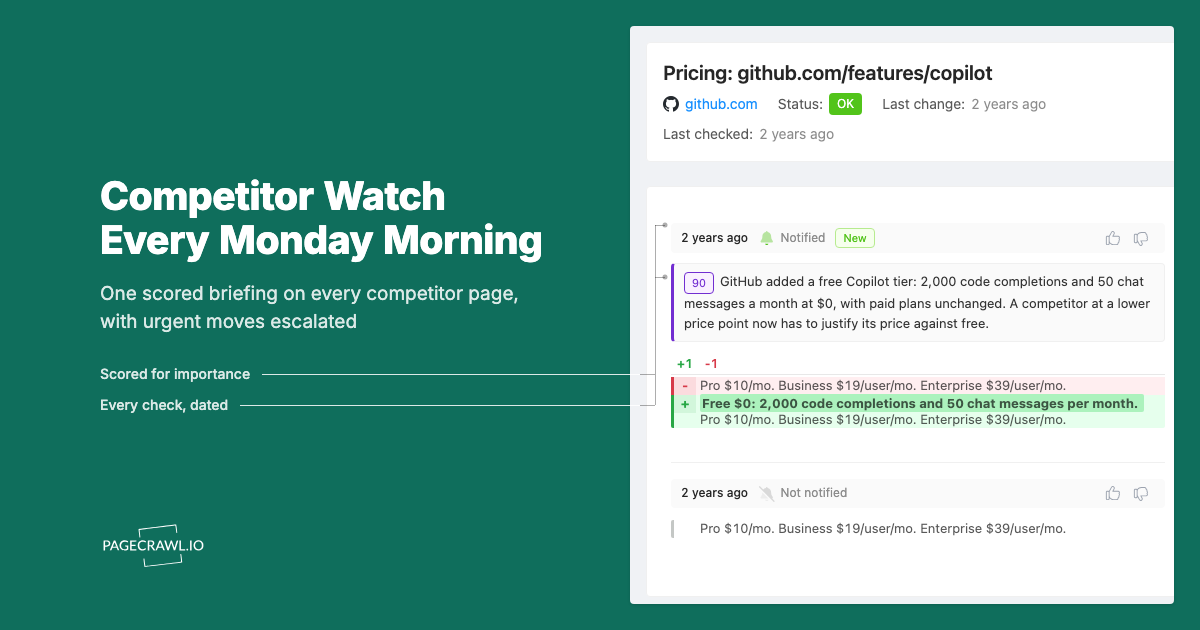
It depends on the budget and the job. Dependabot and Renovate handle routine version bumps but only react once a release is already in your repo. Dedicated supply-chain platforms analyse package behaviour and suit mature AppSec programmes. A page monitor on the registry sits in between: cheap, and triggered by the publish event itself.
| Approach | Cost | Latency | Coverage | Best For |
|---|---|---|---|---|
| Dependabot / Renovate | Free | After release lands in repo | Per-repo | Routine update PRs, not security |
| Snyk / Socket / Phylum | Paid SaaS | Real-time | Curated supply-chain signals | Mature AppSec teams |
| GitHub release feeds | Free | Variable | Only packages with GitHub releases | Awareness, not comprehensive |
| Registry email | Free, limited | Same-day | Subscribed packages | One-off awareness |
| PageCrawl on registry pages | Free tier to $80/year | 15-60 minutes | Any package | Security teams, DevOps, OSS maintainers |
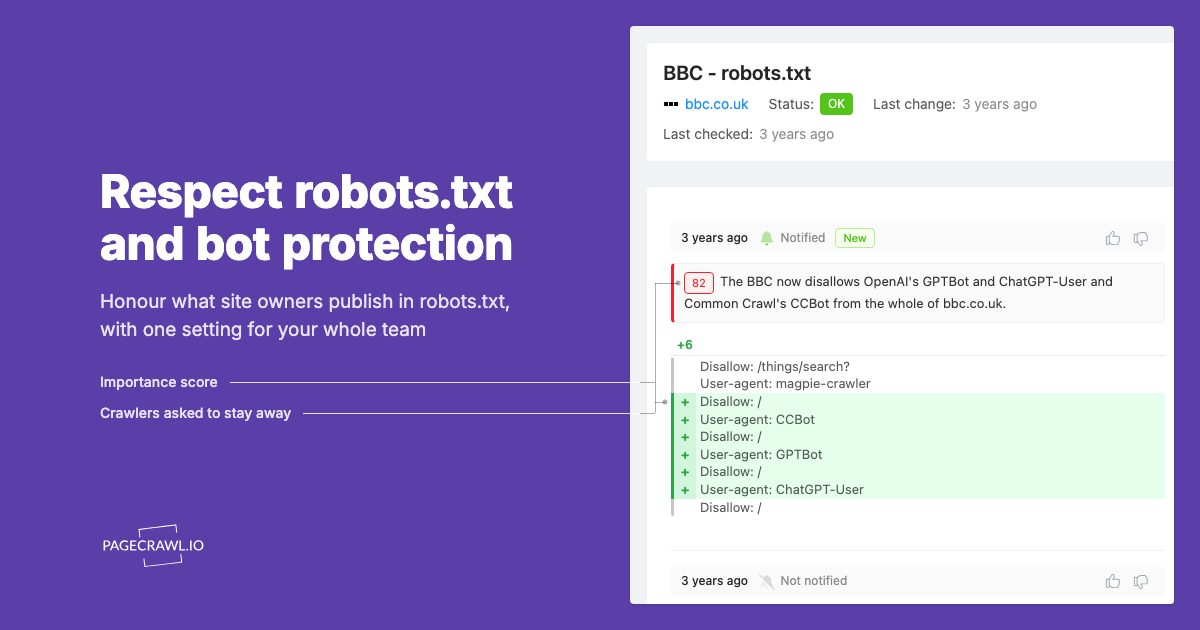
Socket and Phylum are excellent for behavior-level analysis of new releases and the right product for a mature application-security program. PageCrawl complements those products by giving you a cheap, simple monitor at the publish event itself, which is useful for teams without a budget for a dedicated supply-chain platform or as a redundant early-warning layer.
Setting Up Package Release Monitoring in PageCrawl
Step 1: Inventory your top dependencies
Start with the 20-50 packages your application depends on most heavily. Pull from package.json, requirements.txt, Pipfile.lock, or poetry.lock. Prioritize: packages with native code (esbuild, sharp, sqlite3), packages with broad transitive reach (lodash, axios, requests), and packages used in security-sensitive contexts (jsonwebtoken, cryptography).
Step 2: Add the project page URL for each
For each package, paste the PyPI project page or npm package URL into PageCrawl as a content monitor. PageCrawl detects new versions when the latest-version field changes.
Step 3: Use the JSON endpoints for webhook automation
For SOAR or CI/CD integration, monitor the JSON endpoints instead. As described in the guide to the API and webhooks for custom integrations, PageCrawl webhooks can deliver structured payloads to your security pipeline. A change to the latest version field triggers a webhook with the new version, publish timestamp, and maintainer.
Step 4: Pick an appropriate check frequency
Most package release activity follows business hours in the maintainer's time zone. An hourly check catches releases the same day with manageable noise. For very high-risk packages (those with broad reach and history of incidents), 15-minute checks on Standard plan are appropriate.
Step 5: Pair with GitHub release monitoring
Many critical packages also publish releases on GitHub, where the same release notes and changelog monitoring approach applies. A combined monitor of the package page and the GitHub releases page provides confirmation across surfaces. A version appearing on the registry but not GitHub (or vice versa) is itself an anomaly worth investigating.
Step 6: Configure notifications
Route alerts to a #dependency-releases Slack channel for the security or DevOps team. Use AI summaries to flag the specific version, publish time, and maintainer. For high-risk packages, escalate to a dedicated channel with on-call paging.
Worked Example: A 100-Package Watchlist for an AppSec Team
Take an application-security team supporting a polyglot stack with both Python and Node services. The setup:
- Pull the top 100 direct dependencies from
package.jsonandrequirements.txtacross all repos. - Build the registry URL list and import into PageCrawl in one batch.
- Tag PyPI packages with
pypiand npm packages withnpm. - Set hourly checks for 80 routine packages, 15-minute checks for 20 high-risk packages.
- Route alerts to
#dep-releasesSlack and#dep-releases-criticalfor the 20 high-risk ones. - Configure webhooks into the SOAR for automatic ticket creation on high-risk releases.
- Pair with our KEV catalog monitor so that any CVE landing against one of the 100 packages also generates a ticket.
Total cost: Standard plan at $80/year covers all 100 monitors. For an AppSec team, the cost is rounding error against a single avoided supply-chain incident.
Which package release patterns are worth watching for?
The highest-signal ones are an unexpected bump on a long-quiet package, several releases within hours, a maintainer or ownership change, a deprecation notice, a pre-release version that matches a loose semver range, a drastic README rewrite, and provenance or signing metadata appearing or disappearing between versions.
Unexpected version bumps of long-quiet packages. A package that has not released in 18 months suddenly shipping a 0.0.1 patch warrants special review.
Multiple releases within hours. Especially right before a weekend or holiday. Burst-release patterns recur across supply-chain incident history.
Maintainer or ownership changes. Disclosed on the package page. The combination of an ownership reset plus a new release within days is a high-priority signal.
Deprecation notices. May affect your build before you notice. Same-day awareness lets you plan a migration.
Pre-release versions matching loose semver. A 1.2.0-beta.1 matching ^1.0.0 can install accidentally. Monitoring catches the publish event so you can audit ranges.
README diffs. A drastic README change accompanying a new version is sometimes the signature of account compromise (attackers update the README to make the package look legitimate after takeover).
Provenance and signing changes. npm and PyPI both support attestations and signing. A package that loses or gains provenance metadata between versions deserves review.
Combining Package Release Monitoring With Other Signals
The full value of registry monitoring shows up when you pair it with other public security data.
Combine with the CISA KEV catalog. Pair the registry monitor with our CISA KEV monitoring guide, which watches the agency's Known Exploited Vulnerabilities Catalog. When a KEV addition references a package on your watchlist, escalate the next release of that package.
Combine with Docker Hub tag releases. Use our Docker Hub monitor for the base images that contain those packages. A coordinated patch cycle is easier when both signals land in the same channel.
Combine with Kubernetes release feeds. For containerized workloads, our Kubernetes CVE monitor covers the orchestration layer. Together they give a complete supply-chain picture.
Combine with GitHub trending and starred-repo movement. Use our GitHub trending repo guide to discover new packages worth adding to the watchlist before they become critical dependencies.
Use Cases
Application security teams. Critical dependency monitors feed into a manual review queue for high-risk packages. For organizations without a Socket or Phylum budget, this is the cheapest credible supply-chain early-warning system.
DevOps and platform teams. Alerts on packages used in CI pipelines let you pause auto-update jobs when an out-of-pattern release lands. Defensive pause is a real workflow improvement.
Open source maintainers. Watching upstream dependencies of your own project alerts you to breaking changes before users report them. For maintainers with a small bus factor, this is real time saved.
OSS governance and procurement. License and maintainer changes are flagged the day they happen. For organizations with strict OSS compliance, this is the cleanest signal.
Incident response teams. When a supply-chain incident is disclosed, a monitored archive of recent releases helps with scoping (which versions did we install, when did each release publish).
Security researchers. Anomaly patterns in registry data are an interesting research surface. PageCrawl's monitoring archive becomes a free panel for studying release cadence.
Frequently Asked Questions
How does this compare to Dependabot or Renovate? Dependabot reacts after the release is in your repo (a PR is opened). PageCrawl alerts you at the publish event itself, before any automated update job touches the new version. The two are complementary: Dependabot handles the routine update lifecycle; PageCrawl provides the security-aware early warning.
Can I monitor an entire ecosystem rather than per-package? Both PyPI and npm expose RSS feeds for all package releases. These are very high volume and not practical to monitor at the publish event level. For ecosystem-wide signals, use Socket or Phylum. For per-package monitoring of your stack, PageCrawl is the right tool.
What about private registries? PageCrawl can monitor any URL that returns text or JSON, including private registry pages (with appropriate auth headers). The setup is the same as public registries.
How do I scale to thousands of dependencies? Standard at $80/year covers 100 packages comfortably. Enterprise at $300/year covers 500. For very large dependency surfaces, prioritize: monitor direct dependencies aggressively, sample transitive dependencies, and rely on Socket / Phylum for ecosystem-wide coverage.
Will webhook delivery handle bursts? Yes. PageCrawl webhook delivery is asynchronous and queued; bursty release activity is delivered as it is detected without dropped alerts.
Do I need a paid plan? The Free plan supports 6 monitors at hourly checks, enough to test the workflow on the riskiest few packages. Standard at $80/year is the right step for a serious watchlist.
Choosing your PageCrawl plan
PageCrawl's Free plan lets you monitor 6 pages with 220 checks per month, which is enough to validate the approach on your most critical pages. Most teams graduate to a paid plan once they see the value.
| Plan | Price | Pages | Checks / month | Frequency |
|---|---|---|---|---|
| Free | $0 | 6 | 220 | every 60 min |
| Standard | $8/mo or $80/yr | 100 | 15,000 | every 15 min |
| Enterprise | $30/mo or $300/yr | 500 | 100,000 | every 5 min |
| Ultimate | $99/mo or $999/yr | 1,000 | 100,000 | every 2 min |
Annual billing saves two months across every paid tier. Enterprise and Ultimate scale up to 100x if you need thousands of pages or multi-team access.
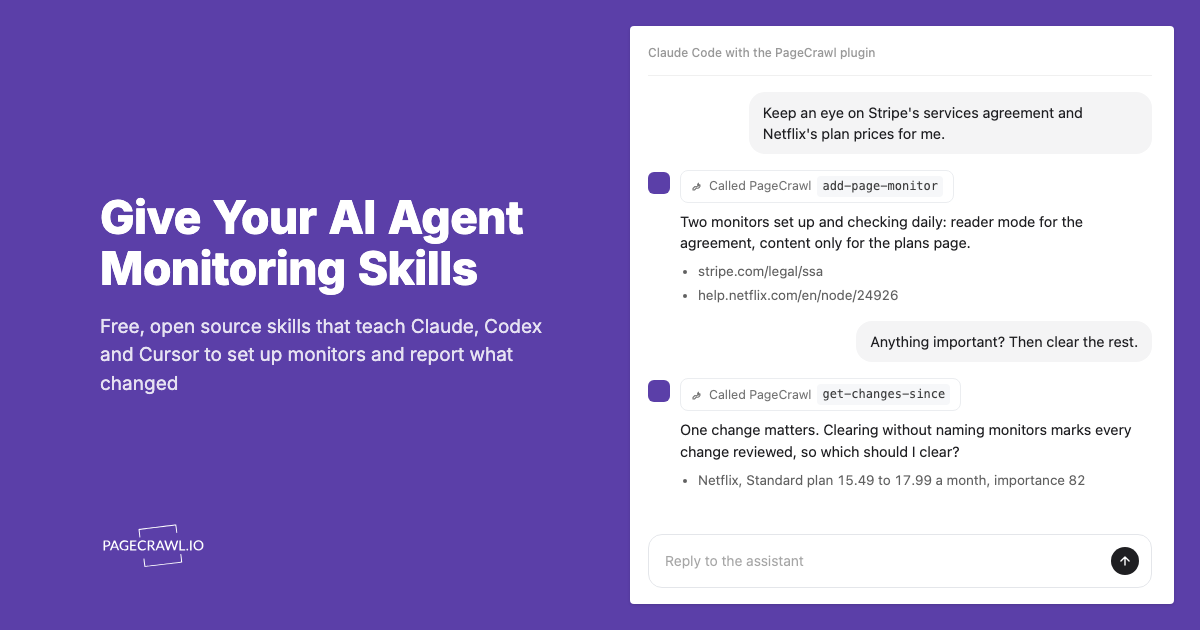
At an engineering hourly rate, Standard at $80/year pays for itself the first time you catch a breaking API change, a deprecated endpoint, or a silent config change before it takes down production. 100 monitored pages is enough to cover the changelogs and API documentation of every third-party API your stack depends on. Enterprise at $300/year adds 5-minute checks and 500 pages. All plans include the PageCrawl MCP Server, which plugs directly into Claude, Cursor, and other MCP-compatible tools. Developers can ask "what changed in the Stripe API docs this month?" and get a summary pulled from your own monitoring history. AI assistants can create monitors through conversation on every plan, including Free, turning your tracked pages into a living knowledge base instead of a pile of alert emails.
Getting Started
List your top 20 dependencies, add their PyPI or npm package pages to PageCrawl on an hourly check. Create a free account, and the next upstream release will arrive in your alert channel before your CI pipeline pulls it.
Once the workflow is in place, expand to a full 100-package watchlist and configure webhook integration with your SOAR or ticketing system. The Standard plan at $80/year is the right step for any AppSec or DevOps team treating dependency releases as a real security surface. For organizations that have been bitten by a supply-chain incident, the cost recovers itself the first time an anomalous release is caught at publish time instead of after compromise.