Last reviewed: August 20, 2026. Prices and plan details reflect each vendor's public pages at the time of review and can change, so confirm on the vendor's site before buying.
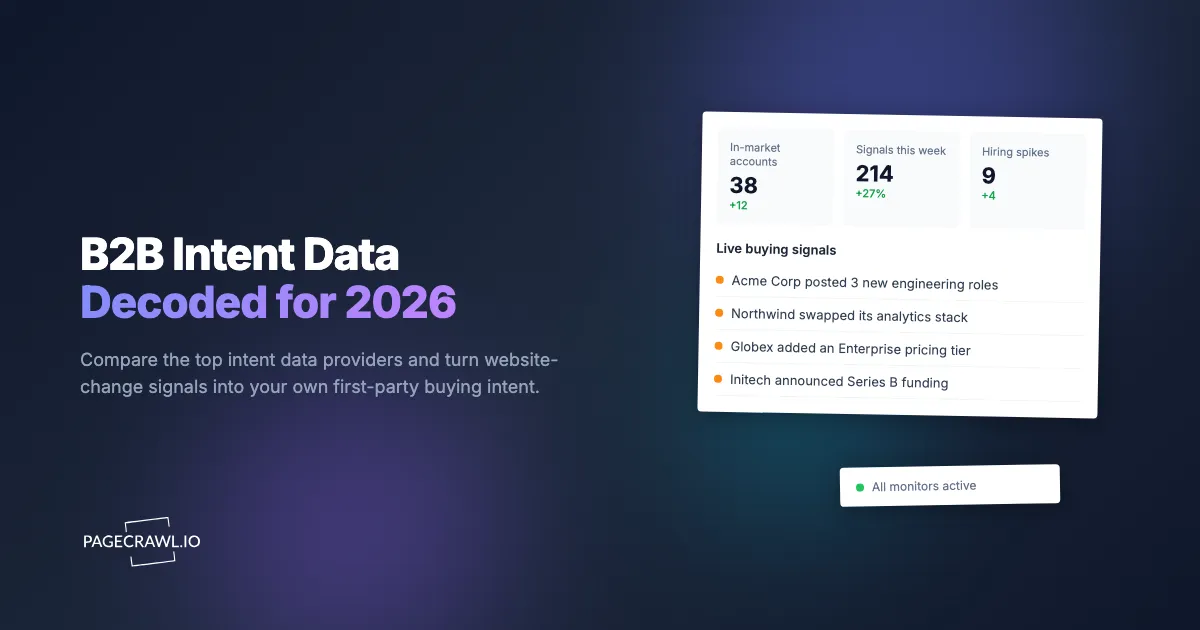
Your best-fit account just opened three engineering roles, swapped their analytics stack, and pushed a new Enterprise tier onto their pricing page, all in the same two weeks. Every one of those moves screams that a buying cycle is starting. And in your CRM, that account is still sitting on "no activity since Q1."
Intent data exists to close that gap. It tells you which companies are quietly researching your category, evaluating competitors, or building toward a purchase before they ever fill out a form. Done well, it lets sales reach out while the prospect is in-market instead of cold-calling a list that went stale months ago.
The problem is that "intent data" means very different things depending on who is selling it. Some track content consumption across a publisher cooperative, some de-anonymize your own site visitors, some read review-site traffic. And a growing number of teams build their own signal layer by watching competitor and prospect websites directly. This guide explains the types, compares the leading providers in 2026, and shows how website-change monitoring gives you first-party intent without an enterprise contract.
Our top picks at a glance:
- Bombora: teams that want category-level reach and can act on company-level signals.
- 6sense: larger teams running a committed account-based motion.
- G2 Buyer Intent: SaaS companies.
- Cognism: outbound teams selling into Europe.
- PageCrawl: teams that want timely, account-specific signals from the public web without an enterprise contract.
What is B2B intent data, in plain terms?
B2B intent data is any behavioral signal that suggests a company is actively researching a product or moving toward a purchase. Instead of demographics ("this is a 500-person SaaS firm"), intent data captures behavior ("this firm spiked on content about data warehouses last week"). It helps you prioritize accounts that are in-market right now.
The promise is timing. You cannot call all 10,000 ideal-fit accounts this quarter, so intent data reorders the list and floats the accounts showing live buying behavior to the top. Not all signals are equal: a single page view is noise, a coordinated research spike across a buying committee is gold, and most providers sit in between. Where a signal comes from is the difference between a focused pipeline and a wall of false positives.
What are the three types of intent data?
Intent data is grouped by who collected it and who owns it: first-party (your own data), second-party (someone else's first-party data shared with you), and third-party (aggregated across a network you do not control). Each type has a different accuracy, cost, and exclusivity profile, and most mature programs blend all three.
First-party intent data
First-party intent is behavior you observe on properties you own: your website, your docs, your pricing page, your product, your emails. It is the most accurate and the most exclusive because nobody else has it. The limitation is reach. You only see companies that already found you, so first-party data is fantastic for late-funnel scoring but blind to accounts researching elsewhere. This is also the category you can expand yourself by monitoring the public web for signals, which we cover below.
Second-party intent data
Second-party intent is another company's first-party data, shared or sold directly to you. The classic example is review-site intent: G2 knows who is comparing your product against a competitor on its platform, and it sells you access to that behavior. It is more exclusive than third-party data (fewer buyers see it) and usually higher quality because the source is a single, well-understood property rather than an anonymous blend.
Third-party intent data
Third-party intent is aggregated across a large network of sites and sold to many buyers at once. Providers infer that a company is "surging" when content consumption across their network spikes for a given topic. It offers the broadest reach (you can see accounts that never touched your site), but it is the noisiest, the least exclusive (your competitors buy the same feed), and usually resolved to the company level rather than a named person.
Known versus anonymous intent
A second axis cuts across all three types: whether the signal is tied to a named contact or just an anonymous account. Most third-party intent is anonymous and account-level ("someone at this company is researching"). De-anonymization tools reverse-resolve anonymous traffic back to a company. The more "known" the signal, the more directly your reps can act.
How do intent data providers collect their signals?
Providers gather signals through three main mechanisms: publisher cooperatives that pool content-consumption data, review and comparison platforms that sell their own visitor behavior, and de-anonymization tools that match anonymous web traffic to companies. The collection method shapes a feed's accuracy, reach, and exclusivity, so know it before you sign.
A cooperative model (the dominant approach for broad third-party intent) tracks topic-level content consumption across thousands of B2B sites and flags accounts that spike above their baseline. Review platforms sell second-party intent because they own a destination buyers visit specifically to compare vendors. De-anonymization vendors enrich your own anonymous traffic, turning first-party visits into account-level intent. Treating website-change monitoring as a signal source runs your own lightweight collection layer, covered in the DIY section.
What should you look for in an intent data provider?
The right provider depends on whether you need reach (find net-new accounts) or precision (prioritize accounts you already know). Evaluate every vendor on four axes: signal accuracy, account coverage and match rate, freshness, and how cleanly the data activates in your stack. A feed you cannot route into a workflow is just an expensive dashboard.
Accuracy and signal-to-noise
How often does "intent" turn into a real opportunity? Topic-level surge data is broad but noisy, so ask for the baseline methodology and how spikes are defined. The best programs validate intent against closed-won data over a quarter rather than trusting raw scores. For a wider view of how to judge competitive signals, see our guide to competitive intelligence sources and tactics.
Coverage and match rate
Two questions matter: how many accounts the provider can see, and what percentage it resolves to a company you actually sell to. A huge network is useless if it only matches 20% of your target list. For de-anonymization tools, ask about match rate on your own traffic, because vendor averages rarely reflect your audience.
Freshness and timing
Intent decays fast. A surge from three weeks ago is a missed window. Ask how often the feed refreshes (daily is the realistic floor for third-party data) and whether you can trigger workflows as soon as a signal lands. The DIY approach has an edge here: you check source pages on your own schedule, so freshness is a setting, not a vendor limitation.
Integration and activation
Data has to reach the people who act on it. Look for native CRM and marketing-automation syncs, webhook or API access, and the ability to push signals straight into Slack or your sales-engagement tool. To wire alerts into a channel your reps already live in, see routing website change alerts to Slack.
How did we review these tools?
We compared each provider on the four axes this guide recommends: signal accuracy, account coverage and match rate, freshness, and how cleanly the data activates in your stack. Pricing and packaging details come from each vendor's public pages, and every profile notes the type of team the provider fits best.
- Accuracy and signal-to-noise
- Coverage and match rate
- Freshness and timing
- Integration and activation
What are the best B2B intent data providers in 2026?
The best providers fall into three buckets: third-party surge networks (Bombora, Cognism), ABM platforms that fuse intent with predictive scoring (6sense, Demandbase), and review or first-party signal sources (G2, ZoomInfo, HubSpot Breeze, and DIY website monitoring). Your choice depends on budget, whether you already run an ABM motion, and how much of the signal you want to own outright.
Bombora
The reference standard for third-party intent. Bombora's Company Surge data measures content consumption across a large cooperative of B2B publishers and flags accounts spiking above their baseline on specific topics. Many other tools resell Bombora under the hood. It is account-level, anonymous, and broad. Best for teams that want category-level reach and can act on company-level signals rather than named contacts.
6sense
A revenue-AI and ABM platform that blends third-party intent, web de-anonymization, and predictive models to score accounts by buying stage. The pitch is orchestration: 6sense tells you which accounts are in "decision" versus "awareness" and triggers plays accordingly. Powerful and enterprise-priced. Best for larger teams running a committed account-based motion who will operationalize the predictions.
G2 Buyer Intent
The leading second-party intent source for software vendors. G2 knows which companies are reading your category, viewing your profile, and comparing you against named competitors on its platform, and it sells you that behavior. It is high-intent because people on a review site are explicitly evaluating tools. Best for SaaS companies. We go deeper in our guide to monitoring G2 reviews and software comparison pages.
ZoomInfo
A broad sales-intelligence platform that pairs one of the largest contact and company databases with intent signals, website-visitor tracking, and "Scoops" (sales triggers like funding and leadership changes). The intent is one feature in a much larger data suite. Best for teams that want enrichment, contact data, and intent in one contract.
HubSpot Breeze Intelligence (formerly Clearbit)
After HubSpot acquired Clearbit, the capabilities now live inside Breeze Intelligence: enrichment, buyer intent, and visitor de-anonymization native to the HubSpot CRM. If your go-to-market already runs on HubSpot, the integration is frictionless. Best for HubSpot-centric teams that want intent and enrichment in one place.
Demandbase
An account-based platform that combines first and third-party intent with advertising, account intelligence, and orchestration. Like 6sense, it targets teams running full ABM rather than buying a raw signal feed. Strong account identification and ad activation. Best for marketing-led ABM programs that tie intent to targeted advertising.
Cognism
A sales-intelligence platform known for phone-verified contact data and strong European coverage compliant with the EU General Data Protection Regulation, with intent powered by the Bombora cooperative. The differentiator is reach into EMEA markets where other databases thin out. Best for outbound teams selling into Europe that want compliant contact data plus topic intent in one place.
PageCrawl (DIY first-party signal layer)
Rather than buying an aggregated feed, PageCrawl lets you build your own intent layer by monitoring the public web for the actions companies take when they enter a buying cycle: hiring, technology changes, pricing updates, expansion, and funding. You pick the source pages, the check frequency, and the alert rules, and you own the resulting data outright. It is the most exclusive intent you can have because nobody else watches the same combination of pages. Best for teams that want timely, account-specific signals without an enterprise contract, and already run competitor website monitoring. Free tier included (6 monitors, 220 checks per month).
How do the providers compare?
Here is an honest at-a-glance view across signal type, data model, and price. Enterprise pricing is custom and depends on seat count and account volume, so treat the figures as directional.
| Provider | Signal type | Data model | Best for | Starting price |
|---|---|---|---|---|
| Bombora | Third-party | Account-level surge | Broad category reach | Custom |
| 6sense | First + third-party | Predictive ABM | Account-based orchestration | Enterprise |
| G2 Buyer Intent | Second-party | Review/comparison traffic | SaaS vendors | From ~$1k/mo |
| ZoomInfo | First + third-party | Data platform + intent | All-in-one data + intent | Enterprise |
| HubSpot Breeze | First + third-party | Native CRM intent | HubSpot teams | Add-on credits |
| Demandbase | First + third-party | ABM + advertising | Marketing-led ABM | Enterprise |
| Cognism | Third-party | Contact data + intent | EMEA outbound | Custom |
| PageCrawl | First-party (DIY) | Web-change signals | Owned, exclusive signals | Free / $8/mo |
How do website-change signals work as DIY intent data?
Website-change signals are first-party intent you collect yourself by monitoring the public pages a company controls. When a target account changes its careers page, swaps a tool in its tech stack, restructures pricing, or announces expansion, those edits are leading indicators of a buying cycle that no aggregated feed will deliver as fast or as exclusively. You own the signal because you chose the source.
The advantage over a purchased feed is precision and timing. You are not inferring intent from an anonymous network, you are watching the exact 50 accounts you care about take concrete, public actions. Four signal categories carry the most weight.
Hiring signals
A burst of job openings in a specific function is one of the clearest buying signals there is. A company posting five new data-engineering roles is about to invest in data infrastructure, and a wave of compliance hires often precedes new tooling budgets. Monitor target-account careers pages and you catch the build-up weeks before procurement starts. Our guide to monitoring competitor job postings for hiring signals walks through the setup in detail.
Technology stack signals
When a company adds, removes, or swaps a tool, it is reshaping its stack, and that often opens a window for adjacent products. Watching for changes in the technologies a site exposes (analytics, chat widgets, payment providers, embedded scripts) flags accounts that are actively re-platforming. See monitoring a competitor's technology stack for how to track these shifts.
Pricing and packaging signals
A pricing-page change is a strategic move you can read directly. A new Enterprise tier signals an up-market push and budget. A repackaging or a price increase changes how prospects compare you against that competitor. Tracking these edits keeps your sales talk tracks current and surfaces accounts whose own pricing changes hint at growth. Our guide to monitoring competitor pricing-page changes covers the noise-filtering details.
Expansion and funding signals
New office locations, new market pages, leadership announcements, and funding news all indicate an account with fresh budget and momentum. A newsroom or press page is the canonical source, and monitoring it catches the announcement on the next check after it goes live rather than weeks later when a third-party feed eventually ingests it. See press release and PR monitoring for tracking these announcements. This is the same family of public-web evidence covered in the broader concept of alternative data feeds.
How do you build a DIY intent signal system in PageCrawl?
You build a DIY intent layer by choosing the source pages for each target account, setting a check frequency, applying keyword and threshold rules so only meaningful changes alert, and routing those alerts to where your team works. The whole thing runs on the free tier (6 monitors, 220 checks per month) while you prove the approach, then scales as you add accounts.

Step 1: Define your account list and signals
List your top 20 to 50 target accounts. For each, decide which signals matter: hiring, tech, pricing, expansion. A high-velocity outbound team usually starts with careers and pricing pages because those move fastest and map most directly to budget.
Step 2: Add the source pages as monitors
For every account, add the specific URLs that carry your chosen signals: the careers or jobs page, the pricing page, the newsroom, and the homepage. Use the relevant tracking mode for each (text or content monitoring for careers and news, price or element tracking for pricing pages) so you capture the change cleanly.
Step 3: Set check frequency by signal speed
Match frequency to how fast the signal moves. Pricing and careers pages justify checks every few hours during business days. A newsroom or expansion page can run daily. On the free tier, reserve your 220 monthly checks for the highest-value pages, then raise frequency on a paid plan as the list grows.
Step 4: Add conditional alert rules
Raw change detection on a careers page will fire on every reworded sentence. Use notification conditions and filters so you only hear about signal-grade changes: a new role title appearing, a price crossing a threshold, or a keyword like "Series" or "now hiring" showing up. Our guide to conditional alerts with keyword and threshold rules shows how to tune this.
Step 5: Route signals to your team
Send alerts to a dedicated Slack channel, your inbox, or straight into your CRM or sales-engagement tool using a webhook integration that posts change data to any external service. The goal: a rep sees "[account] posted 4 new engineering roles" inside the tool they already use, attached to the right account, while the window is open.
Step 6: Review and validate weekly
Once a week, scan the signals that fired and tag the ones that turned into real conversations. Over a quarter you learn which signal types predict pipeline for your business, and you prune the noisy ones. This validation loop is what separates a useful intent program from a dashboard nobody reads. For the strategic frame around all of this, see what competitive intelligence is and how to use it.
Choosing your PageCrawl plan
PageCrawl's Free plan lets you monitor 6 pages with 220 checks per month, which is enough to validate DIY intent signals on your most important accounts before you scale. Most teams graduate to a paid plan once the signals start producing real conversations.
| Plan | Price | Pages | Checks / month | Frequency |
|---|---|---|---|---|
| Free | $0 | 6 | 220 | every 60 min |
| Standard | $8/mo or $80/yr | 100 | 15,000 | every 15 min |
| Enterprise | $30/mo or $300/yr | 500 | 100,000 | every 5 min |
| Ultimate | $99/mo or $999/yr | 1,000 | 100,000 | every 2 min |
Annual billing saves two months across every paid tier. Enterprise and Ultimate scale up to 100x if you need thousands of pages or multi-team access.
Standard at $80/year covers 100 source pages, enough for careers, pricing, and newsroom URLs across roughly 25 target accounts at 15-minute intervals. Catching one hiring spike before a competing rep does turns a cold email into a warm conversation. Enterprise at $300/year extends that to 500 pages at 5-minute checks, enough for an entire named-account list across a full sales team.
Getting Started
Pick your ten most important target accounts. Add their careers and pricing pages as monitors, set conditional rules so only real signals alert, and route them to a Slack channel your reps watch. Run it for two weeks. You will be surprised how many accounts telegraph their next move in plain sight. For the bigger picture on watching competitors beyond intent, see competitive intelligence without an enterprise platform.
The intent data market is crowded, but the most exclusive signal is always the one you collect yourself. Stop renting other people's data and start watching the pages that matter, free for your first six monitors.