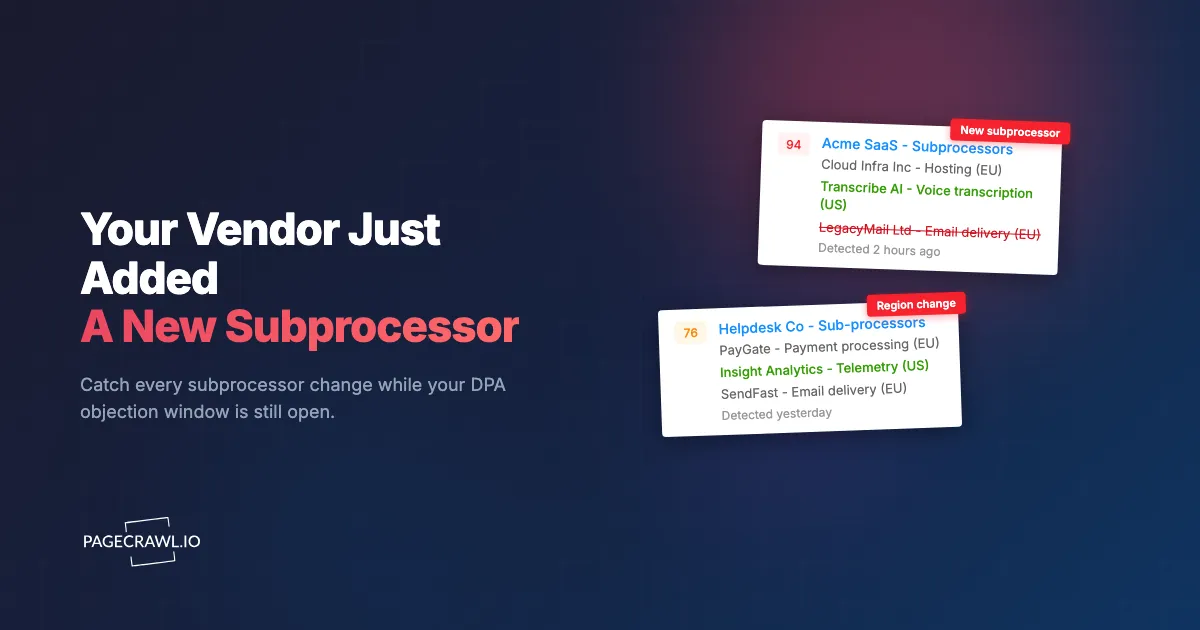
A compliance lead at a 40-person health-tech company opens a customer security questionnaire on a Monday morning. Question 14 asks for a complete list of every subprocessor that touches the customer's data, including the subprocessors used by their own vendors. She pulls up the data processing agreement for their main support tool, clicks through to its public subprocessor page, and finds an entry that was not there at signing: a new AI transcription provider headquartered outside the EU, added eleven weeks ago. The vendor did email a notice. It landed in a shared inbox nobody monitors anymore. The contractual objection window closed two months back, the data has already flowed, and she now has to explain to a customer why an undisclosed processor in a third country has been handling protected health information.
This is the quiet failure mode of modern data supply chains. Almost every SaaS tool you use leans on a stack of other companies to deliver its service, and each of those companies can become a place where your customers' personal data lives. Subprocessors are where data protection obligations get inherited, where data residency commitments get tested, and where an audit finding usually hides. Understanding what a subprocessor is, and keeping track of who yours are, is no longer a legal nicety. It is a core part of running a trustworthy business.
This guide explains what a subprocessor is in plain English, how subprocessors differ from processors and controllers under GDPR, the real-world examples you will encounter every day, why subprocessor changes matter so much for your DPAs and compliance posture, and how to get notified on the next check after a vendor updates its list, the same way teams handle terms of service and privacy policy change tracking.
What is a subprocessor?
A subprocessor is any third party that your vendor (the processor) hires to help process personal data on your behalf. When you use a SaaS tool, and that tool relies on another company's infrastructure or service to store, transmit, or analyze your data, that downstream company is the subprocessor. It is one more link in the chain that handles data you are ultimately responsible for.
Think of it as a sub-contractor relationship. You hand data to a vendor to do a job. That vendor cannot do the whole job alone, so it hands parts of the work (and parts of the data) to other specialists: a cloud host to store records, an email service to send notifications, an analytics provider to understand usage. Each specialist is a subprocessor, and the data it touches is still, legally, your responsibility.
The key phrase is "on your behalf." A subprocessor only counts if it processes personal data as part of delivering the service you bought. A vendor's office cleaning company or accounting firm is not a subprocessor. The cloud provider hosting your customer records absolutely is.
What is the difference between a controller, a processor, and a subprocessor?
The difference comes down to who decides and who acts. The controller decides why and how personal data is processed. The processor acts on the controller's instructions. The subprocessor acts on the processor's instructions to help fulfil that same purpose. GDPR draws hard lines between these roles because legal responsibility flows down the chain differently at each link.
Here is the simplest way to hold the three roles in your head:
| Role | Who it is | What it does | Example |
|---|---|---|---|
| Controller | You (the business that collects the data) | Decides the purpose and means of processing | An online retailer collecting customer orders |
| Processor | Your vendor | Processes data on the controller's documented instructions | The order-management SaaS the retailer uses |
| Subprocessor | Your vendor's vendor | Processes data to help the processor deliver its service | The cloud host storing the order database |
The reason this matters is accountability. As the controller, you stay responsible for the personal data even when it sits three companies deep in the chain. GDPR does not let you outsource the liability along with the data. If a subprocessor you never vetted leaks customer records, regulators and customers still look to you first. That is why a Data Processing Agreement (DPA) almost always requires your processor to flow its obligations down to every subprocessor, and to keep you informed of who those subprocessors are.
This same controller-processor logic shows up across every privacy regime, and the obligations keep shifting as new laws land, which is why many teams pair vendor tracking with GDPR and CCPA privacy law change tracking.
What are real-world examples of subprocessors?
Subprocessors are the infrastructure and service providers your vendors quietly depend on. The most common categories are cloud hosting, email and SMS delivery, analytics, payment processing, customer support tooling, and increasingly AI and machine-learning services. Almost every SaaS product you use is built on a stack of four to twenty of these downstream providers.
To make it concrete, picture a typical CRM platform that your sales team uses. It is the processor. Behind it sits a whole roster of subprocessors:
- Cloud hosting. A major cloud provider stores the actual customer database, files, and backups. This is the single most common subprocessor, and the one where data residency questions usually surface.
- Email and SMS delivery. A transactional email service sends notifications, and an SMS gateway delivers two-factor codes. Both handle contact details and sometimes message content.
- Analytics and product telemetry. A usage-analytics tool tracks which features get used, which means it sees user identifiers and behavior.
- Payment processing. If the product handles billing, a payment processor touches cardholder and billing data.
- Customer support tooling. A helpdesk or live-chat provider may ingest support tickets that contain personal data your users typed in.
- AI and transcription services. Newer entries on subprocessor lists. A vendor that added an AI summarization or transcription feature this year almost certainly added an AI subprocessor to power it.
That last category is where most surprises live in 2026. Vendors race to bolt AI features onto existing products, and each feature can introduce a new processor (sometimes in a new country) without a single line of your contract changing. The practical takeaway: a subprocessor list is a living document, and the AI rows are the ones moving fastest.
Why do subprocessor changes matter for your DPA and compliance?
Subprocessor changes matter because your Data Processing Agreement gives you specific rights that are only useful if you act on them in time. Most DPAs require the vendor to notify you before adding a subprocessor and grant you a window (often 30 days) to object. Miss the notice and you have effectively consented to a new company, possibly in a new country, handling your customers' data.
Three concrete risks ride on every subprocessor change:
Data residency and international transfers. Your DPA or your own customer commitments may promise that data stays inside the EU, the UK, or a specific region. A vendor that adds a subprocessor in a third country can break that promise the moment data starts flowing, and the legal mechanism for that transfer (adequacy, standard contractual clauses) becomes your problem to verify. This is the failure in the opening scenario, and it is the most common audit finding tied to subprocessors.
Your own downstream obligations. If you are a processor to your own customers, your DPA with them mirrors the same flow-down requirements you expect from your vendors. When your vendor adds a subprocessor, you may be contractually obligated to notify your customers, who then get their own objection window. A change you miss does not just sit with you, it cascades to every customer relationship built on that tool.
Records of processing (ROPA). GDPR Article 30 requires controllers and processors to maintain records of processing activities, and an accurate subprocessor inventory is part of that record. A stale list means a non-compliant ROPA. Keeping it current is exactly the kind of ongoing duty we cover in our guide on GDPR records of processing monitoring.
The objection right is the part teams most often waste. You negotiated it during procurement, then never built a process to exercise it. By the time you discover a subprocessor you would have objected to, the window has closed and the data has moved. The whole value of the clause depends on noticing the change while you still have leverage to act on it.
What does GDPR actually say about subprocessors?
GDPR governs subprocessors mainly through Article 28 of Regulation (EU) 2016/679. A processor cannot engage a subprocessor without the controller's authorization, and it must pass its own data-protection obligations down to that subprocessor through a contract. If the subprocessor fails, the original processor stays fully liable to you. These rules are what turn a vendor's subprocessor page into a document with legal weight rather than a marketing footnote.
In practice, Article 28 plays out through a few mechanisms you will see in almost every DPA:
- General written authorization. Rather than approving each subprocessor one by one (specific authorization), most vendors use general authorization: you agree they may engage subprocessors as long as they maintain a current list and notify you of changes with a chance to object. This is why public subprocessor pages exist, and why monitoring them is the practical way to exercise your rights.
- Flow-down obligations. Article 28(4) requires the processor to impose the same data-protection terms on its subprocessors that you imposed on it. The protection is only as strong as the weakest link, which is why knowing the links matters.
- Continued liability. The processor remains fully liable to you for its subprocessors' performance, and that liability sits on top of your own accountability as controller rather than replacing it.
GDPR is not the only regime with these expectations. SOC 2, the vendor-management controls in the ISO 27001 family, and a growing list of sector rules all expect you to track who is in your data supply chain, so the same subprocessor inventory does double duty across multiple audits. Always check the current wording of the regulation and the guidance published by the European Data Protection Board before acting on a subprocessor change; this article is informational, not legal advice.
Where do you find a vendor's subprocessor list, and why is tracking it so hard?
Most reputable SaaS vendors publish a subprocessor list on a public page, usually linked from their trust center, privacy policy, or DPA (look for URLs containing "subprocessors," "sub-processors," or "trust"). The list names each downstream provider, what it does, and often its location. Finding the page is easy. Keeping up with it across a portfolio of vendors is where almost every team falls down.
The difficulty is structural, not a matter of effort. Consider what tracking actually requires:
The notifications are unreliable. Vendors do email subprocessor updates, but those emails go to whatever alias you gave during onboarding (often years ago), land in spam, get buried in a shared inbox, or simply never get sent because the vendor considered a public page to be sufficient notice. Relying on the vendor to push you a timely alert is the exact gap that caused the opening scenario.
The pages change silently. A vendor can add a row to its subprocessor table at any time, with no version history visible to you. A manual check shows you the current state but never tells you what changed or when. By the time you next look, you cannot tell whether a provider was added last week or last quarter, and your objection window may already be gone.
The volume does not scale by hand. A mid-size company easily uses 30 to 80 SaaS tools that process personal data. Visiting each vendor's page on a schedule, diffing it against your last snapshot, and logging the changes is a full-time job that no one actually does.
This is the same fundamental challenge behind any vendor-risk program: the obligation is continuous, but human checking is episodic. We make that case in depth in our guide on continuous vendor monitoring for third-party risk management, and it applies directly here. The only reliable answer is to let software watch the pages for you and tell you as soon as a check finds a changed line.
How do you get notified when a vendor updates its subprocessor list?
You get reliable notification by monitoring each vendor's public subprocessor page for changes automatically, instead of waiting for the vendor to email you. A website change monitor visits the page on a schedule, compares it to the previous version, and alerts you as soon as a check finds a subprocessor added or removed. PageCrawl does exactly this, under its own GDPR and EU data residency commitments, and you can cover your most critical vendors on the free tier (6 monitors, 220 checks per month).

Here is how to set up subprocessor monitoring step by step.
Step 1: Inventory your vendors and find their subprocessor pages. List every SaaS tool that processes personal data on your behalf. For each one, locate its public subprocessor or trust-center page and copy the exact URL. Start with the vendors that handle the most sensitive data (anything touching health, financial, or large volumes of personal records).
Step 2: Add each subprocessor page to PageCrawl. Create a monitor for each URL. Use a text or reader tracking mode so PageCrawl watches the meaningful content of the page (the list of providers) rather than unrelated layout or marketing changes. Reader mode is well suited to these legal and policy pages because it focuses on the substantive text.
Step 3: Set a sensible check frequency. Daily checks are plenty for subprocessor pages, since changes are infrequent but time-sensitive. On the free plan you have 220 checks per month, which comfortably covers six vendors checked daily. Paid plans add more frequent checks and far more monitors if your portfolio is larger.
Step 4: Tighten the alerts to reduce noise. Configure the monitor so you only hear about real list changes, not cookie banners or copyright-year updates. Keyword and threshold rules let you focus on the rows that matter, an approach we detail in our guide on conditional alerts with keyword and threshold rules and in the help centre article on notification conditions and filters. The goal is an alert that means "a subprocessor actually changed," every time.
Step 5: Enable screenshots for evidence. Turn on screenshots so every detected change is captured with a timestamp and the page URL. When a customer asks "when did this subprocessor appear and what did the page say," you have dated proof rather than a vague recollection. The same is true for any policy page, which is why teams pair this with privacy policy and terms of service change monitoring.
Step 6: Route alerts to the right people and systems. Send notifications to the person who actually owns vendor risk, not a stale shared alias. PageCrawl can deliver alerts by email, push them into Slack, or fire a webhook that opens a ticket in your GRC or ticketing system automatically. A webhook turns a detected subprocessor change into a tracked task with an owner and a deadline tied to your DPA objection window.
Step 7: Extend the same approach to related pages. Subprocessor lists rarely change in isolation. The same vendors update their DPAs, privacy policies, and terms, and those changes can carry the same compliance weight. The help centre walkthrough on monitoring terms of service and privacy policy pages for compliance covers the settings that work best for legal text. Once your subprocessor monitors are running, add the vendor's terms of service pages and, for the deepest treatment of this exact workflow, see our companion guide on subprocessor list monitoring for SaaS compliance.
The result is a standing system: every time a vendor quietly edits its subprocessor table, you know within a day, with a timestamped record and a clear owner, while your objection window is still open.
Choosing your PageCrawl plan
PageCrawl's Free plan lets you monitor 6 pages with 220 checks per month, which is enough to validate the approach on your most critical vendors. Most teams graduate to a paid plan once they see the value.
| Plan | Price | Pages | Checks / month | Frequency |
|---|---|---|---|---|
| Free | $0 | 6 | 220 | every 60 min |
| Standard | $8/mo or $80/yr | 100 | 15,000 | every 15 min |
| Enterprise | $30/mo or $300/yr | 500 | 100,000 | every 5 min |
| Ultimate | $99/mo or $999/yr | 1,000 | 100,000 | every 2 min |
Annual billing saves two months across every paid tier. Enterprise and Ultimate scale up to 100x if you need thousands of pages or multi-team access.
The free plan is a genuine starting point: pick your six highest-risk vendors, the ones handling health, financial, or large-scale personal data, and monitor their subprocessor pages daily. Standard at $80/year covers 100 pages, which is enough to watch the subprocessor list, DPA, and privacy policy for a realistic portfolio of SaaS vendors with room to spare. Enterprise at $300/year handles 500 pages for organizations running broad vendor-risk programs across many teams. If catching a single undisclosed third-country subprocessor before its objection window closes saves you one regulatory finding or one lost customer, the subscription has paid for itself many times over.
Getting Started
Subprocessor obligations do not pause between audits, and the vendors that change their lists rarely call to warn you. The cheapest insurance is a monitor that never blinks. Create a free account, add the subprocessor pages of your six most important vendors with reader tracking mode and daily checks, and route the alerts to whoever owns vendor risk. You will know about every change while you still have the right to object. Stop trusting the inbox, and start watching the page.