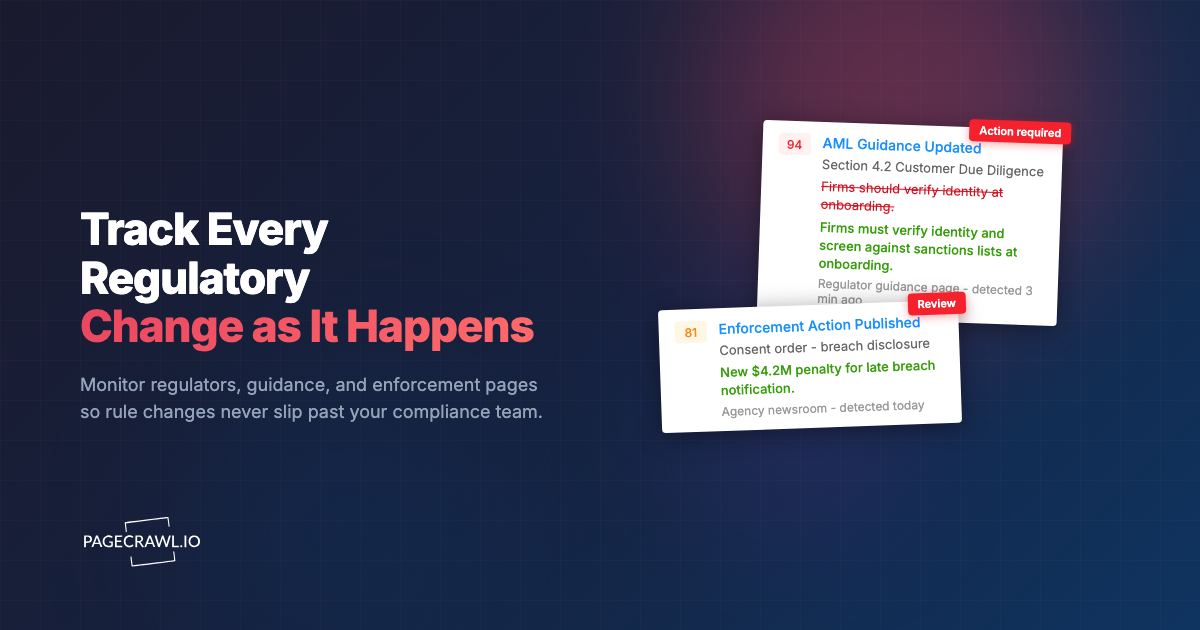
At 8:40 on a Tuesday morning, a compliance analyst at a mid-size bank opens her inbox to find a one-line email from a colleague: "Did you see the regulator updated the AML guidance?" She had not. The change went live two weeks earlier, a single revised paragraph on a guidance page that never triggered a press release. By the time the team finishes assessing the impact, an examiner has already flagged the onboarding flow as out of date. The fix is cheap. The scramble, the documentation, and the awkward conversation with the regulator are not.
This is the exact failure regulatory change management software is built to prevent. Rules do not arrive on a tidy schedule. They arrive as edited guidance pages, freshly published enforcement notices, new entries in an official gazette, and supervisory statements that go live without fanfare. The teams that catch these on day one get weeks to respond. The teams relying on someone remembering to check a website find out during an audit.
This guide compares the best regulatory change management tools available in 2026, from dedicated RegTech platforms to flexible web monitoring, and walks through how to evaluate them on coverage, jurisdictions, workflow, and audit trail, so you can build a process you can actually operate and defend.
How does regulatory change management software work?
Regulatory change management software detects changes to the rules that govern your organization, routes each change to an owner, and records what you did about it. There are two fundamentally different ways tools source those changes, and the distinction matters more than any feature list: one licenses pre-digested regulatory content, the other watches the primary sources directly.
Curated regulatory content feeds (the RegTech model)
Dedicated RegTech platforms use analysts and licensing agreements to ingest thousands of regulatory sources, then deliver structured, tagged "regulatory events" into your workflow with clean metadata: jurisdiction, regulator, topic, effective date, and often a plain-language summary.
Pros: Broad pre-built coverage, structured taxonomy, expert summaries Cons: Expensive, gaps on niche or local sources, and a vendor update cadence that can lag a change by days
Source-level web monitoring
The other approach watches the actual web pages where rules live (regulator handbooks, guidance pages, enforcement listings, gazettes, consultation portals) and alerts you as soon as a check detects that the content changed. It works on any page you can reach in a browser, including the obscure local or sector-specific sources no aggregator covers.
Pros: Works on any source, catches changes on the day they happen, you control exactly which pages matter Cons: You define your own source list, and broad pages need tuning to filter out non-substantive edits
The strongest programs combine both: an aggregator for the big, well-covered regulators, with web monitoring layered on for the long tail the aggregator misses. As our primer on what regulatory intelligence is explains, the detection layer fails far more often than the analysis layer, and detection is exactly where source-level monitoring earns its place.

What should you look for in regulatory change management software?
Evaluate regulatory change management software on four dimensions: source coverage across your jurisdictions, detection accuracy and speed, the workflow that turns a detected change into completed action, and the audit trail that proves you did it. A tool can be strong on one dimension and useless on another, so score each separately.
Source coverage and jurisdictions
Coverage is the foundation: a change you never detect is one you can never act on.
- Breadth: Does it cover every regulator and jurisdiction you operate in, including secondary guidance and enforcement pages, not just primary legislation?
- The long tail: Local regulators, sector-specific bodies, and foreign-language sources are where aggregators thin out. Can you add an arbitrary URL the vendor does not already track?
- Primary vs secondary sources: The authoritative version of a rule lives on the regulator's own site or in an official journal like the Federal Register. Make sure the tool watches that, not a third-party summary that lags by days.
Detection accuracy and timeliness
A tool that misses changes, or buries them under noise, fails quietly until the day it matters.
- Time to alert: Same-day detection is the bar. Weekly digests from an analyst desk are not horizon scanning, they are hindsight.
- Signal vs noise: Regulator pages carry rotating banners, "last reviewed" date stamps, and cookie notices that change without any rule changing. Good tools filter these out, as our guide to reducing false positives explains.
- Document formats: Many rules ship as PDFs, so the tool must detect changes inside PDF documents, not just web pages.
Workflow and accountability
Detection without ownership is a tickbox; the software must move each change through your organization.
- Assignment: Can you route a change to a named owner with a due date?
- Impact assessment: Can you link a change to the policies, controls, and products it affects?
- Prioritization: Look for conditional alerts and keyword rules so a change to a capital requirement escalates differently from a typo fix.
Audit trail and evidence
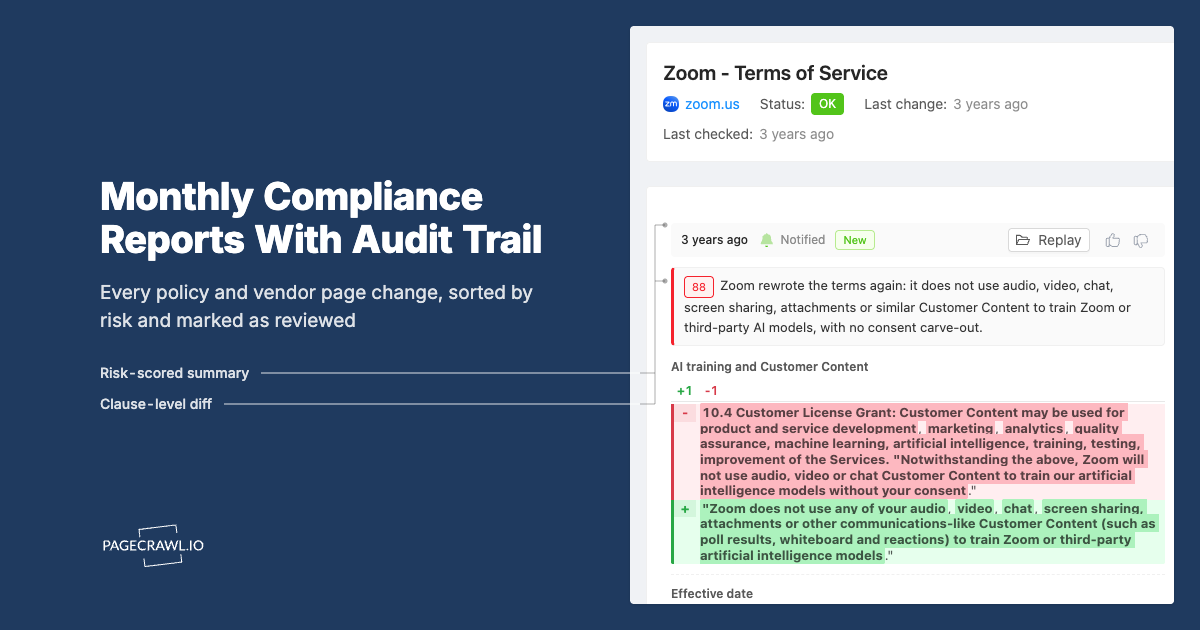
When an examiner asks "how did you know about this rule, and when?", you need a timestamped answer: a dated record of what the source said before and after each change, visual snapshots and signed web archives of the exact wording, and a clean exportable log you can hand over rather than a recollection. The help centre guide on packaging an audit trail for a regulator shows what a defensible evidence bundle actually contains before you are asked for one.
Which regulatory change management tools are best in 2026?
The best regulatory change management tool depends on your size, budget, and how much of the long tail you need to cover. Large regulated enterprises lean on dedicated RegTech aggregators; lean compliance teams and those tracking niche sources get further with flexible web monitoring. Here is an honest look at the main options.
PageCrawl
Type: Web monitoring with smart change detection and AI summaries Starting price: Free (6 monitors), $8/month (100 monitors), $30/month (500 monitors)
PageCrawl monitors the actual web pages where rules live and alerts you as soon as a check picks up an edit. Point it at a regulator's handbook section, a guidance page, an enforcement listing, or a consultation portal, and it checks on a schedule, captures a dated snapshot, and tells you in plain language what changed.
Regulatory monitoring features:
- Monitor any URL, including the niche local and sector sources aggregators skip, across PDFs, gazettes, and regulatory filing pages alike
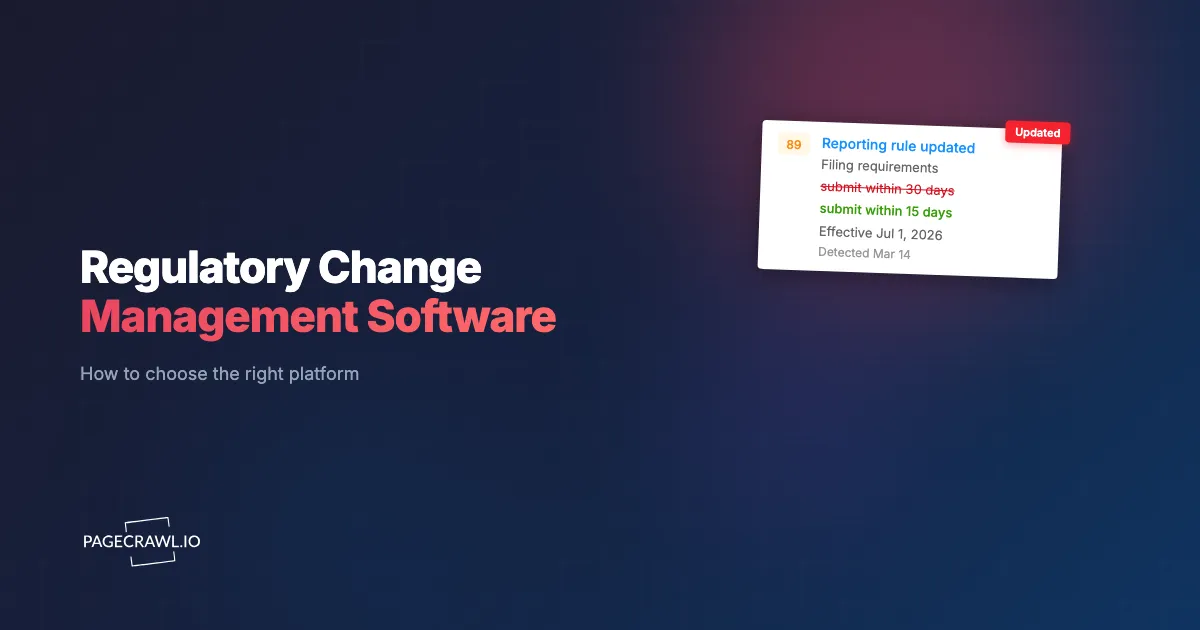
- AI summaries that translate a raw diff into "Section 4.1 changed the review cadence from annual to quarterly"
- Screenshot history for a visual, timestamped audit trail at every check
- Keyword and threshold rules to escalate high-impact changes
- Full notification stack (Slack, Teams, Discord, Telegram, email, webhooks) plus scheduled change briefings
Strengths:
- Works on any source you can open in a browser, so coverage is not capped by a vendor's licensing list.
- Same-day detection: alerts fire on the next scheduled check after the page changes, not when an analyst gets around to reading it.
- The timestamped snapshot history doubles as examination evidence, and login sequences handle portals behind authentication.
- Free tier covers 6 monitors, enough to validate the approach on your most critical sources before spending anything.
Limitations:
- You supply the source list. PageCrawl detects changes brilliantly; it does not ship a pre-built taxonomy of every global regulator the way an enterprise aggregator does.
- Impact assessment lives in your GRC system, with PageCrawl feeding the detection layer via webhook.
Best for: Compliance teams that want fast, defensible detection across major and niche sources without enterprise pricing. Especially strong for banking and financial services teams tracking guidance and enforcement pages.
Thomson Reuters Regulatory Intelligence
Type: Enterprise RegTech content and change management Starting price: Custom (enterprise)
Thomson Reuters Regulatory Intelligence is one of the established aggregators, combining a large licensed content feed with workflow tooling for impact assessment and obligation mapping.
Strengths:
- Very broad pre-built coverage across major global regulators, with expert-written summaries and a structured taxonomy.
- Mature workflow for mapping changes to internal obligations.
Limitations:
- Enterprise pricing that puts it out of reach for smaller teams.
- Coverage thins on local, sector-specific, and non-English sources, and you depend on the vendor's update cadence.
Best for: Large, multi-jurisdiction financial institutions with the budget for a full content-plus-workflow platform.
LexisNexis Regulatory Compliance
Type: Enterprise regulatory content and obligation management Starting price: Custom (enterprise)
LexisNexis Regulatory Compliance pairs a licensed legislative and regulatory feed with obligation libraries that map rules to the actions a firm must take.
Strengths:
- Deep legal content lineage and obligation mapping, integrated with broader legal research workflows.
- Strong on primary legislation and well-covered jurisdictions.
Limitations:
- Heavyweight implementation and enterprise cost.
- Better suited to formal rulemaking than fast-moving guidance pages, and niche sources need manual supplementation.
Best for: Legal and compliance functions that need obligation-level mapping tied to authoritative legal content.
Compliance.ai
Type: AI-driven regulatory change management Starting price: Custom (mid-market to enterprise)
Compliance.ai focuses specifically on regulatory change management, using machine learning to classify and route changes from a broad set of US-centric regulatory sources.
Strengths:
- Purpose-built for the change management workflow, with automated classification and topic tagging.
- Reasonable coverage of US federal and state financial regulators.
Limitations:
- Strongest in US financial services and lighter outside that scope, with mid-market and up pricing.
- Still an aggregator at heart, so the long tail of sources depends on what it ingests.
Best for: US financial services teams that want change management workflow with automated classification.
Manual tracking and legal newsletters
Type: Spreadsheets, email subscriptions, and law firm alerts Starting price: Free to low cost
Many teams still run regulatory change management on a spreadsheet of source URLs, a rota of people who check them, and a stack of law firm newsletters.
Strengths:
- No software cost, and law firm bulletins add genuine legal interpretation.
Limitations:
- Detection depends on a human remembering to check, and newsletters are downstream and slow; by the time one lands, the rule has been live for weeks.
- No timestamped audit trail ("I think I saw it in an email" is not evidence), and it does not scale past a handful of sources.
Best for: Very small operations with a tiny, stable set of sources, as a stopgap before adopting real tooling.
How do PageCrawl and the alternatives compare?
No single tool wins every row. Aggregators bring a pre-built taxonomy and obligation mapping; web monitoring brings same-day detection, arbitrary source coverage, and a snapshot audit trail at a fraction of the cost. For most teams the right answer is layered, as the table below shows.
| Feature | PageCrawl | Thomson Reuters RI | LexisNexis RC | Compliance.ai | Manual / Newsletters |
|---|---|---|---|---|---|
| Same-day detection | Yes | Vendor cadence | Vendor cadence | Yes | No |
| Add any arbitrary source | Yes | Limited | Limited | Limited | Yes |
| Niche / local sources | Yes | Partial | Partial | US-focused | Manual |
| Pre-built taxonomy | No | Yes | Yes | Yes | No |
| PDF change detection | Yes | Yes | Yes | Partial | No |
| Screenshot audit trail | Yes | Limited | Limited | Limited | No |
| AI change summaries | Yes | Yes | Partial | Yes | No |
| Slack / Teams / webhook | Yes | Limited | Limited | Limited | No |
| Starting price | Free | Enterprise | Enterprise | Custom | Free |
| Free tier | 6 monitors | No | No | No | n/a |
How do you build a regulatory change management workflow?
A working regulatory change management workflow has five stages: inventory your sources, set up monitoring, route changes to owners, assess and implement, and prove it with an audit trail. Below is a setup you can run today with PageCrawl's free tier (6 monitors, 220 checks per month), then scale as your source list grows.

Step 1: Inventory your regulatory sources
List every source that can change an obligation you hold:
- Primary regulators: The handbook sections, rulebooks, and guidance pages for each regulator you answer to
- Enforcement and supervision: Consent order listings, enforcement notices, and supervisory statements
- Consultations and gazettes: Consultation portals and official journals, such as EUR-Lex for EU law, where upcoming rules surface first
- Cross-cutting rules: Privacy, security, and operational resilience regimes that span your business
If you operate across regimes, our guides on financial services compliance, legislative tracking, and government agency news help you map which pages to watch.
Step 2: Set up a monitor on each source
For every page in your inventory, create a monitor in PageCrawl:
- Add a page: Paste the source URL and let PageCrawl load it.
- Choose the tracking mode: Use reader or content-only mode for long-form guidance and policy pages so headers, footers, and cookie banners are stripped out and you track only the substantive text.
- Set the frequency: Daily checks suit most regulatory pages; reserve faster intervals for fast-moving enforcement or consultation pages.
- Tune out noise: Exclude "last reviewed" date stamps, visitor counters, and rotating banners so an alert always means a real content change.
Step 3: Route changes to the right owner
Detection only counts if it reaches a person who can act:
- High priority: High-impact changes (capital, conduct, reporting obligations) go to a dedicated Slack or Teams channel and notify the named owner on the check that detects them.
- Daily digest: Lower-impact edits roll up into a daily summary so nothing is missed but the team is not flooded.
- Webhook to your GRC system: Feed every change into your register or ticketing tool, so each becomes a tracked item with an owner and a due date. The webhook integration guide covers the payload format and how to verify the request came from PageCrawl.
- Keyword escalation: Use conditional rules so a change containing terms like "effective date," "penalty," or "must" jumps the queue.
Step 4: Assess impact and implement
For each routed change, your owner records what changed (the AI summary plus the dated diff give you the before and after in seconds), what it affects (the policies, controls, and products in scope), and what to do by when (remediation tasks and a deadline anchored to the rule's effective date). Monitoring surfaces the edit; always confirm the wording and its effect on your obligations against the regulator's own page with qualified counsel, since this article is informational and not legal advice.
Step 5: Keep the audit trail
Every check captures a timestamped snapshot of what the page said. When an examiner asks how and when you knew about a rule, you produce a dated history of the exact wording, not a recollection. Pair this with scheduled briefings so leadership gets a regular, defensible summary of regulatory movement.
What are the most common regulatory change management challenges?
The recurring challenges are silent edits, document formats, and noise. Each one quietly breaks a manual process, and each has a concrete fix once you monitor the primary sources directly rather than waiting for a newsletter.
Silent, unannounced changes
Regulators routinely revise a single line of guidance with no notification, no email, just an edited page. In our experience this is the largest single source of missed obligations, precisely because nothing announces it.
Solution: Monitor the primary source page directly so any content change triggers an alert, announced or not. That is the premise of source-level compliance monitoring software.
Rules buried in PDFs and attachments
A large share of regulatory content ships as PDFs (final rules, technical standards, guidance annexes), and tools that only read HTML miss them entirely.
Solution: Use monitoring that detects changes inside PDF documents and surfaces the changed text the same way it would for a web page.
Alert fatigue from non-substantive noise
Regulator sites are full of changing elements that have nothing to do with rules: cookie banners, "last updated" stamps, and rotating notices that drown real changes.
Solution: Strip boilerplate, exclude volatile elements, and use keyword rules so an alert reliably signals a substantive change. Our guide on reducing false positives walks through the tuning.
Which regulatory sources should you monitor, and how?
Monitor the primary sources where rules originate: regulator rulebooks, guidance pages, enforcement listings, consultations, and official gazettes. The right approach differs by source type, as below.
Rulebooks and guidance pages
The authoritative text of your obligations, plus the guidance that interprets it. Monitor the sections that apply to your business in reader mode so boilerplate is stripped out. Guidance pages are where the quiet, unannounced edits live, so noise filtering matters most here. This is the category that most often catches teams off guard, and the one source-level monitoring protects best.
Enforcement, consultations, and gazettes
New enforcement entries signal where a regulator is focusing, often before formal rule changes follow, so route them to your risk team and check faster. Consultation portals and gazettes show upcoming rules first, giving you the longest lead time. Pair them with legislative tracking so you see proposals before they bind.
Choosing your PageCrawl plan
PageCrawl's Free plan lets you monitor 6 pages with 220 checks per month, which is enough to validate the approach on your most critical regulatory sources. Most compliance teams graduate to a paid plan once they see how much earlier they catch changes.
| Plan | Price | Pages | Checks / month | Frequency |
|---|---|---|---|---|
| Free | $0 | 6 | 220 | every 60 min |
| Standard | $8/mo or $80/yr | 100 | 15,000 | every 15 min |
| Enterprise | $30/mo or $300/yr | 500 | 100,000 | every 5 min |
| Ultimate | $99/mo or $999/yr | 1,000 | 100,000 | every 2 min |
Annual billing saves two months across every paid tier. Enterprise and Ultimate scale up to 100x if you need thousands of pages or multi-team access.
Standard at $80/year covers 100 source pages, enough to track your core regulators, their guidance sections, and key enforcement listings at 15-minute intervals. Catching a single guidance edit on day one instead of week three can be the difference between a routine policy update and a remediation project under examiner scrutiny. Enterprise at $300/year extends that to 500 pages at 5-minute checks, enough for a multi-jurisdiction obligation map across every regulator you answer to.
Getting Started
Pick your five most consequential regulatory sources: the handbook sections, guidance pages, and enforcement listings where a quiet edit would hurt most. Set up a monitor on each, route alerts to a dedicated channel, and feed every change into your register via webhook. Run it for two weeks and watch how many changes no newsletter mentioned.
PageCrawl's free tier includes change detection, AI summaries, screenshot history, and Slack alerts for up to 6 monitors, so you can build a defensible process before spending a cent. Stop finding out about rule changes during the audit. Start finding out the day they happen.