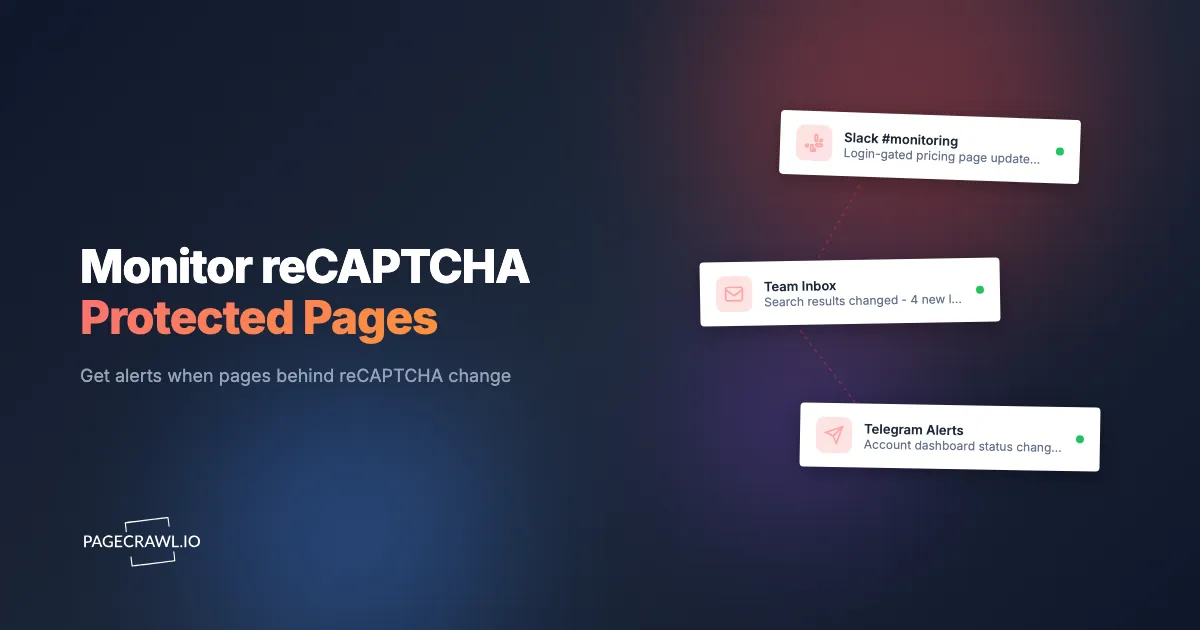
Google reCAPTCHA is the "I'm not a robot" checkbox you have clicked a thousand times, along with the image grids and the invisible version that scores visitors silently. It sits in front of login forms, search results, signup pages, and account areas across a huge share of the web. If the content you want to track lives behind one, a basic monitoring tool never gets past the challenge and never reports the change.
Monitoring a reCAPTCHA-protected page means running a check that clears the challenge and reads the page behind it. On paid plans PageCrawl does this by connecting an optional challenge-solving service such as 2Captcha, including the common case where the challenge only appears after you log in, run a search, or submit a form. This guide walks through how it works and how to keep the cost low.
This is one part of a broader topic. For the full picture across every challenge type, see the guide to monitoring captcha-protected websites.
Can PageCrawl monitor a page behind reCAPTCHA?
Yes. PageCrawl loads pages the way a real browser does, so when a page presents a reCAPTCHA challenge, the connected challenge-solving integration answers it (on paid plans) and PageCrawl captures the content behind it. It then compares each capture to the previous one and alerts you as soon as a check detects a change, exactly as it would for a page with no challenge. The help centre article on monitoring pages that show CAPTCHA covers connecting the integration.
This is necessary because reCAPTCHA is built to stop tools that only fetch raw HTML. Those tools receive the challenge instead of the content, so they report no change indefinitely or alert on the challenge screen. PageCrawl clears the challenge first, then tracks the content you care about, much as residential proxies handle geo-restricted and IP-blocked pages that never show a challenge at all.
Which versions of reCAPTCHA does this cover?
PageCrawl handles the reCAPTCHA versions you meet in practice: reCAPTCHA v2 (the "I'm not a robot" checkbox and the image-selection challenges), the invisible v2 variant that runs without a checkbox, and reCAPTCHA v3, which returns a background score instead of showing a challenge, as described in Google's reCAPTCHA developer documentation. You usually do not need to know which one a site uses; PageCrawl detects it on the page and handles it.
The visible checkbox and image grids are the versions most people recognize. The invisible and score-based versions are easy to miss because they show nothing, yet they still block basic tools in the same way. If an ordinary monitor keeps reporting a login or search page as unchanged for far too long, an invisible reCAPTCHA is a common reason.
How do I monitor a reCAPTCHA that appears after login or a search?
This is the most common and most useful case. reCAPTCHA frequently does not appear on the first page. It shows up after you act: after you submit a login form, run a search, or choose a filter. PageCrawl runs your action steps first, and when reCAPTCHA appears as a result, the challenge-solving integration clears it and the check continues on to capture the page.

A typical action-then-challenge sequence
- Navigate to the starting page.
- Fill the fields you need (for example, an email and password, or a search query).
- Select any dropdown options (a location, a category, a date).
- Click the submit or search button.
- reCAPTCHA appears. The connected challenge-solving integration clears it.
- Wait for the real page to load.
- Check the content for changes.
You configure steps 1 to 4 and 6 to 7 in PageCrawl's Actions system; step 5 is automatic once captcha handling is on. For help building action sequences and finding the fields to fill and buttons to click, see monitoring password-protected websites and the CSS selector guide. If the login also sends a one-time code, PageCrawl can handle that step too.
Because PageCrawl reuses the signed-in session between checks, the login and its challenge usually come up only occasionally, not on every check. Most checks run straight through to the content.
How much does it cost to monitor a reCAPTCHA-protected page?
Checking a page behind reCAPTCHA costs more per check than a standard page, because solving the challenge takes extra work. The cost scales with frequency, so checking once a day or once a week keeps the total very low. It only becomes noticeable if you check every few minutes.
reCAPTCHA often guards pages that change slowly, such as account dashboards, login-gated listings, and search results you review periodically. Those suit a daily or twice-daily check, which catches every meaningful change while keeping the cost near the floor. Reserve frequent checks for the few pages where minutes genuinely count.
Note: captcha handling is available on paid plans. Start on a low frequency, confirm the monitor is capturing the right content, and increase the frequency only for the specific pages that need it.
What can I do once PageCrawl sees the page?
Once the challenge is cleared and the page is captured, everything works like any other monitor. On the next check that finds a difference you get a notification with an AI summary of what changed, routed to email, Slack, Discord, Teams, Telegram, or a webhook, with a priority score so routine updates do not distract from important ones. You can narrow what actually triggers a message with notification conditions and filters.
You can track the entire page or just a single element (a price, a status, a specific row) with a CSS selector, so the challenge in front of the page never gets in the way of watching exactly the content that matters.
Choosing your PageCrawl plan
reCAPTCHA handling is a paid-plan feature. PageCrawl's Free plan lets you monitor 6 pages with 220 checks per month, enough to validate ordinary monitoring before you add protected pages.
| Plan | Price | Pages | Checks / month | Frequency |
|---|---|---|---|---|
| Free | $0 | 6 | 220 | every 60 min |
| Standard | $8/mo or $80/yr | 100 | 15,000 | every 15 min |
| Enterprise | $30/mo or $300/yr | 500 | 100,000 | every 5 min |
| Ultimate | $99/mo or $999/yr | 1,000 | 100,000 | every 2 min |
Annual billing saves two months across every paid tier. Because reCAPTCHA-protected pages are usually best checked once or twice a day, even several of them fit comfortably inside a paid plan's monthly checks. All plans include the PageCrawl MCP Server, so you can ask an assistant like Claude or Cursor what changed behind your monitored logins this week and get an answer drawn straight from your history.
Getting Started
Choose one page behind reCAPTCHA, whether the challenge shows on load or only after you log in and search, and set up a monitor. Add your action steps, enable captcha handling, start with a daily check, and confirm it captures the real content. Then add the rest of your protected pages.
Create a free PageCrawl account and start monitoring your reCAPTCHA-protected pages today.