The pattern repeats with every big kit release. A national team's authentic home shirt appears on the adidas product page with no announcement, the popular sizes of the player-spec version (not the cheaper replica) disappear the same day, and resale listings for the same shirt show up at a hefty premium soon after. The fans who paid retail are the ones who were already watching the product page when it changed state from "Coming Soon" to "Add to Bag."
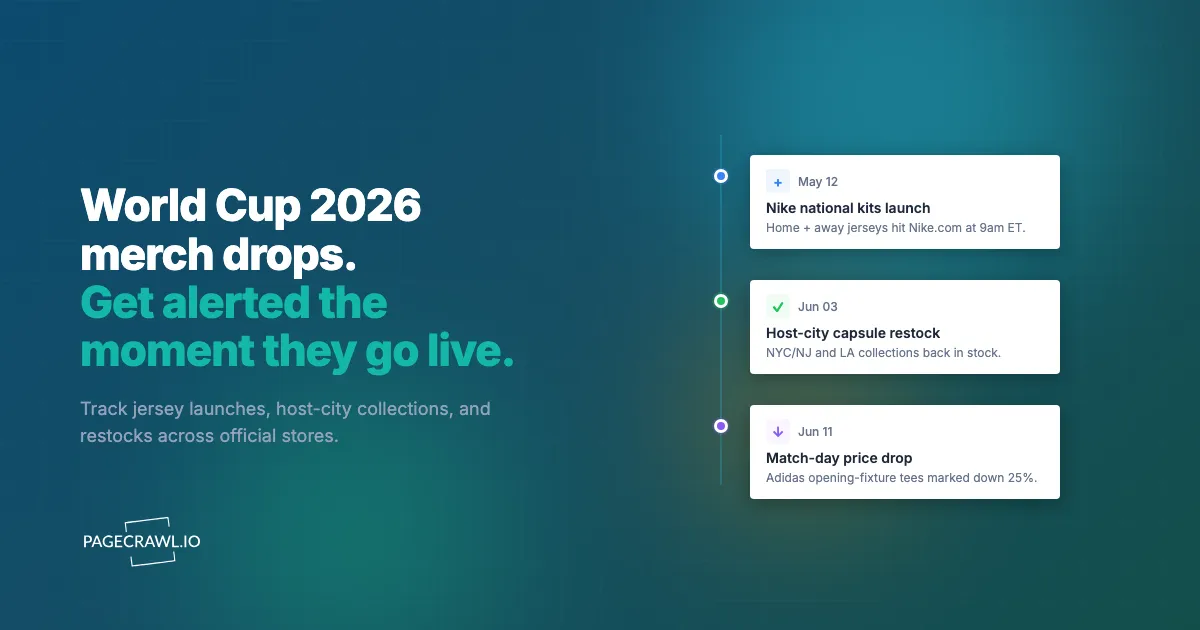
This is the pattern across the entire 2026 tournament. FIFA is staging the World Cup across the United States, Canada, and Mexico in June and July 2026, and the merchandise calendar around it is the busiest in the sport's history. National team kits from adidas and Nike, host-city collections, limited collaboration drops, and stadium-exclusive gear all land on different stores at different times, almost never with reliable advance notice. Authentic jerseys, kids sizes, and anything tied to a specific match or host city sell through fastest. Once a size is gone from the official store, your options are resale at a markup or waiting on a restock that may never come.
This guide covers how World Cup 2026 merchandise actually drops, which stores to watch, and how to set up monitoring that alerts you as soon as a check finds a kit live or a sold-out size back in stock.
How do World Cup 2026 merch drops actually work?
World Cup merch drops through four separate channels that do not coordinate with each other: the kit suppliers' own stores, Fanatics and the official FIFA shop, national federation stores, and general sporting-goods retailers. Each has its own release behavior, and understanding the structure is what makes monitoring effective instead of noisy.
National team kits split between adidas and Nike
The two dominant kit suppliers each outfit a roster of national teams. adidas supplies hosts and several major nations; Nike supplies another large group. Each team gets a home and away kit, and most sell in two tiers: a replica (mass-market fit and fabric) and an authentic (player-spec, smaller allocation, higher price). Authentic versions in popular sizes are the scarce SKUs. They land on the supplier's own store (adidas.com, nike.com), on the national federation's official store, and on third-party retailers, often at slightly different times.
Fanatics is the central licensed-merch channel
Fanatics operates much of the official licensed merchandise, including the FIFA store and many team-specific shops. This is where you find the broadest catalog: jerseys, training gear, scarves, flags, and tournament-branded apparel. Fanatics restocks continuously during the tournament, which makes its category pages high-value monitoring targets for sold-out items coming back.
Host-city and tournament-exclusive collections sell out fastest
Collections tied to specific host cities and to the tournament itself (the official emblem line, host-city capsules, stadium-exclusive gear) carry the smallest allocations and the highest collector demand. Stadium-exclusive items in particular are often available only in a short window and rarely restock online.
Match-driven demand spikes are unpredictable
A team's jersey demand can multiply overnight after a standout result. A previously slow-selling kit can sell out within hours of a memorable match. This is the demand pattern email lists cannot keep up with, because the spike happens faster than the marketing cycle.
What should you watch at each store?
Watch the team landing pages and individual authentic-kit product URLs at adidas and Nike, the team and category pages at Fanatics and the official FIFA shop, and any federation store for your country. The URL structure differs per store, but the monitoring approach is the same: watch the category or product page and alert on the state change from out of stock to available.
adidas. National team kits live under the football/soccer section. Team-specific landing pages list home, away, replica, and authentic variants. Individual product URLs follow adidas.com/us/[product-slug]/[article-code].html. When a size sells out, the size selector disables that option, which is a detectable page change.
Nike. National team kits sit in the Nike soccer section, often with a dedicated team page. Product pages show per-size availability. Nike also runs limited launches through its app and launch calendar that mirror to the web store.
Fanatics and the FIFA store. The official FIFA shop and Fanatics team shops carry the widest catalog. Category pages (by team, by product type) are the best targets because new items and restocks both surface there first.
National federation stores. Many federations run their own official stores, sometimes with exclusive items not sold elsewhere and sometimes with earlier access for a home market.
Major retailers. General sporting-goods retailers carry replica kits and tournament gear. They sometimes restock sizes the supplier stores have already sold through.
A typical authentic-jersey product URL looks like this:
https://www.adidas.com/us/[team]-home-authentic-jersey/[article-code].htmlWhen the kit is purchasable, the size buttons are active. When a size is exhausted, that button changes to a disabled or "notify me" state, which monitoring detects as a page diff.
Comparing Monitoring Approaches
If you have tracked sneaker or ticket drops before, this will feel familiar. The same approaches apply, with the same trade-offs.
| Approach | Cost | Latency | Coverage | Best For |
|---|---|---|---|---|
| Store email and "notify me" lists | Free with account | Minutes to hours | Per-SKU, store-controlled | Casual buyers who accept email latency |
| Manual page refreshing | Free | Real time while watching | One page at a time | A single known drop window |
| Team and fan Discord servers | Free | Variable | Crowd-sourced | Active fans willing to filter chatter |
| Sneaker and drop bots | Paid | Seconds | Curated lists | Resellers willing to pay and configure |
| PageCrawl on store URLs | Free tier to $80/yr | 5-15 minutes | Any URL you choose | Fans and resellers who want first-look access |
The store "notify me" lists are the obvious default, but they fire on the store's own batching schedule rather than when the page actually changes, and they only cover the exact SKU you signed up for. Monitoring the page directly gives you per-page control and routes the alert to whatever channel reaches you fastest. The same logic applies whether you are chasing a sold-out concert ticket or a limited sneaker release.
Setting Up World Cup Merch Monitoring in PageCrawl
PageCrawl monitors any URL you give it and alerts you when a check finds the page has changed. New monitors come with screenshots enabled by default, so every alert includes a visual snapshot of the page as it looked when the change was detected, which makes it obvious whether a size actually came back in stock.

Step 1: Add the stores and team pages you care about
Start with the channels most likely to carry what you want. A reasonable starting watchlist:
https://www.adidas.com/us/soccer-jerseys
https://www.nike.com/w/soccer-jerseys
https://www.fanatics.com/fifa-world-cup
https://www.fifa.com/fifaplus/en/store
Each goes in as a separate monitor. Category pages catch new items and restocks as they surface.
Step 2: Add specific product pages for the kits you actually want
For a particular team's authentic kit, add the exact product URL as its own monitor with product page monitoring for price and availability. The category page might miss a quiet restock of a single size; the product page will not. Use PageCrawl's restock and out-of-stock detection so the alert fires on the availability change rather than on cosmetic page edits.
Step 3: Narrow to the size or variant if you can
Most product pages expose the size selector in the page markup. If you only care about one or two sizes, target that part of the page with a CSS selector so you are alerted specifically when your size returns, not on every minor change. The CSS selector guide walks through pinpointing a single element. This is the difference between a clean "your size is back" alert and a noisy "something on this page changed" alert.
Step 4: Pick a sensible check frequency
World Cup demand is minute-scale on flagship authentic kits and tournament-exclusive items, and hour-scale on broad replica catalogs. A reasonable layering:
- Authentic kits for top teams: 5-15 minutes, especially around their match days.
- Fanatics and FIFA store category pages: 15 minutes during the tournament, hourly otherwise.
- Host-city and stadium-exclusive collections: 15 minutes once they are announced, since allocations are small.
- Replica kits and general retailer pages: hourly. Lower velocity, larger stock.
The free plan checks every 60 minutes, which is fine for broad category monitoring. For a specific authentic kit you expect to sell out fast, the 15-minute frequency on the Standard plan is the practical floor.
Step 5: Route alerts to a fast channel
For the kits and sizes you genuinely want to buy, route alerts to browser and phone push notifications or Telegram so they reach your phone as soon as the check completes. For broad category monitoring where you are browsing rather than racing, email or a daily digest is fine. PageCrawl supports multiple notification channels, so you can split urgent product-page alerts from low-priority category alerts.
Step 6: Use AI summaries to cut the noise
Store category pages are dense, with dozens of product tiles changing constantly. PageCrawl's AI-written change summary describes what actually changed (which kit was added, which item came back in stock) so you can decide in one glance whether to act, instead of opening the page to find out.
Worked Example: A Fan Following Three Teams
A fan following their own national team plus two others set up the following before the tournament started:
- Three authentic home-kit product pages on adidas and Nike, each on 15-minute checks, dropping to 5 minutes on those teams' match days.
- The Fanatics FIFA category page on 15-minute checks for new items and restocks.
- One host-city collection page on 15-minute checks once it was announced.
- Size-specific CSS selectors on the two authentic kits where only one size was wanted.
- All urgent product-page alerts routed to web push, category alerts to a daily email digest.
Across the group stage and knockout rounds, the fan caught two authentic-kit restocks in their size on the first check after the size buttons reactivated, and one host-city item before it sold through. Both authentic kits were trading on resale at well over retail by the time the fan had already bought at list price. Standard plan cost for the window: $8 for the month, or $80 for the year.
Patterns Worth Watching
Authentic kits sell out before replicas. The player-spec versions carry the smallest allocations. If you want authentic, watch it harder and earlier than the replica.
Demand spikes follow results. A team's kit can sell out within hours of a standout win. Tighten the check frequency on a team's product pages on and immediately after their match days.
Host-city and stadium-exclusive items rarely restock. Treat these as one-shot windows. Monitor them from announcement, not from the day they go live.
Restocks cluster mid-tournament. Suppliers and Fanatics often replenish popular sizes after the group stage as they gauge demand. A sold-out kit in week one is worth keeping on a monitor through the knockouts.
Kids and small adult sizes go first. If you are buying for a child or wear a smaller size, expect those to disappear first and come back least often. A size-specific monitor matters most here.
Beyond the Big Stores
A complete World Cup merch watchlist can extend past the main supplier and Fanatics channels.
National federation stores. Federations sometimes carry exclusives and give their home market earlier access. If you follow a specific country, add its official federation store.
Regional store variants. adidas and Nike run country-specific stores. A kit sold out on the US store may still have stock on a regional store, and vice versa. The same monitoring approach used for adidas releases and Nike kit and SNKRS drops applies directly to national team kits.
Resale price tracking. Monitoring resale listings for a kit you missed tells you the real market premium, which helps you decide how aggressively to chase a restock at retail. The mechanics are the same ones covered in the broader sneaker restock guide.
Match-ticket and travel pages. If you are traveling to a host city, the same monitoring setup works for match ticket availability. Watching ticket release pages, flight and travel price pages, and merch pages with one tool keeps the whole trip in one place.
How fast do authentic World Cup kits sell out?
For top teams, popular sizes of the authentic version can be gone within an hour of the page going live, and faster after a strong match result. Replica kits, which carry much larger allocations, last considerably longer and restock more often.
Can monitoring guarantee I get the kit?
No. Monitoring gets you to the page on the next check after the change, which is usually fast enough to beat the resale market, but the final purchase still depends on remaining stock and your checkout speed. It removes the "I found out too late" problem, not the queue.
Should I watch the category page or the product page?
Both. The category page catches new items and surprise restocks across a whole team or tournament collection; the product page catches quiet single-size restocks that a category view can easily miss because the tile itself does not change.
Will I get noise alerts on minor page edits?
Not if you target the size selector or buy button with a CSS selector and enable AI summaries. The alert then fires on availability changes rather than on cosmetic edits like banner rotations, recommended-product rows, or promotional copy.
Do I need a paid plan for World Cup merch alerts?
For a handful of category pages at hourly checks, the free plan's 6 monitors work fine. For an active fan or reseller watching specific authentic kits at 5-15 minute frequency, Standard at $80/year is the right tier.
Choosing your PageCrawl plan
PageCrawl's Free plan lets you monitor 6 pages with 220 checks per month, which is enough to validate the approach on your most critical pages. Most teams graduate to a paid plan once they see the value.
| Plan | Price | Pages | Checks / month | Frequency |
|---|---|---|---|---|
| Free | $0 | 6 | 220 | every 60 min |
| Standard | $8/mo or $80/yr | 100 | 15,000 | every 15 min |
| Enterprise | $30/mo or $300/yr | 500 | 100,000 | every 5 min |
| Ultimate | $99/mo or $999/yr | 1,000 | 100,000 | every 2 min |
Annual billing saves two months across every paid tier. Enterprise and Ultimate scale up to 100x if you need thousands of pages or multi-team access.
If monitoring helps you land one sold-out concert ticket pair, one limited sneaker drop, or one in-demand product at retail instead of resale, Standard at $80/year is already paid for. 100 monitored pages covers every major retailer you care about, and the 15-minute check frequency catches most drops within a check cycle of going live.
Getting Started
Start with the kits and teams you actually care about. Add the adidas and Nike soccer-jersey category pages, the Fanatics FIFA store, and the authentic product pages for your two or three favorite national teams. Set the authentic product pages to 15-minute checks (tighter on match days), the category pages to hourly, and route the product-page alerts to web push or Telegram.
Run that for a week and watch what comes through. Once you see how fast the alerts land, narrow your authentic-kit monitors to your specific size with a CSS selector and add any host-city or stadium-exclusive collections as they are announced. PageCrawl's free tier covers 6 monitored pages, which is enough to cover your top teams and the main store before you decide whether the tournament-long Standard plan is worth the $8 for the month.