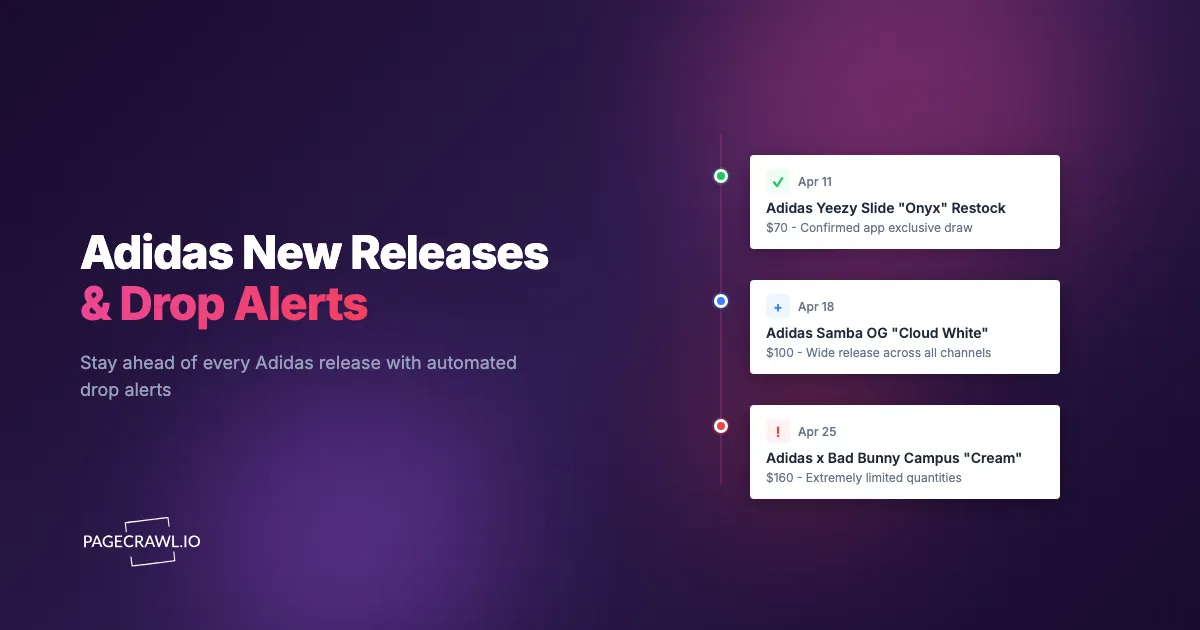
The Adidas Samba Mule sold out within minutes of its initial release. The latest Bad Bunny Forum collaboration never even reached general sale in most regions. And the ongoing Yeezy situation has made release schedules unpredictable at best, with drops happening with little advance notice across different retail channels at different times.
For sneaker collectors, resellers, and anyone trying to buy a specific Adidas release at retail price, the challenge is not knowing what is dropping. The challenge is knowing exactly when and where inventory becomes available, down to the minute. Adidas distributes releases across its own platforms (adidas.com, the Confirmed app), major retailers (Foot Locker, JD Sports, Finish Line), and boutique partners. Each channel operates on its own timeline, with its own inventory allocation, and its own methods for handling high-demand releases.
This guide covers the Adidas release ecosystem, which products sell out fastest, where to monitor for upcoming and restocked inventory, how to set up automated alerts that notify you as soon as a check sees a product become available, and strategies for improving your chances on high-demand releases.
Where does Adidas release new drops?
Adidas releases new drops across adidas.com, the Confirmed app, major retail partners like Foot Locker and JD Sports, and boutique shops. Understanding how Adidas distributes products helps you target your monitoring effectively.
Adidas.com
The main adidas.com website serves as both a standard retail store and a launch platform. Regular products are available continuously, while limited releases appear on scheduled drop dates, often at 7:00 AM or 10:00 AM Eastern Time.
For limited releases, adidas.com may use a queue or waiting room system during high-demand launches. Products appear on the site at the scheduled time, and customers who reach the product page are placed in a virtual queue. Success depends partly on timing and partly on luck.
Product pages for upcoming releases often appear days or weeks before the drop date, showing the release date, price, and product details but without an "Add to Bag" option. When the drop goes live, the page updates to enable purchasing. This transition from "Coming Soon" to available is exactly the change you want to detect.
Adidas Confirmed App
The Confirmed app is Adidas's primary platform for high-demand limited releases. Most Yeezy drops, designer collaborations, and limited-edition models are released through Confirmed rather than the standard website.
Confirmed uses two primary release mechanisms:
Raffle draws. Customers enter during a registration window (typically several days before the release). Winners are selected randomly and notified on release day. This is the most common method for hyped releases.
First Come First Served (FCFS). Products become available at a specific time, and speed matters. Less common for ultra-limited releases but used for wider releases and restocks.
While you cannot monitor an app directly, Adidas often mirrors Confirmed release information on its website, and third-party sneaker news sites track Confirmed releases closely. Monitoring these web sources gives you advance notice of what is dropping on Confirmed and when.
Major Retail Partners
Adidas allocates inventory to large retail partners, each of which handles releases differently:
Foot Locker / Champs Sports. These Foot Locker Inc. brands share inventory systems but maintain separate websites. Limited releases, much like high-demand Jordan drops, often use a reservation system through the FLX app. Standard releases and restocks appear on the website and can be monitored directly.
JD Sports. A major Adidas partner (and a key retailer for Puma's new releases), particularly strong in Europe and increasingly in North America. JD Sports receives exclusive colorways and early access to certain releases. Their website updates product availability in real time.
Finish Line / JD Sports (US). Now under the JD Sports umbrella, Finish Line maintains its own website and release calendar. Some releases land on Finish Line before or after they appear on other channels.
Dick's Sporting Goods. Carries mainstream Adidas releases and occasionally receives limited models. Lower competition than specialty sneaker retailers, making it a good secondary monitoring target.
Nordstrom. Carries Adidas lifestyle and fashion-oriented releases. Some collaborations (particularly designer partnerships) appear at Nordstrom before or instead of athletic retailers.
Boutique and Specialty Partners
Adidas distributes some of its most limited releases through independent sneaker boutiques and specialty retailers. These shops receive tiny allocations (sometimes single-digit pairs per size) and often handle releases through in-store raffles or their own online raffle systems.
Boutiques worth monitoring include: Kith, Packer Shoes, Bodega, SNS (Sneakersnstuff), End Clothing, and Atmos. Each has a website where raffle registration and release information is posted.
Which Adidas releases sell out fastest?
Yeezy drops, designer collaborations, and limited retro reissues sell out fastest. Not every Adidas release requires monitoring, so focus your alerts on the categories with the highest demand relative to supply.
Yeezy (Adidas Yeezy)
Since the Kanye West partnership ended, Adidas has been releasing remaining Yeezy inventory in waves. These drops are unpredictable in timing and quantity. Some colorways sell out within minutes while others sit for hours or days. Demand varies dramatically by model and color.
The Yeezy Boost 350 V2 and Yeezy Slide remain the most consistently high-demand models. Foam Runners also sell well. Less popular models like the Yeezy 500 may not require fast alerts.
Because Adidas schedules Yeezy drops with relatively little advance notice (sometimes announced just days before), monitoring Adidas's Yeezy landing page and sneaker news sites for announcements is essential for staying ahead.
Designer Collaborations
Adidas collaborations with designers and fashion brands create some of the highest demand:
- Bad Bunny Forum and Campus models sell out almost immediately
- Wales Bonner Samba and other silhouettes have become major fashion items
- Pharrell Human Race NMD and other models maintain strong demand
- Jerry Lorenzo / Fear of God Athletics line generates significant hype
- BAPE collaborations remain popular with streetwear collectors
Collaboration releases are typically announced weeks in advance, giving you time to set up monitoring. But the actual purchase window is often minutes, making alerts critical.
Retro and Heritage Reissues
Adidas has been riding a massive wave of retro popularity:
Samba. The Adidas Samba became one of the most popular sneakers globally. Standard colorways are mostly available, but limited editions, premium materials, and collaboration versions sell out quickly.
Gazelle. Similar to the Samba, the Gazelle has experienced a resurgence. Limited colorways and premium versions sell faster than standard options.
Campus. Another retro model seeing strong demand, particularly in collaboration editions.
Spezial. The Adidas Spezial line targets the terrace and casual culture audience. Certain models, particularly those connected to football culture, sell out rapidly in Europe.
Performance Releases
While lifestyle sneakers get the most hype, certain performance releases also warrant monitoring:
- Ultraboost limited colorways and collaborations
- Adizero Adios Pro (running, limited production)
- Predator limited-edition football boots
- AE 1 (Anthony Edwards signature basketball shoe) in limited colorways
Where should you monitor for Adidas drops and restocks?
The highest-value pages are pre-release product pages, retailer release calendars, and sneaker news sites. Focus monitoring on the pages most likely to surface available inventory.
Product Pages (Pre-Release)
When a release date is announced, the product page typically goes live on adidas.com and retail partner sites days or weeks before the drop. Monitoring the product page catches the transition from "Coming Soon" or "Notify Me" to "Add to Bag" or "Buy Now."
This is the most direct monitoring approach. Set up an availability monitor on the specific product URL, the same product page monitoring for spec, price, and availability changes that works on any retailer, and configure alerts for when the status changes.
Release Calendar Pages
Adidas and major retailers maintain release calendar pages listing upcoming drops:
- adidas.com/us/release-dates: Adidas's own calendar
- footlocker.com/release-dates: Foot Locker's upcoming releases
- finishline.com/release-dates: Finish Line calendar
Monitor these pages for new entries. When a new product appears on the release calendar, you get advance notice to prepare monitors for the specific product pages. PageCrawl's automatic page discovery can help identify new product pages as they are added to a retailer's site.
Sneaker News and Information Sites
Dedicated sneaker media sites publish release information before it appears on retail sites:
- Sneaker News (sneakernews.com)
- Sole Collector (solecollector.com)
- Highsnobiety (highsnobiety.com)
- Hypebeast (hypebeast.com)
Monitoring these sites for Adidas-related content, the same job as news and publication monitoring for new articles, gives you the earliest possible notice of upcoming releases, often weeks before products appear on retail sites.
PageCrawl's automatic page discovery can also help with Adidas monitoring. Point it at a retailer's Adidas brand page or a release calendar, and it identifies new product pages as they are added. Instead of manually finding every product URL for an upcoming drop, automatic discovery surfaces new pages for you, so you can add monitors for them before the release date. This is especially useful for retailers like Foot Locker or JD Sports, where new product listings sometimes appear quietly before being featured on the main release calendar.
Setting Up Adidas Monitoring with PageCrawl
Here is a practical setup for comprehensive Adidas release and restock monitoring.

Step 1: Monitor the Release Calendar
Add the Adidas release calendar page (adidas.com/us/release-dates) to PageCrawl. Use "Full Page" monitoring mode to capture all content on the page. Set the check frequency to daily or twice daily. When new products are added to the calendar, you will receive an alert showing the new entries.
This is your early warning system. New calendar entries give you time to research the release and set up specific product page monitors before the drop date.
Step 2: Set Up Product-Specific Monitors
For each release you want to pursue, find the product page URL on adidas.com and each retailer you want to monitor. Add each URL as a separate monitor using "Availability" or "Price" tracking mode.
For example, if you want the upcoming Bad Bunny x Adidas Campus, you might set up monitors on:
- adidas.com product page
- Foot Locker product page
- JD Sports product page
- Finish Line product page
That is four monitors for one product. For the free tier's 6 monitors, this covers one product across four retailers with two monitors left for other products or the release calendar.
Step 3: Configure Timing
For monitors on product pages before a drop, set the check frequency to every 1-2 hours starting a day before the release. During the actual drop window (the morning of the release), the product page will transition from "Coming Soon" to purchasable.
For restock monitoring (products that already dropped and sold out), set checks to every 4-6 hours, the same approach that works for catching other limited-stock deals such as Dyson refurbished restocks. Restocks are less predictable but also less competitive than initial drops, giving you a slightly larger window to act.
Step 4: Choose Fast Notification Channels
When a product becomes available, speed determines whether you get it. Configure notifications for the fastest channels available to you:
Telegram. Pushes the alert to your phone promptly once a check detects the change. Keep Telegram open on your phone and computer so nothing sits unread. This is the recommended channel for sneaker monitoring. Learn more about fast notification setup in our push notification guide.
Discord. If you are part of a sneaker community Discord server, you can route alerts to a private channel or direct message. Useful for group efforts where multiple people are trying for the same release.
Slack. If you prefer Slack, webhook-based notifications deliver alerts with the same speed.
Web Push. Browser-based push notifications work when you are at your computer. Good as a secondary channel alongside mobile notifications.
Email is too slow for sneaker drops. By the time you see an email notification, the product may already be sold out.
Step 5: Size-Specific Monitoring
For some retailers, product pages show availability by size. If you only need a specific size, you can use element-specific monitoring to track the availability indicator for your size rather than the general product page.
On adidas.com, size selection buttons change state between available and sold out. Using a CSS selector that targets the button for your specific size creates a more precise alert. Instead of knowing that the shoe is "available" (but possibly only in sizes you do not need), you know when your exact size is in stock.
This requires slightly more technical setup but dramatically reduces false positives, especially for restocks where only certain sizes come back.
Confirmed App Strategy
While you cannot monitor the Confirmed app directly with web monitoring, you can use monitoring to improve your Confirmed success rate.
Pre-Registration Monitoring
Monitor adidas.com and sneaker news sites for announcements about Confirmed drops. Raffle registration windows open days before the actual release. Missing the registration window means missing the release entirely. Automated alerts about upcoming Confirmed releases ensure you never miss a registration window.
Monitoring for FCFS Drops
Some Confirmed releases use First Come First Served instead of raffles. These are sometimes announced with short notice. Monitoring Adidas's own announcements and sneaker news sources for "FCFS" mentions gives you a heads-up to be ready when the drop goes live.
Post-Draw Restock Monitoring
After a Confirmed draw, unclaimed pairs and returns sometimes reappear as general release inventory on adidas.com or retail partners. This "shock drop" inventory appears without advance notice. Monitoring adidas.com product pages and retail partner pages catches these post-draw restocks.
International Release Differences
Adidas releases do not happen simultaneously worldwide, and availability varies significantly by region.
Staggered Release Dates
A product might drop in Europe on Friday, in Asia on Saturday, and in North America the following week. Monitoring Adidas regional sites (adidas.co.uk, adidas.de, adidas.com.au) gives you advance notice of what is coming to your region and can provide early reviews and sizing guidance.
Regional Exclusives
Some colorways and collaborations are exclusive to specific regions. The Adidas Spezial line, for example, sees much higher demand and more limited releases in the UK and Europe than in North America. Certain collaborations with Asian designers or retailers are exclusive to Asian markets.
If you are willing to use international shipping or forwarding services, monitoring regional Adidas sites expands your options significantly.
Different Retail Partners by Region
Adidas works with different retail partners in different regions. JD Sports dominates in Europe, while Foot Locker is stronger in North America. Boutique partners vary entirely by region. Research which retailers in your target region receive Adidas allocations and set up monitoring accordingly.
Combining with Resale Market Monitoring
For collectors and resellers, monitoring retail availability alongside resale market pricing provides complete market intelligence.
Tracking Resale Values
Monitor resale platform product pages (StockX, GOAT, eBay) for specific models to understand current market value. This helps you decide which releases to prioritize: a shoe that sells for 3x retail on the resale market is worth more effort to secure at retail than one that sells at or near retail.
Price Trend Monitoring
Resale prices fluctuate based on supply and demand. Monitoring these prices over time reveals trends. Some shoes increase in value after the initial drop as supply dries up. Others peak immediately after release and decline as more pairs enter the resale market.
PageCrawl's price tracking shows these trends over time, helping you make informed buying and selling decisions.
Identifying Restock Impact
When Adidas restocks a popular model, resale prices typically drop. Monitoring both the retail availability and the resale price simultaneously shows you the direct impact of restocks on market value.
Managing Multiple Releases
During busy release months, Adidas may drop multiple desirable products per week. Here is how to manage monitoring at scale.
Prioritize by Demand
Not every release needs monitoring. Focus on releases where demand exceeds supply. General releases that will be widely available do not need automated alerts. Save your monitoring capacity for limited editions, collaborations, and high-demand models.
Rotate Monitors
If you are on the free tier (6 monitors), rotate monitors based on the release calendar. A week before a drop, set up monitors for that release. After the drop, if you secured the product or it sold out permanently, remove those monitors and set up monitors for the next upcoming release.
Use Tags for Organization
Tag monitors by release date, brand collaboration, or product type using labels, folders, and workspaces. This makes it easy to find and manage monitors when you have multiple releases being tracked simultaneously.
Common Challenges
Bot Protection on Adidas.com
Adidas employs protection measures on their website, particularly during high-demand releases. Some monitoring tools fail to load product pages accurately because of these protections. PageCrawl handles pages behind bot protection reliably, ensuring your monitors capture accurate availability data even during high-traffic release events.
Page Structure Changes
Adidas periodically redesigns product pages and changes how availability information is displayed. If a monitor stops detecting availability correctly after a site update, reconfigure the monitor to target the updated page structure.
Phantom Availability
Occasionally, a product page may briefly show availability before reverting to sold out. This can happen due to inventory system updates, cancelled orders freeing up stock, or website caching issues. These "phantom" alerts are frustrating but unavoidable with any monitoring approach. The alternative, missing a real restock, is worse.
Add-to-Cart Does Not Guarantee Purchase
Availability means the product is shown as available on the website. It does not guarantee you can complete checkout. During high-demand releases, products may show as available but sell out during the checkout process. Monitor alerts get you to the page fast, but completion depends on checkout speed and competition.
Choosing your PageCrawl plan
PageCrawl's Free plan lets you monitor 6 pages with 220 checks per month, which is enough to validate the approach on your most critical pages. Most teams graduate to a paid plan once they see the value.
| Plan | Price | Pages | Checks / month | Frequency |
|---|---|---|---|---|
| Free | $0 | 6 | 220 | every 60 min |
| Standard | $8/mo or $80/yr | 100 | 15,000 | every 15 min |
| Enterprise | $30/mo or $300/yr | 500 | 100,000 | every 5 min |
| Ultimate | $99/mo or $999/yr | 1,000 | 100,000 | every 2 min |
Annual billing saves two months across every paid tier. Enterprise and Ultimate scale up to 100x if you need thousands of pages or multi-team access.
Landing a single Adidas limited release at retail instead of resale pays for Standard at $80/year many times over. Most hyped drops carry a $50-150 resale premium within hours of selling out, so one successful catch on a Bad Bunny collab or a Yeezy Boost covers the annual subscription outright. Standard's 100 pages are enough to monitor adidas.com, Foot Locker, JD Sports, Finish Line, and a handful of boutiques across your most-wanted releases simultaneously, with 15-minute checks catching availability changes well within the window most restocks are live. Enterprise at $300/year makes sense for resellers tracking hundreds of SKUs across dozens of retailers, with 500 monitors and 5-minute checks that keep pace even during fast-moving surprise drops.
Getting Started
Pick one upcoming Adidas release you care about. Find the product page URL on adidas.com and one or two retail partner sites. Add those URLs to PageCrawl with availability tracking and fast notifications (Telegram or Discord). Set the check frequency to hourly starting a day or two before the scheduled release.
PageCrawl's free tier gives you 6 monitors, enough to track one product across multiple retailers or a couple of products on their primary retail channels. For sneaker enthusiasts tracking multiple brands and releases simultaneously, the Standard plan ($80/year for 100 monitors) provides room for comprehensive monitoring across Adidas, Nike, New Balance, and other brands. The Enterprise plan ($300/year for 500 monitors) supports commercial reselling operations that need to monitor hundreds of products across dozens of retailers.
For monitoring other sneaker brands alongside Adidas, see our out-of-stock monitoring guide for general product availability tracking and our push notification setup guide for optimizing alert speed.
The sneaker market rewards speed and information. Automated monitoring surfaces restocks and availability changes on the next check rather than hours later, giving you the best possible chance to secure the products you want at retail price.