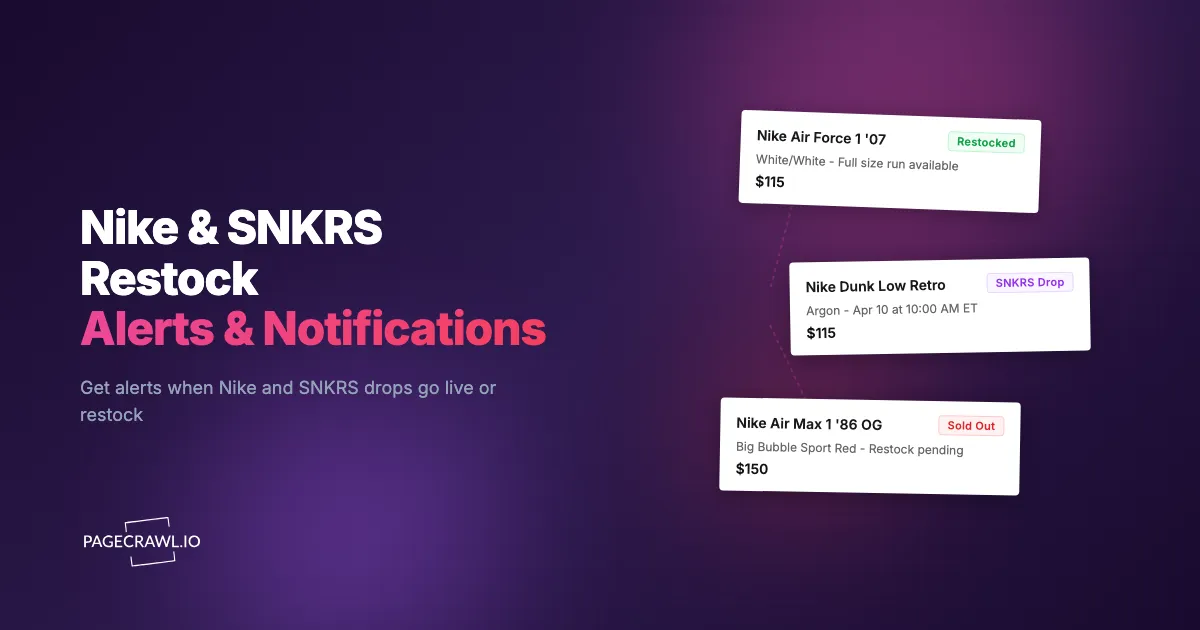
The Air Jordan 4 Bred Reimagined restocked on Nike.com at 7:02am Eastern on a Wednesday. No announcement. No countdown. Returned pairs and cancelled orders went back into inventory, and the product page quietly flipped from "Sold Out" to "Add to Cart." By 7:14am, it was sold out again. Twelve minutes of availability, and unless you happened to be refreshing the page at that exact moment, you never knew it happened.
Nike restocks are one of the most competitive and unpredictable events in online retail. Limited releases, from hyped sneakers to World Cup jersey drops, sell out in seconds during initial drops, but they frequently reappear in small quantities over the following weeks and months. Returned pairs, cancelled orders, and reserved inventory all feed back into the available stock. These restocks are unannounced, brief, and easily missed. Community-run Discord servers and Twitter accounts help, but they depend on someone spotting the restock and posting about it, which means you are always seconds behind.
This guide covers how Nike's release and restock system works, why monitoring Nike.com product pages directly is the fastest way to catch restocks, and how to set up automated alerts that notify you on the next check after a sold-out shoe becomes available again.
How do Nike drops and restocks work?
Nike releases limited sneakers through SNKRS draws, first-come-first-served drops, and Exclusive Access, then feeds returned pairs, cancelled orders, and reserved inventory back onto Nike.com in unannounced restocks. Understanding that split is what tells you which page to monitor.
SNKRS App Releases
Nike's SNKRS app is the primary release channel for limited and hyped sneakers. Releases on SNKRS follow several formats:
Draw releases. You enter during a window (usually 10 minutes), and Nike randomly selects winners. Monitoring does not help with the initial draw, but SNKRS occasionally restocks after the initial release.
FCFS (First Come, First Served). The product goes live at a specific time, and speed determines who gets a pair. These are the most competitive drops on SNKRS.
Exclusive Access. Nike grants purchase access to specific accounts based on engagement, purchase history, and other undisclosed factors. You cannot monitor for Exclusive Access; it simply appears in your SNKRS account.
SNKRS restocks happen when Nike releases additional inventory after the initial drop. These restocks sometimes appear on SNKRS, but more often they surface on Nike.com directly.
Nike.com Releases
Nike.com (the main website, separate from the SNKRS app) handles both general releases and restocks of limited products. Many sneakers that initially release through SNKRS eventually appear on Nike.com for a wider release or as restocked inventory.
Nike.com product pages are ordinary web pages, which makes them a straightforward target for product page monitoring. When a product transitions from "Sold Out" or "Notify Me" to "Add to Cart," the page content changes in a way that automated monitoring picks up on its next check.
Nike by You (Customization)
Nike by You allows customization of select models. Availability on Nike by You is separate from standard releases. A silhouette might be sold out in standard colorways but available for customization. Nike by You availability changes frequently as Nike opens and closes customization windows.
Regional Differences
Nike operates different websites for different regions: nike.com (US), nike.com/gb (UK), nike.com/jp (Japan), and so on. Release dates, availability, and restocks differ by region. A shoe that sold out in the US might still be available in Europe, and vice versa.
For maximum coverage, monitor the Nike website for your region. If you are willing to use international shipping or forwarding services, monitoring multiple regional sites increases your chances.
Why do Nike restocks matter more than the initial drop?
Because the initial drop is only the beginning of a shoe's availability story. Returned pairs, cancelled orders, held-back allocation, and unannounced shock drops all put small quantities back on the page for short windows over the weeks that follow, with no announcement attached.
Returned Inventory
After every release, a percentage of purchases get returned. Sizing issues, buyer's remorse, and failed resale attempts all feed pairs back into Nike's inventory. These returned pairs become available on Nike.com, often without any announcement.
For popular models like the Air Jordan 1, Dunk Low, and Air Max, returns can create dozens of restock events over weeks following the initial release. Each event makes a small number of pairs available for a brief window.
Cancelled Orders
Payment failures, address issues, and manual cancellations release reserved inventory. Nike processes these cancellations in batches, creating periodic restock events that are impossible to predict but consistent in their occurrence.
Reserved Inventory
Nike sometimes holds back inventory from the initial release, making it available later through different channels. A shoe might sell out on SNKRS but appear on Nike.com days later. Nike also allocates inventory to retail partners (Foot Locker, JD Sports, Finish Line) on different schedules.
Shock Drops
Occasionally, Nike releases inventory with no advance notice. No countdown, no SNKRS calendar listing. Pairs just appear on the website. These shock drops are the ultimate test of monitoring speed, as only people actively watching or using automated alerts catch them.
Monitoring Nike Product Pages with PageCrawl
Direct website monitoring is the fastest automated method for catching Nike restocks. You are not waiting for a community post or a third-party notification, you are monitoring the source directly.

Setting Up a Nike Restock Alert
Step 1: Find the product URL. Navigate to the shoe on Nike.com and copy the URL. Make sure you are on the specific product page (the URL should contain the style code, such as /t/air-jordan-1-retro-high-og-shoes-...). Do not use search results or category pages.
Step 2: Add the URL to PageCrawl. Select availability tracking mode. PageCrawl analyzes the page and identifies the current stock status, whether the product shows "Add to Cart," "Sold Out," "Notify Me," "Coming Soon," or size-specific availability.
Step 3: Set check frequency. For actively sought-after restocks, use the highest practical check frequency (every 15-30 minutes). Restocks can sell out in under 15 minutes, so faster checks give you the best chance. For less urgent monitoring, hourly checks still catch most restocks.
Step 4: Configure fast notifications. Speed is everything for Nike restocks. Configure Telegram or Discord notifications for the fastest delivery, since both push straight to your phone once a check detects the change with no email client polling in between. Email is too slow for competitive restocks. For detailed guidance on push notification setup, see our guide on web push notifications.
Step 5: Enable screenshot capture. Screenshots verify what PageCrawl detected. When you get a restock alert, the screenshot shows you the page state, including which sizes are available. This helps you decide whether to act fast or skip (if your size is not available).
When monitoring high-demand releases across many products, PageCrawl's AI importance scoring helps you prioritize which alerts to act on first. The system evaluates each detected change and assigns an importance level based on the significance of what changed. A product flipping from "Sold Out" to "Add to Cart" scores higher than a minor description update, so your most actionable restock alerts rise to the top even when you are tracking dozens of shoes simultaneously.
Size-Specific Monitoring
Most Nike restocks do not make all sizes available. A restock might include only sizes 9, 10.5, and 12. If you need a size 8, that restock is irrelevant to you.
For size-specific monitoring, you have two approaches:
Monitor the product page broadly. Any change from "Sold Out" to available triggers an alert. You then check the page manually to see if your size is included. This is simpler to set up and catches every restock event.
Monitor the size selector. Using a CSS selector that targets the specific size option, you can create a monitor that only alerts when your exact size becomes available. This requires slightly more setup but eliminates false alerts from sizes you do not need.
Both approaches work. For casual monitoring, the broad approach is fine. For serious restock hunting where you do not want unnecessary notifications, size-specific monitoring is worth the extra setup.
Handling Nike's Bot Protection
Nike invests heavily in bot protection to ensure fair access during releases and restocks. Many monitoring tools and scripts fail when attempting to load Nike product pages because they get blocked.
PageCrawl works well with standard Nike.com product pages. Product pages generally load correctly, and stock status is detected accurately for most monitoring setups. SNKRS-specific pages use additional protection layers that may limit monitoring reliability. For the most consistent results, monitor product pages on nike.com rather than SNKRS-exclusive URLs.
Note: Nike.com product pages are more reliably monitored than SNKRS app-specific pages, which use aggressive bot detection that can interfere with automated checks. The help centre article on monitoring pages behind bot protection explains the retries and alternative engines available when a page resists checking.
Should you monitor SNKRS or Nike.com?
Monitor Nike.com. SNKRS is a mobile app whose limited web presence does not always reflect current inventory, while Nike.com product pages are standard pages that show stock status and size availability, and they are where returns, cancellations, and reserved inventory surface first.
SNKRS Limitations for Monitoring
The SNKRS app is a mobile application, not a traditional website. Its web presence (snkrs.com) is limited and does not always reflect real-time inventory status. Monitoring SNKRS directly is less reliable than monitoring Nike.com.
For products that release on SNKRS, the best monitoring approach is:
- Participate in the SNKRS drop directly (draw or FCFS)
- Monitor the Nike.com product page for subsequent restocks
- Monitor retail partner websites for additional allocation
Nike.com as the Primary Monitoring Target
Nike.com product pages are the most reliable monitoring target because:
- They are standard web pages that load consistently
- Stock status changes are reflected directly in the page content
- Size availability is visible on the page
- Restocks from returns, cancellations, and reserved inventory appear here first
Most experienced sneaker collectors prioritize Nike.com monitoring over SNKRS monitoring because the website captures a broader range of restock events.
Expanding to Retail Partners
Nike distributes inventory to retail partners, each of which may have different availability windows.
Foot Locker and Champs
Foot Locker and Champs Sports receive Nike allocation on schedules that differ from Nike.com. A shoe that sold out on Nike.com might still have inventory at Foot Locker, or might restock there first.
Monitor the same shoe across Foot Locker, Champs, and Nike.com to maximize your chances. PageCrawl handles all of these retailers with the same monitoring setup.
JD Sports and Finish Line
JD Sports (and its Finish Line subsidiary) receives separate Nike allocation. Regional availability differs. JD Sports UK and JD Sports US may have different stock levels for the same shoe.
Smaller Retailers and Boutiques
Nike allocates limited releases to boutique sneaker shops. These smaller retailers often have less competition and less sophisticated bot protection, making restocks easier to catch. Monitor boutique product pages alongside major retailers.
For a comprehensive approach to stock monitoring across retailers, see our guide on out-of-stock monitoring.
Notification Strategy for Speed
When a Nike restock lasts 10-15 minutes, the speed of your notification pipeline determines whether you get a pair.
Fastest Channels
Telegram provides the fastest push delivery among common messaging platforms, going straight to your lock screen once a check detects the change. For Nike restock alerts it is the recommended primary channel, and the Telegram notification setup guide walks through connecting a bot to a chat, group, or channel.
Discord webhooks deliver messages to channels quickly. If you are already active in a Discord server, routing alerts there puts them in a context you are already watching.
Slack works for team-based monitoring but mobile push from Slack can be slightly slower than Telegram depending on your notification settings.
For detailed guidance on setting up fast notification channels, see our guide on Slack alerts for website changes.
Notification Best Practices
Keep alerts focused. If you are monitoring 20 Nike products and getting alerts for all of them, important notifications get buried. Monitor only the shoes you genuinely want to buy and would act on right away.
Use distinct alert sounds. Configure a unique notification sound for your PageCrawl alerts on Telegram or Discord. When you hear that sound, you know a restock happened, and you can act without even looking at your phone screen first.
Test your pipeline. Before relying on alerts for a release you care about, trigger a test alert and measure how quickly it reaches your phone. Ensure notifications are not being silenced by Do Not Disturb, battery optimization, or notification grouping.
Building a Complete Sneaker Monitoring System
Serious sneaker collectors build monitoring systems that cover multiple products, retailers, and information sources.
Product Monitoring Layer
This is the core: direct monitoring of product pages on Nike.com and retail partner sites. Set up individual monitors for each shoe and retailer combination. If you want three shoes and monitor five retailers each, that is 15 monitors.
Organize monitors by shoe model using PageCrawl folders. This keeps your dashboard manageable when monitoring many products.
Information Monitoring Layer
Beyond product pages, monitor information sources that signal upcoming restocks:
- Nike's launch calendar page for newly added release dates
- Nike's SNKRS blog for announcements
- Sneaker news sites for restock rumors and early information
These are secondary monitors that provide advance warning rather than real-time restock alerts. Content monitoring mode works well for these pages, with daily or twice-daily check frequency.
Alert Routing
Route product restock alerts (time-sensitive) to Telegram for a fast mobile push. Route information alerts (less urgent) to email or a dedicated Slack channel. This separation ensures you react with appropriate urgency to each type of alert.
What commonly causes false Nike restock alerts?
Four things: routine product page edits like new images or copy, a single returned pair in a size you do not wear, regional redirects sending you to a different Nike site, and a product page being removed entirely rather than restocked. Each has a specific fix below.
False Positives from Page Updates
Nike occasionally updates product page content (descriptions, images, related products) without changing stock status. These changes can trigger alerts if you are monitoring the full page.
Using availability or price tracking mode rather than full-page monitoring reduces false positives. PageCrawl focuses on the stock status element rather than every piece of content on the page.
Size Availability Changes Without Full Restock
Sometimes a single size becomes available briefly (a single returned pair). This technically constitutes a restock, but if it is not your size, the alert is noise. Size-specific monitoring (described above) solves this for dedicated collectors.
Regional Redirects
Nike may redirect you to a regional site based on your location. Ensure the URL you are monitoring is for the correct regional site. If you are in the US monitoring a UK Nike URL, the page might redirect or show different availability.
Product Page Removal
When Nike completely removes a product page (as opposed to marking it sold out), the monitor detects the page change. This does not mean the shoe restocked. PageCrawl's AI-powered change summaries distinguish between a page becoming available and a page being removed, so alerts include context about what actually changed.
Choosing your PageCrawl plan
PageCrawl's Free plan lets you monitor 6 pages with 220 checks per month, which is enough to validate the approach on your most critical pages. Most teams graduate to a paid plan once they see the value.
| Plan | Price | Pages | Checks / month | Frequency |
|---|---|---|---|---|
| Free | $0 | 6 | 220 | every 60 min |
| Standard | $8/mo or $80/yr | 100 | 15,000 | every 15 min |
| Enterprise | $30/mo or $300/yr | 500 | 100,000 | every 5 min |
| Ultimate | $99/mo or $999/yr | 1,000 | 100,000 | every 2 min |
Annual billing saves two months across every paid tier. Enterprise and Ultimate scale up to 100x if you need thousands of pages or multi-team access.
Standard at $80/year pays for itself the first time you buy a pair at retail price instead of resale price. A single pair of Air Jordans bought at retail instead of on the secondary market can save well over the annual cost. 100 monitored pages is enough to cover every Nike silhouette you want across Nike.com, Foot Locker, JD Sports, and boutique retailers at the same time. Checking every 15 minutes means you see most restocks within a quarter hour of them going live, well inside the window before most sought-after shoes disappear.
Getting Started
Start with one or two shoes you genuinely want to buy. Find their Nike.com product pages, set up availability monitors in PageCrawl, and configure Telegram notifications for the fastest possible alerts. Set check frequency to every 15-30 minutes for active restock hunting.
Once you have confirmed that alerts arrive quickly and accurately, expand your monitoring. Add the same shoes on Foot Locker and JD Sports. Add upcoming releases you are interested in. Build out your monitoring system gradually based on what works.
PageCrawl's free tier includes 6 monitors, enough to track a couple of shoes across two or three retailers. The Standard plan at $80/year provides 100 monitors for comprehensive sneaker monitoring across many products and retailers. The Enterprise plan at $300/year covers 500 monitors for resellers and serious collectors tracking large catalogs.
Stop relying on luck and community posts. Monitor Nike directly and be the first to know when your shoes restock.