A meal-kit startup built its entire pitch on one line: cheapest cost per serving. For two years that was true, and it was the only advantage that mattered. Sales decks led with it. The homepage shouted it. Then a larger competitor quietly added a bulk-discount tier and a new "family" plan that undercut them on the exact serving sizes their best customers ordered. The startup found out six weeks later, buried in the exit survey of a churned customer who wrote "switched, it got cheaper elsewhere." The advantage had a half-life. Nobody was measuring it.
This is the trap with competitive advantage: it feels permanent until the moment it is not. Advantages are built and eroded continuously, and most of that happens in public, on competitor websites: a new pricing tier, a fresh integration directory, a careers page filling with data engineers, a homepage that quietly repositions around a feature you lack. The signals are sitting there. The companies that win notice them in hours instead of quarters.
This guide breaks down the 12 types of competitive advantage with real examples, shows you how to detect when a competitor is building one or letting one slip, and closes with a competitive intelligence monitoring setup you can run on PageCrawl's free tier.
What is a competitive advantage, exactly?
A competitive advantage is any structural reason a company can win customers, charge more, or operate more cheaply than its rivals in a way that is hard to copy. The key word is "structural." A clever ad campaign is not an advantage. A patent, a network of millions of users, or a cost base nobody can match is.
Strategists distinguish between a temporary advantage (a head start competitors will eventually neutralize) and a sustainable "moat" advantage (one that gets stronger over time and resists copying). Most businesses run on a stack of several at once, some durable, some fading. Understanding which type you have, and which your competitors are building, is the foundation of any serious competitive intelligence effort.
Which competitive advantages come from cost and scale?
Cost and scale advantages let a company sell at prices rivals cannot match without losing money, or fund growth competitors cannot afford. They are the most measurable advantages because they show up directly on pricing pages, facility announcements, and hiring plans.
Cost leadership
Cost leadership means producing or delivering at a structurally lower cost than anyone else, then passing some of that saving to customers as a price nobody can sustainably beat. Walmart, Costco, Ryanair, and Amazon Basics all run this play. The advantage is not lower prices, it is profiting at a price rivals cannot match.
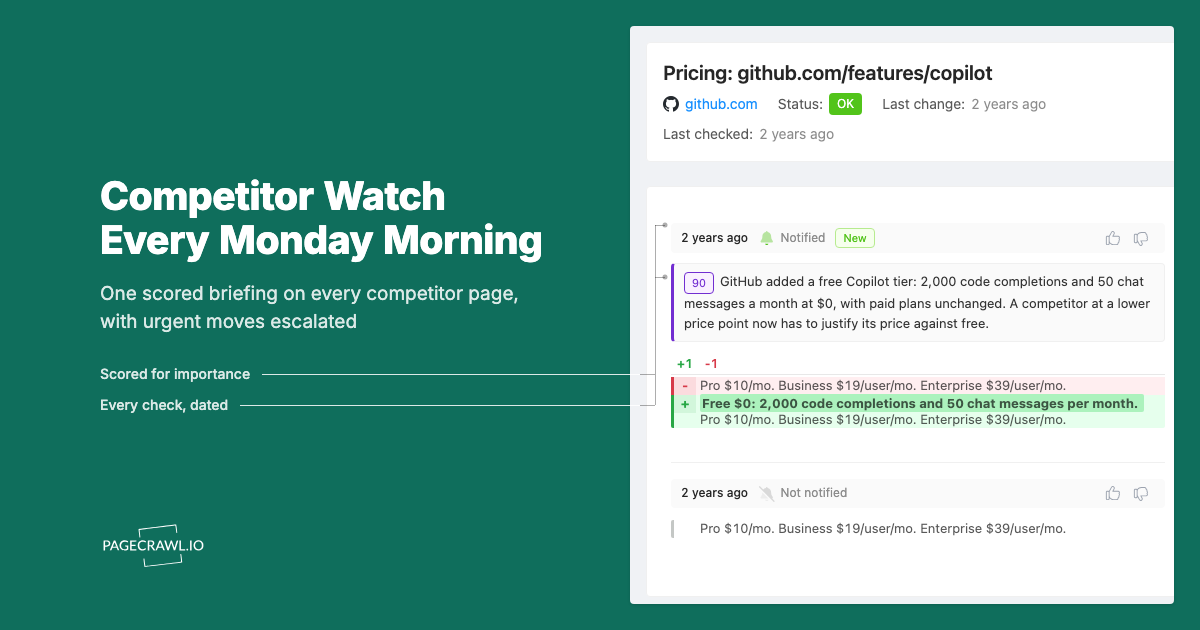
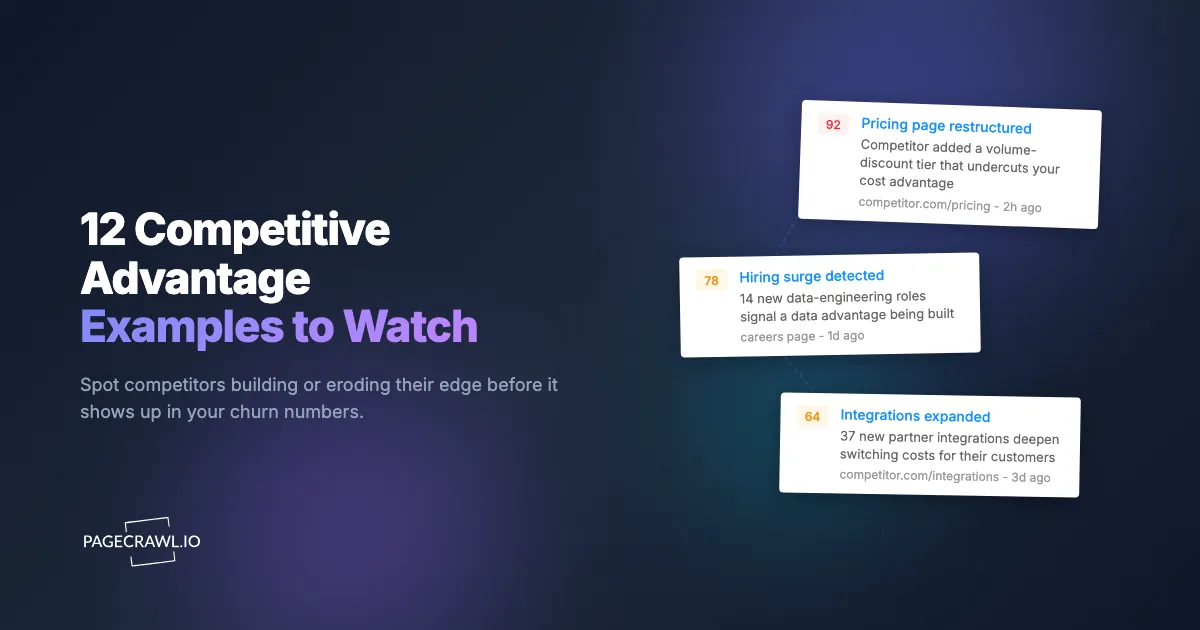
How to spot it: watch competitor pricing pages for new low-end tiers, volume discounts, and price drops that hold instead of bouncing back. A drop that sticks signals a cost-structure change. Continuous competitive pricing analysis turns those individual moves into a trend line you can act on.
Economies of scale
Economies of scale mean unit costs fall as volume rises, so the biggest player keeps getting cheaper to operate. Cloud providers, large manufacturers, and logistics networks live here. AWS can run a server farm at a per-unit cost a startup will never reach, so the lead compounds.
How to spot it: scale-building is loud before it is visible in price. New data-center announcements, factory expansions, and a surge of operational hiring all precede the cost benefit. Tracking a competitor's job postings for hiring signals often reveals a scale move months before it reaches their pricing.
Distribution advantage
A distribution advantage is control of the shelves, screens, or channels through which customers actually buy. Coca-Cola's bottling and shelf-space network, Apple's carrier and retail relationships, and any brand with exclusive placement all hold this. A rival's product quality is irrelevant if it cannot get in front of buyers.
How to spot it: monitor "where to buy," store-locator, and partner pages for new retail relationships, plus press-release feeds for distribution deals. When a competitor adds dozens of stockists or a major channel partner overnight, their reach just expanded.
Which competitive advantages come from customer demand?
Demand-side advantages live in customer behavior rather than in the company's cost base. They are powerful because they get stronger the more customers a company has, which makes them some of the most durable moats in business. Network effects, switching costs, and brand are the three to know.
Network effects
A network effect means the product gets more valuable to each user as more people use it, so the largest network wins by default. Visa, LinkedIn, marketplaces like Airbnb and Uber, and messaging apps all depend on this. A new entrant with a better app still loses, because the value was never the app, it was the other users.
How to spot it: watch for public user counts, "trusted by X million" claims, marketplace listing volumes, and integration directories. Growth in those numbers, tracked over time, is a direct readout of a network advantage strengthening.
Switching costs
Switching costs are the time, money, and risk a customer absorbs to leave, which keeps them locked in even when a rival looks better. Salesforce, SAP, core banking systems, and deeply integrated tools all rely on this. Once a customer has built workflows, integrations, and data history inside a product, leaving stops being free.
How to spot it: monitor competitor integration marketplaces, API documentation, and onboarding/migration pages. Every new integration, certification, or data-import tool a rival adds raises the cost of leaving them and lowers the cost of leaving you.
Brand advantage
A brand advantage is earned preference: customers choose and pay more for a name they trust, independent of features. Apple, Nike, Rolex, and Coca-Cola can charge a premium that has nothing to do with the spec sheet. Brand is slow to build, which is why it is hard to copy.
How to spot it: brand strength is visible in review velocity and sentiment over time. Tracking G2 and software comparison pages, Trustpilot, and app-store ratings shows whether a competitor's reputation is compounding or cracking, brand equity moving before the market reprices it.
Which competitive advantages come from knowledge and protection?
Some advantages come from what a company knows or holds that rivals legally cannot. These are often the most defensible of all, because they are protected by accumulation, patents, or law rather than by execution alone. Data, proprietary technology, and regulatory position make up this group.
Data advantage
A data advantage means a company holds proprietary information that makes its product measurably better, and that gap widens with every customer. Google's search signals, Netflix's viewing data, and Tesla's driving miles all feed back into a product competitors cannot match because they lack the data, not the code.
How to spot it: data moats are built by people and shipped as features. A spike in data-engineering and machine-learning roles, paired with product pages newly emphasizing "personalized," "predictive," or "AI-powered," signals a data advantage forming. Pairing hiring monitors with technology-stack monitoring catches the build-up early.
Proprietary technology and IP
Proprietary technology and intellectual property are advantages protected by patents, trade secrets, or genuinely hard engineering. ASML's lithography, Qualcomm's chip patents, and pharmaceutical compound protection all sit here, where the law or the sheer difficulty forbids a copy.
How to spot it: patent and trademark filings are public and predictive, which is why patent filing monitoring earns a place in a serious CI stack. Tracking patent filings and trademark watch alerts reveals where a competitor is investing R&D long before the resulting product ships, a roadmap leak hiding in plain sight on government databases like the USPTO.
Regulatory and licensing advantage
A regulatory advantage comes from holding a license, approval, or compliance status that legally limits who can compete. Banking charters, telecom spectrum, utility franchises, and FDA approvals all create protected positions. The barrier is not the market, it is the regulator, which a newcomer cannot easily clear.
How to spot it: monitor competitor compliance pages, subprocessor lists, certification badges, and regulatory filing trackers for new approvals, licenses, or accreditations. When a rival earns a certification you lack (SOC 2, HITRUST, a new market license), they just unlocked customers you cannot legally serve yet.
Which competitive advantages come from positioning and execution?
The final group comes from how a company positions itself and how fast it moves. These advantages are less about structure and more about choices, which makes them more copyable but also faster to deploy. Differentiation, location, and speed round out the 12.
Differentiation
A differentiation advantage means offering something customers genuinely value that rivals do not, so price stops being the deciding factor. Apple's design, Dyson's engineering, and Liquid Death's branding all sell on difference rather than discount, which removes them from a price war entirely.
How to spot it: differentiation shows up first in messaging. Watch competitor homepages, feature pages, and positioning copy for shifts in the words they lead with. When a rival rewrites its hero section, tracking competitor websites for those copy changes is one of the highest-signal monitors you can run.
Location and access advantage
A location or access advantage is privileged physical or market position: prime real estate, port access, mineral rights, or first dibs on scarce supply. A coffee shop on the only corner by the station, or a retailer with the best mall placement, wins on geography competitors cannot replicate.
How to spot it: track competitor store-locator pages and new-location announcements for physical expansion, and watch supplier or "available at" pages for exclusive access deals. A wave of new locations in your territory is a land grab worth seeing as it happens.
Speed and execution
A speed advantage means shipping, restocking, or iterating faster than anyone else, so the company is always a step ahead. Amazon's delivery promises, Zara's and Shein's fast-fashion cycles, and rapid-release software teams all compete on tempo, keeping rivals permanently reacting.
How to spot it: tempo is measurable. Track a competitor's changelog, release-notes, and blog publishing cadence, plus shipping and delivery promises on product pages. An accelerating release rhythm signals an execution advantage building, and a stalling one signals trouble. A structured CI program turns that cadence into a leading indicator of a competitor's health.
How do you spot a competitor building a new advantage?
You spot it by watching the leading indicators, not the finished product. Advantages announce themselves weeks or months early through hiring, filings, integration counts, certifications, and quiet copy changes. By the time the advantage shows up in a press release, you are already behind. Monitor the inputs, not just the outputs.

Concretely, the earliest signals fall into a few buckets. Hiring surges in a specific discipline (data, hardware, compliance) reveal where a competitor is investing before any product ships. New entries in an integration or partner directory show switching costs being poured. Fresh certifications reveal regulatory unlocks, patent filings expose the R&D roadmap, and homepage or pricing copy changes betray a repositioning. No single signal is conclusive, but a cluster pointing the same way is a strategic shift you can act on. This pattern-recognition work is what separates real competitive intelligence from occasional Googling.
How do you tell when your own advantage is eroding?
Your advantage is eroding when the gap that made you the obvious choice shrinks: a competitor matches your price, copies your headline feature, earns your certification, or out-ships your release cadence. You learn it the painful way from a churned customer, or the useful way from a monitor the day the competitor's page changes.
The clearest erosion signals are direct competitive matches. If your edge is cost, erosion is a rival's sustained price cut to your level, which is why teams running SaaS pricing-page monitoring catch margin threats first. If your edge is a feature, erosion is that feature appearing on a competitor's product page. If your edge is speed, it is a rival's changelog accelerating past your own. Each of these lives on a public web page that changes on a specific day, and that change is the alert you want. The companies that hold their advantages longest see the erosion first and respond while there is still room.
How do you monitor competitive advantages with PageCrawl?
You monitor competitive advantages by pointing automated change detection at the specific pages where each advantage type leaves a footprint, then routing alerts to where your team already works. PageCrawl checks those pages on a schedule, detects meaningful changes, and notifies you, so you watch dozens of competitive surfaces without manual refreshing. Here is a setup you can build in under 20 minutes.
Step 1: Pick one competitor and map its advantage surfaces. Start with a single primary rival. List the pages that expose each advantage type: pricing page (cost), careers page (scale and data), integrations directory (switching costs), homepage and a key feature page (differentiation), and store-locator or compliance page if relevant. Five to eight URLs is plenty to start.
Step 2: Create an account and add your first monitor. Sign up for PageCrawl's free tier (6 monitors and 220 checks per month, no card required). Paste the competitor's pricing page URL and create the monitor. The free tier alone covers your top competitor's most important surfaces, which is enough to prove the approach.
Step 3: Choose the right tracking mode per page. PageCrawl offers a range of tracked element types for text, numbers, and visual changes, so match the mode to the surface. For pricing pages, use price tracking so PageCrawl extracts and trends the actual numbers. For homepages and feature pages, use full-page or content tracking to catch copy and positioning changes. For careers and integration directories, full-page tracking flags new entries as they appear.
Step 4: Set a checking frequency that matches the page's volatility. Pricing and homepage messaging change without warning, so check those most often. Careers and compliance pages move slowly, so a daily or weekly check is enough. Matching frequency to volatility keeps you inside your check budget while still catching fast-moving threats.
Step 5: Route alerts to where your team will see them. Connect notifications to email, Slack, or another channel so competitive changes land in front of the right people soon after a check detects them, not weeks later in a customer conversation.
Step 6: Review changes as a team and act on patterns. Use the Kanban-style review board to triage detected changes together: mark routine edits as seen, flag the ones that signal an advantage shift, and leave notes. When several monitors light up around the same theme, that is your cue to update positioning, revisit pricing, or brief sales.
Step 7: Expand competitor by competitor. Once the workflow proves itself on one rival, repeat for your next two or three. A focused set of monitors across your top competitors gives you continuous coverage of every advantage surface that matters, the backbone of a working competitive intelligence program.
Choosing your PageCrawl plan
PageCrawl's Free plan lets you monitor 6 pages with 220 checks per month, which is enough to validate the approach on your most critical competitor pages. Most teams graduate to a paid plan once they see the value.
| Plan | Price | Pages | Checks / month | Frequency |
|---|---|---|---|---|
| Free | $0 | 6 | 220 | every 60 min |
| Standard | $8/mo or $80/yr | 100 | 15,000 | every 15 min |
| Enterprise | $30/mo or $300/yr | 500 | 100,000 | every 5 min |
| Ultimate | $99/mo or $999/yr | 1,000 | 100,000 | every 2 min |
Annual billing saves two months across every paid tier. Enterprise and Ultimate scale up to 100x if you need thousands of pages or multi-team access.
For tracking competitive advantages, Standard at $80/year is the natural fit: 100 pages covers five to ten competitors with pricing, product, careers, and integration pages each monitored, and 15-minute checks turn time-to-awareness from weeks into minutes. Enterprise at $300/year suits teams watching a crowded landscape, with 500 pages, SSO, and the full API for feeding change data into your own dashboards. Every plan, including Free, includes the PageCrawl MCP Server, so anyone on your team can ask an AI assistant to summarize what changed across a competitor over any period, straight from your live monitoring archive.
Getting Started
Pick your single most threatening competitor right now and map five pages: pricing, homepage, a key feature page, careers, and integrations. Set up monitors on PageCrawl's free tier and route the alerts to a channel your team checks daily. Within two weeks you will catch a change you would otherwise have heard about from a customer, and that early warning usually pays for the whole effort. Competitive advantage is not a trophy you win once. It is a position you defend every day, and the side that sees the change first gets to respond.