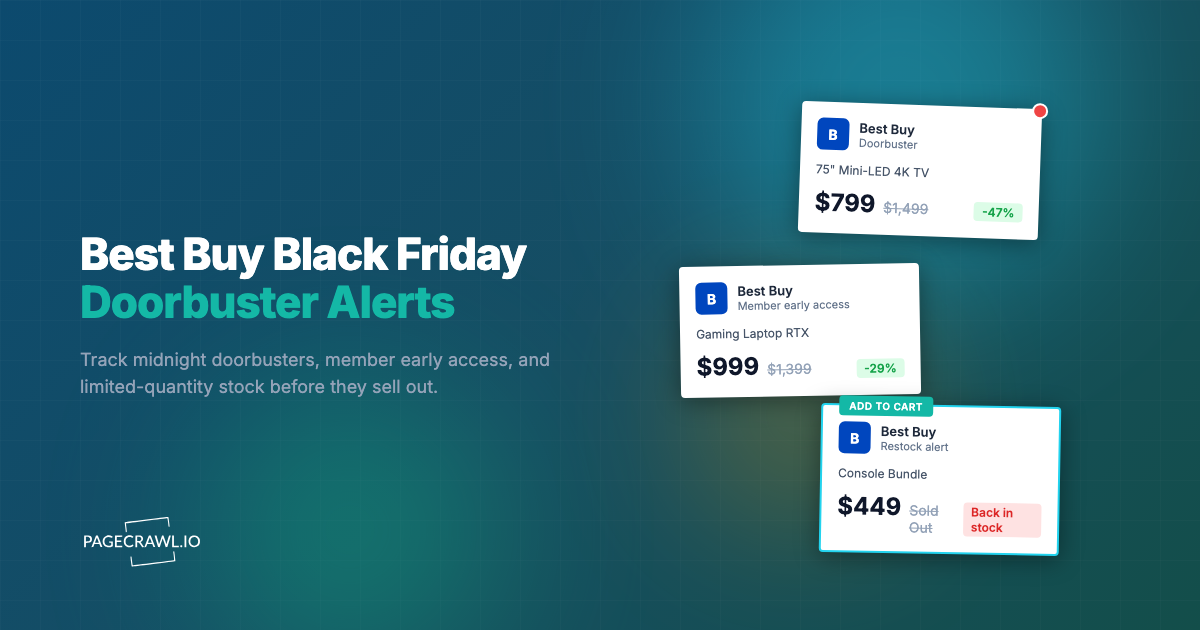
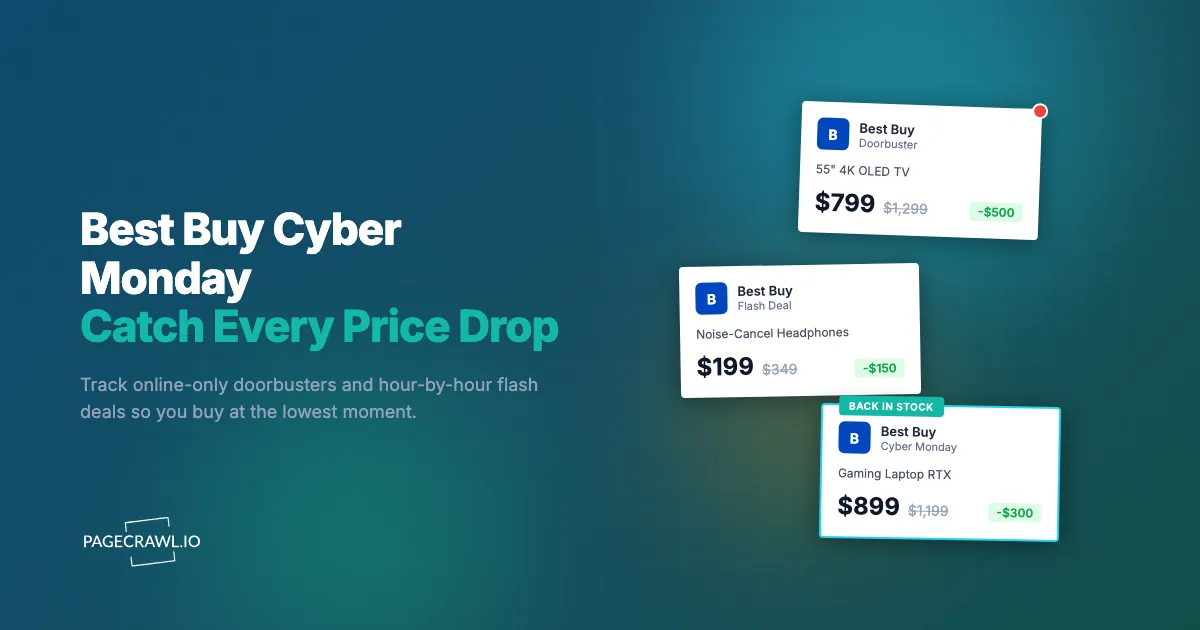
Here is how a typical Cyber Monday plays out on BestBuy.com: a 55-inch OLED TV drops from $1,299 to $799 at 8am, sells through its online allocation by 10:30am, and quietly reappears at $899 that evening when Best Buy releases a second batch. A pair of flagship noise-cancelling headphones goes to $199 as a midday flash deal, holds for about three hours, then climbs back to $279. If you check Best Buy once that morning, you see one snapshot of a price board that moves all day long.
Best Buy runs Cyber Monday differently from most retailers. It is online-first by design, so the best deals are not in a store flyer waiting for you at 6am. They are online-only doorbusters with capped quantities, a rotating "Deal of the Day," and flash deals that surface and expire on their own schedule across the day. Prices move hour to hour, popular SKUs flip between in stock and sold out, and member tiers get early access before the public sale even opens. The shopper who wins is not the one refreshing the homepage. It is the one whose tools are watching the exact product pages and pinging as soon as a check catches a price at its floor.
This guide covers how Best Buy's Cyber Monday pricing actually behaves, when to start tracking, which categories reward monitoring most, and how to build an automated alert system with PageCrawl that catches online-only price drops within minutes of going live. For the broader cross-retailer playbook, start with our Black Friday and Cyber Monday deal alerts hub.
Why does Best Buy Cyber Monday need hour-by-hour monitoring?
Best Buy Cyber Monday needs hour-by-hour monitoring because the deals are online-only, quantity-capped, and time-boxed. Prices change multiple times a day, doorbusters sell through their allocation in minutes, and flash deals appear without advance notice. A once-a-day manual check catches a single frame of a price board that shifts continuously from morning through midnight.
Online-only doorbusters with capped quantities
Best Buy's headline Cyber Monday deals are online doorbusters: a sharp discount on a specific model, available in limited online quantity. When the allocated units sell, the price either reverts or the product flips to "Sold Out." There is no rain check on a Cyber Monday doorbuster. The signal you actually want is "this exact SKU is at its lowest price and still purchasable," and that window can last minutes, not hours.
Flash deals and the rotating Deal of the Day
On top of the doorbusters, Best Buy layers a "Deal of the Day" and shorter flash deals that surface throughout Cyber Monday. These are not all published in advance with a price and a timestamp. You know a category is likely to get hit, but not the exact model or the exact moment. Frequent page monitoring catches the new price on the next check, which is the most reliable way to be early on an unannounced flash deal.
Prices that move hour to hour
A single product page on BestBuy.com can show three or four different prices over one Cyber Monday. A laptop opens at $899, a midday promotion pushes it to $849, it sells through and reverts to $999, then drops again to $879 in the evening as inventory frees up. Without a continuous record of those moves, you cannot tell whether the price in front of you right now is genuinely the best of the day or just the one you happened to load.
Member early access (My Best Buy Plus and Total)
Best Buy's paid membership tiers, My Best Buy Plus and Total, often get early access to deals and member-only pricing that opens before the public sale. Those early windows have less competition for capped doorbusters. If you are a member, monitoring the relevant product pages during the early-access window gives you first pick before the rest of the traffic arrives.
When do Best Buy's Cyber Monday deals actually start?
Best Buy's Cyber Monday deals effectively start weeks before the day itself. Early November brings pre-sale and "early access" pricing, Black Friday week runs major online events, and the weekend in between often resets prices before Cyber Monday's online-exclusive drops. Start tracking in early November so you have a baseline before any "sale" price appears.
Build a price baseline in early November
Adding Best Buy product monitors in early November gives you three to four weeks of price history before Cyber Monday. That baseline is what separates a real deal from a manufactured one. When Best Buy advertises a TV at "$500 off" on Cyber Monday, your tracked history tells you whether the reference price was real in October or quietly nudged up in mid-November to make the discount look bigger.
Track Black Friday week and the weekend in between
Best Buy's Black Friday and Cyber Monday pricing is one continuous event, not two days. Many models hit a strong price on Black Friday, hold or rise over the Saturday and Sunday, then get a fresh online-exclusive cut on Cyber Monday. Some items are actually cheaper on Black Friday; others bottom out on Monday. Monitoring the full window is the only way to know which pattern a given product follows.
Watch Cyber Monday and Cyber Week
Cyber Monday, a term coined by the National Retail Federation in 2005, is Best Buy's online showcase, with deals built for shipping and digital fulfillment rather than store pickup: headphones, smaller electronics, accessories, software, and online-exclusive bundles. Deeper or clearance-style cuts often continue through Cyber Week on models that did not sell through. For non-urgent buys, keeping monitors running for the following week can surface a lower price than Monday itself.
What should you monitor at Best Buy on Cyber Monday?
Monitor the electronics categories where Best Buy discounts most aggressively: TVs, laptops, headphones, tablets, gaming, and smart home. These see the largest and most volatile Cyber Monday price moves. Pick the exact models and configurations you intend to buy, add each product page as its own price and stock alert monitor, and prioritize high-demand items that sell through fast.
- TVs: OLED and large 4K models are perennial online-doorbuster material, often 30 to 40 percent off. Monitor the exact size and model number you want, because pricing varies sharply between a 55-inch and a 65-inch of the same line.
- Laptops: Specific configurations swing $100 to $300. Track the precise SKU. A nearly identical model with a different processor or storage tier can have a completely different deal.
- Headphones and earbuds: Flagship noise-cancelling models are reliable Cyber Monday flash-deal targets and a category where Best Buy frequently matches or beats other retailers.
- Gaming: Console bundles, controllers, headsets, and storage drop across the weekend. High-demand bundles flip in and out of stock, so pair price tracking with out-of-stock and restock monitoring.
- Tablets and smart home: Tablets, smart displays, video doorbells, and streaming devices regularly hit annual lows during the Cyber window.
For the full mechanics of watching Best Buy product pages year-round, see our dedicated Best Buy price tracker guide.
How do you set up Best Buy Cyber Monday alerts with PageCrawl?
You set up Best Buy Cyber Monday alerts by adding each product page as a Price monitor in PageCrawl, raising the check frequency for the Cyber window, and routing alerts to a fast channel. PageCrawl renders Best Buy pages fully like a real browser, so it reads the live price and stock state reliably. Follow these steps.

Step 1: Build your Best Buy shopping list
List every product you plan to buy and open its product page on BestBuy.com. Use the specific model URL, not a category or search results page, so the monitor tracks one SKU's price and availability. If you are also buying from other retailers, grab the matching product URLs there too. You will add each as a separate monitor.
Step 2: Add each page as a Price monitor
For each Best Buy URL, create a PageCrawl monitor in "Price" tracking mode. This automatically detects the price element and records changes over time, building the hour-by-hour history you need to judge a deal. If you want to track stock state in parallel, add availability monitoring so you also catch a sold-out doorbuster coming back. New monitors include screenshots by default, giving you a visual record of each price state.
Step 3: Set meaningful price thresholds
Rather than firing on every minor change, use conditional price and threshold rules so alerts only trigger on moves that matter:
- Target price: Alert me when this TV drops to $799 or below.
- Percentage drop: Alert me on a 15 percent or larger drop from the recent average.
- Back in stock at a price: Alert me when a sold-out doorbuster returns and is purchasable.
This keeps your Cyber Monday alerts signal-heavy instead of drowning you in noise on a day when dozens of products move at once.
Step 4: Raise the check frequency for the Cyber window
Flash deals and capped doorbusters reward speed. Increase the check frequency on your high-priority Best Buy monitors for the days around Cyber Monday, then lower it again afterward to conserve your check quota. PageCrawl's bulk edit for monitored pages lets you bump an entire folder of monitors from daily to every few minutes in one action, instead of editing each one by hand when timing matters most.
Step 5: Route alerts to a fast channel
For a midday flash deal, an email you read three hours later is useless. Send your highest-priority Best Buy alerts to a fast channel: browser and mobile push notifications for items that might sell out, or a shared Slack channel if you are coordinating gift buying across a family or team. Keep email for the slower, stable-price items where seconds do not decide the outcome.
Step 6: Organize with folders and automate with webhooks
When you are tracking 20 to 50 products, use labels, folders, and workspaces to group monitors by category or recipient and tag them by priority. Power users can take it further with webhook automation: log every Best Buy price change to a Google Sheet, push deal alerts into a private channel, or feed prices into a spreadsheet that ranks the best buys automatically.
How do you tell a real Best Buy deal from an inflated one?
You tell a real Best Buy deal from an inflated one by comparing the Cyber Monday "sale" price against your own tracked price history. If the model held steady through October and then dropped sharply on Cyber Monday, the discount is genuine. If the reference price crept up in mid-November right before the "sale," the savings are partly manufactured.
This is exactly why starting in early November pays off. By Cyber Monday you have weeks of data points for every product on your list. PageCrawl's price history chart shows every recorded price, so a deal that is truly at a new low is obvious at a glance, and a "$300 off" tag sitting on top of a recently inflated base price is just as obvious. Your data also reveals whether Cyber Monday is actually the year's floor, since some electronics hit lower prices during back-to-school events or random clearance. If you have been tracking long enough, you know the real bottom and can hold out for it with confidence.
How do you track the same Best Buy product across other retailers?
You track the same product across retailers by adding the matching product page from each store as its own monitor, then comparing their price histories side by side. Identical electronics routinely carry meaningfully different prices at Best Buy, Amazon, and other retailers within the same Cyber Monday hour, and the cheapest store shifts through the day.
The best Cyber Monday shoppers do not commit to one retailer. They buy each item wherever it is lowest at that moment, and use price-match policies to claim that price at their preferred store. Add the Best Buy page, the Amazon listing, and any other retailer as separate Price monitors, and PageCrawl's cross-retailer price comparison view lines them up automatically. Factor in shipping speed, free-shipping thresholds, and Best Buy's same-day store pickup, since a slightly higher price you can collect today can beat a cheaper one that ships next week.
What are the most common Best Buy Cyber Monday monitoring mistakes?
The most common mistakes are starting too late, checking too infrequently, monitoring category pages instead of exact SKUs, and ignoring stock. Each one quietly costs you the deal you set out to catch.
- Starting on Cyber Monday morning: With no price baseline, you cannot tell a genuine drop from an inflated one. Begin tracking in early November.
- Checking too slowly for hot items: A daily check will miss a three-hour flash deal entirely. Raise the frequency on high-demand electronics for the Cyber window.
- Monitoring the wrong URL: A category or search page mixes many products and prices. Always monitor the specific model's product page so the alert means something.
- Tracking price but not stock: A capped doorbuster can sell through before you act. Pair price alerts with restock monitoring so you also catch the moment inventory returns.
- Alert fatigue from over-monitoring: Two hundred monitors firing all day buries the alerts that matter. Track products you genuinely intend to buy, and reserve the fastest channels for your must-buy tier.
Choosing your PageCrawl plan
PageCrawl's Free plan lets you monitor 6 pages with 220 checks per month, which is enough to validate the approach on your most critical pages. Most teams graduate to a paid plan once they see the value.
| Plan | Price | Pages | Checks / month | Frequency |
|---|---|---|---|---|
| Free | $0 | 6 | 220 | every 60 min |
| Standard | $8/mo or $80/yr | 100 | 15,000 | every 15 min |
| Enterprise | $30/mo or $300/yr | 500 | 100,000 | every 5 min |
| Ultimate | $99/mo or $999/yr | 1,000 | 100,000 | every 2 min |
Annual billing saves two months across every paid tier. Enterprise and Ultimate scale up to 100x if you need thousands of pages or multi-team access.
For Best Buy Cyber Monday specifically, frequency is the feature that wins deals. Standard at $80/year covers 100 product pages at 15-minute checks, enough to track a full holiday list across Best Buy and other retailers. Enterprise at $300/year drops checks to every 5 minutes across 500 pages, so on a quantity-capped online doorbuster you are alerted in the first minutes rather than after it sells through. A single flash deal caught, one $500-off TV you would have missed by refreshing manually, typically pays for the annual plan many times over.
Getting Started
Start now, even though Cyber Monday is weeks away. The earlier your Best Buy monitors run, the more price history you bank, and the easier it becomes to recognize a genuine online-only doorbuster when it lands.
Pick 5 to 10 products from your list, open each one's BestBuy.com product page, and add it to PageCrawl in Price mode. Let them run through November to build a baseline, raise the check frequency for the Cyber window, and route your must-buy items to push or Slack. The free tier's 6 monitors are enough to prove the concept on your highest-priority items before you expand.
The shoppers who score the best Best Buy Cyber Monday deals are not the ones hammering refresh at midnight. They are the ones already watching, who get the alert within minutes of the price hitting its floor and buy before it sells out.