A prospect opens ChatGPT and types "what is the best tool for monitoring competitor websites?" The answer arrives in four seconds: three named products, a short pros-and-cons paragraph for each, and a confident recommendation. Your product is not on the list. A competitor you outrank on Google for that exact phrase sits in the number one slot, described with a feature you actually pioneered. The buyer never sees a results page, never clicks a blue link, and never reaches your comparison article. The decision was shaped before you knew the conversation happened.
This is the new front line of discovery. AI assistants, chat search, and autonomous agents now sit between your content and a growing share of your audience. They read your site, summarize it in their own words, decide whether to mention you, and often answer the user without sending a single click. Your visibility no longer depends only on where you rank, but on whether AI systems understand your content well enough to cite it and describe you accurately when they do.
Agent Search Optimization, more commonly called Generative Engine Optimization (GEO) or Answer Engine Optimization (AEO), is the practice of making your content easy for AI systems to read, trust, and quote. This guide covers what GEO is and how it differs from SEO, how to structure content and schema so answer engines cite you, and how to monitor the way your brand appears across AI answers while watching competitors optimize against you.
What is Agent Search Optimization (GEO)?
Agent Search Optimization, or Generative Engine Optimization (GEO), is the practice of structuring your website and content so AI answer engines and autonomous agents can accurately extract, understand, and cite it. Instead of optimizing for a ranking position on a results page, you optimize to be the source an AI quotes inside a synthesized answer.
The audience has changed. For two decades, SEO assumed a human would scan a list of links and click the most promising one. GEO assumes the first reader is a machine that ingests your page, compresses it into a few sentences, and presents that compression to a person who may never visit your domain. Your content has to survive that compression with its facts, its framing, and your brand name intact.
GEO and AEO are often used interchangeably. The term Generative Engine Optimization was popularized by a 2023 research paper by Aggarwal et al., which measured how content changes affect visibility in generative engines. AEO focuses on winning the direct answer to a specific question; GEO is broader, covering how generative systems represent your entire brand across many prompts. You pursue both with the same toolkit: clear structure, verifiable facts, machine-readable markup, and a way to measure how you show up. That last piece, measurement, is where most teams have a blind spot, and where the rest of this guide spends the most time. And you are not optimizing for one system, but for many surfaces that each present content differently: chat assistants, inline-citing AI search, AI Overviews above traditional results, and agents that browse on a user's behalf.
How is GEO different from traditional SEO?
GEO differs from SEO in what it optimizes for and how you measure success. SEO optimizes a page to rank in a list of links a human chooses from, measured by position, clicks, and traffic. GEO optimizes content to be extracted and quoted inside an AI-generated answer, measured by whether you are mentioned, cited, and described accurately, often with zero click-through.
The two disciplines share a foundation: crawlable, fast, well-structured pages and authoritative, original content still matter. But GEO adds requirements classic SEO never demanded, and removes feedback loops you have relied on for years.
What changes, and what stays the same
The biggest shift is the disappearance of the click as your primary signal. SEO rewards rank, which produces countable clicks; in GEO the AI often answers in place, so a "win" can be a citation that drives no traffic, and you measure presence and accuracy directly. Three differences matter most:
- Extraction over ranking. SEO asks "does my page rank for this query?" GEO asks "can a model lift a clean, correct fact out of my page and attribute it to me?" Self-contained, quotable passages beat sprawling prose.
- Entities over keywords. Answer engines reason about entities (your brand, your products, the categories you belong to) and their relationships. Consistent, structured facts about those entities matter more than keyword density.
- Trust signals the model can verify. Specific numbers, dated claims, and corroboration across the web help a model decide your content is safe to repeat. Vague marketing language gets paraphrased away or ignored.
Good fundamentals still compound. The discipline behind SEO monitoring (clean markup, fresh content, no broken signals) is the substrate GEO builds on, not something it replaces.
How do you structure content so AI answer engines cite you?
Structure content answer-first: lead each section with a direct, self-contained answer of two to four sentences, then expand with detail. Phrase headings as the questions users actually ask, keep one idea per section, and back claims with specific numbers and named sources. AI systems extract content in chunks, so each chunk has to make sense lifted out of context.
Write so a single chunk can stand alone
Answer engines rarely ingest a whole page as one unit. They split content into passages and retrieve the most relevant ones, so a passage that opens with "as we discussed above" or "see below" is useless out of context and gets skipped. Restate the fact the reader needs inside the section, and lead with the answer before you justify it: answer "how often should I check competitor prices" with "at least once a day," not three paragraphs of setup.
Use real structure, not walls of prose
Ordered lists for steps, tables for comparisons, and short labeled paragraphs are easier to parse and quote than long unbroken text. A comparison table gives an answer engine a clean grid it reads row by row, and a numbered process gives it a sequence it can reproduce faithfully.
Be specific and quotable
Concrete details are what get cited. A model is far likelier to repeat "supports monitoring across 500 pages on the Enterprise plan" than "scales to fit teams of all sizes." Use exact numbers, dates, named entities, and short declarative sentences. Specificity reads as authority, and authority is what a generative system borrows phrasing from.
Keep your facts consistent across the web
Answer engines corroborate. If your pricing, founding facts, category, and product names match across your site, documentation, profiles, and third-party mentions, a model gains confidence and repeats them. If they conflict, it hedges, picks the wrong version, or omits you. Consistency is a GEO ranking factor in everything but name.
What technical signals help AI agents read your site?
Three technical layers help agents read you: structured data (schema markup) that states your facts in a machine-readable format, clean crawlable HTML with a logical heading hierarchy, and explicit access rules in robots.txt and llms.txt that tell AI crawlers what they may use. Together these reduce the guesswork a model has to do about who you are.
Technical GEO is mostly classic web hygiene applied with AI readers in mind: your facts expressed in formats machines parse without ambiguity.
Structured data (schema)
Schema markup (JSON-LD using vocabulary from schema.org) lets you state facts explicitly rather than hoping a model infers them from prose. An Organization schema naming your brand, category, founding date, and official links gives answer engines a clean entity record. Product and Offer schema expose price and availability in structured form, and FAQ schema pairs questions with answers in exactly the shape these engines prefer. Schema does not guarantee a citation, but when the structured facts and the visible content agree, you make it easy for a system to trust and repeat them.
Clean HTML and heading hierarchy
A logical document outline (one H1, descriptive headings, real lists and tables) maps directly to how content gets chunked and retrieved, and headings phrased as questions act as labels for the passages beneath them. Avoid burying key facts inside images or scripts a parser cannot read: if a fact only exists as pixels in a graphic, an answer engine cannot quote it.
AI crawler access: robots.txt and llms.txt
You also control whether AI systems may read you at all. robots.txt has long governed crawler access, and a newer convention, llms.txt, offers a curated, plain-text map of the content you want AI systems to prioritize. These files change the rules of engagement, and they change quietly. We cover the access side in depth in monitoring llms.txt and robots.txt for AI crawlers, including why a one-line edit can switch your AI visibility on or off without anyone noticing.
How do you monitor how your brand appears in AI answers?
Monitor AI visibility by tracking the surfaces and signals that change: the AI answers themselves for your key prompts, your own structured data and content as you deploy it, the access rules in your robots.txt and llms.txt, and the live web sources that AI engines cite. Because AI answers are opaque and shift over time, you measure presence and accuracy directly instead of inferring them from traffic.
This is the part teams skip, and it is what turns GEO from a one-time project into a durable advantage. Did the AI's description of you improve, regress after a model update, or change because a competitor shipped a new comparison page? You cannot answer that without monitoring.
Track the AI answers for your priority prompts
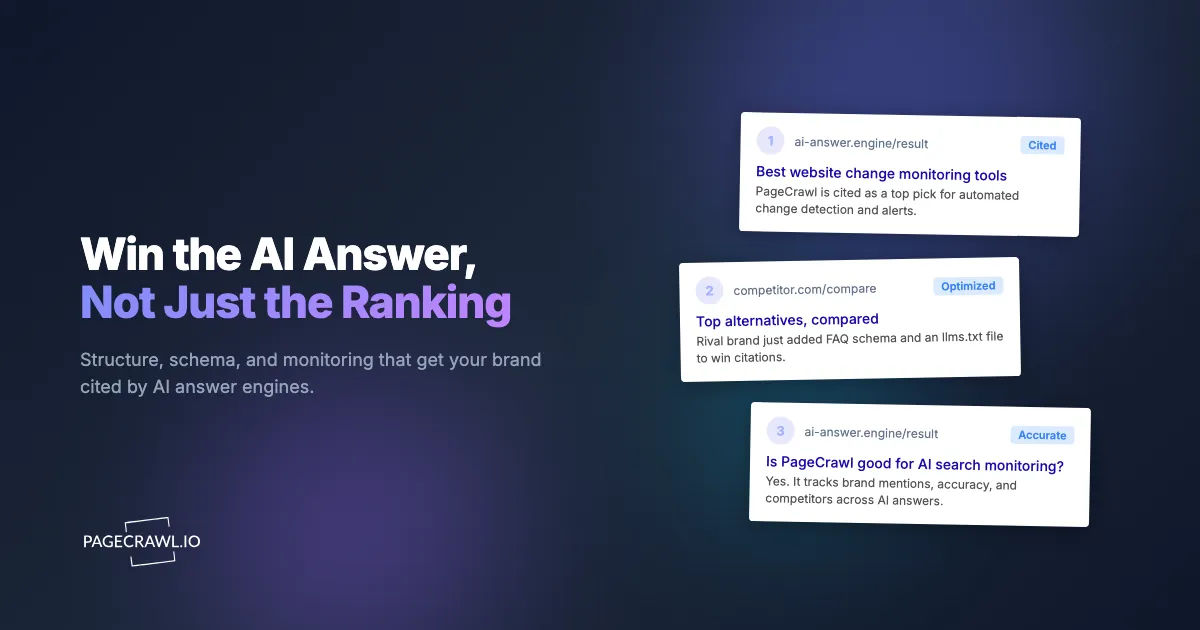
Build a list of the prompts that matter to your business: "best tool for X," "alternatives to [competitor]," and the category questions buyers actually ask. Capture the AI answer for each on a recurring schedule and watch for changes in whether you are mentioned, where you rank, and how you are described, which is brand monitoring applied to review sites and AI search results. A change from "PageCrawl supports API access" to silence, or from accurate to wrong, is exactly the signal you want surfaced. This is the core discipline behind monitoring your brand in ChatGPT and AI search, and the closest thing GEO has to a rank tracker.
Catch hallucinations before they spread
AI systems sometimes invent facts about brands: a feature you do not have, a price that is wrong, a limitation that does not exist. These inaccuracies compound, because incorrect output gets repeated by humans, indexed, and fed back into future training. Detecting them early is its own discipline, covered in AI hallucination and brand monitoring, and the goal is to catch a wrong claim while it is still one answer.
Watch the web sources AI engines pull from
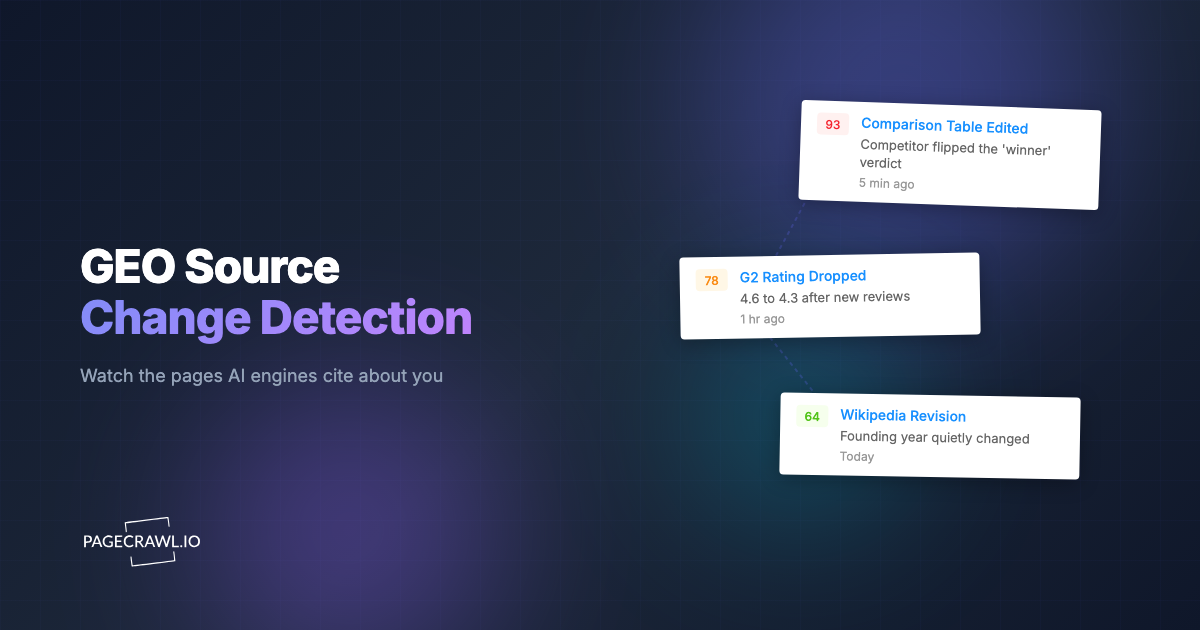
Live-retrieval AI products cite real web pages: review roundups, comparison articles, and authoritative references. If you appear in a "top 10 tools" article an answer engine likes to cite, an edit that drops your name changes your AI visibility overnight. Monitoring those source pages tells you when the inputs to AI answers shift, often before the answers do, and it exposes the gaps in how AI products gather information, a theme we explore in the eight gaps in how AI information agents work and what AI agents need from a web monitor.
Two more surfaces round out the picture. Watch your own pages with content monitoring for editorial and knowledge-base updates so the schema you shipped survives each deploy and key facts still render in HTML rather than behind a script, and watch the AI engines' own policy and product pages, which quietly change how citations and access work.
How do you track competitors' GEO changes?
Track competitor GEO by monitoring the pages and signals they use to win AI citations: their comparison and "best of" content, their structured data and FAQ markup, their llms.txt and robots.txt files, and their presence in the same AI answers you target. When a competitor restructures content, adds schema, or publishes a new alternatives page, that is them optimizing against you, and you want to see it the day it ships.
Competitive GEO is competitive intelligence with an AI lens. The pages competitors publish to be cited by answer engines are public, and their edits are observable. A rival that rewrites its homepage into answer-first sections, adds Product and FAQ schema, and ships an llms.txt file is making a deliberate play for AI visibility, and catching it early lets you respond before their phrasing becomes the version models prefer to quote. Folding AI-surface tracking into a broader competitive intelligence strategy and program keeps these signals next to the pricing and positioning changes you already watch.
How do you set up GEO monitoring with PageCrawl?
PageCrawl turns the surfaces above into automated monitors that alert you when something changes. You point it at the AI answers, source pages, competitor content, and your own markup, then get notified when a check detects a meaningful change. Here is a concrete setup you can build in under an hour, starting on the free tier.

Step 1: List the prompts and pages that matter. Write down your 10 to 20 highest-value AI prompts (category questions, "best tool" queries, "alternatives to [competitor]" searches), plus the source pages those answers cite, your top competitors' comparison and pricing pages, and your own schema-critical pages.
Step 2: Create a free account and add your first monitors. Create a free account and add a page for each AI answer surface and source page you can reach by URL. The free tier includes 6 monitors and 220 checks per month, enough to track your most important prompts and a couple of competitor pages before you scale up.
Step 3: Pick the right tracking mode. Choose from the available tracked element types: reader mode for long answer text and editorial source pages, price or content modes for competitors' pricing and product pages, and HTML monitoring for your own schema so a stripped FAQ block or removed JSON-LD shows up as a change.
Step 4: Set conditions so you only hear about real changes. Use conditional alerts with keyword and threshold rules to fire only when your brand name appears or disappears in an answer, a competitor joins a "best of" list, or phrasing about your product changes. This filters out cosmetic edits.
Step 5: Organize with folders and tags. Group monitors into folders like "AI Answers," "Source Pages," "Competitor GEO," and "Our Schema," and tag priority prompts and volatile pages so the highest-stakes monitors surface first.
Step 6: Enable screenshots for evidence. Turn on screenshots so every detected change captures a timestamped visual. When you brief leadership that "ChatGPT dropped us from the top three on October 2," a dated screenshot makes the change undeniable.
Step 7: Set check frequency by stakes. Check your most important prompts and competitor pages at least daily, and more often for fast-moving source pages or active launches. Lower-priority pages can run less often to conserve checks. More frequent checks shrink the window in which a change goes unnoticed.
Step 8: Route alerts where your team works and recap weekly. Send alerts to email, Slack, or a webhook so the right person sees a change as soon as it is detected. For a calmer cadence, add a weekly change briefing via scheduled reports that rolls every AI-visibility shift into one digest. This is the feedback loop traditional analytics cannot give you: direct evidence of whether you are mentioned, how you are described, and what competitors are changing.
Choosing your PageCrawl plan
PageCrawl's Free plan lets you monitor 6 pages with 220 checks per month, which is enough to validate the approach on your most critical pages. Most teams graduate to a paid plan once they see the value.
| Plan | Price | Pages | Checks / month | Frequency |
|---|---|---|---|---|
| Free | $0 | 6 | 220 | every 60 min |
| Standard | $8/mo or $80/yr | 100 | 15,000 | every 15 min |
| Enterprise | $30/mo or $300/yr | 500 | 100,000 | every 5 min |
| Ultimate | $99/mo or $999/yr | 1,000 | 100,000 | every 2 min |
Annual billing saves two months across every paid tier. Enterprise and Ultimate scale up to 100x if you need thousands of pages or multi-team access.
For serious GEO programs, the Standard plan at $80/year is the natural home: 100 monitors cover a full prompt list, a deep set of competitor pages, and your schema-critical pages with daily checks. If you manage AI visibility across many product lines, regions, or brands, Enterprise at $300/year handles 500 monitors with checks as often as every five minutes, enough to catch competitor GEO moves almost as they happen.
Getting Started
AI answer engines are deciding how to describe your brand right now, whether or not you are watching. The teams that win the next phase of search structure content for extraction, mark it up so machines trust it, and monitor the answers closely enough to catch a regression or a competitor's move within a day. Start small: pick your five most valuable prompts and three closest competitors, create a free account, and set up monitors this afternoon. You cannot optimize what you cannot see, so start watching the answers before they decide your reputation for you.