Google announced Information Agents at I/O 2026. They watch public pages, summarise what changed, and surface the result inside Search and Gemini. For a casual consumer with a Google account and a flight to track, that is fine.
For a business, a team, a regulated function, or an AI agent stack, it is not. Information Agents were built for Google's product surface, Google's billing, and Google's geography. Every gap below is a place PageCrawl already ships the answer, and the Google Information Agents alternative comparison sets the two products side by side. Eleven of them, in plain language.
1. Twenty dollars a month before the agent does anything useful
Information Agents sit inside Google AI Pro at $20 a month, with the serious features parked inside AI Ultra at $200. The free tier is a teaser. If you came from Google Alerts (free forever) that is a jump.
PageCrawl does this. Free tier with real monitors, paid plans starting at single-digit dollars, pricing published openly, no agent bundle required.
2. US-first rollout, the rest of the world waits
Google launches roll out US-first. Information Agents are no exception. If you are in the UK, EU, Canada, Australia, India, anywhere else, you are queueing.
PageCrawl does this. Global signup, global payment processing, EU data residency available, live in every market on day one.
3. Locked to a single Google account
Information Agents live inside a personal Google account. Sharing means sharing a login or duplicating setup across teammates and hoping they configure identically.
PageCrawl does this. Workspaces, shared monitors, role-based access, a single billing relationship, audit trail of who changed what. Built for teams from the first commit.
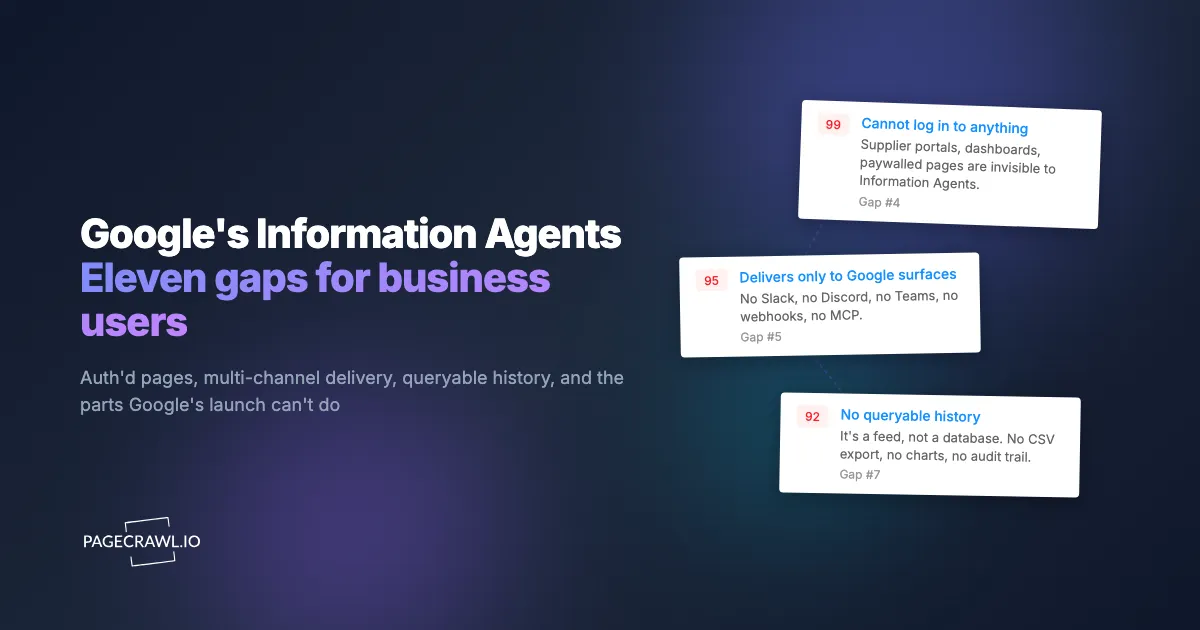
4. Cannot log in to anything
Information Agents do not log in. They do not touch your supplier portal, your competitor's gated pricing, your bank's transaction history, or your internal dashboards. Anything behind a session is invisible.
The pages worth monitoring are almost always the ones behind a login.
PageCrawl does this. Auth'd page monitoring is first-class from Standard and up. The Stealth engine holds a session, navigates behind login, and watches member-only pages on the same schedule as public ones. Same diff format, same AI summary, same channel delivery as public pages.
5. Delivers only to Google surfaces
Information Agents push to Search, Gemini, and Google's notifications. That is useless if your team lives in Slack, your community in Discord, your stakeholders in Teams, your on-call in PagerDuty, or your dev team on a webhook.
PageCrawl does this. Native delivery to email, Slack, Discord, Microsoft Teams, Telegram, generic webhooks, RSS, and the MCP server at https://mcp.pagecrawl.io/mcp for direct conversational access from Claude, ChatGPT, Cursor, and any MCP-compatible client. Every change routes itself to where the work happens.
6. AI summary instead of the literal change
Information Agents paraphrase. That is fine for "the new iPhone was announced", terrible for "the price moved from £49.99 to £52.49" or "this clause in the terms was removed". When the change is the literal text, you need the literal text.
PageCrawl does this. Red-and-green strikethrough diff, before-and-after screenshots, numeric extraction for prices, ratings, stock counts. AI summaries, AI noise filter (suppresses cosmetic banner and cookie changes), AI pattern learning, and AI custom instructions sit alongside the raw diff, not in place of it. Bring your own AI key if you want unlimited usage.
7. A feed, not a database
Information Agents are designed to be scrolled, not to track a page over time the way continuous monitoring does. They are not built for "show me every price change on this SKU over six months as a CSV" or "export change history for these 40 monitors for the board report".
PageCrawl does this. Queryable change history, public API, CSV and Excel export, charts, dashboards, the whole audit trail. Built for analysis, not just notification.
8. Built for apartments and flights, not regulated or niche work
Google's launch examples are real estate and flight prices. Real consumer use cases, real consumer engineering. If you monitor a regulator's PDF library, a competitor's changelog, an NHS procurement page, a council agenda, a niche industry forum, or your own product page for unauthorised edits, you are not in Google's optimisation roadmap.
PageCrawl does this. PDF monitoring as a first-class engine (with positional table reconstruction). RSS/Atom/JSON feed engines. Inbound email ingest. Selector-level tracking. Structured extraction. Three engines (Fast, Default, Stealth) so the right tool handles each page. Proxy infrastructure across UK, EU, US, Canada, and Australia, including residential, so geo-restricted and IP-blocked pages resolve cleanly.
9. No evidence layer underneath the alert
A natural-language summary inside Gemini is not evidence. It is a paraphrase generated by a model, on top of a page that may have been edited or deleted by the time anyone wants to verify it. For compliance teams, legal teams, marketing-claims review, and anything that touches a regulator, that is the wrong artefact.
PageCrawl does this. The Web Evidence Layer is a custom capability we enable per account on request, then activate per monitor. When it is on, each captured change is packaged as a WACZ archive (the open format built on WARC, ISO 28500) carrying a domain-identity signature (Let's Encrypt), an RFC 3161 timestamp from a commercial TSP, a Bitcoin blockchain anchor via OpenTimestamps, and on the eIDAS Custom add-on a qualified timestamp from a QTSP on the EU Trusted List. The archive replays in any compliant viewer with the original site offline. The full stack lives at /web-archives.
10. No MCP, no path into the agent itself
Information Agents are the destination. Your agent stack needs the monitor to be a source, and to be something the agent can create and own. There is no MCP endpoint, no way for Claude, ChatGPT, or Cursor to set up a monitor in conversation, query it, pull change history, fetch diffs, or trigger a check on demand.
PageCrawl does this. The MCP server at https://mcp.pagecrawl.io/mcp gives any client that speaks the Model Context Protocol direct access to every monitor in every workspace. Connect via OAuth 2.0: in your AI tool's connector settings, add PageCrawl and sign in once, as described in the guide to connecting AI assistants over MCP. No API key to paste, and it works on Free accounts (headless clients like Claude Code or Cursor can use a personal API token from Settings > API instead).
The assistant can do real work, not just read. It can create a monitor from a URL in conversation on any plan, including Free (it auto-detects the right tracking mode across 13 modes, sets screenshots and cookie/overlay handling by default, and applies tags, frequency, and notification channels you describe). It can also list monitors, retrieve diffs, fetch the latest values for up to 50 monitors at once, and pull changes since a given point. On every plan, including Free, it can also act: trigger a check on demand, manage tags, organize monitors into folders, mark changes seen, and update a workspace's monitoring defaults. That full loop, an agent that stands up persistent, owned monitoring and then queries and acts on it, is exactly what Google's Information Agents cannot do. Compatible with Claude.ai, Claude Code, Cursor, ChatGPT, OpenClaw, and any MCP-aware tool. Five minutes to connect.
11. No commitment that the service will still exist in 2027
Google has discontinued a long list of products that teams built workflows on. Google Reader, Inbox, Google Domains, Google Code, Stadia, Cloud Print, and Hangouts each had paying customers, active users, and in several cases years of public roadmap before they were shut down. The pattern is well documented and ongoing, as the running Killed by Google graveyard shows.
Information Agents fit the risk profile cleanly. They are a brand-new consumer feature, paywalled inside AI Pro, with no published SLA, no enterprise commitment, and no roadmap beyond the launch announcement. They sit inside Search, a product line that is itself being restructured around AI, and the AI Pro subscription they live in has been re-tiered more than once in the last 18 months. None of that means the feature will be cancelled. It does mean that betting a critical workflow on it carries real platform risk.
PageCrawl has been monitoring web pages since it launched in 2018. Pricing is published, DPAs are signed on request, and full data export is available on every plan at any time, in CSV or Excel format (plus WACZ where audit-ready archiving is enabled for your account). If you build a critical workflow on PageCrawl and ever want to leave, you leave with your data, your history, and your evidence archives intact.
PageCrawl does this. Published pricing, signed DPAs, full data export at any time on any plan, in CSV or Excel (plus WACZ where audit-ready archiving is enabled). Survivable by design.
What does a business actually need instead?
A business needs monitoring it controls: any URL including pages behind a login, delivery into the tools the team already uses, an exportable history it can query later, and an API plus an MCP endpoint an agent can drive. PageCrawl is the business stack Information Agents are not trying to be.

- MCP server at https://mcp.pagecrawl.io/mcp. Create monitors, query them, retrieve diffs, fetch history, and manage tags and folders, all in conversation with Claude, Cursor, ChatGPT, OpenClaw, and any MCP-aware client. It works on every plan, including Free, and the MCP server overview covers what each client can do once it is connected.
- Auth'd pages from Standard and up. Member-only sites, supplier portals, internal dashboards, customer-account areas, paywalled industry sources.
- Channel coverage that matches real teams. Email, Slack, Discord, Microsoft Teams, Telegram, generic webhooks, RSS, browser push, and Scheduled Reports.
- Three capture engines. Fast for static HTML and feeds, Default for ordinary modern sites, Stealth for the hardest defended pages. PDF, RSS/Atom/JSON, and inbound email are first-class engines too.
- Real AI features. AI change summaries, AI noise filter (suppresses cosmetic banner and cookie changes), AI pattern learning, AI custom instructions, bring-your-own-key.
- Scheduled Reports. Daily, weekly, or custom-cadence digests grouped by folder, with shareable links and CSV/Excel/PDF export. Stronger than what competitors ship.
- Queryable history and public API. CSV, Excel, PDF export. Full timeline per monitor. Read and write via REST.
- Web Evidence Layer, available on request. WACZ archive, domain-identity signature, RFC 3161 timestamp, OpenTimestamps anchor, optional QTSP on the eIDAS Custom add-on. One bullet on this list, not the whole list.
- Teams, workspaces, role-based access, audit trail.
- Global signup, transparent pricing, free tier and Personal plan from $8/mo, Enterprise from $30/mo, Ultimate from $99/mo.
- EU/UK/Canada/Australia coverage on day one. Proxy locations across UK, EU, US, Canada, and Australia.
- Survivable, exportable, no platform-graveyard risk. Monitoring web pages since 2018, published pricing, signed DPAs, full data export at any time on any plan in CSV or Excel (plus WACZ where audit-ready archiving is enabled).
When do Google's Information Agents make sense?
Information Agents make sense when every box below ticks: you are one person, the pages are public, the use case is mainstream (real estate, flights, consumer products, news), a natural-language summary inside Gemini is what you want, and you were already paying for AI Pro for unrelated reasons. That is a real use case. We are not the answer there.
For everything else, you need infrastructure.