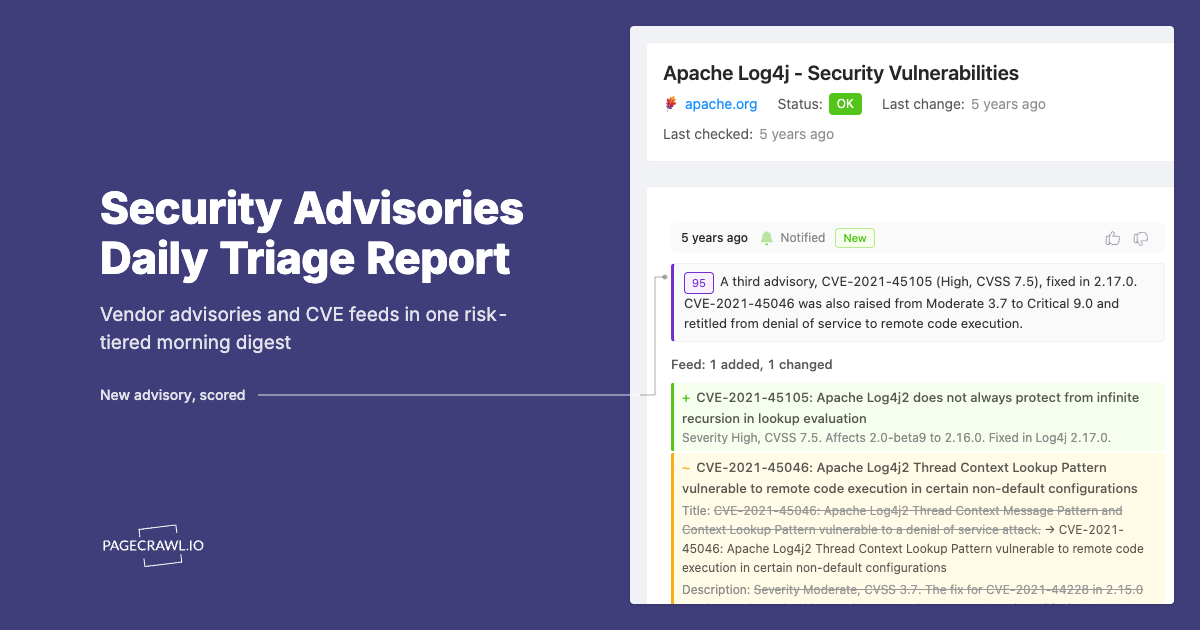
On December 9, 2021, a critical vulnerability in Apache Log4j was disclosed publicly and catalogued by the National Vulnerability Database as CVE-2021-44228. Within hours, attackers were actively exploiting it. Organizations that learned about the vulnerability within the first day had time to patch or mitigate. Organizations that found out a week later were already compromised.
This is an extreme example, but the pattern repeats at smaller scales constantly. A library you depend on ships a breaking change that your CI pipeline does not catch until production breaks. A SaaS tool you rely on deprecates an API endpoint with 30 days notice buried in a changelog. A framework you use releases a security patch, and you do not notice for three weeks because nobody on your team subscribes to the mailing list.
The problem is not that software moves fast. The problem is that updates are scattered across dozens of sources: GitHub release pages, changelog URLs, documentation sites, package registry pages, security advisory databases, blog posts, and mailing lists. No single person can check all of them manually, and no single feed aggregates all of them.
This guide covers the types of software updates worth tracking, where to find them, and how to build an automated monitoring system that alerts your team when something changes.
Which software updates are worth tracking?
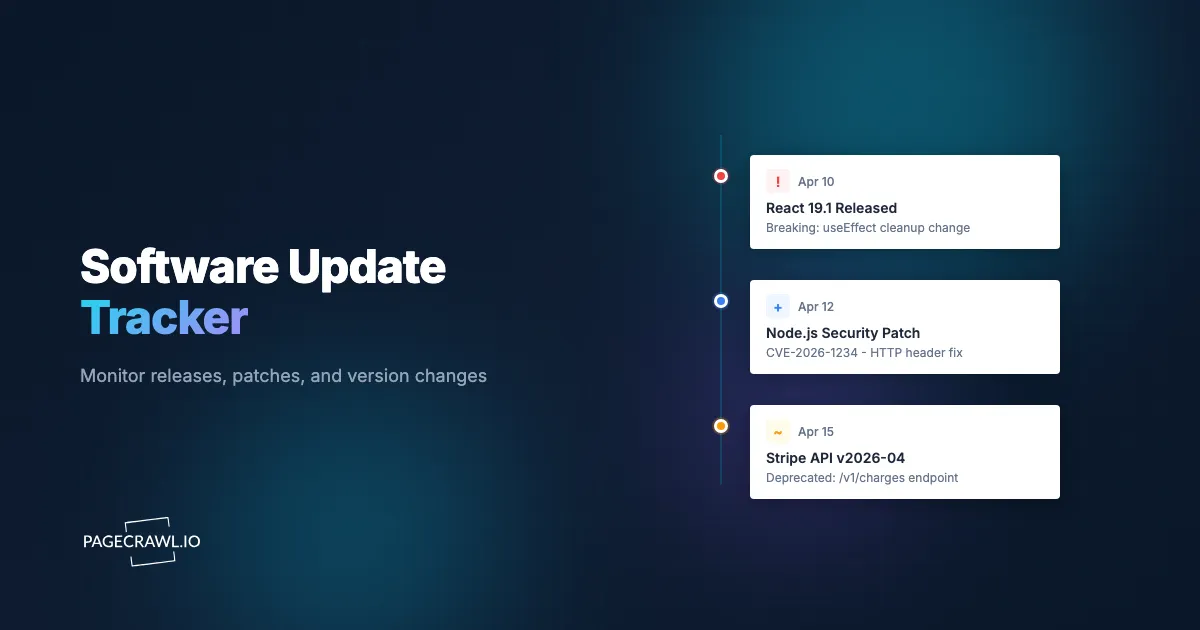
Security patches first, then breaking changes and deprecations, then new features, package metadata changes, firmware, and OS or platform updates. Not every update matters equally, so prioritize monitoring by the impact a missed update would have on your team.
Security Patches and CVEs
Security updates are the highest priority. A disclosed vulnerability in a dependency you use is a ticking clock. The window between public disclosure and active exploitation continues to shrink, sometimes to hours.
Sources to watch:
- Vendor security advisory pages (for example, the Node.js security releases page, Python security advisories, or the Nginx security advisories page)
- The National Vulnerability Database (NVD)
- CISA's Known Exploited Vulnerabilities catalog
- GitHub Security Advisories for repositories you depend on
- Distribution-specific security trackers (Ubuntu USN, Red Hat CVE database, Debian Security Tracker)
Breaking Changes and Deprecations
Breaking changes cause outages when they catch you off guard. A removed function, a changed default, a renamed configuration key, or a deprecated API endpoint can break your application if you upgrade without reading the changelog.
The tricky part is that breaking changes are not always labeled clearly. A minor version bump might contain a "behavioral change" that breaks your specific use case. Monitoring changelogs and release notes lets you review changes before upgrading rather than discovering them after.
New Feature Releases
New features in your dependencies can eliminate custom code you have been maintaining. A library adding native support for something you built a workaround for means you can simplify your codebase. New features in competitor tools or platforms you integrate with may also require you to update your own product to stay compatible.
Package and Dependency Updates
Package registries (npm, PyPI, Packagist, RubyGems, crates.io, Maven Central) publish new versions continuously. While tools like Dependabot and Renovate handle automated pull requests for version bumps, they do not tell you what changed. A PR that bumps a version number does not explain whether the change is a trivial fix or a major refactor that needs careful testing.
Monitoring the changelog or release page alongside automated PRs gives you the context to make informed upgrade decisions.
Firmware and Hardware Updates
Teams managing infrastructure, IoT devices, or network equipment need to track firmware updates. Router firmware, switch OS updates, NAS system updates, and device firmware patches are published on vendor support pages that often require selecting an operating system before the download list appears, and are rarely announced through developer-friendly channels like RSS or GitHub.
OS and Platform Updates
Operating system releases, kernel updates, and platform changes (AWS service updates, Google Cloud release notes, Azure updates) affect your deployment environment. A new OS version might change default behavior. A cloud platform update might deprecate a feature you rely on.

Why does manual update tracking break down?
Because release information is fragmented across mailing lists, GitHub notifications, RSS feeds, community channels, and bot-generated pull requests, and none of them covers the whole stack. Most teams rely on some combination of these approaches, and each has gaps.
Mailing lists and newsletters: Effective when they exist, but subscribing to 30 mailing lists means 30 sources of email noise. Important announcements get buried alongside routine updates.
GitHub Watch and notifications: GitHub's Watch menu has a Custom option that limits a repository's notifications to releases, which keeps issue and pull request noise out. But you set it up one repository at a time, the notifications go to each person's GitHub inbox or email rather than a team channel, and it only covers GitHub-hosted projects.
Vendor RSS feeds: Some vendors publish RSS feeds for their changelogs or blogs. This is one of the better approaches when feeds exist, but many do not offer them. See our RSS feed monitoring guide for setup details.
Social media and community channels: Twitter, Reddit, Hacker News, and Discord channels are where many updates are first discussed, but they are unreliable as primary notification sources. You might see an announcement, or the algorithm might bury it.
Dependabot and Renovate: These tools automate version bump PRs but do not explain what changed or why. They are complements to changelog monitoring, not replacements.
The core problem is fragmentation. Your 40 dependencies might have release information spread across 15 different GitHub repos, 8 vendor websites, 5 documentation sites, and a dozen blog posts. Checking all of them manually is not realistic on any regular cadence.
Where should you monitor for software updates?
Point monitors at the canonical source for each category: release and changelog pages, GitHub or GitLab release pages, documentation sites, app store listings, security advisory pages, and package registry pages. Here is what each one gives you.
Release Pages and Changelogs
Most software projects maintain a dedicated changelog page, a CHANGELOG.md file, or a releases page. These are the single best source for understanding what changed in a release, and release notes and changelog monitoring turns them into alerts.
Common URL patterns:
github.com/{owner}/{repo}/releasesdocs.stripe.com/changelog(a docs-site changelog)/blog/releaseson the vendor's site/whats-newon the vendor's site
For a detailed guide on monitoring SaaS changelogs specifically, see our changelog monitoring guide.
GitHub and GitLab Release Pages
GitHub's releases page (/releases) for any repository shows tagged releases with release notes. This is the most structured source for open-source projects, and every public repository also publishes it as an Atom feed at github.com/{owner}/{repo}/releases.atom, which PageCrawl's Feed mode reads as one item per release with its name, link, and the opening of its notes. The feed also lists pre-releases (betas and release candidates) and tags that have no Release.
GitLab has an equivalent releases feature at /-/releases for self-hosted and gitlab.com projects, with a feed at gitlab.com/{group}/{project}/-/releases.atom. You can also paste a GitHub or GitLab.com repository's Releases page into Track New Page: PageCrawl follows the same feed. The help centre guide to monitoring GitHub and GitLab repositories lists the tag, commit, and file addresses as well.
For a complete walkthrough of GitHub-specific monitoring, see our GitHub releases monitoring guide.
Documentation Sites
Breaking changes and deprecation notices often appear in documentation before they appear in changelogs. An API reference page that suddenly marks an endpoint as "deprecated" or adds a migration guide is an early signal that a breaking change is coming.
See our documentation site monitoring guide for setup details.
App Store Listings
Mobile and desktop app updates are published through app stores. Monitoring these listings catches version bumps, new feature descriptions, and changelog entries in the "What's New" section.
See our app store monitoring guide.
Security Advisory Pages
Dedicated security advisory pages are the fastest source for vulnerability disclosures:
- NVD (nvd.nist.gov): Comprehensive CVE database, updated as vulnerabilities are analyzed
- CISA KEV (cisa.gov/known-exploited-vulnerabilities-catalog): Actively exploited vulnerabilities that federal agencies must patch
- Vendor security pages: Most major projects maintain a security advisory page (for example, the Django security page, Rails security page, or WordPress security page)
- GitHub Advisory Database: Aggregates security advisories across the ecosystem
Package Registry Pages
While automated tools handle version bumps, monitoring the package page itself catches metadata changes, deprecation notices, and ownership transfers that automated tools miss.
Key registry pages:
- npmjs.com/package/{name}
- pypi.org/project/{name}
- packagist.org/packages/{vendor}/{name}
Setting Up a Software Update Tracker With PageCrawl
Here is a practical workflow for building a dependency monitoring dashboard.

Step 1: List Your Critical Dependencies
Start with the dependencies that would cause the most damage if a breaking change or security issue went unnoticed. For most teams, this is 10 to 20 packages: your web framework, database driver, authentication library, payment processor SDK, and the core infrastructure services you deploy on.
Step 2: Find the Release or Changelog URL for Each
For each dependency, find the canonical source for release information. Prefer this priority order:
- GitHub/GitLab releases page (structured, reliable)
- Vendor changelog page (comprehensive)
- Documentation site changelog section (often the most detailed)
- Blog or announcements page (less structured but sometimes the only option)
Step 3: Add Monitors With the Right Tracking Mode
Different sources work best with different tracking modes:
- GitHub and GitLab releases: Use Feed on the release feed (
github.com/{owner}/{repo}/releases.atomorgitlab.com/{group}/{project}/-/releases.atom), so each new release is reported as its own item with its version and link instead of as a page diff - Changelog pages: Use fullpage mode if the entire page is the changelog, or use a CSS selector to target the latest entry section
- Security advisory pages: Use fullpage mode to catch any new advisory, including those added as new page elements
- Documentation pages: Use content-only mode to filter navigation and sidebar changes
Step 4: Set Up Team Notifications
Route alerts to where your engineering team already works:
- Slack or Discord channels for fast team awareness
- Webhooks for integration with internal tools or ticketing systems
- Email for audit trails and async review
For security advisories, consider routing to a dedicated channel with higher urgency so they do not get lost alongside routine release notes.
Step 5: Use AI Summaries to Highlight Breaking Changes
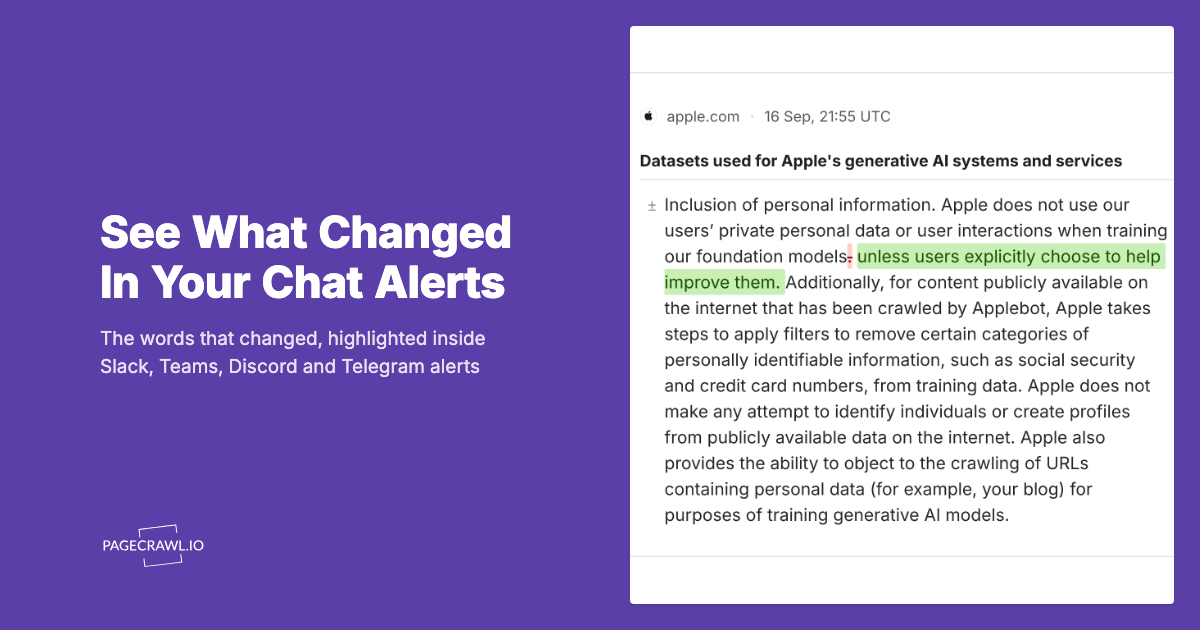
PageCrawl's AI summaries analyze the diff and describe what changed in plain language. For a changelog update, instead of seeing a raw diff with 200 lines of markdown changes, you get a summary like "New release v4.2.0: deprecated the authenticate() method in favor of verifyToken(), added rate limiting to the /api/users endpoint, fixed SQL injection vulnerability in the search query builder."
This makes triage significantly faster, especially for teams monitoring 20 or more dependencies. The help centre overview of how PageCrawl uses AI explains what the summaries cover and how to read the importance scoring.
Advanced Patterns
Webhook to CI/CD Pipeline
Use PageCrawl's webhook and REST API output for developers to trigger automated responses when critical dependencies update. When a security advisory page changes, a webhook can trigger a CI pipeline that runs your test suite against the latest patched version, or create a ticket in your issue tracker.
See our n8n integration guide for examples of building automated workflows triggered by page changes.
Monitoring Multiple Package Versions
If you maintain multiple applications on different versions of a dependency, set up separate monitors for each relevant version's changelog or release branch. This ensures you see updates relevant to your specific version rather than sifting through changes for versions you do not use.
Security-Focused Monitoring Cadence
For security advisory pages, use the highest check frequency your plan allows. Security disclosures often go from publication to active exploitation within hours. A 15-minute check frequency on Standard, or 5-minute on Enterprise, means you learn about new advisories before most of the internet does.
For less critical release pages (feature updates, minor version bumps), daily or twice-daily checks are usually sufficient, and the help centre guide to check scheduling shows how to confine those checks to working hours.
Choosing your PageCrawl plan
PageCrawl's Free plan lets you monitor 6 pages with 220 checks per month, which is enough to validate the approach on your most critical pages. Most teams graduate to a paid plan once they see the value.
| Plan | Price | Pages | Checks / month | Frequency |
|---|---|---|---|---|
| Free | $0 | 6 | 220 | every 60 min |
| Standard | $8/mo or $80/yr | 100 | 15,000 | every 15 min |
| Enterprise | $30/mo or $300/yr | 500 | 100,000 | every 5 min |
| Ultimate | $99/mo or $999/yr | 1,000 | 100,000 | every 2 min |
Annual billing saves two months across every paid tier. Enterprise and Ultimate scale up to 100x if you need thousands of pages or multi-team access.
At an engineering hourly rate, Standard at $80/year pays for itself the first time you catch a breaking API change, a deprecated endpoint, or a silent config change before it takes down production. 100 monitored pages is enough to cover the changelogs and docs of every third-party API your stack depends on. Enterprise at $300/year adds 5-minute checks and 500 pages. All plans include the PageCrawl MCP Server, which plugs directly into Claude, Cursor, and other MCP-compatible tools. Developers can ask "what changed in the Stripe API docs this month?" and get a summary pulled from your own monitoring history. AI assistants can create monitors through conversation on every plan, including Free, turning your tracked pages into a living knowledge base instead of a pile of alert emails.
Getting Started
Start with your five most critical dependencies, the ones that would cause a production incident or a security exposure if you missed an update. Add their release feeds or changelog pages to PageCrawl (Feed for a GitHub or GitLab release feed, Full Page Text with Content only for a changelog page), and route alerts to your team's Slack or Discord channel.
Run it for two weeks. You will likely discover that some dependencies update more frequently than you expected, that some changelog pages are noisier than others (and need CSS selectors to target the right section), and that AI summaries save real time when triaging updates.
From there, expand to your full dependency list and add security advisory pages for the frameworks and platforms you depend on. PageCrawl's free tier includes 6 monitors with all notification channels, which is enough to cover your most critical dependencies while you test the workflow.