Priya runs bids for a 40-person systems integrator in Paya Lebar. On a Tuesday afternoon a colleague forwarded her a GeBIZ Invitation to Tender for exactly the network refresh work her team was built to win. The closing date was nine days out. Nine days sounds survivable until you count what sits inside it: a site visit, three subcontractor quotes, a security clearance letter, and a pricing schedule needing her director's signature. The notice had been live for six days, because nobody had opened the portal since the previous Wednesday.
Two floors up, the compliance lead at the same firm's fintech client had a mirror-image problem. The Monetary Authority of Singapore had published a circular affecting how incident reports are filed. He found out from a law firm newsletter eleven days later, which is a fine way to learn regulatory history and a terrible way to learn a live obligation. Nobody had missed a deadline yet. They had simply spent eleven of their available days not knowing.
Both problems have the same shape. The information is public, free, and sitting on a government website that nobody on the team is paid to refresh. Singapore's agencies publish well, in English and in one place, which makes the failure mode purely about attention rather than access. This guide covers what to monitor across GeBIZ and Singapore's financial, media, and data protection regulators, why agency mailing lists keep letting things through, and how to set up monitoring that surfaces a new tender or a revised notice while there is still runway.
What is GeBIZ and why do tender notices go stale so quickly?
GeBIZ is the Singapore Government's central e-procurement portal, where public sector agencies publish their buying opportunities and suppliers download documents and submit bids. Notices appear with fixed closing dates, so every day you do not see a new listing is a day removed from your bid preparation window, not a day added to the deadline.
The publishing thresholds that decide what you see
Singapore's procurement regime routes opportunities into different instruments depending on value. As set out in the guide to the Singapore Government procurement regime published on GeBIZ itself, lower-value requirements are sourced through Invitations to Quote, larger ones go out as Invitations to Tender, and complex or consultancy-led work is packaged as a Request for Proposal. Your ideal work may therefore not arrive under the label you search for. A firm filtering only for tenders never sees the quotation-level work that often opens an agency relationship.
Fixed closing dates make discovery lag expensive
A closing date does not move because you found the notice late. If an ITT runs for three weeks and you discover it in week three, you are not doing a three-week bid in five days, you are doing a worse bid or no bid. The value is not in seeing the notice, it is in seeing it on day one instead of day twelve. Teams that win consistently are rarely better writers. They started earlier.
Amendments and addenda change the deal after you have started
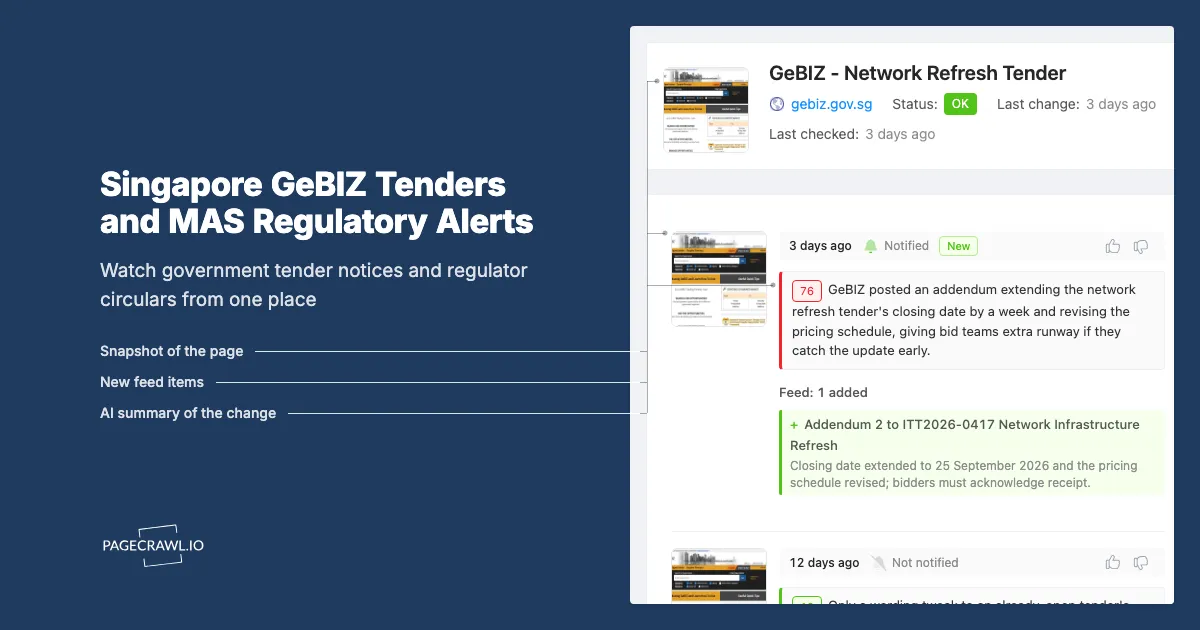
The listing you downloaded is not necessarily the listing that gets evaluated. Agencies issue clarifications, revised specifications, extended closing dates, and corrected schedules against live notices, and a bid built on a superseded document gets marked down on compliance grounds. Monitoring the notice page, not just the notice list, catches the amendment that changes your pricing basis a week after you locked your numbers.
Award results are a competitive intelligence feed
Awarded contract information published on the portal tells you who won, at what value, and for which agency. Read across a year, that is a map of which incumbents hold which relationships and roughly what an agency pays for a category of work. A monitor on the awards listing turns it into a passive feed.
Which Singapore government and regulator pages should you monitor?
Monitor four layers: the GeBIZ opportunity listings filtered to your categories, the individual notice pages for tenders you are actively bidding, the regulator pages that govern your clients or your own licence, and the consultation pages where rules change before they are rules. Most APAC teams need somewhere between six and thirty monitors to cover this properly.
GeBIZ opportunity and award listings
Start with the searches you would run manually. Whatever filtered view of open opportunities matches your category, agency, or keyword set is the page to watch, and a change there means a new listing has entered your addressable pipeline. Add the awarded contracts view as a second, lower-frequency monitor. If your firm serves several distinct categories, run one monitor per category, because a broad monitor produces alerts you cannot triage.
MAS notices, circulars, and guidelines
The Monetary Authority of Singapore publishes its regulatory instruments as a structured library of notices, guidelines, circulars, and codes. Notices are legally binding on the institutions they name, guidelines set out expectations, and circulars carry practical instruction. For a regulated firm, or a vendor selling into one, monitor the listing page for each instrument type plus the specific instruments your obligations are built on, because a revision to an existing notice is far easier to miss than a brand new one.
IMDA consultations and regulatory frameworks
The Infocomm Media Development Authority runs public consultations on its regulations and licensing pages before frameworks change. A consultation is the cheapest early warning available: it tells you what the rule will probably be, months before it binds, and gives you a formal channel to respond. Windows are short and the deadline is stated in the paper, so a monitor on the consultation index turns a missed window into a diarised one.
PDPC advisory guidelines and enforcement decisions
Singapore's Personal Data Protection Commission issues advisory guidelines interpreting the Personal Data Protection Act, revising them as new topics arise (children's data and the use of personal data in AI systems being recent examples). It also publishes enforcement decisions, the most concrete signal available about how the regulator actually reads the Act. If you already track privacy rules elsewhere, our post on regulatory compliance monitoring covers structuring a multi-jurisdiction programme without doubling the workload.
Why aren't official email subscriptions and newsletters enough?
Agency mailing lists are opt-in, category-scoped, and built for announcements rather than revisions. They reliably tell you about a headline launch and routinely say nothing when an annex is replaced, a closing date shifts, or a guideline is quietly reissued. Law firm newsletters are thorough but arrive on a publishing schedule measured in weeks.
Subscriptions cover new publications, not edits
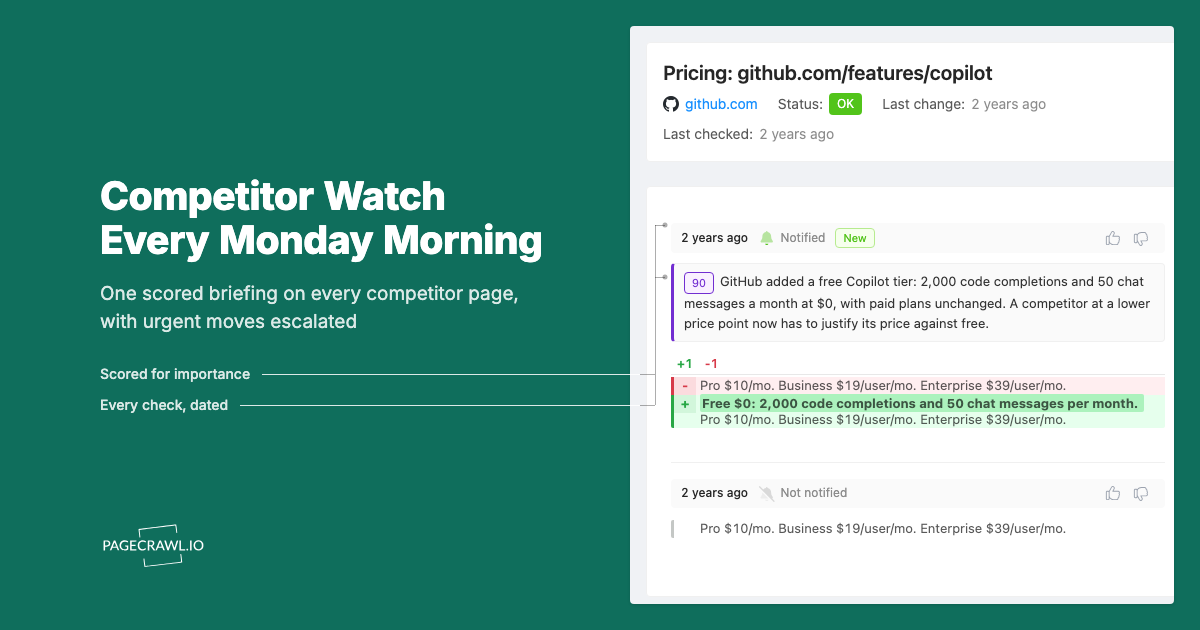
The most consequential changes are frequently edits to documents you already comply with: a reporting window shortened, a definition widened, a threshold moved, an annex swapped. An announcement email is generated when something is published. Nothing is generated when page four of an existing PDF changes. Change monitoring treats a revision as an event, which is why compliance teams want a diff rather than a headline.
Category filters push you into all-or-nothing
Sign up narrowly and you miss the cross-category item that matters. Sign up broadly and your team stops reading within a fortnight. Rules-based alerting solves that by letting the condition, not the category, decide whether you get pinged.
How do you set up Singapore tender and regulatory alerts with PageCrawl?
Point PageCrawl at the exact filtered listing or document page you would otherwise refresh, pick a tracking mode that suits the page type, set a check frequency that matches how costly a late discovery would be, and route alerts to the channel your team already lives in. A working setup takes under ten minutes per monitor.
Copy the URL you would actually check. On GeBIZ, run your normal search with your category, agency, and status filters applied, then copy the resulting URL. Do the same for a MAS instrument listing or the IMDA consultation index. Monitoring your filtered view rather than a generic homepage is what makes the alerts relevant rather than noisy.
Add the URL to PageCrawl and pick a tracking mode. For listing pages (open opportunities, consultation indexes, circular libraries), use content tracking so a new row registers as a change. For a specific tender notice or a guideline you must comply with, use text tracking so an amended clause or revised annex is captured. For a PDF-based instrument, use PDF extraction so the text inside the file is compared, not the file name.
Set your check frequency against your deadline risk. For live tenders where an addendum could reset your pricing, check as often as your plan supports. Free checks hourly, Standard every 15 minutes, Enterprise every 5, Ultimate every 2. For a regulator's guideline library, daily is proportionate. Note: the tradeoff is not accuracy, it is how long a change sits unseen before the next check finds it.
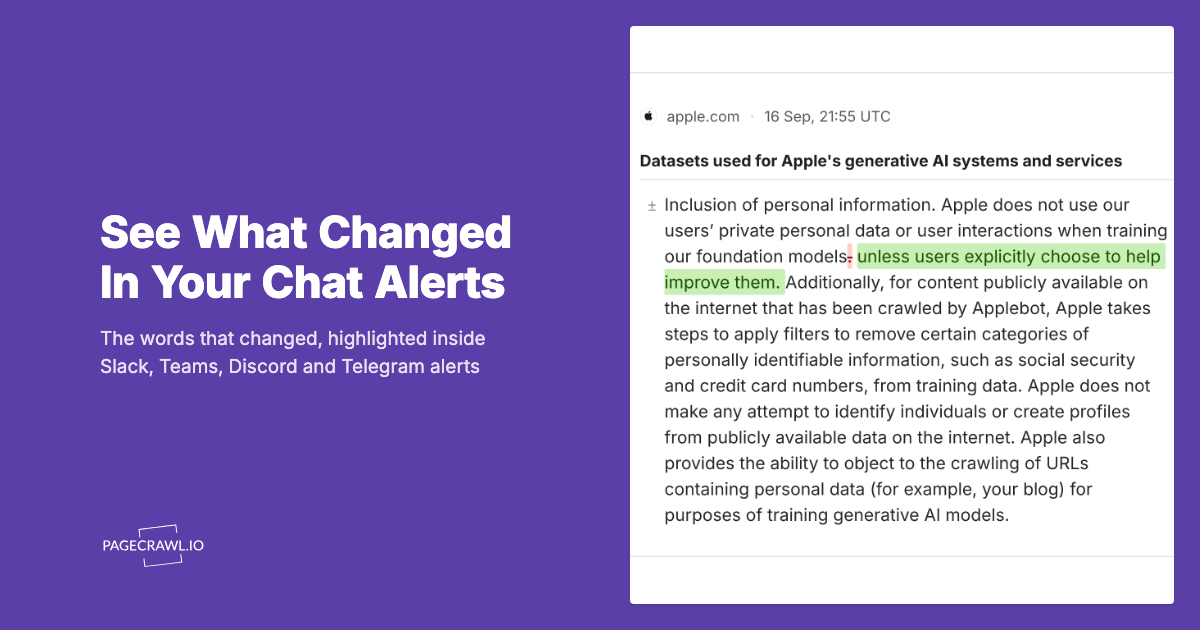
Choose notification channels per audience. Bid teams usually want alerts where the bid/no-bid decision gets made, which for most Singapore firms is Microsoft Teams or Slack. Compliance leads often prefer email for the paper trail. PageCrawl sends to email, Slack, Discord, Teams, Telegram, and webhooks, and one monitor can use several at once.
Add keyword and threshold rules so only relevant changes fire. On a GeBIZ listing, restrict alerts to changes containing your service keywords or your target agency names. On a regulator page, key on words like "effective", "revised", "takes effect", "response by", or the name of the notice you comply with. Our walkthrough on conditional alerts using price, keyword, and threshold rules shows how to build these conditions so a busy index page stays quiet until it matters.
Turn on screenshots and keep the history. For compliance work, a timestamped capture of a page as it read on a given date is the artefact an auditor asks for when you claim you responded promptly, and it turns the account into an evidence archive rather than a notification service.
Route webhooks into your bid or GRC system. If you track opportunities in a CRM or obligations in a GRC tool, a webhook can create the record automatically so the alert becomes a task without anybody retyping it.
How do MAS, IMDA, and PDPC publish changes differently?
Each body has a different publication rhythm and a different cost of missing something, so they deserve different monitoring settings rather than one uniform policy. MAS revises binding instruments continuously, IMDA changes rules through time-boxed consultations, and PDPC updates interpretive guidance and publishes enforcement outcomes that set practical precedent.
| Body | What to watch | Typical change type | Suggested check frequency |
|---|---|---|---|
| MAS | Notices, guidelines, circulars, codes | Revision to a binding instrument or a new circular | Hourly to every 15 minutes |
| IMDA | Consultation index, frameworks and policies | Consultation opened with a stated response deadline | Hourly to daily |
| PDPC | Advisory guidelines, enforcement decisions | Revised guidance, new enforcement outcome | Daily |
| GeBIZ | Filtered opportunity searches, awards | New notice, amendment, closing-date change | As fast as your plan allows |
MAS: binding instruments that get quietly amended
Because MAS notices bind the institutions they apply to, the reference version matters. A firm's control framework is usually mapped to specific paragraph numbers, and a revision that renumbers or rewrites a paragraph breaks that mapping silently. Monitor the instruments your controls cite, not only the news page, and keep the diff.
IMDA: consultations are your early-warning layer
Consultation papers state the proposal and the response deadline together, which makes them the highest-value single page type in Singapore regulatory monitoring. The window between publication and deadline is your entire opportunity to influence the outcome and to start preparing for it. Missing the consultation does not just cost you a submission, it costs you the head start every competitor who responded now has. This is the same logic behind horizon scanning as a discipline: watch the draft, not just the law.
PDPC: guidance revisions and enforcement precedent
Advisory guidelines are periodically reissued rather than replaced, so the change is often a new section inside a familiar document. Enforcement decisions matter for a different reason: they show what the regulator considered inadequate in a real organisation. Watching both keeps your privacy posture aligned with current interpretation rather than the version you read when you first implemented the PDPA.
How does Singapore fit into a wider APAC monitoring programme?
Most teams that monitor Singapore also sell or comply across at least two neighbouring markets, so Singapore is best treated as one country module in a regional setup rather than a standalone project. The structure repeats cleanly: procurement portal plus financial regulator plus sector regulator, per jurisdiction, with a shared alerting and review routine on top.
The regional pattern is the same shape
Australia and New Zealand run centralised tender portals in the same way GeBIZ does, covered in our post on AusTender and GETS tender monitoring. Japan's regulatory publishing is split across several agencies with an English lag, covered in the FSA and METI monitoring guide. Add Singapore and you have the three markets most APAC teams need first. Built as folders of monitors, adding a fourth country is an afternoon.
Time zones and the weekly review
Singapore agencies publish in SGT, so for a European or American team the working day's changes land overnight. Run alerting for anything carrying a deadline and a scheduled digest for everything else, then hold a short weekly review of the digest. The alerts handle urgency, the digest handles awareness.
What problems come up when monitoring Singapore government portals?
Three issues recur: search URLs that do not reproduce your filtered view, listing pages that churn on counters and banners rather than real additions, and instruments published as PDFs where the link stays identical while the document changes. All three are solved during setup rather than being ongoing maintenance.
Search URLs that do not survive a fresh session
Some portal searches encode state in a way that a fresh visit does not reproduce, so a copied URL may return a generic view instead of your filtered one. When that happens, monitor the closest stable public listing you can reach directly and lean harder on keyword conditions, filtering at the alert stage rather than the page stage.
Listing churn that is not a real change
Government listings often carry counters, "last updated" stamps, rotating banners, and pagination artefacts that shift without any new item appearing. Left alone these generate alerts that teach people to ignore alerts. PageCrawl lets you exclude a region after it triggers a false alarm, and a busy index page then settles into silence except for genuine additions. Our guide to reducing monitoring false positives covers the tuning pattern in detail, and it is worth doing in the first week rather than after the team has learned to skim past the notifications.
Instruments published as PDFs
Much Singapore regulatory content lives inside PDF documents rather than HTML pages, and a monitor that only sees the link will not notice that the file behind it changed. Use PDF text extraction so the comparison happens on the document contents, which is what turns "a page changed" into "paragraph 4.3 reporting window changed from 30 days to 14 days".
Choosing your PageCrawl plan
PageCrawl's Free plan lets you monitor 6 pages with 220 checks per month, which is enough to validate the approach on your most critical pages. Most teams graduate to a paid plan once they see the value.
| Plan | Price | Pages | Checks / month | Frequency |
|---|---|---|---|---|
| Free | $0 | 6 | 220 | every 60 min |
| Standard | $8/mo or $80/yr | 100 | 15,000 | every 15 min |
| Enterprise | $30/mo or $300/yr | 500 | 100,000 | every 5 min |
| Ultimate | $99/mo or $999/yr | 1,000 | 100,000 | every 2 min |
Annual billing saves two months across every paid tier. Enterprise and Ultimate scale up to 100x if you need thousands of pages or multi-team access.
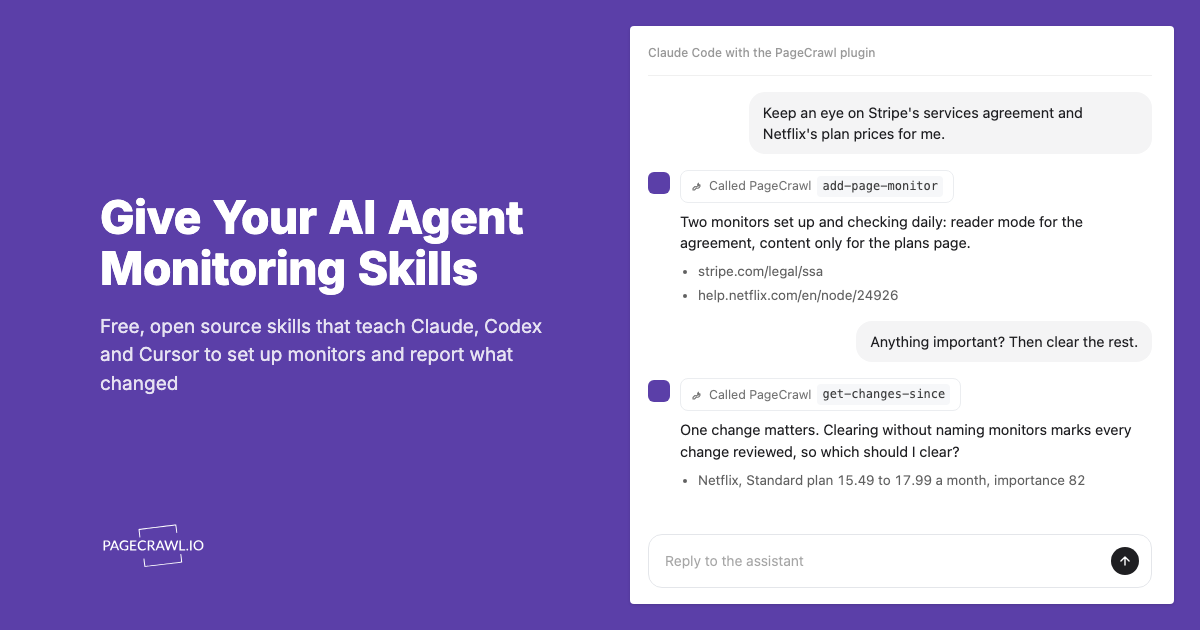
Compliance monitoring is the cheapest insurance you can buy. A single missed regulatory change can trigger fines in the tens or hundreds of thousands, not to mention the audit overhead of proving you did not see it coming. Enterprise at $300/year covers 500 regulatory pages with unlimited history and timestamped screenshots, which is usually exactly what an assessor wants to see. All plans include the PageCrawl MCP Server, so your compliance team can ask Claude to summarize every change to a specific regulation over the last quarter and pull the exact diff, turning your monitoring history into a queryable audit trail. AI assistants can create monitors through conversation on every plan, including Free. Standard at $80/year is enough to cover 100 pages across your primary regulatory bodies if your program is smaller.
Getting Started
Pick the single page where being six days late would hurt most. For a supplier that is your filtered GeBIZ opportunity search. For a regulated firm it is the MAS instrument your control framework cites by paragraph number. Set up that one monitor, choose the tracking mode that matches the page type, and route it to the channel where a decision actually gets made.
Then add three more over the following week: the IMDA consultation index, the PDPC advisory guidelines page, and the GeBIZ awards listing for your category. Turn on screenshots so you accumulate dated evidence from day one, and add keyword conditions after the first false alarm rather than trying to predict them.
Run it for a fortnight and look at what arrived. The first time a tender notice or a revised circular reaches your team with the full window still intact, the setup has justified itself.
Stop refreshing the portal on a Wednesday. Let the next opportunity and the next rule change come to you.