A program officer at a family foundation released the year-two tranche of a three-year, $450,000 capacity grant in March. In June, a board member forwarded her a local news story: the grantee had not filed a Form 990 in three years and had appeared on the IRS automatic revocation list two months earlier. The foundation had wired money to an organization that was no longer tax-exempt. Nobody had looked at the grantee's IRS record since the original due-diligence packet was assembled eighteen months before.
Nothing about that failure was exotic. The information was public the entire time. The IRS publishes an organization's exempt status, determination letter, and filed returns on a free search tool. Charity Navigator publishes rating changes, Candid publishes transparency seals, and state registries publish suspensions. Every one of those pages is a URL that can be watched. The gap is not access to data. It is that due diligence is treated as a one-time event at the start of a grant and never revisited while the money is still flowing.
Donors have the same blind spot at smaller scale. You set up a recurring monthly gift to a charity you researched carefully once, and then never look again while ratings drop and the standing order keeps going out.
This guide covers what to watch across IRS records, rating agencies, and grant eligibility registries, and how to set it up as a standing monitor instead of a calendar reminder you will eventually snooze.
What nonprofit records should donors and grantmakers monitor?
Watch four record types: the IRS exempt-status record and posted Form 990 returns, the Charity Navigator rating page, the Candid transparency profile, and any state charity registration required where the organization solicits. Together those cover legal standing, financial health, and disclosure quality, which is what a funding decision rests on.
The IRS exempt status record
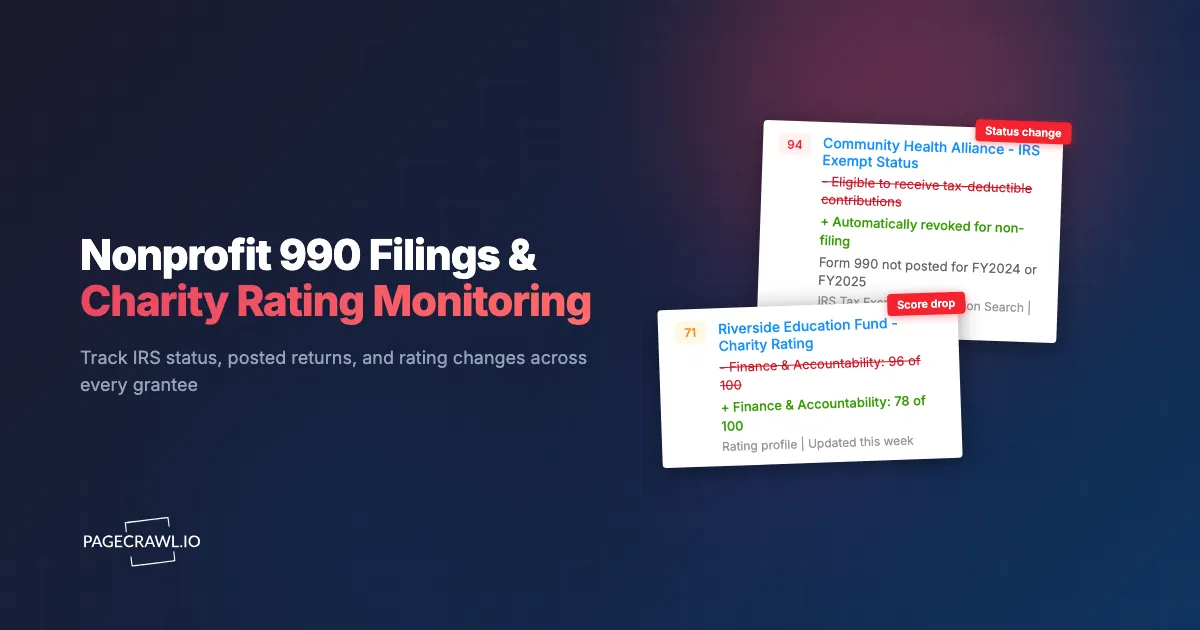
The primary record is the organization's entry in the IRS Tax Exempt Organization Search. It shows whether the organization is currently eligible to receive tax-deductible contributions, carries its determination letter, links the electronically filed returns the IRS has published, and shows whether the organization appears on the auto-revocation list.
Search by EIN rather than name. Names collide, chapters share branding, and a fiscal sponsor is often a different legal entity from the program you think you are funding. The EIN is the only thing that keeps a monitor pointed at the right organization when the charity rebrands.
Posted Form 990 returns
Form 990 is the annual information return tax-exempt organizations file under section 6033, and it is a public document carrying revenue, expenses, executive compensation, board composition, related-party transactions, and program accomplishments. Smaller organizations file the shorter Form 990-EZ (available, with exceptions, to organizations with gross receipts under $200,000 and total assets under $500,000), and those whose gross receipts are normally $50,000 or less file the electronic Form 990-N e-Postcard instead.
The return is due on the 15th day of the fifth month after the fiscal year ends, with the option of a single six-month extension. For a December year end, that means a May deadline and a November extended deadline. Those are the dates a new return is most likely to appear, and when a monitor earns its keep, because "the 990 we were promised never showed up" is a finding you want in June, not in next year's audit.
Charity rating and transparency profiles
Charity Navigator, founded in 2001, scores organizations across beacons including Finance and Accountability, Impact and Results, Culture and Community, and Leadership and Adaptability. Candid's GuideStar awards Seals of Transparency at Bronze, Silver, Gold, and Platinum levels, each requiring the organization to disclose more. Both give each organization a stable URL, which makes them straightforward to watch.
A score movement is rarely the story by itself. It tells you where to look. A Finance and Accountability drop usually traces back to something concrete in the newest filing: a lapsed independent audit, a governance policy that disappeared, a sharp change in a compensation figure. The rating is the smoke alarm, and the 990 is where you find the fire.
State registration and grant eligibility status
Most states require charities soliciting donations there to register with a state charity official, usually the Attorney General or Secretary of State, and most publish a searchable registry. A lapsed or suspended registration will not necessarily show up in any national database, but it can make the organization ineligible for grants and corporate matching, and sometimes for fundraising in that state at all. For federal funding, an expired SAM.gov entity registration has the same effect, and it expires annually.
Why does an organization's tax-exempt status disappear without warning?
Because revocation for non-filing is automatic. Under the 2006 Pension Protection Act, an organization that fails to file a required annual return or notice for three consecutive years loses its exempt status by operation of law. The IRS publishes those organizations on its auto-revocation list, updated monthly, and the revocation itself is not appealable.
The three-year trigger
The clock is unforgiving because it is arithmetic, not judgment. Three consecutive missed years of Form 990, 990-EZ, 990-PF, or 990-N and the status is gone. Small organizations are the most exposed. A group under the 990-N threshold has only a short electronic notice to file, which is exactly why it gets forgotten during a bookkeeper transition or board turnover, and three quiet years pass before anyone notices.
The list is published monthly, not continuously
The IRS automatic revocation of exemption page explains that the list gives each organization's name, EIN, type, last known address, effective revocation date, and the date it was added, and that the IRS updates it every month. Two things follow. There is no notification pushed to you as a funder, so if you are not looking at the page you do not know. And the effective revocation date is often earlier than the publication date, so by the time a name appears you may already have paid a non-exempt entity.
What revocation means for your money
Contributions to a revoked organization are not deductible from the effective revocation date. For a private foundation, a grant to an entity that has lost its public charity status can create expenditure responsibility obligations or a taxable expenditure, which is a legal and accounting problem rather than an awkward conversation. For an individual donor it means a deduction the IRS can disallow.
How do you set up nonprofit filing and rating monitors in PageCrawl?
Point PageCrawl at the specific record pages for each organization you fund, use text tracking so wording changes register, check daily for status pages and weekly for rating pages, and route alerts to the channel your program team actually reads. A grantee portfolio of a few dozen organizations takes an afternoon to set up once.
- Collect EINs first. Before adding a single URL, list every organization you fund with its EIN. This is the step people skip, and the one that prevents you from monitoring the wrong entity. Chapters, affiliates, and fiscal sponsors all share names.
- Add the IRS record URL for each organization. Look each EIN up in the IRS Tax Exempt Organization Search and copy the resulting record URL. This is your legal-standing monitor and the most important one in the set.
- Pick text or content tracking, not full-page. You want changes to the words on the page: deductibility status, a new return appearing, a revocation notice. Full-page visual tracking fires on layout and banner changes and teaches your team to ignore the alerts.
- Add the Charity Navigator and Candid profile URLs. One monitor each per organization, on text tracking, so a beacon score, seal level, or advisory notice registers as a wording change.
- Set check frequency by record type. Daily for IRS status and state registration pages, where finding out late is costly. Weekly for rating and transparency profiles, which do not move faster than that. Free-tier hourly checks cover all of these, but the 6-page limit binds quickly on a real portfolio.
- Add keyword rules so the alert means something. Set conditions on "revoked," "revocation," "suspended," "not currently eligible," "delinquent," and "advisory" so those always break through, and a threshold rule on a numeric rating score so a one-point move stays quiet. Our walkthrough of conditional alerts using price, keyword, and threshold rules covers the syntax.
- Route notifications to the right channel. PageCrawl delivers to email, Slack, Discord, Microsoft Teams, Telegram, and outbound webhooks. Send status-change alerts where your program officers already work, and a weekly digest of everything else to email. Use a webhook if you want alerts written back into a grants management system.
- Turn on screenshots and keep the history. Every check stores a timestamped record of what the page said, so when an auditor asks what you knew and when, the archive answers instead of your memory.
- Group the monitors into folders. One folder per portfolio, program area, or program officer. Folders are what make a hundred monitors a workflow rather than a wall of alerts.
A sensible starting portfolio
| Record | Tracking mode | Frequency | Alert on |
|---|---|---|---|
| IRS exempt status record | Text | Daily | Any wording change, keyword "revoked" |
| Posted 990 returns list | Text | Weekly | A new filing year appearing |
| Charity Navigator rating | Text | Weekly | Score movement, advisory notice |
| Candid transparency profile | Text | Weekly | Seal level change |
| State charity registry entry | Text | Daily | "Delinquent," "suspended," "expired" |
| SAM.gov registration (federal funding) | Text | Weekly | Expiration date change, status change |
What should a grantmaker do differently between grant cycles?
Move from point-in-time due diligence to continuous due diligence. Most foundations verify status thoroughly at the application stage and then do not look again until renewal, which leaves a gap of a year or more while payments continue. Monitoring closes that gap without adding staff time.
The diligence gap is where the risk sits
Application-stage diligence is usually excellent. Someone pulls the 990, checks the determination letter, reads the audit, and writes it up. Then the grant is approved and the file closes. Multi-year grants pay out across the exact window nobody is watching, and that is when an executive director departs, an audit finding lands, or a filing gets missed. Continuous monitoring does not replace the initial review. It keeps it from going stale.
Tiering your grantee portfolio
Not every grantee warrants daily checks. Tier 1 is your largest commitments and any organization with a known governance or financial concern: IRS status daily, ratings weekly. Tier 2 is the bulk of your active portfolio: IRS status weekly, ratings via a quiet digest. Tier 3 is pipeline organizations, where a rating change is useful context but not urgent. This is the same logic that makes grant funding opportunity monitoring manageable on the incoming side, applied to money going out.
Building an evidence trail
Auditors care about process, not intentions. A monitoring history showing a grantee's IRS record was checked on a schedule, with timestamped captures of what it said, is a materially stronger answer than "we reviewed status at approval." It also protects your program officers: when a grantee's status changes and you act within days, the record shows it.
How can individual donors use this without a research team?
Pick the three to six organizations that receive most of your giving and monitor their IRS record and Charity Navigator page. That is well inside a free plan. The point is not to police charities. It is to make sure the recurring gifts you set up years ago still go to organizations you would choose today.
Start with your recurring gifts
Recurring donations most need this, because they are the ones you no longer think about. Pull your bank statement, list every charity taking a monthly or annual payment, and look each one up by EIN. Monitor the survivors, cancel the rest.
Give the alerts somewhere quiet to land
A donor does not need a push notification about a charity rating. Send these to email as a weekly or monthly digest, so the only thing reaching you between digests is a genuine status problem. Our guide to reducing website monitoring false positives covers how to train a monitor to ignore parts of a page that change without meaning anything.
Verify before the year-end rush
Deductibility depends on the organization's status at the time of the gift, and December is when most giving happens and the least verification does. A monitor that has watched an organization's IRS record all year means you are not checking anything on 31 December. You already know. If you also track the tax rules governing the deduction itself, our post on monitoring IRS tax code changes covers the guidance side.
Which changes actually matter and which are noise?
Prioritize legal standing over everything: revocation, status change, deductibility limits, a suspended state registration. Then substantive financial changes in a newly posted 990. Rating score movements of a point or two, layout updates, and boilerplate rewrites are noise and should stay in a digest.
High-priority signals
These deserve an alert the same day a check finds them.
- Appearance on the IRS auto-revocation list, or the exempt-status record showing contributions are no longer deductible.
- A state charity registration turning delinquent, suspended, or expired where the organization solicits.
- A donor advisory notice appearing on the rating page.
- A required Form 990 still missing well past the extended deadline for that fiscal year.
- An expired SAM.gov registration for a grantee expecting federal pass-through funding.
Medium-priority signals
These belong in a weekly digest a program officer scans.
- A meaningful move in a beacon score, particularly Finance and Accountability.
- A Candid Seal of Transparency dropping a level, which usually means disclosed information was withdrawn or went stale.
- A newly posted 990 showing a large swing in program expenses, executive compensation, or net assets.
- Leadership changes on the organization's own site, especially executive director, CFO, or board chair.
Noise to suppress
Nonprofit sites and rating profiles are full of movement that means nothing: donation ticker totals, rotating impact photography, campaign banners, "last updated" timestamps, cookie notices, and social feed embeds. Exclude those regions once and the monitor settles into silence, which is the state you want it in. A monitor that alerts weekly is ignored within a month.
How do you scale this across a large grantee portfolio?
Monitor by tier, not uniformly. Four record types times a hundred grantees is four hundred monitors, manageable if you reserve daily checks for legal-standing pages and use folders, tags, and digests to keep the volume readable. Most foundations land between one and three monitors per grantee.
Let an assistant do the reading
Every plan includes the PageCrawl MCP Server, so an AI assistant can query your monitoring archive directly. "Which grantees had an IRS status change this quarter?" is answered from your history rather than a fresh round of manual lookups. Assistants can also create monitors through conversation, so a new grant gets its monitors without anyone opening a form.
Push results into your grants system
Outbound webhooks let a detected change write straight into whatever you use to manage grants, so a status alert becomes a task on a program officer's list rather than an email they might archive. That is what makes monitoring part of the workflow instead of a parallel system somebody has to remember to consult.
Choosing your PageCrawl plan
PageCrawl's Free plan lets you monitor 6 pages with 220 checks per month, which is enough to validate the approach on your most critical pages. Most teams graduate to a paid plan once they see the value.
| Plan | Price | Pages | Checks / month | Frequency |
|---|---|---|---|---|
| Free | $0 | 6 | 220 | every 60 min |
| Standard | $8/mo or $80/yr | 100 | 15,000 | every 15 min |
| Enterprise | $30/mo or $300/yr | 500 | 100,000 | every 5 min |
| Ultimate | $99/mo or $999/yr | 1,000 | 100,000 | every 2 min |
Annual billing saves two months across every paid tier. Enterprise and Ultimate scale up to 100x if you need thousands of pages or multi-team access.
Compliance monitoring is the cheapest insurance you can buy. A single missed regulatory change can trigger fines in the tens or hundreds of thousands, not to mention the audit overhead of proving you did not see it coming. Enterprise at $300/year covers 500 regulatory pages with unlimited history and timestamped screenshots, which is usually exactly what an assessor wants to see. All plans include the PageCrawl MCP Server, so your compliance team can ask Claude to summarize every change to a specific regulation over the last quarter and pull the exact diff, turning your monitoring history into a queryable audit trail. AI assistants can create monitors through conversation on every plan, including Free. Standard at $80/year is enough to cover 100 pages across your primary regulatory bodies if your program is smaller.
Getting Started
Start with the organizations where being wrong would cost the most. For a foundation, that is your three largest active grant commitments. For a donor, it is whatever is on your recurring giving list.
- Look each organization up by EIN in the IRS Tax Exempt Organization Search and copy the record URL.
- Add those URLs to PageCrawl with text tracking, daily checks, and keyword rules on "revoked," "suspended," and "delinquent."
- Add the Charity Navigator or Candid profile for the same organizations on a weekly check, routed to a digest rather than an alert.
- Give it a month, then expand to the rest of the portfolio and add state registration pages for the states where your grantees solicit.
Due diligence you did eighteen months ago is a document, not a control. Put the records on watch and let the changes come to you.