It is Friday afternoon in Week 6. Your starting running back has been listed as a limited participant three days running, and every fantasy article you read says he is trending toward playing. At 4:12pm the team posts its final game status and he is Questionable. At 5:40pm the beat reporter adds that he was in a walking boot leaving the facility. You do not see either update because you are driving home. Sunday morning you set your lineup on autopilot, he is inactive 90 minutes before kickoff, and you take a zero at a position where your bench had a startable option all along.
The manager in third place saw the same team page update on Friday evening, claimed the backup that night, and started him for 21 points. He did not have better information than you. He had the same information, sooner. That is the entire edge.
Fantasy football is a game of small, perishable facts: who practiced, who sits second on the depth chart, who got activated off injured reserve. Those facts appear on official team websites and the league's injury pages before they are aggregated, tweeted, and written up. If you read them in a Wednesday morning waiver column, you are reading them after everyone else in a 12-team league already did.
This guide covers what the NFL publishes and when, which pages are worth monitoring, how to set up alerts that reach your phone on practice days, and how to convert an early injury signal into a waiver claim before your league catches up.
Why do NFL injury reports decide your fantasy week?
Injury reports are the only mandatory, league-governed disclosure of player availability. Practice participation and game status designations tell you who might miss snaps before the game starts, which drives every start-sit and waiver decision you make. Everything else in fantasy analysis is opinion built on top of that raw disclosure.
The report is a rule, not a courtesy
Under the league's personnel (injury) report policy, published through NFL Football Operations, teams must list any player whose injury causes him to miss a game, prevents him from finishing one, or stops him completing his normal practice workload, even when the club is confident he will suit up. Because it is enforceable with fines, teams file it consistently and on a schedule. That predictability is what makes it monitorable. A rumour arrives whenever a reporter feels like posting. A practice report arrives on a fixed weekly rhythm at a fixed URL.
Practice participation is the leading indicator
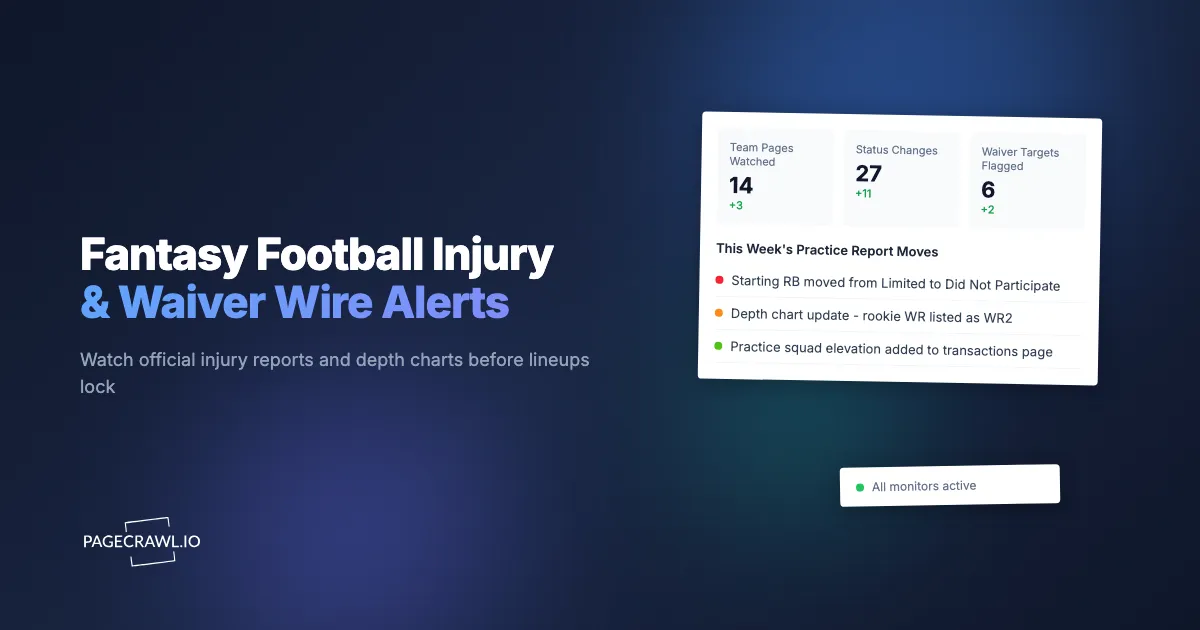
Three participation levels appear on the report: Did Not Participate, Limited Participation, and Full Participation. A player who moves from DNP on Wednesday to Limited on Thursday to Full on Friday is trending up. One going the other way is trending toward inactive. That trend is visible on the club's own page days before the final game status. Most managers only look at the Friday designation, so the Wednesday and Thursday rows are where the cheap information lives.
Game status is a three-tier signal
The league removed the "probable" designation, leaving Questionable, Doubtful, and Out. Questionable now does a lot of work, covering everything from a player who will suit up through soreness to a genuine game-time decision. When a starter lands on Questionable, the backup behind him is the most valuable free agent in your league for roughly 48 hours. Knowing that on Friday evening rather than Sunday morning is the difference between adding him for nothing and bidding against six other managers.
The depth chart is the other half of the story
An injury only matters in fantasy if you know who absorbs the vacated work. That is the depth chart, published on the same team sites and quietly updated all season as roles change. A receiver moving from WR3 to WR2 on the official chart is a start-worthy signal that never trends on social media. Depth chart changes also front-run injuries: a rookie climbing the chart in October reflects a coaching decision, and coaching decisions stick longer than a one-week absence.
What exactly should you monitor for injury and waiver news?
Monitor the injury report page and the depth chart page on the official site of every team that employs a player you own or want, plus the league-wide injury index. Those pages are the source that every aggregator, app, and columnist reads from, and they are ordinary public web pages that change on a schedule you can track.
The league-wide injury index
The official NFL injury report collects the week's filings across all 32 clubs in one place, which makes it the right first monitor if you only want one. The trade-off is volume: on a Wednesday afternoon dozens of rows change at once, so a plain "this page changed" alert on it is close to useless. Add keyword conditions for the player names on your roster and watch list and it becomes a personalised wire.
Individual team injury report pages
Every club maintains its own page, for example the New York Giants injury report, and these are the pages worth watching closely. They are narrower, so a change is far more likely to be relevant, and they often post the participation grid before the league-wide index reflects it. Set one up for each team that matters to you. If you roster players across eight teams and have three more on your waiver watch list, that is 11 monitors, which fits comfortably in a small paid plan and still leaves room for depth charts.
Depth chart pages
Official depth charts live in the same team section of the site and change less often than injury reports, which makes them ideal for monitoring: almost every change is meaningful. A backup moving into the starting slot, a new third-down back appearing, or a receiver dropping a rung all deserve an alert. Because the update rate is low, you can watch depth charts with a straightforward content monitor and expect a quiet feed with occasional high-value pings.
Transactions and roster move pages
Team transaction pages record signings, releases, practice squad elevations, and injured reserve activations, the moves that create free agents in your league before anyone writes about them. A back signed off another club's practice squad on Tuesday afternoon is available in your league Tuesday afternoon.
Aggregators as a backstop, not a primary
Sites like ESPN's NFL injury status page standardise formatting across all 32 clubs and often add context the team page omits, so they are a good safety net. They also inherit whatever lag exists between the club publishing and the aggregator ingesting. Monitor the source for speed, the aggregator for coverage.
When does the injury information actually change during the week?
During the regular season, teams file practice participation on Wednesday, Thursday, and Friday, with final game status designations due Friday afternoon for a Sunday game. Teams playing on other days shift to an equivalent compressed schedule. That means your monitoring value is concentrated in three afternoons and one Sunday morning window.
The Wednesday through Friday rhythm
Wednesday's report is the first look and often the most surprising, because it is the first disclosure after the team has reviewed the previous game. Thursday shows direction. Friday brings the game status designation, which for a Sunday game is due by the league's Friday afternoon deadline. If you check only once a week, check Friday. If you can check three times, take all three practice days, because the Wednesday DNP that becomes a Thursday Full is the pickup nobody else bothered to notice.
The Sunday inactives window
Roughly 90 minutes before kickoff, clubs publish their inactive lists and every Questionable player resolves. This is the tightest window of the week and the one that costs managers the most points. A monitor on the team page with a short check interval covers it while you are making coffee, which beats finding out at 1:07pm that your flex was scratched at 11:30am.
The Tuesday waiver deadline
Most fantasy leagues process waiver claims overnight into Wednesday, with claims due Tuesday night, though the exact processing time is a per-league setting you should check in your own league rules. Practically, this means the news that breaks Monday night and Tuesday is the news that decides your claims, and the news that breaks Wednesday afternoon is what you are bidding on next week. Monday night game injuries and Tuesday transaction moves are therefore the highest-leverage alerts of the entire week.
| Day | What publishes | Fantasy decision it drives |
|---|---|---|
| Monday night / Tuesday | Post-game injury news, transactions, practice squad moves | This week's waiver claims |
| Wednesday | First practice participation report | Early waiver targets, trade offers |
| Thursday | Second practice report, direction of trend | Start-sit leaning, FAAB budget |
| Friday | Final practice report and game status designation | Lock in start-sit, late free agent adds |
| Sunday, ~90 min pre-kickoff | Inactive lists | Final lineup swaps |
The offseason exception
Outside the regular season the reporting cadence relaxes, but depth charts and transaction pages stay busy. Training camp is when roles get decided, and an unofficial August depth chart frequently survives into September. For dynasty and best-ball leagues, the summer is when depth chart monitoring pays best, because nobody else is watching.
How do you set up fantasy injury and depth chart alerts in PageCrawl?
You add each team injury report and depth chart URL as a monitor, choose a tracking mode that watches the report area rather than the whole page, set the check frequency high enough to cover practice-day afternoons, and route alerts to a phone channel. Setup for a full roster takes about 20 minutes once.
Collect your URLs. From the official site of every club employing a player on your roster or watch list, copy the injury report URL and the depth chart URL. Add the league-wide injury index as a catch-all. Ten to fifteen URLs covers a typical 12-team redraft roster.
Add the URL to PageCrawl. Paste each link in as a new monitor and name it clearly, for example "Giants injury report" and "Giants depth chart," so in Week 11 you can identify an alert from the notification title alone.
Pick the tracking mode. Use content or text tracking scoped to the report region rather than a full-page visual comparison. Team sites carry rotating hero modules, video carousels, ticket promos, and sponsor blocks that change constantly and mean nothing. Narrowing to the report area removes almost all of that noise.
Set your check frequency. Injury reports deserve the highest frequency your plan allows during Wednesday to Friday afternoons and the Sunday pre-kickoff window. Depth charts and transaction pages are fine slower. Hourly checks on the free tier prove the setup works; the 15-minute, 5-minute, and 2-minute paid frequencies are what actually cover the Friday designation drop and Sunday inactives.
Choose notification channels. PageCrawl sends to email, Slack, Discord, Microsoft Teams, Telegram, browser push, and webhooks. For fantasy, pick something that reaches your pocket: Telegram and Discord both push straight to your phone, and a Discord channel doubles as a shared feed if your league or your group chat wants to argue about the news in real conversation. Keep email as a secondary record rather than your alarm, since it is the slowest channel to actually reach your attention.
Add keyword and threshold rules. This is what turns a noisy page into a useful one. Attach conditions so an alert only fires when the change contains a name you care about, or a status word like "Out," "Doubtful," "Questionable," or "designated to return." Our guide to conditional alerts using price, keyword, and threshold rules walks through the setup. On the league-wide index, keyword rules are not optional. Without them you will get an alert every time any of 32 teams files anything.
Enable screenshot capture and group your monitors. A screenshot attached to the alert lets you read the participation grid from the notification without opening a browser, which matters on a Sunday morning. Then group monitors into folders by team so you can mute a club on its bye week and re-enable it after.
How do you turn an injury alert into a winning waiver claim?
Speed only converts into points if you already know what you would do with the news. Decide in advance which backup you would claim behind each of your starters, know your league's waiver processing time, and set your FAAB ceiling before the alert arrives. Then the alert is a trigger, not the start of research.
Pre-build your contingency map
Before the week starts, write down the handcuff behind each running back you own and the next man up at receiver and tight end. When the alert lands saying your starter was a DNP, you are not researching a depth chart at 4pm, you are submitting a claim you decided on days earlier. Managers lose waiver races on decision time more often than on information time.
Know your league's processing rules
Waiver rules differ enough between leagues to change your whole strategy. In a FAAB league, an early alert lets you budget a bid calmly. In a rolling free agency league, a Tuesday transaction alert may let you add a player outright with no claim at all. Read your league settings once in preseason and note the processing time. An alert that lands after your claim deadline is trivia.
Separate "act now" from "note for later"
A Wednesday Limited for a veteran with a chronic ankle is usually maintenance. A Wednesday DNP for a player who has never missed a practice is a genuine signal. Build two lanes: push notifications for your starters and their direct backups, and a daily email digest for the wider watch list. The same instinct that keeps sportsbook line movement alerts useful applies here, filter hard so the pings you get are ones you act on.
Use the archive as evidence
Every check PageCrawl runs is stored, so you build a timestamped history of how a player's status moved across the week and the season. You can see that a receiver was Limited on four consecutive Wednesdays before missing a game, or that a club quietly changed its depth chart two weeks before benching a starter. It also settles trade arguments, because you have the page as it read on the day rather than as somebody remembers it.
What goes wrong when monitoring NFL team pages?
The main problems are page noise from promotional modules, alert fatigue during the Wednesday filing rush, and pointing a monitor at a page that renders its report through a widget. All three are solvable with tracking scope and filtering, and none of them require you to babysit anything.
Promotional noise on team sites
Official club sites are commercial properties, rotating ticket offers, sponsor units, video thumbnails, and merchandise banners on their own schedule, none of it football information. Monitor the full page and you get alerted about a shifting hero image. Scope the monitor to the injury table or depth chart region, and mark any stray element as ignored after its first false positive. Our guide to reducing monitoring false positives covers that training process.
The Wednesday afternoon flood
Most of the league files on Wednesday afternoon. Monitor several team pages plus the league index without filters and your phone buzzes for an hour, so you learn to ignore it, which defeats the purpose. Keyword conditions on your own player names fix this. Better still, keep the league-wide index on a daily digest and reserve push notifications for the clubs where you have exposure.
Pages that load the report dynamically
Some team sites render the injury grid through an embedded component, so a naive text scrape returns a container and no rows. PageCrawl renders pages the way a browser does before comparing them, so the report content is what gets compared. If one page still proves stubborn, watch the league-wide index for that club's rows, or the team's transactions page, which carries the roster moves anyway.
Bye weeks and roster churn
A monitor set up in Week 2 can be watching a club you no longer care about by Week 9. Pause bye-week teams, delete monitors for players you dropped, add monitors for players you claimed. Ten minutes of housekeeping after waivers process keeps the signal clean, the same discipline that makes sports ticket availability monitoring worth running rather than muting.
Monitoring does not replace judgement
An alert tells you a status changed. It does not tell you whether a Questionable running back gets 18 carries or 6. You still have to weigh the matchup and decide. What monitoring removes is the worst failure mode in fantasy, which is not being wrong, it is not knowing. Losing because your starter got hurt in the first quarter is bad luck. Losing because he was ruled out three hours before kickoff and you never saw it is avoidable.
Choosing your PageCrawl plan
PageCrawl's Free plan lets you monitor 6 pages with 220 checks per month, which is enough to validate the approach on your most critical pages. Most teams graduate to a paid plan once they see the value.
| Plan | Price | Pages | Checks / month | Frequency |
|---|---|---|---|---|
| Free | $0 | 6 | 220 | every 60 min |
| Standard | $8/mo or $80/yr | 100 | 15,000 | every 15 min |
| Enterprise | $30/mo or $300/yr | 500 | 100,000 | every 5 min |
| Ultimate | $99/mo or $999/yr | 1,000 | 100,000 | every 2 min |
Annual billing saves two months across every paid tier. Enterprise and Ultimate scale up to 100x if you need thousands of pages or multi-team access.
If monitoring helps you land one sold-out concert ticket pair, one limited sneaker drop, or one in-demand product at retail instead of resale, Standard at $80/year is already paid for. 100 monitored pages covers every major retailer you care about, and the 15-minute check frequency catches most drops the moment they go live.
Getting Started
Start with one team, the one whose injury news would most damage your season. Add its official injury report page and its depth chart page as two monitors, scope them to the report region, and route alerts to Telegram or Discord so they reach your phone on a Friday afternoon.
Run those two through a single game week. When the Friday designation lands on your phone before it lands in your group chat, expand to the rest of your roster's teams and add keyword filters on the league-wide index for your waiver watch list. Then do the ten-minute housekeeping pass after waivers each week: pause bye-week teams, drop monitors for players you cut, add monitors for players you claimed.
Stop refreshing team sites on Friday afternoon. Let the injury report come to you, and be the manager who already submitted the claim.