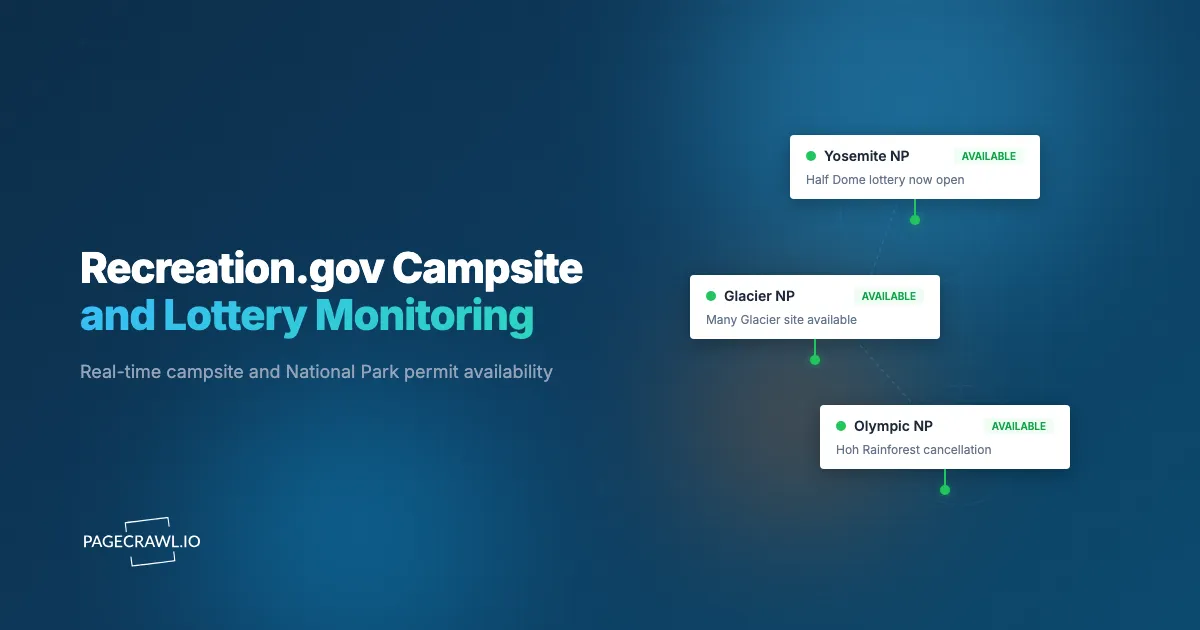
A four-person hiking group had been trying to land a Half Dome day-hike permit for three years. Every year they entered the preseason lottery, every year they lost, and every year they refreshed Recreation.gov for cancellations through the summer with no luck. In 2024, one of them set up a continuous monitor on the daily-lottery cancellation page. Three weeks into the season, at 2:14pm on a Wednesday, the page updated with two available permits for the following Tuesday. The notification hit their group chat within four minutes. They booked within seven minutes. Half Dome was on for the following week.
Recreation.gov is the gateway for federal campsite reservations, National Park permits, and lotteries like Half Dome, The Wave, Mount Whitney, and a long list of river permits. Premium campsites and permits release on tightly controlled schedules, and cancellations open within minutes of being made. Most users rely on manual refreshing of the booking pages and miss most of the openings. The serious bookers either run their own monitoring scripts or use commercial cancellation services that charge per alert.
Recreation.gov protects its booking transaction flow against automated access, but the calendar and permit information pages are publicly viewable and update reliably. Monitor those pages, not the live booking transaction, and you can catch availability on the first check after it appears.
This guide covers how Recreation.gov publishes availability, the patterns worth watching for, and how to set up a continuous monitor that puts every cancellation, lottery opening, and rolling-release window into your phone within minutes of the calendar updating.
Quick Setup
Pick a popular park or paste a campground URL, set your dates, and PageCrawl will alert you as soon as a check finds an open campsite. Checks run as often as every 2 minutes on paid plans and hourly on the free plan.
Why monitor Recreation.gov?
The combination of extreme demand and unpredictable cancellation timing makes Recreation.gov one of the highest-value use cases for personal page monitoring. Sites that look fully booked all season quietly open and close again in minutes, and nobody can refresh a calendar page around the clock.
Cancellation Availability Opens Otherwise Unbookable Spots
Premium campsites and permits show as fully booked for months, but cancellations happen continuously. Learning about a cancellation within a few minutes is the difference between a successful booking and refreshing the page for the rest of the day.
Lottery Openings Have Strict Deadlines
Half Dome, The Wave, Mount Whitney, and river permit lotteries open and close on fixed schedules. Missing a lottery opening by even a day means waiting until next year. Continuous monitoring of lottery announcement pages, the same job event schedule and date-change monitoring does for conference and booking calendars, prevents missed windows.
Rolling Release Windows Open at Predictable Times
Many campsites release reservations on rolling 6-month or 4-month windows. Knowing exactly when the release window opens lets you compete for the most desirable dates.
Holiday Week Availability Closes in Seconds
Holiday week availability at popular sites closes within seconds of release. The tightest practical check frequency you can run is the only realistic way to compete.
How does Recreation.gov publish availability?
Recreation.gov exposes each campground and permit at a stable URL with calendar and availability information rendered as part of the page, which is what makes it monitorable:
https://www.recreation.gov/camping/campgrounds/{id}
https://www.recreation.gov/permits/{id}
https://www.recreation.gov/ticket/{id}
The calendar shows date-by-date availability. When availability changes (cancellation, release, lottery opening), the page updates accordingly. PageCrawl detects the calendar text changes as content updates.
Lottery announcement pages are typically separate from the booking pages and publish open and close dates well in advance. Add lottery pages for any permit you plan to enter.
Comparing Monitoring Approaches
| Approach | Cost | Latency | Coverage | Best For |
|---|---|---|---|---|
| Manual refresh | Free | Variable | Per-page | Casual checking |
| Campnab | $$ per alert | Minutes | Recreation.gov | Single-trip cancellation hunting |
| CampScanner / similar | $$ subscription | Minutes | Recreation.gov | Active campers |
| Personal Python scripts | Engineering time | Custom | Anything | Technical users |
| PageCrawl on Recreation.gov URLs | Free tier to $80/year | 2-15 minutes | Any Recreation.gov page | Outdoor enthusiasts and tour operators |
PageCrawl provides the core monitoring capability without per-alert fees or per-trip subscription pressure. The same monitoring setup also works for any other booking or registration site you care about, like watching for open seats in full college courses during add/drop.
Setting Up Recreation.gov Monitoring in PageCrawl

Step 1: Find the campsite or permit page URL
Each campground or permit type has a stable URL on Recreation.gov. Copy the calendar or details page URL for your target.
Step 2: Add the page as a content monitor
Sign in to PageCrawl, click Track New Page, and paste the URL. Use content monitoring so calendar text changes are detected.
Step 3: Add lottery announcement pages for relevant permits
For lottery-based permits (Half Dome, The Wave, Mount Whitney, river permits), add the lottery announcement page in addition to the booking page.
Step 4: Pick a check frequency
Cancellations and lottery openings require the fastest practical check frequency, because an alert can only go out once a check has actually run against the page.
- Cancellation hunting: 15-minute checks (Standard plan). Catches most openings within 15 minutes.
- Premium site hunting: 2-minute checks (Ultimate plan). The tightest interval available, for the highest-demand sites.
- Lottery opening awareness: 60-minute checks (Free plan). Adequate for lottery window awareness.
If you only care about openings during hours you could realistically act on them, check scheduling lets you concentrate your check budget on those days and hours instead of spreading it thinly across the whole week.
Step 5: Route to fast notification channel
Recreation.gov availability evaporates quickly. Telegram, web push, or an SMS equivalent are the fastest paths from alert to booking. See the Telegram alerts guide for setup, or the help centre walkthrough on enabling browser push notifications if you want alerts on the phone in your pocket.
Step 6: Include Recreation.gov URL in the alert for one-tap booking
Configure the alert to include the booking URL so you can tap from your phone notification directly into the booking flow.
Worked Example: A Yosemite Trip Monitoring Setup
A group planning a Yosemite trip with Half Dome day-hike permits and multi-night camping typically sets up:
- Add Half Dome day-hike lottery announcement page (1 monitor).
- Add Half Dome daily lottery cancellation page (1 monitor).
- Add 3 Yosemite Valley campground booking pages (Upper Pines, Lower Pines, North Pines) (3 monitors).
- Add 2 backcountry permit pages for any longer trip extensions (2 monitors).
- Set frequency to 15 minutes on cancellation pages, daily on lottery announcement.
- Route alerts to a Telegram group with the booking URL in the alert.
Total: 7 monitors. Total cost: free or $80/year depending on frequency needs. The group gets continuous awareness across every page that matters for the trip.
Patterns Worth Watching For
Calendar transitions from unavailable to available. Highest-priority alerts. Hearing about the opening on the very next check is the difference between booking and missing.
Lottery application window openings. Lottery windows have fixed open and close dates. Missing the window means waiting until next year.
Rolling release dates. Many campsites release on rolling 6-month or 4-month windows. Knowing exactly when the release lands lets you book the most desirable dates.
Holiday and weekend openings. Holiday-week and weekend availability closes within seconds. Highest urgency.
Permit type additions. Some lottery programs add new permit types or routes mid-season. Worth catching for opportunistic booking.
Combining Recreation.gov With Other Outdoor Signals
Recreation.gov monitoring is most actionable in the broader outdoor activity context.
Combine with permit issuance pages from state parks. State park systems use parallel reservation systems with their own pages.
Combine with weather and wildfire monitoring. Pair Recreation.gov monitoring with the National Weather Service, the National Interagency Fire Center, or AirNow air quality pages for trip-day awareness.
Combine with trail conditions pages. National Park Service and US Forest Service condition pages affect trip planning.
Combine with shuttle and access road status. Some popular sites have access shuttles or seasonal road closures published on separate pages.
Combine with outfitter listing pages. Commercial outfitters operating on permitted river or backcountry trips have their own scheduling that complements Recreation.gov permits.
Who benefits most from Recreation.gov monitoring?
Anyone whose plans depend on a page they cannot watch all day: outdoor enthusiasts chasing sold-out sites, tour operators rebooking customer trips, lottery hopefuls tracking application windows, outdoor media covering park access, hiking clubs coordinating group trips, and photographers who need one specific date at one specific place.
Outdoor enthusiasts. Availability alerts on the next check for sites you have refreshed dozens of times by hand. Most monitoring setups pay for themselves the first time they land an otherwise-impossible booking.
Tour operators. Cancellation monitoring supports rebooking customer trips and securing make-up permits when original plans change.
National Park lottery hopefuls. Lottery window awareness ensures application deadlines don't slip. For first-come-first-served lottery cycles, fast notification matters even more.
Outdoor industry media. Permit and lottery availability is a frequent content topic. Media outlets use continuous monitoring to surface news on park access changes.
Hiking and camping clubs. Clubs coordinating group trips benefit from monitoring across multiple sites for trip flexibility.
Photography and adventure planning. Specific date-and-location combinations (full moon over a backcountry site, autumn foliage at a high-elevation campsite) require precise booking that monitoring enables.
Frequently Asked Questions
Does PageCrawl actually book the site for me? No. PageCrawl alerts you as soon as a check detects the availability. You book directly on Recreation.gov, which prevents automated bot-style booking and complies with Recreation.gov terms.
How quickly do cancellations appear on the calendar? Within seconds of being released by the cancelling user. PageCrawl picks up the change on the next check cycle.
Can I monitor multiple campsites in parallel? Yes. PageCrawl supports any number of Recreation.gov pages. Most users monitor 5-15 pages for a trip.
What about state park reservation systems? State park systems use their own platforms (ReserveAmerica, etc.) with their own URLs. The same monitoring approach works.
Will Recreation.gov block this kind of monitoring? PageCrawl checks public pages at reasonable frequencies. The booking transaction itself happens on Recreation.gov, which is the protected flow. Monitoring the public calendar pages is fine.
Do I need a paid plan to catch cancellations? The free plan supports 6 monitors at 60-minute checks, which catches some openings. Standard at $80/year with 15-minute checks is the practical minimum for serious cancellation hunting.
Choosing your PageCrawl plan
PageCrawl's Free plan lets you monitor 6 pages with 220 checks per month, which is enough to validate the approach on your most critical pages. Most teams graduate to a paid plan once they see the value.
| Plan | Price | Pages | Checks / month | Frequency |
|---|---|---|---|---|
| Free | $0 | 6 | 220 | every 60 min |
| Standard | $8/mo or $80/yr | 100 | 15,000 | every 15 min |
| Enterprise | $30/mo or $300/yr | 500 | 100,000 | every 5 min |
| Ultimate | $99/mo or $999/yr | 1,000 | 100,000 | every 2 min |
Annual billing saves two months across every paid tier. Enterprise and Ultimate scale up to 100x if you need thousands of pages or multi-team access.
If monitoring helps you land one holiday-week campsite, one Half Dome cancellation, or one river permit you would otherwise have waited a year for, Standard at $80/year is already paid for. 100 monitored pages covers every campground and permit page for a season of trips, and the 15-minute check frequency catches most openings within about a quarter of an hour of the calendar updating.
Getting Started
Find the campsite or permit page URL for your target trip, add it to PageCrawl on a 15-minute check, and route alerts to Telegram or web push. Create a free account and you will see the next cancellation or release window on the first check after it lands.