A real estate investor focused on three counties in the Tampa Bay area noticed a single-family home appear on the Hillsborough County foreclosure calendar with an opening bid roughly 60% of what the comparable sales suggested it should be. The property was in a target ZIP code, the address showed no obvious title issues, and the auction was set for two weeks out. The investor pulled title, walked the exterior, and was first in line at the courthouse on auction day. Two competing bidders showed up. The property closed at roughly 70% of comparable value. Total elapsed time from calendar appearance to closing: just under 21 days. None of the local investor Facebook groups had flagged it.
County foreclosure auctions remain one of the few ways to acquire real estate at meaningful discount to market. Most US counties publish auction calendars on the sheriff or county clerk website with property addresses, opening bids, and sale dates. The calendars update continuously as new properties enter the docket, others are postponed, and completed sales report out. The challenge is that each county publishes on its own schedule, with its own portal, and there is no central feed. Investors who systematically monitor target-county calendars pick up inventory earlier than the local Facebook groups, the wholesalers, and the casual auction-day spectators.
This guide covers how county foreclosure calendars work, the patterns worth watching for, and how to set up a continuous monitor across your target counties that surfaces new auction listings and sale-date shifts the day they post.
Quick Setup
Enter your county, set your max opening bid, pick property types, and PageCrawl will alert you daily as new foreclosure auctions match your criteria.
Why should investors monitor county foreclosure calendars?
Because there is no central feed and no notification: each county posts its own calendar on its own schedule, and inventory appears, gets postponed, or gets cancelled without anyone telling you. Same-day awareness of foreclosure activity in target markets is one of the highest-value monitoring use cases for real estate investors and individual buyers.
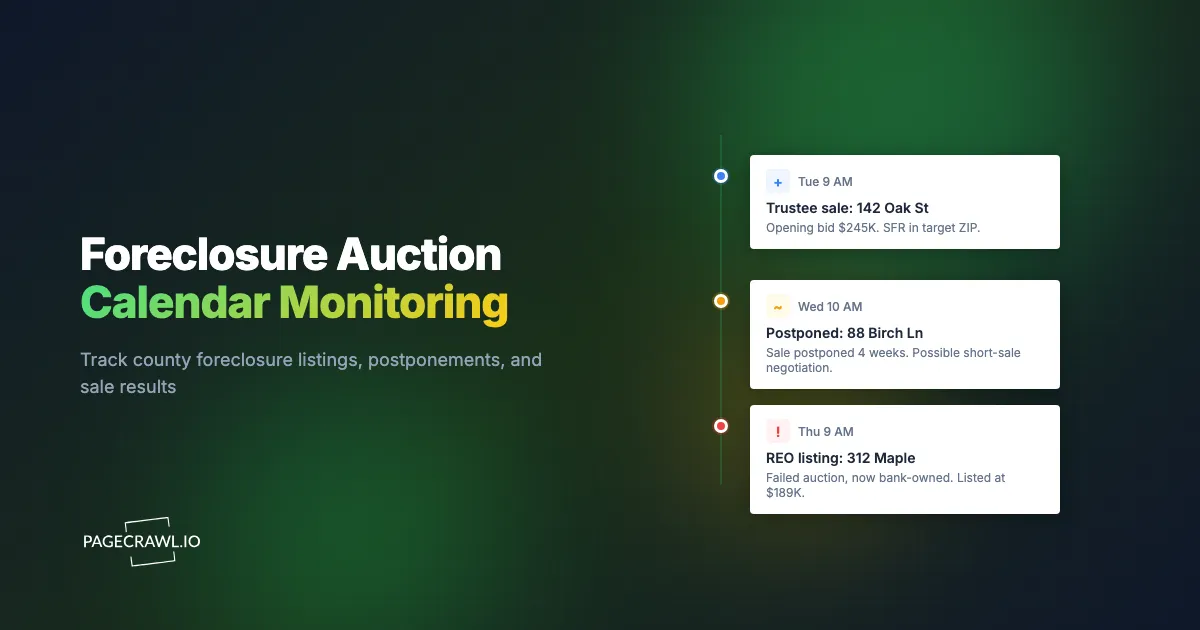
New Listings Add Inventory Before Competing Bidders See It
Foreclosure inventory typically hits the calendar a few weeks before the auction, depending on your state's notice requirements. Same-day awareness gives you maximum time for title research, property inspection, financing arrangement, and competitive positioning.
Postponements Signal Borrower-Lender Negotiations
When an expected sale is postponed, the lender and borrower may be negotiating a workout, short sale, or modification. Postponements sometimes lead to REO listings later, sometimes to short sale opportunities, sometimes to private workouts where a savvy buyer can position.
Cancellations Mean Expected Sales Will Not Occur
When a foreclosure is cancelled, the borrower has cured, refinanced, or the lender has decided against pursuing. Worth tracking because cancelled foreclosures sometimes return months later.
Sale Results Reveal Closing Prices and Market Velocity
Aggregate sale results tell you what foreclosed property is actually trading for in your submarket. This is foundational comparable data for valuing future opportunities.
How do county foreclosure calendars work?
Each county publishes its own scheduled sales, usually on the sheriff or county clerk site, as a list of rows carrying property address, opening bid, sale date, and case number. Rows change status as the process moves: scheduled, postponed, sold, or cancelled. Calendar formats vary, but the URL pattern is typically stable:
https://www.{county}.gov/sheriff/foreclosure-sales
https://www.{county}.gov/clerk/foreclosures
Each scheduled sale appears as a row with property address, opening bid, scheduled date, and case number. Sales status (scheduled, postponed, sold, cancelled) updates as the auction process progresses.
In trustee-sale states, notices of sale are also published in approved newspapers under statutory notice requirements. Some counties also publish a separate REO list for failed-auction properties returned to lender.
Foreclosure procedure is set by state law and varies widely, so confirm every sale's status directly with the county before you bid. The Consumer Financial Protection Bureau and HUD both publish plain-language explanations of the process and of borrower protections. This article is informational, not legal or investment advice.
Comparing Monitoring Approaches
| Approach | Cost | Latency | Coverage | Best For |
|---|---|---|---|---|
| Manual county checks | Free | Days | Per-county | Casual checking |
| Auction.com / Hubzu | Free / fees | Variable | National | Online auction inventory |
| RealtyTrac | $$ | Daily | National | Aggregated foreclosure data |
| County email subscriptions | Free | Inconsistent | Per-county | Light awareness |
| PropertyRadar | $$ | Daily | West-coast focus | Investor analytics |
| PageCrawl on county URLs | Free tier to $80/year | Daily | Any county page | Investors with defined target counties |
The commercial foreclosure data aggregators cover broader inventory but with multi-day latency and at meaningful subscription cost. PageCrawl gives investors same-day awareness on the specific counties that matter to their thesis at a fraction of the cost.
Setting Up Foreclosure Monitoring in PageCrawl

Step 1: Identify target counties
Pick the counties you actively pursue. Most investors have a clearly defined 3-10 county target footprint.
Step 2: Find each county's auction calendar URL
Most counties publish auction calendars on the sheriff or clerk website. The URL is typically stable, though the format varies. Find and bookmark each calendar page.
Step 3: Add each calendar as a content monitor
Sign in to PageCrawl, click Track New Page, and paste each calendar URL. Use content monitoring so new auction entries and status changes are detected.
Step 4: Add trustee sale publication pages where applicable
In trustee-sale states (California, Texas, Arizona, Nevada, others), notices are published in approved newspapers. Add the newspaper publication pages as siblings for cross-confirmation.
Step 5: Pick a check frequency
Calendar updates land during business hours. Daily checks support same-day evaluation.
- Awareness only: Daily checks for general investor coverage.
- Active acquisition strategy: 60-minute checks during the days leading up to known auction dates.
- High-velocity wholesale operation: 15-minute checks for fastest awareness.
Step 6: Wire alerts to investor channel
Route to a #foreclosure-watch Slack channel, following the help centre walkthrough on sending change notifications to a Slack channel. Alerts go out as soon as a check detects the calendar change, so the delivery window matches the frequency you picked in Step 5. PageCrawl's AI change summaries describe the property and status change for triage.
Worked Example: A Multi-County Foreclosure Investor's Watch
A regional investor active in 5 Florida counties typically sets up:
- Add the foreclosure auction calendar for each county sheriff or clerk site (5 monitors).
- Add the REO list page for each county where lenders publish post-auction inventory (5 monitors).
- Add the foreclosure notice page in the approved local newspaper for each county (5 monitors).
- Set frequency to daily.
- Route alerts to
#foreclosure-pipelineSlack channel with county-specific tagging.
Total: 15 monitors. Total cost: $80/year. The investor gets continuous awareness across the full target footprint with a single channel.
Patterns Worth Watching For
New listings in target ZIP codes or price ranges. Highest-priority alerts. Same-day awareness drives title and inspection workflow.
Postponements of major properties. Postponed sales sometimes indicate borrower-lender negotiation. Worth tracking for short sale or REO follow-up.
Opening bid changes. Lenders sometimes adjust opening bids between calendar appearance and auction date. Lower opening bids signal lender flexibility.
REO listings after failed auctions. Properties that fail at auction return to lender as REO and often list within weeks, where real estate listing monitoring picks up the price drops and status changes. Same-day awareness positions you for the REO listing.
Multi-county pattern detection. When foreclosure volume rises across multiple target counties simultaneously, broader market stress may be emerging.
Combining Foreclosure Monitoring With Other Real Estate Signals
Foreclosure monitoring is most actionable in the broader real estate intelligence context.
Combine with permit monitoring. Pair with our local zoning and planning permit monitoring guide for development opportunity overlap.
Combine with commercial listings. Pair with our LoopNet and Crexi commercial real estate listing alerts guide for multifamily and commercial foreclosure adjacency.
Combine with rural land listings. Pair with our rural land and recreational property listing alerts guide for rural foreclosure opportunities.
Combine with title and tax delinquency lists. Some counties publish tax delinquency lists that lead foreclosure pipelines by a year or more, which is the same government and public records monitoring pattern applied a step earlier in the cycle.
Combine with court docket monitoring. Foreclosure court dockets capture filings before they reach the auction calendar. Where accessible, these are higher-signal than the auction calendar itself.
Use Cases
Real estate investors. Same-day inventory awareness in target markets drives acquisition pipeline. Most investors find that one well-positioned auction win pays for years of monitoring cost.
Buyer's agents. Foreclosure activity informs comparable analysis and supports buyer client representation in distressed transaction strategy.
Title companies. Calendar monitoring supports proactive title work and pre-auction title insurance underwriting.
Market researchers and analysts. Foreclosure volumes are a leading housing market indicator. Continuous monitoring across multiple markets supports trend analysis.
Wholesale operators. Wholesalers reselling distressed inventory rely on same-day calendar awareness to identify and lock up assignment opportunities.
Foreclosure attorneys. Defense attorneys representing borrowers use calendar monitoring to identify cases where they may be retained.
Frequently Asked Questions
How quickly do new auctions appear on county calendars? Within days of court filing. Some counties update daily, others weekly. PageCrawl picks up changes on the next check.
Can I monitor multiple counties in a single account? Yes. PageCrawl supports any number of county calendars. Most investors monitor 3-10 counties.
What about non-judicial foreclosure states? In non-judicial states, the trustee sale process publishes notices through different channels (newspapers, dedicated foreclosure sites). Monitor the relevant publication pages.
Can I get alerts only for properties under a certain price? By default PageCrawl alerts on every change, but notification conditions and filters let you narrow alerts to keyword matches such as a target ZIP code or street name. AI summaries describe the listing so you can filter by price in your channel.
What about online auction platforms? Online auction platforms (Auction.com, Hubzu) and government surplus auction sites like GovDeals and GSA Auctions expose search URLs that can also be monitored. Add as siblings to county calendar monitoring.
Do I need a paid plan for foreclosure monitoring? The free plan supports 6 monitors, enough for a small target footprint. Standard at $80/year supports a full multi-county watch with REO and newspaper siblings.
Choosing your PageCrawl plan
PageCrawl's Free plan lets you monitor 6 pages with 220 checks per month, which is enough to validate the approach on your most critical pages. Most teams graduate to a paid plan once they see the value.
| Plan | Price | Pages | Checks / month | Frequency |
|---|---|---|---|---|
| Free | $0 | 6 | 220 | every 60 min |
| Standard | $8/mo or $80/yr | 100 | 15,000 | every 15 min |
| Enterprise | $30/mo or $300/yr | 500 | 100,000 | every 5 min |
| Ultimate | $99/mo or $999/yr | 1,000 | 100,000 | every 2 min |
Annual billing saves two months across every paid tier. Enterprise and Ultimate scale up to 100x if you need thousands of pages or multi-team access.
If monitoring helps you land one foreclosure auction property you would otherwise miss, Standard at $80/year is already paid for. 100 monitored pages covers every county auction calendar and trustee notice page in your target markets, and the 15-minute check frequency catches most calendar additions the day they post.
Getting Started
Pick the counties you target, find each foreclosure calendar URL, and add them to PageCrawl on a daily check. Create a free account and the next auction listing or postponement will arrive in your channel the day it lands.