Your competitor published a product demo video three weeks ago. It now has 200,000 views and is ranking for keywords your team has been targeting in blog posts. Their comment section is full of potential customers asking questions. Your team had no idea the video existed until a customer mentioned it in a sales call.
YouTube is one of the most-used search and discovery surfaces on the web and a primary content platform for nearly every industry. Competitors use it for product launches, thought leadership, customer education, recruitment, and brand building. A competitor's YouTube activity reveals strategic priorities, messaging shifts, audience engagement levels, and content investments that other intelligence sources miss entirely.
Yet most competitive intelligence programs overlook YouTube. Teams track competitor websites, social media posts, and press releases, but YouTube channels go unmonitored. Videos are published, descriptions are updated, playlists are reorganized, and community posts go live without anyone on your team noticing.
This guide covers why YouTube competitor monitoring matters, what specifically to track, how to set up automated monitoring, and how to turn YouTube intelligence into actionable strategy.
Why should you monitor competitor YouTube channels?
Because a competitor's YouTube channel broadcasts strategy before their website or press releases do. Uploads reveal positioning shifts, demo videos leak features and pricing hints, engagement metrics show what the shared audience cares about, and ad creative often appears on the channel first. None of it triggers a notification for you.
Content Strategy Signals
The videos a competitor publishes reveal their strategic priorities. A sudden shift from product tutorials to thought leadership content suggests a repositioning effort. An increase in customer testimonial videos might indicate a push for social proof ahead of a major sales campaign. A series of comparison videos targeting specific competitors (possibly including you) signals a new competitive positioning.
Monitoring video uploads and titles over time reveals these patterns before they become obvious through other channels, the video equivalent of content monitoring across blogs and editorial pages. By the time a competitor's YouTube strategy shows results in their market positioning, you have already missed weeks or months of lead time.
Product and Feature Announcements
Many companies announce new products or features through YouTube videos before or alongside traditional channels. Demo videos, walkthroughs, and announcement videos often contain details that press releases omit, including user interface screenshots, pricing hints, integration demonstrations, and roadmap previews.
Catching these videos early gives your product and marketing teams time to prepare responses, whether that means accelerating your own feature development, adjusting messaging, or preparing sales team battle cards.
Audience Engagement Intelligence
YouTube's public engagement metrics (views, likes, comments) provide direct insight into what resonates with your shared audience. A competitor's video that attracts unusually high engagement suggests a topic or format that the audience cares about. Low engagement on certain topics suggests areas of limited interest.
Comment sections are particularly valuable. Customers ask questions, express frustrations, and request features in YouTube comments. Monitoring these conversations reveals unmet needs that your product or marketing can address.
Ad Strategy Insights
Competitors running YouTube ad campaigns often publish the ad creative as unlisted or public videos on their channel. Monitoring new video uploads catches these ads, revealing messaging, targeting themes, value propositions, and promotional offers that inform your own advertising strategy.
What should you monitor on a competitor's YouTube channel?
Watch six things: the channel main page, the videos tab, individual video descriptions, playlists, community posts, and the About section. Each surface reveals a different kind of intelligence, so pick the ones that match the question you are trying to answer rather than monitoring everything at once.
Channel Main Page
The channel's main page (youtube.com/@channelname) shows the channel's current presentation: featured video, channel description, subscriber count, total videos, and highlighted content. Changes to this page reflect strategic decisions about how the competitor wants to be perceived.
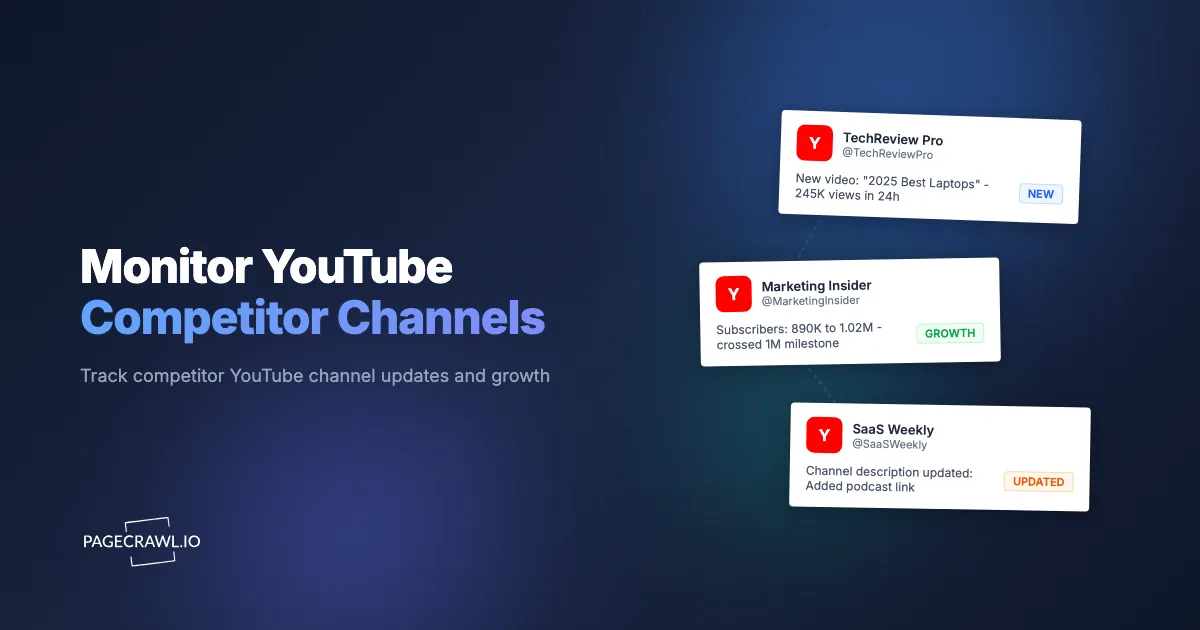
Monitor the main page for changes to the channel description (which often reflects positioning shifts), the featured video (which indicates current priorities), and subscriber count milestones.
Videos Tab
The videos tab lists all public uploads in reverse chronological order. This is the primary source for detecting new content. When a competitor publishes a new video, the videos tab changes.
Monitoring this page catches new uploads within your check frequency. Combined with content-only monitoring mode, PageCrawl detects new video titles and descriptions as they appear.
Video Descriptions and Metadata
Individual video descriptions often contain important details: product links, promotional codes, event announcements, partnership mentions, and calls to action. Competitors update video descriptions over time, adding new links, updating pricing, or revising messaging.
Monitoring specific high-value videos catches description updates that might indicate changing strategies or new promotions. For technical details on monitoring specific page elements, see our CSS selector guide.
Playlists
Playlist organization reveals how a competitor categorizes and prioritizes their content. A new playlist titled "Enterprise Solutions" or "Migration from [Your Product]" is a direct competitive signal. Changes to playlist order or composition suggest shifting priorities.
Community Posts
YouTube's community tab allows channels to post text updates, polls, images, and links. These posts often announce upcoming content, gather audience feedback, or share news. Community posts are easy to miss because they do not appear in standard YouTube subscription feeds as prominently as videos.
About Section
The About section contains the channel description, business email, links to other social profiles, and sometimes location information. Changes here can signal rebranding, new partnerships, or shifted focus areas.
How do you track a YouTube channel's RSS feed?
Point a monitor at https://www.youtube.com/feeds/videos.xml?channel_id=CHANNEL_ID and track it in feed mode. YouTube publishes a feed for every channel, and it is the most reliable way to detect new uploads, because the feed is a small XML document rather than a JavaScript-heavy page. PageCrawl's feed tracking mode for RSS, Atom, and sitemaps treats each video as a separate item, so you are alerted about additions rather than about raw text differences. That makes it the recommended starting point for YouTube channel monitoring.
How YouTube RSS Feeds Work
Every YouTube channel has an RSS feed at a predictable URL format:
https://www.youtube.com/feeds/videos.xml?channel_id=CHANNEL_IDThe channel ID is a string starting with "UC" found in the channel's URL or page source, and the YouTube Help Center explains where a channel's advanced settings expose it. This feed lists the most recent 15 videos with their titles, descriptions, publication dates, and thumbnail links.
Setting Up RSS Monitoring
PageCrawl can monitor RSS feeds directly. Add the YouTube RSS feed URL as a monitor, and PageCrawl tracks changes to the feed content. When a new video appears in the feed, you receive an alert with the video title and description. For more on this approach, see our guide to RSS feed monitoring.
RSS monitoring is fast and lightweight. Because these feeds are plain XML documents in the Atom syndication format, they load quickly and reliably. The limitation is that RSS only covers the 15 most recent videos and does not capture changes to existing videos, channel descriptions, playlists, or community posts.
RSS vs Web Page Monitoring
RSS monitoring and web page monitoring serve complementary purposes:
RSS Monitoring: Best for catching new video uploads quickly with minimal resource usage. Simple to set up, reliable, and fast.
Web Page Monitoring: Best for tracking changes to existing content, channel presentation, playlists, community posts, and engagement metrics. Captures information that RSS feeds do not include.
For comprehensive competitor YouTube monitoring, use both approaches. RSS provides fast new-video alerts while web page monitoring captures everything else.
Setting Up YouTube Monitoring with PageCrawl
PageCrawl handles the technical challenges of monitoring YouTube pages, including dynamic content loading and JavaScript-heavy page rendering.

Monitoring the Videos Page for New Uploads
Step 1: Navigate to the competitor's YouTube channel and click the "Videos" tab. Copy the URL (it will look like youtube.com/@channelname/videos).
Step 2: Add the URL to PageCrawl. Select reader mode, which extracts the main content from the page and strips away navigation, ads, and sidebar elements. Reader mode is particularly effective for YouTube channel pages because it focuses on the video titles and descriptions while filtering out recommended videos, ad placements, and other peripheral content that changes on every visit.
Step 3: Set your check frequency. For active channels that post multiple times per week, check every 6-12 hours. For channels that post weekly or less, daily checks are sufficient.
Step 4: Configure notifications. For competitive intelligence, email digests work well for weekly review. For time-sensitive competitors (such as those likely to announce products or run promotions), use faster channels like Slack or Telegram.
When a new video appears on the channel, PageCrawl detects the change and sends you an alert with the video title and relevant details.
Monitoring Individual Video Pages
For high-value competitor videos (product demos, pricing pages, comparison content), monitor the individual video page:
Step 1: Navigate to the specific video on YouTube and copy the URL.
Step 2: Add the URL to PageCrawl using fullpage monitoring mode to capture the video description, title, and surrounding content.
Step 3: Set daily or weekly monitoring depending on how frequently you expect changes.
This catches description updates, title changes, pinned comment modifications, and other metadata changes that indicate strategic adjustments.
Monitoring Channel Descriptions and About Pages
The channel's About page changes less frequently than video content, but changes are often strategically significant. Monitor the About page with weekly checks. Changes to the channel description, business email, or linked websites indicate positioning shifts or organizational changes.
Combining RSS and Page Monitoring
For the most comprehensive coverage, set up two monitors per competitor channel:
- RSS feed monitor: Catches new video uploads within hours. Lightweight and reliable.
- Videos page monitor: Catches visual changes, playlist updates, and content reorganization that RSS misses.
This combination ensures you miss nothing while keeping resource usage reasonable.
Building a Competitor Content Dashboard
Monitoring YouTube channels alongside other competitive intelligence sources creates a comprehensive view of competitor activity.
Organizing YouTube Monitors
Use PageCrawl folders to organize your YouTube monitors by competitor. Within each competitor folder, group monitors for their website, social profiles, and YouTube channel. This organizational structure makes it easy to see all activity from a single competitor in one place. The help centre guide to organizing monitored pages with labels, folders, and workspaces covers how the hierarchy works.
For details on organizing monitors and building dashboards, see our guide to building custom monitoring dashboards.
Webhook Integration for Content Databases
PageCrawl's webhook notifications send structured data about detected changes. You can pipe this data into a database, spreadsheet, or content management system to build a historical record of competitor content activity.
Over time, this database reveals publishing frequency, topic focus areas, content format preferences, and seasonal patterns. These insights inform your own content strategy. For setup details, see our guide to webhook automation.
Correlating YouTube Activity with Other Signals
YouTube activity rarely happens in isolation. A competitor publishing a product demo video often coincides with website updates, social media campaigns, and press outreach. By monitoring YouTube alongside their website changes, you build a timeline of coordinated competitive activity.
This timeline helps you understand the competitor's go-to-market playbook: how they sequence announcements, which channels they prioritize, and how quickly they execute campaigns.
Which teams get the most out of YouTube monitoring?
Marketing, content and agency teams, product teams, and newsrooms each pull different value from the same monitors. Marketing tracks messaging and campaign timing, product teams mine demos and comments for features, creators watch formats and collaborations, and journalists use channels as a source feed.
Marketing Teams
Marketing teams use YouTube monitoring to track competitor messaging evolution, identify successful content formats, discover trending topics in the industry, and benchmark their own content performance against competitors.
Content Gap Analysis: If a competitor publishes a series of educational videos on a topic you have not covered, that is a content gap worth addressing. Monitoring catches these gaps as they develop rather than after the competitor has established authority.
Campaign Timing: Detecting a competitor's video campaign launch gives you time to respond with your own content or adjust planned campaigns to avoid being overshadowed.
Content Creators and Agencies
Independent creators and content agencies monitor competitor channels to stay aware of trending formats, successful thumbnails, title patterns that drive engagement, and emerging topics before they become saturated.
Format Innovation: When a competitor adopts a new video format (shorts, long-form deep dives, live streams) and it performs well, that signals audience appetite for that format.
Collaboration Intelligence: Monitoring video descriptions and community posts reveals collaborations and partnerships that might represent opportunities for your own outreach.
Product Teams
Product teams monitor competitor YouTube channels for feature demonstrations, roadmap hints, user feedback in comments, and competitive positioning.
Feature Discovery: Product demo videos often show capabilities that are not prominently featured on the competitor's website. Monitoring these videos gives product teams early awareness of competitive features.
User Feedback Mining: YouTube comments on competitor product videos are an unfiltered source of user opinions. Comments requesting features, reporting bugs, or comparing products provide direct competitive intelligence.
Media Companies and Journalists
Media organizations monitor YouTube channels for breaking news, source material, exclusive content, and trend detection.
Source Monitoring: Journalists covering specific companies or industries track their YouTube channels alongside press pages for early access to announcements and visual material, which is the wider job of media monitoring for journalists and press pages.
Trend Detection: Monitoring multiple channels in a category reveals emerging trends based on what creators are publishing and what audiences are engaging with.
YouTube Monitoring for Reputation Management
Beyond competitive intelligence, YouTube monitoring supports brand reputation management.
Monitoring Mentions of Your Brand
Set up monitors for YouTube search results pages for your brand name and product names. When new videos mentioning your brand appear in search results, you receive an alert. This catches reviews, comparisons, complaints, and endorsements. For a broader approach to reputation monitoring, see our guide to online reputation monitoring.
Review and Comparison Video Tracking
Product review videos can significantly influence purchasing decisions. Monitoring YouTube search results for "[your product] review" or "[your product] vs [competitor]" catches new reviews as they appear, giving your team time to respond in comments, prepare counter-messaging, or engage with the reviewer.
What are the common challenges with YouTube monitoring?
Four things trip up YouTube monitors: pages that build themselves with JavaScript, elements that change on every visit (view counts, recommendations, ads), rate limiting when you check too aggressively, and unlisted videos that never appear on the public channel page. Each has a straightforward fix.
Dynamic Page Loading
YouTube pages load content dynamically using JavaScript. Not all monitoring tools handle this effectively. PageCrawl renders pages fully before analyzing content, ensuring that dynamically loaded elements like video titles, descriptions, and subscriber counts are captured accurately.
Frequent Minor Changes
YouTube pages contain elements that change on every visit: view counts, ad placements, recommended videos, and timestamps. These minor changes can trigger false alerts if monitoring is not configured correctly.
Solution: Use content-only monitoring mode to focus on the channel's actual content rather than peripheral page elements. This filters out noise from ads, recommendations, and view count updates.
Rate Limiting and Access
YouTube may rate-limit or restrict access to pages that receive too many automated requests.
Solution: Use reasonable check frequencies. Checking a channel page every 6-12 hours is sufficient for most competitive intelligence needs and stays well within normal access patterns.
Unlisted and Private Content
Competitors may publish unlisted videos (accessible via direct link but not visible on the channel page) or private videos. Monitoring the public channel page cannot detect these. However, unlisted videos shared in newsletters, social media, or embedded on websites can be monitored individually if you obtain the direct URL.
Choosing your PageCrawl plan
PageCrawl's Free plan lets you monitor 6 pages with 220 checks per month, which is enough to validate the approach on your most critical pages. Most teams graduate to a paid plan once they see the value.
| Plan | Price | Pages | Checks / month | Frequency |
|---|---|---|---|---|
| Free | $0 | 6 | 220 | every 60 min |
| Standard | $8/mo or $80/yr | 100 | 15,000 | every 15 min |
| Enterprise | $30/mo or $300/yr | 500 | 100,000 | every 5 min |
| Ultimate | $99/mo or $999/yr | 1,000 | 100,000 | every 2 min |
Annual billing saves two months across every paid tier. Enterprise and Ultimate scale up to 100x if you need thousands of pages or multi-team access.
Catching a competitor's product demo or announcement video the same day it is published, rather than weeks later via word of mouth, is the kind of lead time that changes how your team responds. Standard at $80/year gives you 100 pages, enough for RSS feed monitors and channel page monitors across every competitor YouTube channel you care about and then some. Enterprise at $300/year fits content and product teams tracking a large number of channels across multiple markets, with 500 pages, 5-minute checks, and SSO support.
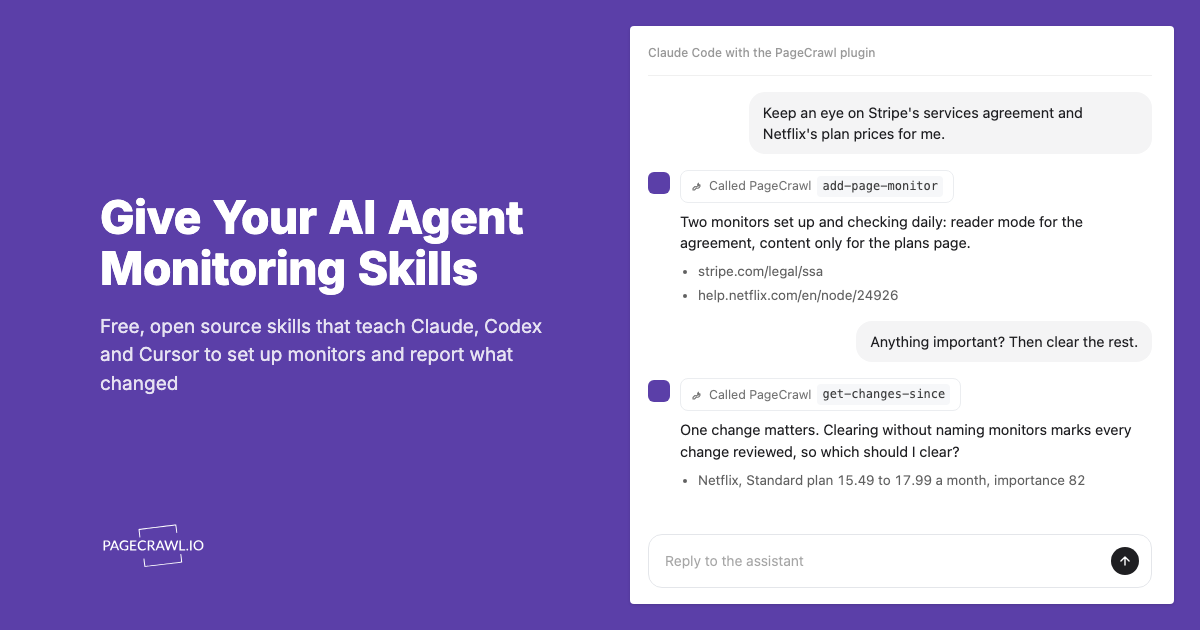
All plans include the PageCrawl MCP Server, so you can ask "what did our competitors publish on YouTube this month?" and get a structured summary pulled from your monitoring archive. AI assistants can create monitors through conversation on every plan, including Free.
Getting Started
Choose three to five competitor YouTube channels that are most relevant to your business. For each channel, set up two monitors: one for the channel's RSS feed (for fast new-video detection) and one for the videos page (for comprehensive change tracking).
Configure email notifications for a weekly review cadence. Each week, review the alerts and note patterns: publishing frequency, topics covered, engagement levels, and any strategic shifts in messaging or positioning.
As you develop a rhythm, expand monitoring to include specific high-value videos, competitor channel About pages, and YouTube search results for your brand and product names. Use PageCrawl folders to organize monitors by competitor for clean reporting.
For competitive intelligence context beyond YouTube, combine this monitoring with LinkedIn page tracking and comprehensive competitor website monitoring for a complete view of competitor activity.
PageCrawl's free tier includes 6 monitors, enough to track two or three competitor YouTube channels with RSS and page monitoring. The Standard plan at $80/year provides 100 monitors for teams tracking multiple competitors across YouTube and other platforms. The Enterprise plan at $300/year covers 500 monitors for agencies and enterprises running comprehensive competitive intelligence programs.
Start monitoring your competitors' YouTube channels today. The videos they publish tomorrow will tell you where they are heading.