Ana runs trade compliance for a machinery importer in North Rhine-Westphalia. Her company brings in steel castings and aluminium extrusions from three continents, and since 1 January 2026 every one of those consignments sits inside the definitive Carbon Border Adjustment Mechanism regime. Her calendar has the annual declaration date on it. Her supplier questionnaires are out. She thought she was ahead.
Then a colleague forwarded a law firm alert about a revised guidance document for authorised CBAM declarants. The PDF on the Commission's own site had been quietly replaced eleven days earlier, and a worked example on installation-level emissions data had changed in a way that invalidated the calculation template Ana had already sent to four suppliers. Nobody emailed her. There was no press release. The file name was identical. Only the content and the "last updated" line had moved.
That is the shape of the CBAM problem. The obligation is simple at a high level: importers of covered goods report embedded emissions and, from the definitive regime, buy and surrender certificates against them. The operational detail, though, lives in guidance documents, registry notices, FAQ pages, and implementing acts that change on their own schedule, usually without any notification reaching the people who have to comply.
This guide covers what actually changes in the CBAM regime, which official pages are worth watching, how to structure monitors so registry guidance and scope proposals reach you on the next check rather than the next quarterly briefing, and how to keep timestamped evidence of what the rules said on the day you relied on them.
What is CBAM and what changed in the definitive regime?
CBAM is the EU's carbon border levy on imports of carbon-intensive goods. Since 1 January 2026 it applies under its definitive regime, according to the European Commission's Taxation and Customs Union pages. The transitional phase of quarterly reports with no financial charge is over. Importers now need authorised declarant status, verified emissions data, and CBAM certificates.
From quarterly reports to an annual declaration with money attached
During the transitional phase that ran from October 2023, importers filed quarterly CBAM reports and paid nothing. The definitive regime replaces that with a single annual CBAM declaration covering the previous calendar year, and the emissions in it have to be verified by an accredited verifier. Reported figures now carry a price, because the declarant surrenders CBAM certificates matching the embedded emissions of the goods imported.
The Commission set the annual declaration deadline at 30 September of the following year, meaning the first declaration covering 2026 imports falls due on 30 September 2027, with the matching certificate surrender on the same date and certificate sales opening on 1 February 2027. That date was moved from an earlier 31 May date, which is exactly the kind of change that breaks an internal compliance calendar built once and never revisited.
Authorised CBAM declarant status is a gate, not a formality
Only an authorised CBAM declarant can bring covered goods into the customs territory. Importers apply through the CBAM Registry, and the national competent authority in their member state processes the application. That means two moving targets rather than one: the Commission's central guidance on what the application needs, and the member state authority's own procedural notes, forms, and contact points, which are published nationally and updated on national timetables.
Which sectors are covered
The mechanism covers cement, iron and steel, aluminium, fertilisers, electricity, and hydrogen, defined by customs codes rather than by product descriptions. The customs code list is the part that matters operationally. A single added or removed code can pull a component your company has imported for years into scope, or push it out, and nothing about the physical product changes to warn you.
Which official CBAM pages should you monitor?
Monitor the Commission's CBAM hub and its sub-pages for the definitive regime, the registry, and legislation and guidance, plus EUR-Lex for the amending acts themselves and your national competent authority page. Those five sources carry nearly every operational change that will reach you as a surprise otherwise.
The Commission's CBAM pages
The Carbon Border Adjustment Mechanism section of the Taxation and Customs Union site is the primary source. It branches into pages for the definitive regime, the CBAM Registry, sectors, verification, the price of CBAM certificates, and legislation and guidance. The legislation and guidance page is the highest-value monitor of the set, because that is where revised guidance documents for declarants and for third-country installation operators are published or replaced.
Watch these as separate monitors rather than one. A change on the certificate price page means something different to your finance team than a change on the verification page means to your data team, and separate monitors let you route the alerts to different people.
EUR-Lex for the legal text
The guidance explains; the legal act binds. The amending regulation adopted under the EU simplification package, Regulation (EU) 2025/2083, was published in the Official Journal on 17 October 2025 and amended the founding CBAM Regulation (EU) 2023/956. Implementing and delegated acts continue to arrive on their own cadence. Monitoring a saved search or a document page on EUR-Lex gives you the authoritative text on the day it publishes rather than a summary of it weeks later.
Your national competent authority
Every member state designates a national competent authority that handles declarant authorisation and enforcement in that country. Their pages carry the forms, the queue times, the local guidance, and the enforcement signals. If you import through more than one member state, you have more than one of these to watch, and they do not update in step with each other or with Brussels. Add your national customs administration alongside them, since notices about how CBAM goods are declared at import surface there first, and add your customs broker's notice page if declarations run through one.
Why do CBAM changes slip past compliance teams?
Because most CBAM changes are silent edits to existing pages and documents rather than announcements. A guidance PDF is replaced under the same file name, an FAQ answer is rewritten, a customs code list gains a line. There is no email, no RSS item, and often no visible date change, so a manual reader sees nothing.
Silent document replacement
Guidance documents are the worst offender. A revised version keeps the same URL, so a bookmark still resolves and looks current. The only way to know it moved is to compare the current content against what you saw last time, which is precisely what content monitoring does and precisely what nobody has time to do by hand across twenty documents.
Practical CBAM questions also get answered in FAQ and question-and-answer documents that nobody treats as legislation but everybody follows. When an answer about default values, indirect emissions, or the treatment of a specific production route is rewritten, it changes what your suppliers must give you, and those edits rarely carry a version number.
Deadlines that move
The annual declaration date moving to 30 September of the following year is the headline example, but the same applies to registry availability windows, certificate sale start dates, and the transitional accommodations that phase out over the first years of the definitive regime. A compliance calendar is a snapshot of the rules on the day it was built. Without monitoring, it silently drifts out of date.
Newsletters and advisers arrive after the fact
Law firm alerts and industry newsletters are useful, but they are downstream. Someone has to notice the change, write it up, get it through review, and send it. That is typically days to weeks. Where the change affects a document you have already circulated to suppliers, those days are the difference between correcting the request and collecting the wrong data all quarter. This is the general problem covered in our guide to regulatory horizon scanning: the further a signal travels from the source before it reaches you, the less time you have to act on it.
What should you actually track on each CBAM page?
Track four things: dates, numbers, covered product codes, and the wording of obligations. Everything else on a Commission page is navigation, cookie notices, and social links that will generate noise. Narrowing each monitor to the substance is what turns a page watcher into a usable compliance feed.
| What to track | Where it lives | Why it matters |
|---|---|---|
| Deadline dates | Definitive regime page, registry page, guidance PDFs | Declaration, surrender, and certificate sale dates drive your internal calendar |
| Covered customs codes | Sectors page, annexes to the regulation on EUR-Lex | A code added or removed changes which of your parts are in scope |
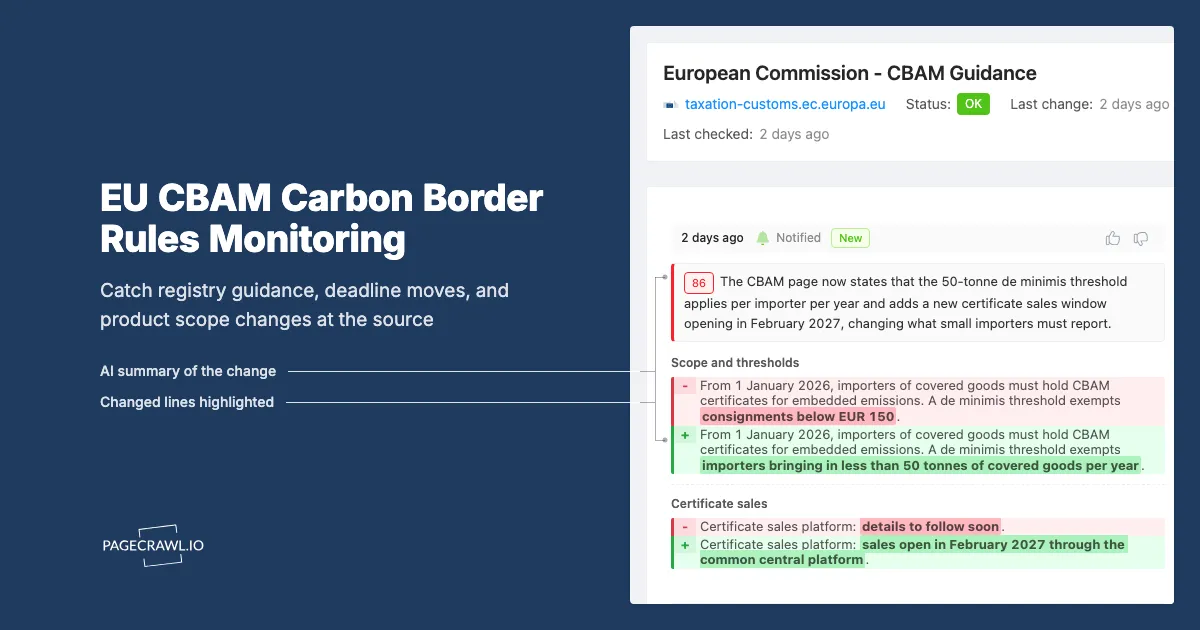
| Thresholds and exemptions | Legislation and guidance page, amending acts | The de minimis mass threshold decides whether you are in scope at all |
| Guidance document versions | Legislation and guidance page | Worked examples and default values feed your supplier data requests |
| Registry procedures | CBAM Registry page, national authority pages | Application steps, required attachments, and access changes |
| Certificate pricing method | Price of CBAM certificates page | Cost exposure per tonne of embedded emissions |
The de minimis threshold is a scope decision, not a detail
The simplification package introduced a single mass-based de minimis threshold: importers bringing in 50 tonnes or less of covered goods per year are exempt, with hydrogen and electricity excluded from that exemption. For an importer sitting near the line, the exact wording of that threshold, how the mass is cumulated, and any subsequent amendment to it decides whether the whole compliance programme applies. That makes the pages carrying it worth a dedicated monitor with a numeric alert rule.
Proposed scope extension to downstream goods
On 17 December 2025 the Commission proposed extending CBAM to roughly 180 downstream steel- and aluminium-intensive product categories from 1 January 2028, together with a new concept of abusive practices aimed at circumvention. The proposal has to go through the ordinary legislative procedure, so its content can change substantially between proposal and adoption. For a machinery, appliance, or construction products importer, this is the single most consequential CBAM file in progress, and it is worth monitoring the legislative procedure page and the Commission communications rather than waiting for the final act.
How do you set up CBAM monitoring in PageCrawl?
Add each official CBAM page as its own monitor, pick a tracking mode that matches the page type, check daily on the guidance and registry pages, and route alerts to the channel your compliance team already reads. Setup takes about fifteen minutes for a full CBAM watchlist and then runs without maintenance.
- Add the URL. Start with the Commission's CBAM legislation and guidance page, then add the definitive regime page, the registry page, and the sectors page as separate monitors. Copy each URL from your browser exactly as it resolves, including the language suffix, so the monitor watches the same version you read.
- Pick the tracking mode. Use reader mode for long-form guidance and legal text so the monitor extracts the main body and ignores menus and footers. Use PDF extraction for guidance documents and annexes published as PDFs, so a replaced file is compared on its contents rather than on its file name. Use specific text tracking when you only care about one block, such as the deadlines section of the definitive regime page.
- Set check frequency. Daily is right for guidance, registry, and national authority pages. Move to the fastest frequency your plan allows in the weeks around a known deadline or a pending vote, when a same-day change is likeliest to matter. Checks run as often as every 2 minutes on the highest plans, though CBAM rarely needs that.
- Choose notification channels. Send alerts to email for the record, and to Slack, Microsoft Teams, Discord, or Telegram for the channel your team actually watches during the working day. Webhooks push the change into a GRC platform, a ticketing system, or a compliance register so each alert becomes a tracked item rather than a message someone scrolls past.
- Add keyword and threshold rules. Attach conditions so alerts fire on substance: keywords such as "authorised declarant", "annual declaration", "surrender", "default values", "verification", or the CN codes you import under. On numeric pages, set a threshold rule so a change to the de minimis tonnage or a certificate price figure raises a higher-priority alert. Our walkthrough of conditional alerts using price, keyword, and threshold rules covers the mechanics.
- Group the monitors in a folder. Put everything under a folder named for the obligation, for example "CBAM", with tags for source type (Commission, EUR-Lex, national authority, customs). When an auditor asks how you track the regime, the folder is the answer.
- Turn on screenshot capture and history. Every check keeps a timestamped record of what the page said. That archive is the evidence that on the date you built your calculation template, the guidance said what you say it said.
Routing alerts to the right person
CBAM changes land on different desks. Certificate pricing is a finance question, verification and installation data is an operations question, customs codes are a trade compliance question, and the downstream scope proposal is a strategy question. Set the notification channel per monitor rather than sending everything to one shared inbox, which is the routing discipline that makes a multi-source programme workable, as covered in our guide to tracking multiple regulatory websites.
How does CBAM monitoring fit into a wider compliance programme?
CBAM sits at the intersection of trade compliance and sustainability reporting, so the same monitors feed both. The customs code and duty side overlaps with tariff monitoring, the emissions data side overlaps with climate disclosure work, and the evidence trail serves both audits. One watchlist covering both avoids duplicated effort and split ownership.
Overlap with tariff and customs monitoring
CBAM liability attaches to goods identified by customs codes, so the people already watching duty rates and classification changes are watching adjacent pages. If your team tracks tariff schedules, the CBAM annexes belong in the same review cycle. Our guide to tariff and trade policy monitoring for import duty changes covers that side of the workflow, and the two watchlists share sources, owners, and escalation paths.
Overlap with sustainability reporting
The embedded emissions data you collect from suppliers for CBAM is closely related to the scope 3 information sustainability teams gather for climate disclosure. Where a CBAM guidance change alters what suppliers must provide, that ripples into disclosure work too. Our guide to monitoring ESG and climate disclosure requirements covers the disclosure side, and running both watchlists in one place means a single guidance change reaches both teams on the same alert.
Evidence for the audit
Verified declarations invite scrutiny. Being able to show the exact wording of the guidance on the date you relied on it, with a timestamp and a screenshot, is a materially stronger position than saying you remember it differently. Unlimited history and timestamped captures turn your monitoring log into an audit artefact, which is the same argument made in our guide to environmental regulation monitoring.
What mistakes should you avoid when monitoring CBAM?
The common failures are monitoring the whole page instead of the substance, watching only Brussels and ignoring national sources, treating a single alert as the end of the process, and setting the watchlist up once and never revising it as the regime matures.
Monitoring the whole page
Commission pages carry navigation, language switchers, and related-content blocks that change without meaning anything, and a full-page monitor on one of these produces alerts nobody reads within a fortnight. Use reader mode, or narrow the monitor to the section that carries the obligation, and mark the noisy regions to be ignored after the first false alarm.
Watching Brussels only
The Commission publishes the rule. Your national competent authority and your national customs administration publish how it is applied to you, including forms, queues, and enforcement posture. Teams that monitor only the central pages get the principle on time and the procedure late, which is the half that determines whether your declaration is accepted.
Treating the alert as the deliverable
An alert says something changed. Somebody still has to read the diff, decide whether it affects your goods, update the calendar or the supplier request, and record the decision. Push alerts into a system where each one becomes a task with an owner. A feed of unread notifications is not a compliance programme.
Freezing the watchlist
CBAM is still being built out. New implementing acts, the pending downstream scope proposal, and further guidance mean pages appear that did not exist when you set up. Review the watchlist quarterly, add the pages the last quarter's changes pointed at, and retire monitors on pages that have gone static.
Choosing your PageCrawl plan
PageCrawl's Free plan lets you monitor 6 pages with 220 checks per month, which is enough to validate the approach on your most critical pages. Most teams graduate to a paid plan once they see the value.
| Plan | Price | Pages | Checks / month | Frequency |
|---|---|---|---|---|
| Free | $0 | 6 | 220 | every 60 min |
| Standard | $8/mo or $80/yr | 100 | 15,000 | every 15 min |
| Enterprise | $30/mo or $300/yr | 500 | 100,000 | every 5 min |
| Ultimate | $99/mo or $999/yr | 1,000 | 100,000 | every 2 min |
Annual billing saves two months across every paid tier. Enterprise and Ultimate scale up to 100x if you need thousands of pages or multi-team access.
Compliance monitoring is the cheapest insurance you can buy. A single missed regulatory change can trigger fines in the tens or hundreds of thousands, not to mention the audit overhead of proving you did not see it coming. Enterprise at $300/year covers 500 regulatory pages with unlimited history and timestamped screenshots, which is usually exactly what an assessor wants to see. All plans include the PageCrawl MCP Server, so your compliance team can ask Claude to summarize every change to a specific regulation over the last quarter and pull the exact diff, turning your monitoring history into a queryable audit trail. AI assistants can create monitors through conversation on every plan, including Free. Standard at $80/year is enough to cover 100 pages across your primary regulatory bodies if your program is smaller.
Getting Started
Start with four monitors, which fits inside the free tier. Add the Commission's CBAM legislation and guidance page, the definitive regime page, the CBAM Registry page, and your national competent authority's CBAM page. Set them all to reader mode and a daily check, and send the alerts to the channel your compliance team already reads rather than a shared inbox.
Once those are running, add the depth. Put PDF monitors on the specific guidance documents your calculation templates depend on, add a keyword rule for the CN codes you import under, and add a monitor on the legislative file for the proposed downstream scope extension so you see amendments as they land rather than after adoption. Group everything in a CBAM folder, turn on screenshots so the history stands up as evidence, and review the list once a quarter.
Your CBAM calendar is only as current as the pages it was built from. Put a watch on those pages today.