In late 2023, the Environmental Protection Agency finalized new PFAS reporting requirements under TSCA Section 8(a)(7). Companies that manufactured or processed PFAS in any year since 2011 had to submit detailed reports. The reporting deadline was aggressive, and organizations that learned about the requirement late scrambled to gather data spanning over a decade of operations. Those who tracked EPA publications as they were released had months of lead time. Those who relied on trade association summaries or industry newsletters found out weeks later, sometimes after their competitors had already begun compliance work.
Environmental regulations affect nearly every sector of the economy, from manufacturing and energy to construction, agriculture, and technology. The regulatory landscape spans federal agencies, 50 state environmental departments, regional air quality districts, and local authorities, each publishing rules on their own schedule, in their own format, on their own websites. A manufacturing facility operating in three states might need to track the EPA, three state Departments of Environmental Quality, two regional air quality management districts, and multiple local authorities. Manually checking all of these sources is not feasible at the frequency needed to catch changes promptly, which is the gap regulatory intelligence tooling for tracking agencies across jurisdictions fills.
This guide covers the environmental regulatory landscape, which specific agencies and pages to monitor, how to set up automated tracking with PageCrawl, and how to build workflows that turn regulatory detection into compliance action. For a broader look at regulatory monitoring across all industries, see our regulatory compliance monitoring guide.
Who regulates environmental compliance in the US?
Environmental compliance is governed by a layered system: the EPA and other federal agencies set minimum standards, all 50 state environmental agencies implement and often exceed them, and regional air and water districts plus local permitting authorities add another layer. Each publishes on its own schedule, on its own website.
Federal Environmental Agencies
Environmental Protection Agency (EPA). The EPA is the primary federal environmental regulatory body. It administers the Clean Air Act, Clean Water Act, RCRA (Resource Conservation and Recovery Act), CERCLA (Superfund), TSCA (Toxic Substances Control Act), and numerous other statutes. The EPA publishes proposed rules, final rules, guidance documents, enforcement actions, and policy memoranda through multiple channels.
Key EPA publication sources:
- Federal Register entries (proposed and final rules)
- EPA news releases and press releases
- Office-specific pages (Office of Water, Office of Air and Radiation, Office of Land and Emergency Management)
- Regional office pages (EPA has 10 regional offices with distinct priorities)
- Enforcement and compliance pages
Department of Transportation (DOT). DOT regulates hazardous materials transportation, including environmental aspects of spills and containment requirements.
Army Corps of Engineers. Administers wetlands permits (Section 404 of the Clean Water Act) and navigable waters regulations.
Department of Energy (DOE). Energy efficiency standards, nuclear waste management, and environmental impact requirements for energy projects.
State Environmental Agencies
Every state has an environmental regulatory agency, though names vary: Department of Environmental Quality (DEQ), Department of Environmental Protection (DEP), Department of Environmental Conservation (DEC), or variations thereof. These agencies:
- Implement federally delegated programs (most states administer their own Clean Air Act and Clean Water Act programs under EPA oversight)
- Set state-specific standards that may be stricter than federal requirements
- Issue and modify permits for air emissions, water discharges, and waste management
- Publish enforcement actions and compliance guidance
- Maintain permit databases and regulatory updates pages
For a company operating in multiple states, tracking each state's environmental agency is essential. California's CARB (California Air Resources Board) and DTSC (Department of Toxic Substances Control) frequently set standards that exceed federal requirements and influence national policy. Texas's TCEQ (Texas Commission on Environmental Quality), New York's DEC, and Pennsylvania's DEP are similarly active.
Regional and Local Authorities
Air quality management districts. In states like California, regional air quality districts (South Coast AQMD, Bay Area AQMD, San Joaquin Valley APCD) set rules for stationary source emissions that can be more stringent than state-level requirements. These districts publish rules, permit conditions, and enforcement actions independently.
Water quality boards. Regional water quality control boards regulate discharges to surface water and groundwater within their jurisdictions.
Local planning and zoning authorities. Environmental conditions attached to land use permits, construction permits, and zoning approvals can impose site-specific requirements.
Which environmental regulations should you monitor?
Monitor by environmental medium and by cross-cutting topic. Pick the media your operations touch (air, water, waste, chemicals, remediation), then add the cross-cutting themes that move fastest right now, notably PFAS, environmental justice, and greenhouse gas rules. Not all regulatory publications are equally relevant, so prioritize by operational profile.
Regulations by Environmental Medium
Air quality regulations. Relevant for manufacturing, energy generation, chemical processing, and any facility with emissions. Monitor EPA air quality rulemakings, state air quality agency pages, and regional air district rule development pages. Key topics: National Ambient Air Quality Standards (NAAQS) updates, New Source Performance Standards (NSPS), Maximum Achievable Control Technology (MACT) standards, and greenhouse gas regulations.
Water quality regulations. Relevant for facilities with water discharges, water treatment operations, agriculture, and construction. Monitor EPA water program pages, state water quality agency pages, and watershed-specific authorities. Key topics: effluent limitation guidelines, stormwater permit modifications, PFAS discharge limits, and nutrient standards.
Waste management regulations. Relevant for any facility generating, transporting, treating, or disposing of hazardous or solid waste. Monitor EPA RCRA program pages and state hazardous waste agency pages. Key topics: hazardous waste listing changes, disposal requirements, recycling exemptions, and remediation standards.
Chemical regulations. TSCA governs chemical manufacturing and use. Monitor EPA's Office of Chemical Safety and Pollution Prevention for new chemical reviews, existing chemical risk evaluations, and reporting requirements. PFAS regulations are currently the most active area.
Remediation and cleanup. Monitor EPA Superfund pages and state voluntary cleanup program pages if you own or operate on potentially contaminated property. New cleanup standards, liability determinations, and institutional control requirements publish through these channels.
Cross-Cutting Topics
Some environmental regulatory topics span multiple media and agencies:
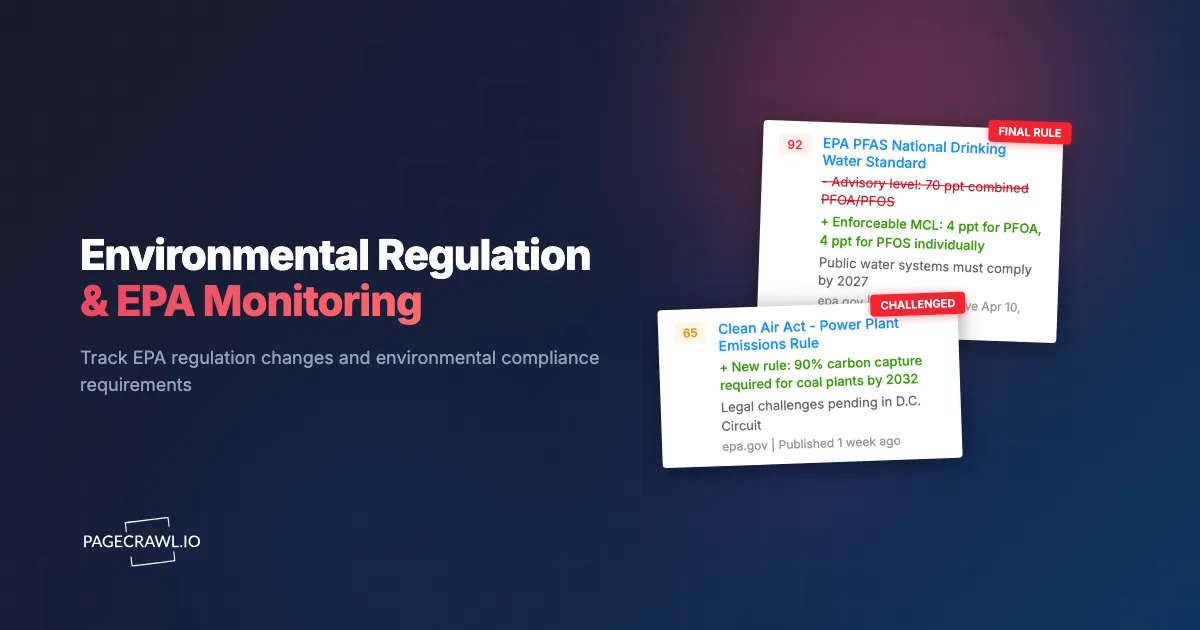
PFAS (per- and polyfluoroalkyl substances). PFAS regulations are developing rapidly at both federal and state levels. The EPA has proposed or finalized drinking water standards, reporting requirements, and potential Superfund designations. States are independently setting their own PFAS standards for water, soil, and air. Monitoring PFAS-related publications across all relevant agencies is critical for affected industries.
Environmental justice. EPA and state agencies are increasingly incorporating environmental justice considerations into permitting and enforcement decisions. Facilities in or near designated environmental justice communities face heightened scrutiny and potentially stricter requirements.
Climate and greenhouse gas regulations. Federal and state greenhouse gas reporting, emissions trading programs (California's cap-and-trade, RGGI in the Northeast), methane reduction requirements, and carbon capture regulations are evolving. Energy companies, manufacturers, and large facilities need to track these developments.
Setting Up EPA Monitoring with PageCrawl
Automated monitoring of environmental regulatory sources catches publications on the next scheduled check after they appear, rather than whenever someone on your team happens to look.

Monitoring the Federal Register for Environmental Rules
The Federal Register is where all federal proposed rules and final rules are officially published.
Step 1: Identify relevant Federal Register sections. The Federal Register organizes entries by agency. EPA entries appear under "Environmental Protection Agency." Navigate to the EPA section of the Federal Register website and find the pages listing recent proposed rules and final rules.
Step 2: Create a PageCrawl monitor for EPA Federal Register entries. Use reader mode tracking, which is particularly well suited for regulatory pages. Reader mode intelligently extracts the main content from a page, stripping away navigation menus, sidebars, footer links, cookie banners, and other clutter that surrounds the actual regulatory text. Government websites are notorious for dense layouts with dozens of sidebar links and navigation elements that change independently of the content you care about. Reader mode eliminates these distractions so that the only changes detected are changes to the regulatory content itself. This dramatically reduces false alerts from government pages where the navigation or sidebar updates regularly while the regulatory text stays the same. If a page still generates noise, the help centre's guide to reducing false positive notifications covers section exclusions, the Ignore dates filter, and the other quieting options.
Step 3: Configure keyword-focused monitoring. If your business is affected by specific regulatory areas (air quality, water discharge, hazardous waste, PFAS), configure the AI to focus on changes relevant to those terms. The AI summary will describe what was published, letting you quickly determine relevance without reading the full Federal Register entry.
Step 4: Set check frequency. The Federal Register publishes daily on business days. A check frequency of every 6 to 12 hours ensures you catch new publications within the same day. For critical regulatory areas, daily checks at a consistent time ensure nothing is missed.
Monitoring EPA News and Press Releases
EPA news releases announce significant regulatory actions, enforcement cases, and policy changes, often before the formal Federal Register publication.
Step 1: Navigate to EPA's news release page. The EPA maintains a news release page. This page lists all recent news releases from EPA headquarters and regional offices.
Step 2: Create a PageCrawl monitor. Monitor this page using content-only mode. The AI summary describes new releases as they appear.
Step 3: Filter by topic. The EPA's news page allows filtering by topic (air, water, land, chemicals, enforcement). If the filtered URL is stable (the filter parameters are in the URL), create monitors for your specific topics rather than the unfiltered page. This reduces noise from irrelevant announcements.
Monitoring EPA Program-Specific Pages
For deeper coverage, monitor the specific EPA program pages relevant to your operations:
- Air quality: EPA's Clean Air Act page, NAAQS review page, air toxics page
- Water: EPA's Clean Water Act page, NPDES permitting page, drinking water standards page
- Waste: EPA's RCRA page, hazardous waste program page, e-waste guidance
- Chemicals: EPA's TSCA page, new chemicals program, PFAS page
- Enforcement: EPA's enforcement page, compliance assistance page
Each of these pages updates when new guidance, rules, or announcements are published within that program area. Monitor them at daily or twice-daily frequency.
Monitoring State Environmental Agencies
State monitoring requires replicating the federal monitoring strategy for each state where you operate.
Identifying State Sources
For each state:
- Find the state's environmental agency website (search for "[state name] department of environmental quality" or similar)
- Locate the agency's news or updates page
- Find the page for your specific program area (air permits, water permits, waste management)
- Identify any public notice or rulemaking pages where proposed rules are posted for comment
Multi-State Monitoring Setup
For a company operating in three states, the monitoring list might look like:
State 1 (e.g., California):
- CARB regulatory actions page
- DTSC news and enforcement page
- Regional AQMD rule development page
- State Water Resources Control Board updates
State 2 (e.g., Texas):
- TCEQ news and rulemaking page
- TCEQ air permit notices
- TCEQ water quality updates
State 3 (e.g., Pennsylvania):
- PA DEP news releases
- PA DEP regulatory actions
- PA DEP permit decision pages
This totals roughly 10 to 15 monitors for three states, plus the 5 to 8 federal monitors. With PageCrawl's Standard plan supporting 100 monitors at $80/year, you can cover extensive multi-state operations with room for additional sources.
State-Specific Considerations
Some states publish environmental regulatory changes differently:
- California often leads with more stringent standards. CARB, DTSC, and the regional AQMDs each publish independently. California alone might require 8 to 10 monitors for comprehensive coverage.
- New York publishes environmental regulatory changes through the Department of Environmental Conservation and the state register. The state register is a key monitoring target for proposed rules.
- Florida DEP publishes emergency orders and rule changes that can take effect quickly. Monitoring their news page catches time-sensitive requirements.
- Multi-state compacts: If you operate in states covered by the Regional Greenhouse Gas Initiative, monitor the RGGI Inc. website for auction results and program changes.
Building an Environmental Compliance Workflow
Detection is the first step. What happens after a regulatory change is detected determines whether monitoring translates to compliance.
Detection to Assessment
When PageCrawl detects a new regulatory publication:
- AI summary provides initial triage. The AI summary describes what was published. This lets your environmental compliance team quickly assess relevance without opening the full document.
- Notification routes to the right team. Configure notifications to reach your environmental compliance staff. For companies with dedicated EHS (Environment, Health, and Safety) teams, route alerts to a shared Slack or Teams channel. For smaller organizations, email to the responsible individual works.
- Full document review. For relevant publications, the team reviews the complete document on the agency's website. The PageCrawl change link goes to the monitored page where the new content appeared.
Assessment to Action
After determining a regulatory change is relevant:
- Impact analysis. Which facilities, processes, or products are affected? What compliance obligations does this create?
- Timeline identification. When does the regulation take effect? Is there a comment period? What are the compliance deadlines?
- Resource planning. What resources (staff, equipment, process changes, permits) are needed for compliance?
- Implementation tracking. Create tasks and track completion against deadlines.
Automating the Workflow with Webhooks
For organizations with compliance management systems, webhook notifications can automate the intake process:
- Webhook delivers the regulatory change detection to your compliance management platform
- The platform creates a regulatory change record automatically
- A workflow assigns the change to the relevant compliance team member for assessment
- Deadlines and milestones are tracked within the system
This automation eliminates manual data entry and ensures no detected change falls through the cracks. For a detailed webhook automation setup, see our webhook integration guide.
Industry-Specific Monitoring Strategies
Different industries face different environmental regulatory priorities. Here are monitoring strategies tailored to common sectors.
Manufacturing
Manufacturing facilities typically need comprehensive environmental monitoring across all media:
Air emissions. Monitor EPA NSPS and MACT standards, state air permit programs, and regional air quality district rules. For manufacturers using volatile organic compounds (VOCs), solvent-based processes, or combustion equipment, air quality regulations are a primary compliance concern.
Wastewater discharge. Monitor EPA effluent guidelines and state water quality permits. Manufacturing processes that generate wastewater with metals, organic compounds, or elevated temperature face discharge limits that change as the science evolves.
Hazardous waste. Monitor EPA RCRA program and state hazardous waste pages. Hazardous waste generator requirements, storage limits, and disposal standards affect manufacturers across industries.
Chemical reporting. Monitor EPA TSCA and TRI (Toxic Release Inventory) pages. Chemical manufacturers and users face evolving reporting requirements, particularly for PFAS and other emerging contaminants.
Energy (Oil, Gas, Renewables)
Methane regulations. The EPA's methane regulations for oil and gas operations are undergoing significant revisions. Monitor the EPA's oil and gas air quality page and the Office of Air and Radiation updates page.
Water management. Produced water disposal, hydraulic fracturing fluid disclosure, and surface water protection regulations vary by state. Monitor state oil and gas commissions alongside environmental agencies.
Renewable energy siting. Solar and wind project environmental reviews, wildlife impact assessments, and habitat protection requirements publish through both federal (Fish and Wildlife Service, BLM) and state agencies.
Construction and Development
Stormwater management. Construction General Permits (CGPs) require stormwater pollution prevention plans. Monitor EPA's stormwater page and state construction stormwater programs for permit modifications and new requirements.
Wetlands and waters. The definition of "Waters of the United States" (WOTUS) has changed multiple times. Monitor EPA and Army Corps of Engineers pages for jurisdictional determinations and Section 404 permitting changes.
Soil contamination. Construction on previously developed land may encounter contamination. Monitor state voluntary cleanup programs and brownfield development incentive pages.
Waste Management
Disposal and treatment standards. Monitor EPA RCRA subtitle C (hazardous waste) and subtitle D (solid waste) pages for changing standards.
Emerging waste streams. E-waste, PFAS-containing materials, and lithium-ion batteries are generating new regulatory attention. Monitor EPA and state pages for new waste designation and handling requirements.
Landfill regulations. Methane capture requirements, liner standards, and groundwater monitoring obligations evolve through both federal and state regulatory processes.
Archiving Regulatory Changes
Environmental regulations have long compliance timelines and may be referenced years after publication. Website archiving preserves the exact content of regulatory publications as they appeared when you detected them.
PageCrawl's screenshots and signed, timestamped web archives capture:
- The full text of the regulatory publication as it appeared on the agency's website
- The date and time of detection
- Visual screenshots showing the page layout and content
This documentation serves several purposes:
- Audit trail. Demonstrates when your organization became aware of a regulatory change
- Historical reference. Regulatory pages sometimes change after initial publication (corrections, amendments). Your archive preserves the original version
- Compliance evidence. Shows that your monitoring system was active and detecting changes during the relevant period
How do you manage environmental monitoring at scale?
Give the watchlist structure: organize monitors by jurisdiction and medium, set check frequency to match each source's publication cadence, and review the whole list quarterly for dead or moved URLs. Organizations with facilities in multiple states or complex environmental profiles may need 50 to 200 monitors for comprehensive coverage, and that volume only stays usable if it is organized.
Organizing Monitors by Jurisdiction and Medium
Use folders, labels, and workspaces to organize environmental monitors:
- Federal/Air, Federal/Water, Federal/Waste, Federal/Chemical
- California/CARB, California/DTSC, California/AQMD
- Texas/TCEQ-Air, Texas/TCEQ-Water
- PFAS (cross-jurisdictional tag for all PFAS-related monitors)
This organization lets you quickly see all monitors for a specific state or environmental medium, and filter for cross-cutting topics like PFAS.
Prioritizing Alert Frequency
Not all regulatory sources publish with equal frequency or urgency:
- Daily monitoring: EPA Federal Register entries, state regulatory action pages, enforcement pages
- Twice-weekly monitoring: EPA program-specific pages, state permit pages
- Weekly monitoring: Industry standard body pages, EPA regional office pages, less active state agencies
Adjusting frequency based on publication cadence conserves your monitoring quota for the sources that matter most.
Quarterly Review and Source Updates
Environmental regulatory sources change over time. Agencies redesign websites, create new program pages, or consolidate content. Review your monitoring list quarterly to:
- Verify all monitored URLs are still active and correct
- Add new sources identified during the quarter (new state programs, new EPA initiatives)
- Remove or replace monitors for pages that have been retired or restructured
- Adjust check frequencies based on observed publication patterns
Compliance Monitoring Software Integration
PageCrawl serves as the detection layer in a broader environmental compliance management system. For organizations using dedicated compliance software, the compliance monitoring integration guide covers how to connect automated detection with compliance management workflows.
For teams building custom solutions, the PageCrawl API and webhook system provide structured data that feeds into databases, dashboards, and tracking systems. A custom environmental compliance dashboard might display:
- Recent regulatory changes detected across all jurisdictions
- Changes categorized by relevance (direct impact, potential impact, informational)
- Compliance action items with deadlines
- Historical timeline of regulatory changes in your operational areas
Choosing your PageCrawl plan
PageCrawl's Free plan lets you monitor 6 pages with 220 checks per month, which is enough to validate the approach on your most critical pages. Most teams graduate to a paid plan once they see the value.
| Plan | Price | Pages | Checks / month | Frequency |
|---|---|---|---|---|
| Free | $0 | 6 | 220 | every 60 min |
| Standard | $8/mo or $80/yr | 100 | 15,000 | every 15 min |
| Enterprise | $30/mo or $300/yr | 500 | 100,000 | every 5 min |
| Ultimate | $99/mo or $999/yr | 1,000 | 100,000 | every 2 min |
Annual billing saves two months across every paid tier. Enterprise and Ultimate scale up to 100x if you need thousands of pages or multi-team access.
Standard at $80/year pays for itself quickly against the cost of a single missed EPA or state permit change, which can mean violation notices, corrective action costs, or permit renewal complications. 100 pages covers your primary federal and state environmental sources across every regulatory area your operations touch. Enterprise at $300/year extends to 500 pages with 5-minute checks and timestamped screenshots for organizations with extensive multi-state regulatory requirements.
All plans include the PageCrawl MCP Server, which lets your EHS team ask Claude to pull every change to a specific regulation or permit requirement over any period and have the evidence ready before an inspection or audit. AI assistants can create monitors through conversation on every plan, including Free.
Getting Started
Environmental compliance monitoring does not require monitoring every possible regulatory source from day one. Start with the sources most directly relevant to your operations and expand systematically.
Begin with these monitors:
- EPA Federal Register entries for your primary regulatory areas (air, water, waste, or chemicals)
- EPA news releases for early notice of significant actions
- Your state's environmental agency news page for each state where you operate
- One or two program-specific pages for the regulations most critical to your operations (e.g., PFAS if you handle fluorinated substances, air quality if you operate combustion equipment)
This starting set uses 5 to 10 monitors, well within PageCrawl's free tier of 6 monitors for the most critical sources, or comfortably within the Standard plan's 100 monitors at $80/year for broader coverage. The Enterprise plan at $300/year supports 500 monitors for organizations with extensive multi-state operations and complex environmental profiles.
Configure notifications to reach your EHS or compliance team directly. Use email for daily digests of regulatory changes, and Slack or Teams for per-change alerts on high-priority sources, which arrive on the check that detects the update. Set up webhook integrations if you use compliance management software that can receive automated inputs.
Environmental regulatory compliance is a continuous obligation. Automated monitoring ensures that no regulatory change goes undetected, giving your team the maximum time to assess, plan, and implement compliance before deadlines arrive.
Create a free PageCrawl account and start tracking the environmental regulations that affect your operations.