A 25% tariff on steel imports gets announced on a Friday afternoon. Your procurement team placed a large order on Thursday. The price you negotiated assumed a 10% duty rate. By Monday morning, your landed cost has changed by six figures, your margins on three product lines are negative, and a competitor who saw the announcement in real time has already locked in pre-tariff pricing with their supplier.
Trade policy is shifting faster than it has in decades. New tariffs, retaliatory duties, product exclusions, and exemption windows are announced with little warning and take effect quickly. In 2025 alone, the United States imposed new tariffs across a wide range of product categories, China responded with retaliatory duties, the EU adjusted its Carbon Border Adjustment Mechanism, and multiple countries revised their free trade agreement terms. Each of these changes directly affects the cost of goods for businesses that import, export, or compete with imported products.
This guide covers why trade policy monitoring matters, what sources to track, what types of changes to watch for, how to set up automated monitoring for tariff and trade policy pages, and how to build a workflow that keeps your trade compliance team informed before changes hit your bottom line.
Why does trade policy monitoring matter?
Trade policy monitoring matters because a tariff change hits four things at once: your landed cost, your customs compliance exposure, your pricing position against competitors, and your window to file for an exclusion. Each of those clocks starts on the day the notice publishes, not the day you happen to read it.
Supply Chain Cost Impact
Tariffs are a direct cost increase on imported goods. A new 10% duty on a component you import at $500,000 per month adds $50,000 to your monthly costs immediately. But the secondary effects often exceed the direct tariff cost. Suppliers adjust pricing. Logistics routes change. Alternative sourcing takes time to set up. Companies that learn about tariff changes early can negotiate with suppliers, adjust orders, or source alternatives before the change takes effect.
Beyond direct imports, tariffs on raw materials cascade through domestic supply chains. Steel tariffs increase costs for every manufacturer that uses steel, whether they import it directly or buy from a domestic supplier whose pricing reflects the tariff-adjusted market.
Compliance Risk
Importing goods at the wrong duty rate, whether intentionally or through ignorance of a recent change, creates customs compliance risk. U.S. Customs and Border Protection (CBP) can assess penalties for incorrect duty payments, and repeated errors trigger heightened scrutiny of all your shipments. Under the customs penalty statute, 19 U.S.C. 1592, the penalty for fraudulent underpayment can reach the domestic value of the goods, while penalties for negligence can reach a multiple of the lost duties.
Staying current with tariff changes is not optional. It is a compliance requirement for any company that imports goods.
Competitive Advantage
Trade policy creates asymmetric information advantages. Companies that track tariff changes closely can adjust pricing before competitors, secure pre-tariff inventory, file for exclusions before deadlines close, and shift sourcing to countries with favorable trade agreements. Companies that learn about changes days or weeks later are forced to absorb costs or raise prices reactively.
In industries with thin margins (electronics, apparel, food products, auto parts), the difference between knowing about a tariff change on day one versus day ten can determine whether you are profitable on a product line.
Exemption and Exclusion Deadlines
Many tariff actions include exclusion processes that allow companies to request exemptions for specific products. These exclusion windows have firm deadlines. Section 301 tariff exclusions, for example, have had application windows as short as 30 days. If you do not know about the exclusion process, you cannot apply. Monitoring the regulatory filing pages where exclusion announcements appear is the only reliable way to catch these deadlines.
Which sources should you monitor for tariff changes?
Six source families cover almost every tariff change that will reach your invoices: the USTR, CBP, the Federal Register, the WTO, the European Commission's trade pages, and the trade ministries of the countries you buy from or sell to. Industry associations are a useful secondary layer for interpretation.
United States Trade Representative (USTR)
The Office of the United States Trade Representative is the primary source for U.S. trade policy actions. Their website publishes announcements about tariff actions, trade agreement negotiations, exclusion processes, and retaliatory measures. Key pages to monitor include:
- Press releases and fact sheets: Announcements of new tariff actions, trade agreement updates, and policy changes
- Section 301 investigation pages: Tariff lists, exclusion processes, and modifications to existing tariff actions
- Federal Register notices: USTR publishes formal notices that specify affected HTS codes, duty rates, and effective dates
U.S. Customs and Border Protection (CBP)
CBP implements tariff changes at the border. Their website provides operational guidance that matters for compliance:
- CSMS (Cargo Systems Messaging Service): Technical updates about duty rate implementations and system changes
- Trade policy updates: Guidance on how to classify goods and calculate duties under new tariff actions
- Informed compliance publications: Detailed guidance on classification and valuation
Federal Register
The Federal Register is where tariff actions become legally binding. Presidential proclamations, agency notices, and proposed rules all appear here. The Federal Register is particularly useful because:
- It publishes proposed tariff changes before they take effect, giving you advance notice
- It contains the specific HTS codes and duty rates for each tariff action
- Its search functionality lets you create targeted queries for your product categories
For more on monitoring Federal Register content, see our guide to regulatory compliance monitoring.
World Trade Organization (WTO)
The World Trade Organization publishes trade policy reviews, dispute settlement rulings, and notifications from member countries about tariff changes. WTO dispute outcomes can signal upcoming tariff changes months before they take effect domestically. Monitoring WTO dispute pages relevant to your industry provides early warning of potential tariff shifts.
EU Trade Commission
For businesses that import or export to the European Union, the European Commission's trade pages publish anti-dumping duty announcements, safeguard measures, and trade agreement updates. The EU's Official Journal contains the legal texts of trade measures, similar to the U.S. Federal Register.
Country-Specific Trade Ministry Sites
If you source from or sell to specific countries, their trade ministry websites are essential monitoring targets:
- China's Ministry of Commerce (MOFCOM): Retaliatory tariff announcements, anti-dumping investigations, and trade policy statements
- UK Department for Business and Trade: Post-Brexit trade agreements and tariff schedules
- Canada's Department of Finance: Tariff schedule changes and trade remedy actions
- Japan's Ministry of Economy, Trade and Industry (METI): Trade policy updates and export control changes
Industry Association Pages
Trade associations often translate government announcements into industry-specific impact assessments. Organizations like the National Association of Manufacturers, the U.S. Chamber of Commerce, and sector-specific groups publish analysis alongside the raw government announcements. These pages are valuable secondary monitoring targets because they provide context your compliance team can act on immediately.
What types of tariff changes should you watch for?
Watch seven categories: brand-new tariff proclamations, rate changes on existing duties, product exclusion lists, retaliatory tariffs from trading partners, free trade agreement updates, anti-dumping and countervailing duty orders, and Section 301 or Section 232 actions. Not all of them carry equal urgency.
New Tariff Announcements
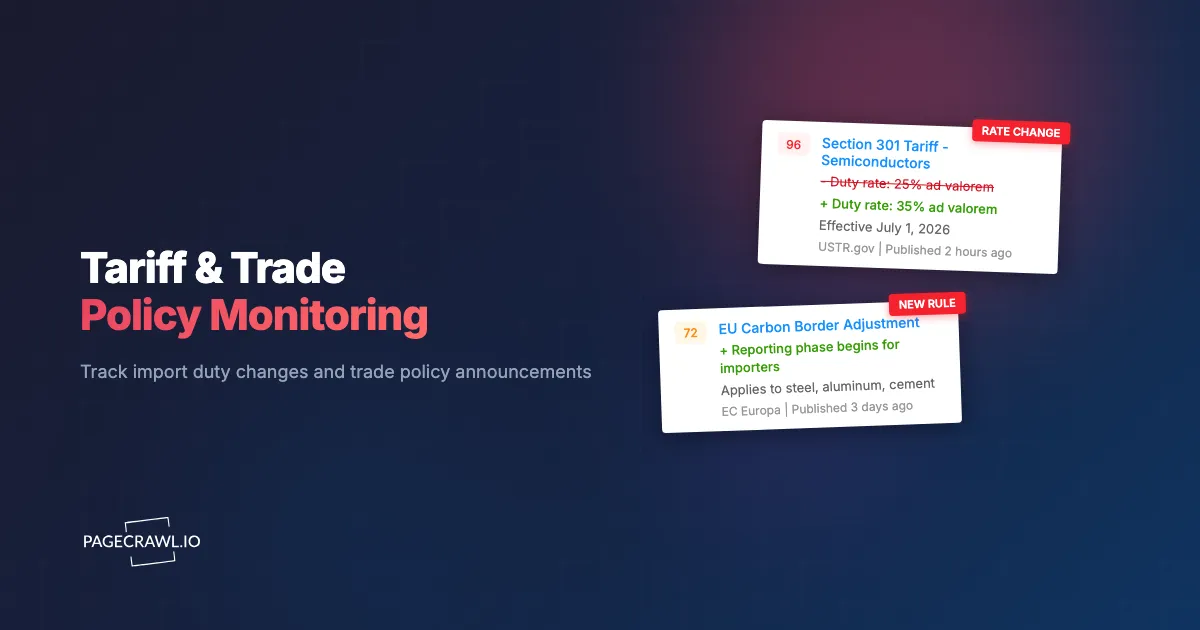
Presidential proclamations or executive orders imposing new tariffs on countries or product categories. These are the highest-urgency changes because they can take effect quickly and affect broad product categories. Recent examples include tariffs on Chinese goods under Section 301, steel and aluminum tariffs under Section 232, and reciprocal tariffs on multiple trading partners.
Rate Changes on Existing Tariffs
Modifications to existing duty rates, including increases, decreases, or restructuring of tariff tiers. These changes are sometimes incremental (a rate moving from 10% to 15%) but can significantly affect margins at scale.
Product Exclusion Lists
Lists of specific HTS codes or products that are excluded from broader tariff actions. Exclusion lists are published in the Federal Register and on USTR's website. They change frequently, with products being added, removed, or having their exclusion periods extended.
Retaliatory Tariffs
When the U.S. imposes tariffs, trading partners often respond with retaliatory duties on U.S. exports. If you export products, monitoring retaliatory tariff announcements from key trading partners is critical. These announcements appear on the trade ministry websites of the retaliating country.
Free Trade Agreement Updates
New trade agreements, modifications to existing agreements, or withdrawal from agreements change the duty rates for goods traded between member countries. The USMCA (replacing NAFTA), bilateral agreements with specific countries, and ongoing negotiations all affect duty calculations. For broader coverage of policy monitoring, see our guide to government agency news monitoring.
Anti-Dumping and Countervailing Duties
The U.S. Department of Commerce and the International Trade Commission investigate claims that foreign goods are being sold below fair value (dumping) or benefit from unfair subsidies. These investigations result in additional duties on specific products from specific countries. Anti-dumping duty orders can add anywhere from a modest percentage to several hundred percent on top of the standard duty rate for affected goods.
Section 301 and Section 232 Actions
Section 301 actions target unfair trade practices by specific countries. Section 232 actions address imports that threaten national security. Both result in additional tariffs on top of standard duty rates. Monitoring the investigation and review process for these actions gives you advance warning of upcoming tariff changes.
Is manual tariff monitoring good enough?
Manual monitoring fails predictably once you pass a handful of sources. A weekly review of government sites means you can learn about a change six days late, sources get skipped, attention drifts after quiet weeks, coverage disappears when one person is away, and there is no record of what a page said on a given date.
Why Manual Monitoring Fails at Scale
Frequency gaps: Tariff announcements can appear any day of the week. A weekly check means you could learn about a change up to six days after it was published. If the change takes effect in 15 days (common for tariff actions), you have lost nearly half your preparation time.
Source coverage: A single compliance analyst cannot reliably check USTR, CBP, the Federal Register, WTO, EU Trade Commission, and multiple country-specific trade ministry sites every day. Sources get skipped. Pages get missed.
Attention drift: When a manual check of 15 websites returns no changes for two weeks straight, the analyst starts skimming. The one critical change that does appear gets overlooked because it is buried in routine page updates.
Knowledge concentration: When tariff monitoring depends on one person's routine, that monitoring stops during vacations, sick days, and turnover. The new hire does not know which specific pages to check or what to look for.
No audit trail: Manual checks leave no record of what was checked, when, or what the page said at the time. If a dispute arises about when your company became aware of a tariff change, you have no documentation.
Automated monitoring solves all of these problems. It checks every source on a consistent schedule, never skips a page, captures the content at the time of each check, and alerts the right people as soon as a check detects a change. For a comparison of monitoring approaches, see our guide to legislative tracking.
Setting Up Automated Trade Policy Monitoring
PageCrawl monitors web pages for changes and sends alerts when content is updated. Here is how to configure it for trade policy monitoring.

Monitoring USTR Announcements
Start with the USTR press release and fact sheet pages. These are the first place new tariff actions appear.
- Add the USTR press releases page as a new monitor in PageCrawl
- Set the tracking mode to "Content Only" (this strips navigation, headers, and other page elements, focusing on the actual announcements)
- Set the check frequency to every 6 hours (USTR publishes updates during business hours, but checking more frequently ensures you catch same-day announcements)
- Enable AI-powered summaries and smart filtering and set the focus area to "tariff announcements, trade policy changes, duty rate modifications, exclusion processes"
Content Only mode works well for text-heavy government agency and public records pages because it ignores layout changes and navigation updates that would otherwise trigger false alerts. You only get notified when the actual content changes.
Monitoring Federal Register Search Results
The Federal Register allows you to create search queries that return results for specific topics. This is particularly powerful for tariff monitoring because you can target specific HTS codes or product categories.
- Go to federalregister.gov and create a search for your relevant terms (for example, "Section 301" or specific HTS codes like "8541.40" for solar cells)
- Copy the URL of the search results page
- Add this URL as a monitor in PageCrawl
- Use "Content Only" mode with daily checks
- Set the AI focus to summarize new entries and highlight duty rate changes
This approach lets you create multiple targeted monitors, each focused on the product categories most relevant to your business. One monitor for steel products, another for electronics components, another for agricultural goods.
Monitoring CBP Announcements
CBP's trade update pages provide implementation details that affect how duties are actually collected. Monitor the CSMS messages page and the trade policy update page.
- Add CBP's trade-related news and CSMS pages as monitors
- Use "Content Only" mode at a 12-hour check frequency
- Set AI focus to "customs duty implementation, classification changes, trade remedy enforcement"
Setting Up Keyword-Based Alerts
For monitors covering broad pages (like the Federal Register or USTR press releases), use PageCrawl's AI summary feature to filter for specific terms. Configure the AI focus area with your specific HTS codes, product names, country names, or tariff section references. The AI summary will highlight changes that match these terms, reducing noise from unrelated updates on the same page. You can tighten this further with per-page notification conditions and keyword filters, so a monitor only alerts when the change text contains one of your HTS codes or country names.
Monitoring International Sources
For EU Trade Commission, WTO, and country-specific trade ministry sites, the setup follows the same pattern. Add the relevant announcement pages, use Content Only mode for text-heavy government sites, and configure AI focus areas for your specific trade interests.
Note: Some government websites update their page layouts periodically without changing the substantive content. Content Only mode significantly reduces false positives from these layout changes, but review your alert history after the first two weeks and adjust your monitoring configuration if needed.
Building a Trade Intelligence Workflow
Monitoring is the detection layer. The workflow you build around it determines how quickly your organization can act on changes.
Routing Alerts to the Right People
Different types of trade policy changes require different response teams:
- Tariff rate changes: Procurement, finance, and pricing teams need to know quickly to adjust purchase orders and pricing models
- Exclusion announcements: Legal and compliance teams need to assess whether your products qualify and prepare applications
- Retaliatory tariffs on exports: Sales and business development teams need to inform customers and adjust export pricing
- Anti-dumping investigations: Legal counsel needs to track proceedings and assess potential exposure
Set up PageCrawl notifications to route alerts to the appropriate team channels. Use Slack integration to deliver alerts directly to team-specific channels where they will be seen and acted on.
Webhook Integration for Internal Systems
For organizations with internal trade compliance systems, ERP platforms, or custom dashboards, PageCrawl's webhook feature sends structured data about detected changes to any endpoint. This allows you to:
- Automatically create tickets in your compliance management system when a tariff change is detected
- Update internal duty rate databases when rate changes are published
- Trigger review workflows when exclusion deadlines are announced
- Log all detected changes for audit trail purposes
Automation Platform Integration
Connect PageCrawl to automation platforms for more complex workflows. With n8n integration, you can build workflows that parse tariff announcements, extract affected HTS codes, cross-reference against your product catalog, and send targeted alerts only to the teams managing affected products.
Zapier integration provides similar capabilities with a lower technical barrier, letting you connect trade policy alerts to hundreds of downstream tools including project management platforms, email sequences, and spreadsheet tracking.
Centralized Trade Intelligence Dashboard
Create a shared view where your trade compliance team can see all active monitors, recent changes, and pending actions. Use tags in PageCrawl to organize monitors by source type (USTR, CBP, Federal Register, international), by product category, or by urgency level. This gives the team a single place to assess the current trade policy landscape without checking multiple sources manually.
Industry-Specific Monitoring Strategies
Different industries face different trade policy exposures. Here are monitoring strategies tailored to common scenarios.
Manufacturing
Manufacturers are often the most directly affected by tariff changes because they import raw materials, components, and finished goods.
Priority sources: USTR Section 301 and Section 232 pages, Federal Register searches for your specific HTS codes, CBP classification guidance, and anti-dumping duty announcements from the Department of Commerce.
Key monitoring focus: Raw material tariff rates (steel, aluminum, chemicals, rare earth elements), component duty rates for your bill of materials, and country-of-origin rule changes that affect your sourcing strategy.
Response workflow: When a tariff change is detected on a material you import, automatically notify procurement to assess the impact on current purchase orders and alert finance to model the margin impact across affected product lines.
Retail and Ecommerce
Retailers importing finished goods face tariff exposure across hundreds or thousands of SKUs. The challenge is monitoring at the product category level rather than tracking individual items.
Priority sources: USTR tariff lists (organized by HTS chapter), Federal Register exclusion announcements, and trade agreement updates that affect your primary sourcing countries (often China, Vietnam, Bangladesh, India, Mexico).
Key monitoring focus: Consumer goods tariff rates by HTS chapter (apparel in chapters 61-62, electronics in chapter 85, furniture in chapter 94), exclusion processes for high-volume product categories, and de minimis threshold changes that affect direct-to-consumer imports.
Response workflow: Route tariff change alerts to your merchandising team alongside procurement. Pricing decisions on imported consumer goods need to account for duty changes, and the merchandising team needs to adjust retail pricing or promotional strategy accordingly.
Agriculture
Agricultural trade policy involves both import duties and export-related retaliatory tariffs. Farmers and agricultural businesses face tariff exposure on both sides.
Priority sources: USDA Foreign Agricultural Service trade updates, USTR retaliatory tariff pages (key trading partners often target agricultural exports), WTO agricultural trade dispute pages, and the Federal Register for phytosanitary and food safety import requirements.
Key monitoring focus: Export market access changes (retaliatory tariffs on soybeans, pork, dairy, and other U.S. agricultural exports), import duty rates on fertilizers, equipment, and agricultural chemicals, and trade agreement agricultural provisions.
Response workflow: Alert both the sales team (for export market changes) and the procurement team (for input cost changes). Agricultural commodities have tight margins, so even small duty rate changes affect profitability.
Technology
Technology companies face trade policy exposure through component imports, finished device imports, and export control restrictions that increasingly overlap with tariff policy.
Priority sources: Bureau of Industry and Security (BIS) export control updates, USTR technology-related tariff actions, semiconductor and advanced technology tariff pages, and trading partner retaliatory actions targeting technology products.
Key monitoring focus: Semiconductor and chip tariff rates, export control restrictions that affect which components you can source and from where, tariff rates on servers, networking equipment, and consumer electronics, and IP-related trade actions.
Response workflow: Technology supply chains often involve multiple countries for design, fabrication, assembly, and testing. A tariff change on one segment can affect the entire chain. Route alerts to supply chain management with context about which stage of production is affected.
Choosing your PageCrawl plan
PageCrawl's Free plan lets you monitor 6 pages with 220 checks per month, which is enough to validate the approach on your most critical pages. Most teams graduate to a paid plan once they see the value.
| Plan | Price | Pages | Checks / month | Frequency |
|---|---|---|---|---|
| Free | $0 | 6 | 220 | every 60 min |
| Standard | $8/mo or $80/yr | 100 | 15,000 | every 15 min |
| Enterprise | $30/mo or $300/yr | 500 | 100,000 | every 5 min |
| Ultimate | $99/mo or $999/yr | 1,000 | 100,000 | every 2 min |
Annual billing saves two months across every paid tier. Enterprise and Ultimate scale up to 100x if you need thousands of pages or multi-team access.
A single tariff announcement caught a day late can cost more in unplanned landed-cost increases than years of Standard plan fees. Standard at $80/year covers 100 pages, which is enough to monitor USTR, CBP, the Federal Register, and the trade ministry sites of your top sourcing countries simultaneously. Enterprise at $300/year adds 500 pages with 5-minute check frequency and timestamped page snapshots that serve as an audit trail if your duty calculations are ever questioned.
All plans include the PageCrawl MCP Server, so your trade compliance team can ask Claude to pull every tariff-related page change from the past quarter and summarize the rate movements by HTS chapter without leaving their workflow. AI assistants can create monitors through conversation on every plan, including Free.
Getting Started
Pick three trade policy sources that are most relevant to your business right now. For most companies importing goods into the United States, that means the USTR press releases page, a Federal Register search for your primary HTS codes, and CBP trade updates.
Set up PageCrawl monitors for these three sources using Content Only mode with 6 to 12 hour check frequencies. Configure AI summaries focused on your product categories and enable Slack or email notifications to your trade compliance team.
Run this initial setup for 30 days. Review which monitors are generating useful alerts and which are producing noise. Adjust your AI focus areas based on what matters. Then expand: add international sources for your key trading partners, monitor industry association pages for analysis and commentary, and set up webhook integrations to feed changes into your internal systems.
PageCrawl's free tier includes 6 monitors, which is enough to cover the core U.S. trade policy sources. If you need broader coverage across international sources and product categories, paid plans start at $8/month for 100 pages and $30/month for 500 pages.
Trade policy will continue to shift rapidly. The businesses that track these changes continuously will consistently outperform those that rely on secondhand information and delayed reactions. Automated monitoring is the foundation of that advantage.