A manufacturer posts a $500 rebate on commercial HVAC equipment. It is valid for 60 days and applies to units your company was already planning to purchase. Your procurement team finds out about the rebate 45 days later during a routine vendor check. You scramble to get the purchase order through before the deadline, but the approval process takes three weeks. The rebate expires. You buy the same equipment at full price.
Rebates and cashback offers represent real money, often hundreds or thousands of dollars on business purchases, and significant savings on consumer goods. But they are scattered across dozens of sources: manufacturer websites, retailer rebate centers, utility company programs, government incentive portals, and credit card reward programs. Each source publishes offers on its own schedule, with its own format, and its own expiration timeline. Nobody can manually check all these sources frequently enough to catch every relevant offer.
This guide covers where rebates and cashback offers are published, why they are so easy to miss, how to set up automated monitoring across rebate sources with PageCrawl, specific strategies for different rebate types (manufacturer, utility, government, retailer), and how to build a rebate tracking system for both business procurement and personal savings.
Why does rebate monitoring matter?
Rebate monitoring matters because rebates are not small savings. They represent some of the largest discounts available, particularly on high-ticket business purchases, and they run on strict deadlines. Finding out about a $500 rebate after the window closes costs exactly as much as never finding out at all.
The Scale of Missed Rebates
Studies consistently find that a significant percentage of available rebates go unclaimed. Manufacturers budget for rebate redemption rates knowing that many buyers will either not find the rebate, forget to submit it, or miss the deadline. This is by design. Rebates are offered as an incentive but priced with the assumption that a large portion will not be redeemed.
For businesses making regular large purchases, unclaimed rebates across a year can total tens of thousands of dollars. A construction company that buys equipment and materials throughout the year might miss 10-15 rebate opportunities annually, each worth $200-2,000.
Time-Limited Offers
Most rebates have strict expiration dates. A manufacturer might offer a rebate for one quarter only. A utility company program might have limited funding that runs out before the program's scheduled end date. Government incentive programs operate within fiscal year budgets. The time-limited nature means that even knowing a rebate exists is not enough. You need to know about it early enough to act.
Stacking Opportunities
The most significant savings come from stacking multiple offers. A manufacturer rebate combined with a retailer sale combined with a credit card cashback offer can dramatically reduce the effective cost. But stacking requires knowing about all available offers simultaneously, which requires monitoring multiple sources.
Competitive Advantage for Businesses
In industries with tight margins (construction, HVAC, plumbing, electrical contracting), the difference between claiming and missing rebates can meaningfully affect profitability. A contractor who systematically captures every available rebate has a cost advantage over competitors who rely on stumbling across offers randomly.
Where are rebates published?
Rebates and cashback offers are published across five broad source types: manufacturer promotions pages, retailer rebate centers, utility efficiency programs, government incentive portals, and credit card offer pages. Each publishes on its own schedule and needs a slightly different monitoring approach.
Manufacturer Websites
Manufacturers across industries post rebates on their websites to drive product sales. These typically appear on:
- Promotions or rebates page: A dedicated section of the manufacturer's website listing current offers
- Product-specific pages: Rebate callouts on individual product listings
- Dealer/contractor portals: Business-specific rebates visible only on professional sections of the site
- Seasonal campaign pages: Temporary landing pages for seasonal promotions
Common manufacturer rebate categories include:
- Building materials: Insulation, roofing, windows, siding, and flooring manufacturers
- HVAC equipment: Furnaces, air conditioners, heat pumps, and related components
- Appliances: Kitchen and laundry appliances from major brands
- Power tools and equipment: Commercial and consumer tool manufacturers
- Electronics: Computing, audio, and communication equipment
- Automotive parts: Components, accessories, and aftermarket parts
Retailer Rebate Centers
Major retailers operate rebate centers where they aggregate offers from multiple manufacturers:
- Home Depot rebate center: Aggregates manufacturer rebates on home improvement products
- Lowe's rebate center: Similar aggregation for home improvement and appliance rebates
- Menards rebate center: Well-known for weekly mail-in rebate programs
- Staples and Office Depot: Business supply rebates and volume purchase incentives
These retailer pages are excellent monitoring targets because they consolidate offers from many manufacturers into a single page that updates regularly.
Utility Company Rebates
Utility companies (electric, gas, water) offer rebates for energy-efficient and water-efficient upgrades. These programs are funded through rate-payer contributions and government mandates, creating a significant pool of rebate money:
- Electric utility rebates: Energy-efficient appliances, lighting upgrades, HVAC systems, insulation, smart thermostats, and solar installations
- Gas utility rebates: High-efficiency furnaces, water heaters, and building envelope improvements
- Water utility rebates: Low-flow fixtures, efficient irrigation systems, and water-saving appliances
Utility rebate programs change quarterly or annually as budgets are allocated and exhausted. Monitoring your utility company's rebate page catches new programs when they launch and alerts you when existing programs are renewed or modified.
Government Incentive Programs
Federal, state, and local governments offer rebates, tax credits, and incentive programs:
- Federal tax credits: Energy-efficient home improvements, electric vehicles, clean energy installations
- State rebate programs: State-specific programs for energy efficiency, EV purchases, and renewable energy
- Local incentives: City and county programs for water conservation, solar installations, and building upgrades
- Business incentive programs: Economic development incentives, job creation credits, and industry-specific programs
Government incentive pages are particularly important to monitor because programs launch and expire based on legislative actions and budget cycles that are difficult to predict, the same deadline problem grant and funding opportunity monitoring solves for funded programs. For detailed government monitoring strategies, see our guide on regulatory compliance monitoring.
Credit Card and Financial Cashback
Credit card companies, banks, and financial platforms offer rotating cashback categories, limited-time bonus offers, and merchant-specific promotions. These change frequently:
- Rotating quarterly categories: Cards like Chase Freedom and Discover rotate their 5% cashback categories each quarter
- Limited-time merchant offers: Amex Offers, Chase Offers, and Citi Merchant Offers provide statement credits for purchases at specific merchants
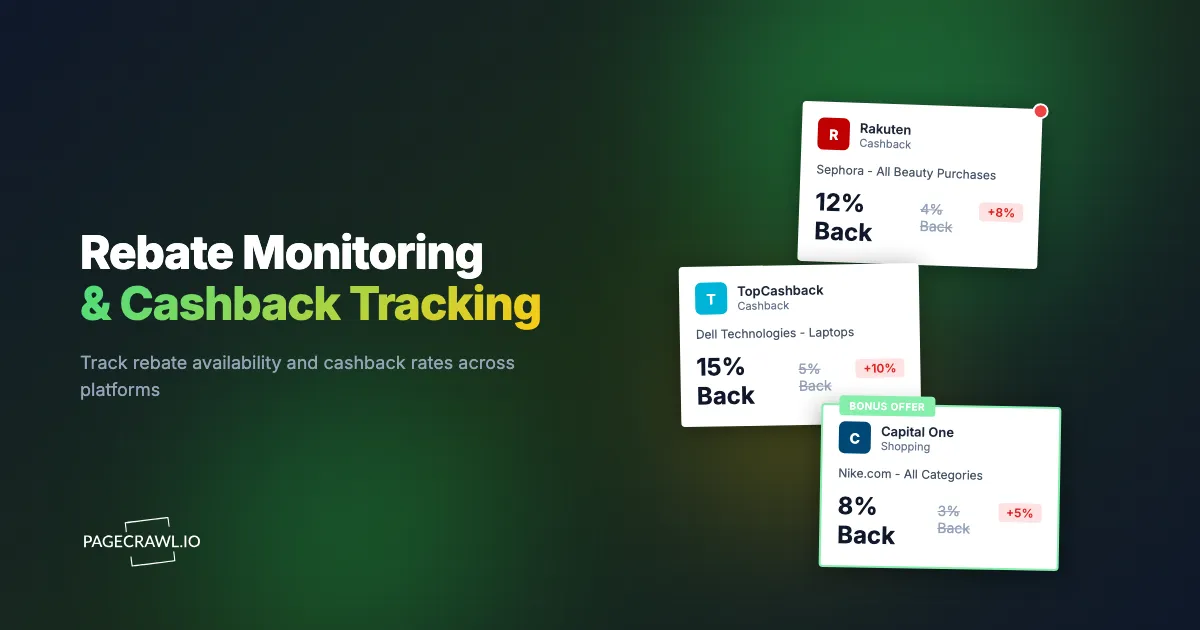
- Shopping portal bonuses: Rakuten, TopCashback, and similar platforms offer elevated cashback rates during promotional periods
What makes rebate monitoring hard to do manually?
Four things make manual rebate monitoring impractical: sources are fragmented across unrelated websites, formats vary from clean listings to PDF attachments, programs expire or exhaust their budgets without warning, and qualification rules mean not every offer you find actually applies to you.
Fragmented Sources
A single business purchase might have relevant rebates from the manufacturer, the retailer, the utility company, and a government program. Each is published on a different website, updated on a different schedule, and formatted differently. Checking all of them manually for every purchase category is impractical.
Varying Formats
Some rebate pages are well-structured with clear offer titles, amounts, and expiration dates. Others publish PDF documents. Some are simple web pages with a list of current offers. Others require navigating multiple subpages or filtering by product category. This inconsistency makes it impossible to build one monitoring approach that works for every source.
Expiration and Budget Exhaustion
Rebate programs expire. Some expire on a fixed date. Others expire when funding runs out, which can happen before the published end date. Utility company rebates frequently exhaust their annual budgets months early, ending programs ahead of schedule with little warning.
Monitoring catches both the initial announcement (so you know the rebate exists) and any changes to the page (including early termination notices, extended deadlines, or modified terms).
Qualification Requirements
Rebates often have qualification requirements: specific product models, purchase dates, professional licensing, geographic restrictions, or income limits. A rebate that looks relevant might not apply to your specific situation. Automated monitoring surfaces the offers. Human review determines applicability.
Setting Up Rebate Monitoring with PageCrawl
Here is how to build a systematic rebate monitoring setup.

Step 1: Map Your Rebate Sources
Start by identifying every source that might publish rebates relevant to your purchases:
For businesses:
- List every manufacturer whose products you regularly buy and find their promotions/rebates page
- Identify the rebate center pages for your primary retailers
- Find your utility company's energy efficiency rebate page
- Locate state and local government incentive program pages
- Check industry trade associations, which sometimes aggregate member company rebates
For consumers:
- Find the rebate and promotions pages for brands you buy regularly
- Locate your utility company's residential rebate page
- Check your state's energy office or consumer protection agency for available incentive programs
- Identify the cashback portal or credit card offers page you use most
Step 2: Add Monitors for Each Source
For each rebate source, create a PageCrawl monitor:
Manufacturer rebate pages: Use "Content Only" or "Reader" tracking mode. Set check frequency to every 12-24 hours. Manufacturer rebate pages typically update weekly or monthly, not hourly.
Retailer rebate centers: Use "Content Only" mode. Set check frequency to daily. Retailer rebate pages update more frequently as they aggregate offers from multiple manufacturers.
Utility company rebate pages: Use "Content Only" mode. Set check frequency to weekly or every few days. Utility programs change quarterly at most, but monitoring weekly catches budget exhaustion notices and new program launches.
Government incentive pages: Use "Content Only" mode. Set check frequency to weekly. Government programs change infrequently but monitoring ensures you catch new programs when they launch.
For rebate pages that link to PDF documents with offer details, PageCrawl detects when new PDFs are added to the page. You can also watch the documents themselves, since monitoring changes inside PDF files catches revised amounts, terms, and expiration dates that never appear on the landing page.
For each source, see our CSS selector guide to learn how to target specific content areas on rebate pages that may have complex layouts.
Step 3: Configure Meaningful Notifications
Not every rebate page change requires urgent attention:
Per-change alerts: High-value manufacturer rebates on products you are actively planning to purchase. Configure email or Slack notifications for these, and you will hear about the offer as soon as a check picks up the page change.
Daily digest: Retailer rebate center updates, new utility rebates, and credit card cashback changes. Review these as a batch once per day.
Weekly summary: Government incentive pages and lower-priority manufacturer pages. Review weekly during procurement planning.
Digests and summaries are built with scheduled reports that bundle changes into periodic emails, so the low-priority sources stay out of your inbox until you are ready to review them.
Use PageCrawl's webhook integration to route rebate alerts into your procurement workflow, project management tool, or a shared Slack channel where your team can evaluate offers collectively.
Step 4: Organize by Category
Create folders to keep your rebate monitors manageable:
- Manufacturer Rebates: Organized by manufacturer or product category
- Retailer Programs: Home Depot, Lowe's, and other retailer rebate centers
- Utility Rebates: Electric, gas, and water utility programs
- Government Incentives: Federal, state, and local programs
- Credit Card/Cashback: Rotating categories and limited-time offers
Tag monitors by relevance: "HVAC," "electrical," "appliances," "vehicles," or whatever categories match your purchasing patterns. This lets you quickly find all rebate monitors relevant to a specific upcoming purchase.
Monitoring Energy Efficiency Rebates
Energy efficiency rebates deserve special attention because of their value and complexity.
Utility Company Programs
Electric and gas utilities offer rebates on a wide range of energy-efficient products and upgrades:
- HVAC systems: $300-2,000+ for high-efficiency furnaces, air conditioners, and heat pumps
- Water heaters: $100-500 for heat pump or high-efficiency tank water heaters
- Insulation and weatherization: $200-1,000+ for attic insulation, air sealing, and building envelope improvements
- Smart thermostats: $50-100 per thermostat
- LED lighting: $1-5 per bulb or fixture (adds up for commercial retrofits)
- Commercial equipment: Thousands of dollars for commercial HVAC, lighting, and refrigeration upgrades
These programs are funded annually. A program available in January might be fully subscribed by August. Monitoring catches both the annual renewal and any mid-year changes to availability or funding levels.
Federal Tax Credits and Incentives
Federal energy efficiency incentives change with legislation. The Inflation Reduction Act created significant new credits for home energy improvements, electric vehicles, and clean energy installations. These credits have specific qualification requirements, annual limits, and expiration dates that can change.
Monitor the Department of Energy consumer resources pages, the IRS guidance on energy credits, and the ENERGY STAR rebate finder to stay current on available federal incentives.
State Energy Programs
State energy offices administer additional rebate and incentive programs that stack on top of utility and federal programs. These vary widely by state and change frequently:
- Some states offer additional EV purchase rebates
- Some states provide rebates for energy audits
- State-specific weatherization assistance programs serve qualifying households
- Commercial building efficiency incentives vary by state
Monitor your state energy office's incentive page to catch new programs and changes to existing ones. The DSIRE database, maintained by the N.C. Clean Energy Technology Center, is a useful starting point for finding which state and local programs exist before you decide which pages to watch.
Building a Rebate Calendar for Procurement Teams
For businesses with regular procurement cycles, a rebate calendar transforms monitoring data into purchasing strategy.
Align Purchases with Rebate Windows
When monitoring reveals a new manufacturer rebate, check whether your procurement schedule can be adjusted to take advantage of it. A $500 rebate on equipment you were planning to purchase next quarter might justify accelerating the purchase to the current quarter.
This does not mean making unnecessary purchases. It means timing planned purchases to coincide with available rebates whenever possible.
Track Rebate Deadlines
When you discover a relevant rebate, add its expiration date to your procurement calendar. Rebate deadlines become purchasing deadlines. If a rebate requires purchase by March 31, the purchase order needs to be completed with enough lead time for delivery and installation (if applicable) before that date.
Document Savings
Track every rebate your monitoring system helps you capture. This data serves two purposes:
- ROI justification: Demonstrating the value of your monitoring system (when the captured rebates far exceed the cost of monitoring, the investment is obvious)
- Procurement optimization: Historical rebate data reveals patterns (which manufacturers offer rebates regularly, which quarters have the most offers) that inform future purchasing strategy
Share Across Teams
Rebate opportunities often span departments. A utility rebate on HVAC equipment is relevant to facilities management. A manufacturer rebate on computer equipment is relevant to IT. A government incentive for workplace improvements is relevant to operations.
Route monitoring alerts to a shared channel where all relevant team members can see opportunities. Better yet, use webhook automation to create tasks in your project management system when new rebates are detected.
When you first set up rebate monitoring for a manufacturer, PageCrawl's automatic page discovery can scan the manufacturer's entire website and surface all pages related to promotions, rebates, and incentive programs. Instead of manually hunting for the right rebate page buried three levels deep in the site navigation, automatic discovery finds those pages for you and lets you add them as monitors directly.
Use Cases by Industry
Construction and Contracting
Contractors deal with high material costs and thin margins. Manufacturer rebates on building materials, HVAC equipment, plumbing fixtures, and electrical components can significantly improve project profitability. Monitor:
- Building material manufacturer rebate pages (insulation, roofing, windows, siding)
- HVAC equipment manufacturer promotions
- Plumbing fixture manufacturer rebates
- Electrical equipment manufacturer incentives
- Retailer rebate centers (Home Depot Pro, Lowe's for Pros)
- Utility company contractor programs (many utilities offer rebates to contractors who install qualifying equipment)
Fleet Managers
Organizations managing vehicle fleets benefit from monitoring:
- Vehicle manufacturer fleet rebates and incentive programs
- Government EV fleet incentive programs
- Fuel card cashback and loyalty programs
- Tire manufacturer rebate programs
- Parts and maintenance supplier promotions
Fleet purchases are large and recurring. Even small per-vehicle rebates multiply across a fleet into meaningful savings.
Retailers and E-commerce
Retailers monitoring rebate sources gain pricing intelligence and margin improvement:
- Manufacturer rebates on products they carry (which they can either claim or pass through to customers)
- Competitor promotional offers (to understand competitive pricing moves). For more on competitive pricing, see our guide on competitor price tracking tools
- Equipment and supply rebates for business operations
Consumers
Individual consumers benefit from rebate monitoring for large planned purchases:
- Appliance manufacturer rebates when replacing kitchen or laundry equipment
- Utility company rebates for home efficiency upgrades
- Government incentives for solar installations, EV purchases, and home improvements
- Credit card rotating cashback category announcements
- Seasonal manufacturer promotions (holiday, back-to-school, spring/summer)
Advanced Rebate Tracking Strategies
Stacking Multiple Offers
The highest savings come from combining offers. For a high-efficiency heat pump purchase, you might stack:
- Federal tax credit for energy-efficient home improvement
- State energy rebate program
- Utility company heat pump rebate
- Manufacturer seasonal promotion rebate
- Retailer loyalty program discount
- Credit card cashback or statement credit
Monitoring all of these sources simultaneously lets you identify when multiple offers align. On qualifying purchases, stacking can cut the effective cost substantially compared with claiming any single offer on its own.
Monitoring for Budget Exhaustion
Some rebate programs, especially utility and government programs, have fixed budgets. When the budget is spent, the program closes early. Monitoring the program page catches announcements about remaining funds, participation caps, and early closure notices.
For high-value programs, check frequently enough to catch these announcements before the program closes. A utility rebate program that announces "50% of funds remaining" is a signal to act quickly.
Seasonal Rebate Patterns
Many rebate sources follow predictable seasonal patterns:
- Q1 (January-March): New annual utility rebate budgets launch. Tax-season related financial offers appear
- Q2 (April-June): Spring home improvement rebates. HVAC manufacturer promotions ahead of cooling season
- Q3 (July-September): Back-to-school electronics and supplies promotions. Summer clearance rebates
- Q4 (October-December): Holiday manufacturer promotions. Year-end spending incentives. Utility programs may close as annual budgets deplete
Knowing these patterns helps you prioritize monitoring and set expectations for when new offers will appear.
Combining with Price Monitoring
A rebate on a product that is also on sale creates the best possible purchase price. Monitor both the rebate source (for new rebate offers) and the product pages at your preferred retailers with price drop and stock monitoring. When a rebate coincides with a sale, act quickly.
For product price monitoring setup, see our guides on Amazon price tracking and Walmart price tracking.
What are the most common rebate monitoring mistakes?
The four mistakes that cost the most money are monitoring a summary page instead of the full rebate catalog, checking far more often than the page actually changes, skipping the qualification fine print before committing to a purchase, and missing the post-purchase submission deadline.
Monitoring the Wrong Page
Many manufacturer websites have multiple sections that reference rebates. The landing page might list only featured promotions while a deeper page has the full rebate catalog. Spend time navigating each source to find the most complete listing page.
Setting Check Frequency Too High
Rebate pages do not change hourly. Checking manufacturer rebate pages every 2 hours wastes monitoring resources. Daily or every-other-day checks are sufficient for most rebate sources. Reserve higher-frequency monitoring for time-sensitive sources like limited-budget utility programs.
Ignoring Qualification Requirements
Not every rebate applies to every purchase. Read the terms carefully before committing to a purchase based on a rebate. Common restrictions include specific product models or series, purchase date windows, geographic limitations, professional licensing requirements, and minimum or maximum purchase quantities.
Failing to Submit on Time
Knowing about a rebate and capturing the rebate are different things. Most rebates require submission within a fixed window after purchase, often 30 to 90 days, with specific documentation (receipts, UPC codes, serial numbers, proof of installation). Build a rebate submission process that triggers as soon as a qualifying purchase is made.
Choosing your PageCrawl plan
PageCrawl's Free plan lets you monitor 6 pages with 220 checks per month, which is enough to validate the approach on your most critical pages. Most teams graduate to a paid plan once they see the value.
| Plan | Price | Pages | Checks / month | Frequency |
|---|---|---|---|---|
| Free | $0 | 6 | 220 | every 60 min |
| Standard | $8/mo or $80/yr | 100 | 15,000 | every 15 min |
| Enterprise | $30/mo or $300/yr | 500 | 100,000 | every 5 min |
| Ultimate | $99/mo or $999/yr | 1,000 | 100,000 | every 2 min |
Annual billing saves two months across every paid tier. Enterprise and Ultimate scale up to 100x if you need thousands of pages or multi-team access.
A single captured rebate on an HVAC unit, appliance, or commercial equipment purchase often covers Standard for several years. At $80/year, 100 monitored pages handles your electric and gas utilities, a dozen manufacturer promotions pages, and your primary retailer rebate centers with room to spare. Daily checks are sufficient for most rebate sources, so the check budget goes a long way. Enterprise at $300/year suits procurement teams monitoring rebate programs across multiple product categories, multiple states, and international markets, where missing one offer on a large purchase order is measurably more expensive than the plan itself.
Getting Started
Identify the 3-5 sources most likely to publish rebates relevant to your regular purchases. For most households, that is your electric utility's rebate page, 1-2 manufacturer sites for planned large purchases, and a retailer rebate center. For businesses, add your primary equipment manufacturers and any government incentive programs in your state.
Add each source URL to PageCrawl with "Content Only" tracking mode. Set check frequency to daily for retailer and manufacturer pages, and weekly for utility and government pages. Configure email notifications so you see new offers in your inbox.
PageCrawl's free tier includes 6 monitors, enough to cover your utility company, a couple of manufacturers, and a retailer rebate center. The Standard plan at $80/year covers 100 pages, which handles comprehensive rebate monitoring across multiple manufacturers, retailers, utilities, and government sources. Enterprise at $300/year handles 500 pages for procurement teams monitoring rebate sources across multiple product categories and geographies.
The difference between capturing and missing rebates is not luck. It is knowing about them in time to act. Automated monitoring eliminates the information gap and turns rebate savings from accidental finds into systematic cost reduction.