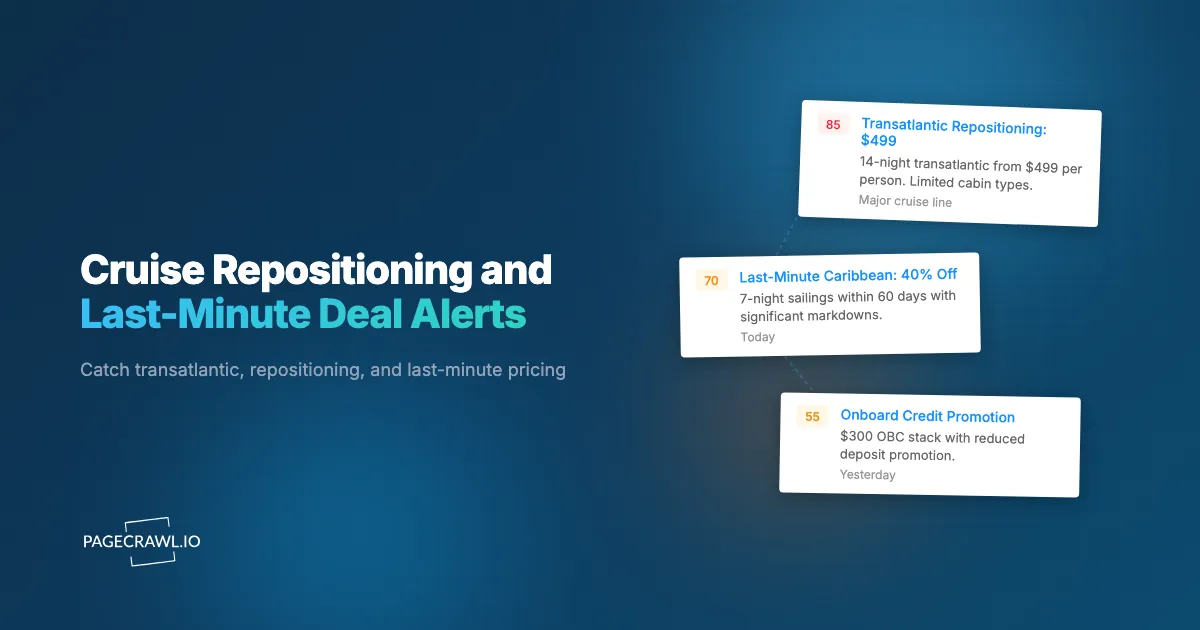
A typical transatlantic repositioning cruise on a major line opens at roughly $500-700 per person for an inside cabin, less than half the per-night rate of a comparable Caribbean week on the same ship. The catch is that they sell quietly, on cruise line specials pages and aggregator search results, and the best cabins on the best itineraries book within the first few weeks of release.
Cruise pricing is also unusually volatile inside the final 90 days before sailing. Cruise lines fill empty cabins with aggressive last-minute pricing, sometimes dropping fares 40-60% to move inventory. Onboard credit promotions stack with these drops, and the right alert at the right moment can turn a normal Caribbean week into a near-free vacation with $400 of bar tab thrown in. The pricing changes are public, the deals pages render normally, and a continuous travel fare monitor catches the windows that disappear before email blasts go out.
This guide covers how cruise lines and aggregators publish promotional pricing, what patterns drive the cheapest fares, and how to set up monitors that surface repositioning launches and last-minute drops in time to book.
Quick Setup
Pick the cruise lines you cruise with and the deal types you want (repositioning, last-minute, transatlantic), and PageCrawl will alert you when new sailings post.
Why are cruise promotion pages worth monitoring?
Cruise promotion pages are worth monitoring because repositioning itineraries price in a category of their own, last-minute fares drop hard inside 90 days, and onboard credit promotions stack with discounted base fares. Three structural facts about cruise pricing make monitoring unusually valuable.
Repositioning Itineraries Are A Different Pricing Category
Twice a year, cruise lines move ships between hemispheres. Ships repositioning from Mediterranean summer to Caribbean winter sail westbound across the Atlantic in October and November. Ships repositioning from Alaskan summer to Mexican Riviera winter sail south down the Pacific coast in September. These crossings are 10-15 nights, often with only 2-3 ports, and they often price at half or less of the line's typical per-night rate because most cruisers want sun-and-port itineraries, not slow ocean crossings.
Last-Minute Pricing Drops Hard Inside 90 Days
Cruise economics depend on filling cabins because onboard revenue (drinks, excursions, casino) is where margin lives. An empty cabin earns nothing. Cruise lines drop prices aggressively inside 90 days to fill remaining inventory, and the steepest drops happen 30-60 days out. Catching one of these drops on a sailing you would have taken anyway can save thousands per cabin.
Onboard Credit Promotions Stack With Discounted Fares
Free gratuities, $400 onboard credit, free drinks packages, and free WiFi promotions stack with discounted base fares on most lines. A 50%-off fare plus $400 OBC plus free gratuities on a 7-night sailing is real value, often available only inside narrow promotional windows.
New Itinerary Launches Open Novel Routes Worth Booking Early
When a cruise line announces a new ship or a new itinerary, the first booking window often carries introductory pricing meaningfully below the long-run average for that itinerary. Monitoring catches launches the day they post.
How are cruise promotional pages structured?
Each major cruise line publishes a deals page that lists active promotional fares, onboard credit offers, and limited-time sales in a tile grid that changes as offers open and expire:
https://www.royalcaribbean.com/cruise-deals
https://www.ncl.com/cruise-deals
https://www.carnival.com/cruise-deals
https://www.celebritycruises.com/cruise-deals
https://www.princess.com/cruise-deals/
https://www.hollandamerica.com/en/us/offers.html
These pages render a tile grid of active offers with rotating featured itineraries. New offers add tiles. Expired offers remove tiles. PageCrawl tracks the page contents and flags any change.
Aggregators like CruiseCompete, VacationsToGo, and CruiseCritic specials pages aggregate offers across lines. These pages are often the fastest way to find repositioning and last-minute pricing because they surface deals across the entire industry on a single search.
For repositioning specifically, search an aggregator with filters set to transatlantic, transpacific, or Panama Canal itineraries, then save the URL as a monitor. New itineraries matching the filter add rows to the result set, triggering alerts.
Comparing Approaches
| Approach | Cost | Latency | Coverage | Best For |
|---|---|---|---|---|
| Manual cruise line refresh | Free | Days | Per line | Casual checkers |
| Cruise line email | Free | Hours to days | Subscribed members | Light watchers |
| Travel agency promotional emails | Free | Hours | Agency-curated | Existing agency clients |
| CruiseCritic deals page | Free | Hours | Cross-line | Generalist cruisers |
| PageCrawl on line and aggregator pages | Free tier to $80/year | 1-24 hours | All lines, all filters | Active cruise planners |
Travel agencies that specialize in cruises (CruiseCompete, ShipMate) sometimes surface fares before the cruise line itself fully publicizes them. Layering both on top of monitoring the line's own page gives the broadest coverage.
Setting Up Cruise Monitoring

Step 1: Add cruise line specials pages
Add the deals page for every line you would consider. The four major mass-market lines plus one or two premium lines (Celebrity, Princess) is a good starting watchlist.
Step 2: Add an aggregator search for repositioning
On CruiseCompete or VacationsToGo, build a search filtered to transatlantic, transpacific, or Panama Canal itineraries. Copy the result URL. Each line publishes most repositioning sailings 12-18 months in advance, so this monitor surfaces them as they launch.
Step 3: Add aggregator searches for last-minute deals
Build a parallel search for sailings departing within 90 days from your home embarkation cities. These are the candidates for the deepest last-minute drops.
Step 4: Set daily checks
Cruise pricing is not minute-sensitive but daily checks catch most price drops in time to book. For repositioning launches, weekly checks are enough since launches happen on a multi-month cadence.
Step 5: Route alerts to email
For cruise planning, email notifications are the right channel. The volume is manageable, the alerts deserve a careful read, and booking usually involves a call or chat with a travel agent rather than a one-tap action.
Step 6: Pair with travel agent and group rate pages
Some of the best cruise fares only appear through specific agencies or group blocks. If you have a cruise agent you trust, ask them which agency-specific pages list their best fares and add those as siblings.
Worked Example: A Transatlantic At The Right Price
A retired couple with flexible timing wants to do their first transatlantic crossing in the next 12 months. The setup:
- Add Royal Caribbean, Norwegian, Carnival, Celebrity, and Princess deals pages.
- Add a VacationsToGo search filtered to transatlantic sailings for the next 18 months.
- Tag everything
transatlantic. - Set daily checks and route to email.
Three months in, the VacationsToGo alert fires: a Celebrity transatlantic from Lisbon to Fort Lauderdale launches at $799 per person ocean-view including $400 onboard credit and free gratuities. Total all-in for two: roughly $2,000 for 13 nights, which is less than 7 nights in a typical Caribbean balcony. They book within a week, ahead of the typical first-month price tightening as the itinerary fills.
Patterns Worth Watching
Repositioning launches. Pacific repositioning launches in early calendar year for the September-October sailing window. Atlantic repositioning launches mid-calendar for the October-November sailing window. Catching them in the first month is the difference between $499 and $899 fares.
Inside-30-day price drops. Lines panic-discount empty cabins. Sailings with weak demand can drop 40-60% in the last month. If your dates are flexible and you live within driving distance of a major embarkation port, this is the highest-leverage cruise monitoring you can do.
Onboard credit stacking promotions. "Free at sea," "all included," and similar package promotions stack with discounted fares. A 30% fare cut plus a package promotion is the real-money win.
New ship inaugural itineraries. First and second sailings of a brand-new ship often launch with promotional pricing to drive sea trials and media coverage. Monitoring catches launches the day they post.
Black Friday and Wave Season sales. Late November Black Friday deals and January-March Wave Season specials are the highest-density cruise promotion windows of the year. Multiple lines run concurrent sales and Wave Season specifically is where the best annual cruise fares appear.
Combining Cruise Alerts With Other Travel Signals
Pair with flight monitors. Cruise fares mean nothing if flights to the embarkation port cost more than the cruise itself. See the Southwest fare sale alerts guide for one cheap-flight monitoring approach.
Pair with hotel promotions in embarkation cities. Many cruisers book a pre- or post-cruise hotel in the port city. The Marriott Bonvoy and IHG promotion monitoring guide covers the chain promotion side.
Pair with passport and visa news pages. Repositioning itineraries cross multiple jurisdictions. Visa policy changes affect feasibility. A monitor on the State Department's traveler advisories provides context.
Pair with weather and hurricane tracking. Caribbean and Atlantic itineraries are weather-sensitive. A monitor on the National Hurricane Center flags when storm tracks affect upcoming sailings.
Use Cases
Cruise enthusiasts. Same-week awareness of repositioning openings is the operating norm. Three or four cruises a year, each booked at the right window, generates more savings than the monitoring plan costs many times over.
Retirees with flexible timing. Flexibility is the structural advantage. Last-minute drops favor anyone who can shift dates by a week. A retiree watchlist on last-minute pricing from their home port captures the largest single category of cruise savings.
Group cruise organizers. Coordinating a multi-family cruise is hard. Promotion alerts let the organizer move the group quickly when a strong window opens and the price holds long enough to lock all cabins.
Travel agents. Continuous promotion monitoring informs client recommendations and lets agents add value beyond rates. A per-client folder per active cruise pursuit, built with labels, folders, and workspaces, is the standard pattern.
Travel content creators. Repositioning and last-minute deals are evergreen affiliate content. Same-day coverage when a sale activates earns the affiliate click before competitors.
Cruise reviewers. Itinerary launches and new-ship debuts drive review content. Monitoring catches launches in time to book first sailings.
Frequently Asked Questions
How far in advance do cruise lines publish repositioning itineraries? Typically 12-18 months. The launch month is when pricing is sharpest. As the itinerary fills, prices rise.
Are last-minute drops always good deals? Not always. Some last-minute drops reflect undesirable itineraries or weak ships. Cross-check with Cruise Critic reviews before booking.
Can I monitor specific cabin types or categories? PageCrawl tracks the deals page content. Per-cabin-type pricing usually requires a search on the line's booking engine. For specific cabin-class watching, monitor the booking page for your target cabin category.
Will alerts catch agency-specific promotional pricing? Only if you monitor the agency pages directly. Major travel agencies have their own promotional pages that PageCrawl can monitor like any other URL.
What about luxury lines (Silversea, Regent, Crystal)? Same approach. Add the deals page for each luxury line. Luxury repositioning is its own category and prices can drop substantially inside 90 days for itineraries that have not filled.
Do I need a paid plan to monitor cruise pages? No. A typical watchlist of 4-5 line pages plus an aggregator search fits comfortably inside the 6-monitor free tier.
Choosing your PageCrawl plan
PageCrawl's Free plan lets you monitor 6 pages with 220 checks per month, which is enough to validate the approach on your most critical pages. Most teams graduate to a paid plan once they see the value.
| Plan | Price | Pages | Checks / month | Frequency |
|---|---|---|---|---|
| Free | $0 | 6 | 220 | every 60 min |
| Standard | $8/mo or $80/yr | 100 | 15,000 | every 15 min |
| Enterprise | $30/mo or $300/yr | 500 | 100,000 | every 5 min |
| Ultimate | $99/mo or $999/yr | 1,000 | 100,000 | every 2 min |
Annual billing saves two months across every paid tier. Enterprise and Ultimate scale up to 100x if you need thousands of pages or multi-team access.
If monitoring helps you land one repositioning fare at its launch price or one deep last-minute drop, Standard at $80/year is already paid for. 100 monitored pages covers every cruise line and aggregator you care about, and the 15-minute check frequency catches most drops on the next check after they go live.
Getting Started
Add the major cruise line deals pages plus an aggregator search for repositioning itineraries to PageCrawl on a daily check. Create a free account and the next price drop or itinerary launch will arrive in your inbox the day it lands.