A premium kitchen appliance brand spent three years building its reputation around quality and a $349 retail price point. Then a single unauthorized Amazon seller listed the product at $267. Within a week, four authorized dealers matched the price to stay competitive. Within a month, the product's perceived value had shifted, margins across the dealer network had collapsed, and two authorized dealers had dropped the brand entirely because they could no longer sell it profitably.
This scenario plays out across industries every day. Without a Minimum Advertised Price (MAP) policy and the tools to enforce it, brands lose control of their pricing, their dealer relationships, and ultimately their brand positioning. MAP enforcement is not just a pricing strategy. It is a brand protection imperative that determines whether your products are perceived as premium or commodity.
This guide covers what MAP pricing is and how it works legally, how to create an effective MAP policy, how to monitor compliance across your dealer network at scale, and how to build enforcement workflows that protect both your brand and your dealer relationships.
What is MAP pricing and why does it matter?
A Minimum Advertised Price policy sets the lowest price at which dealers and retailers are allowed to advertise a product. It does not restrict what a retailer charges at the point of sale. It controls what appears on websites, in advertisements, in email campaigns, and in other public-facing marketing materials. It matters because the advertised price is the signal buyers use to judge value, so uncontrolled discounting erodes brand positioning and dealer margins at the same time.
The Distinction Between MAP and Resale Price
This distinction is legally critical. Resale Price Maintenance (RPM), where a manufacturer dictates the actual selling price, has a more complex legal standing and is judged case by case under the rule of reason established in Leegin Creative Leather Products v. PSKS. MAP policies, which only govern the advertised price, are generally considered legal under the US antitrust rules enforced by the Federal Trade Commission because they do not restrict the final transaction price. A retailer can sell below MAP as long as they do not advertise that lower price publicly.
In practice, MAP policies function as effective price floors for most online retail because the advertised price and the selling price are the same on product pages. A retailer cannot show a below-MAP price on their website without violating the policy, even if they frame it as a sale or promotion.
Why Brands Need MAP Policies
Protecting brand value. Price is a signal. Consumers associate higher prices with higher quality. When products are consistently advertised at deep discounts, the perception shifts from "premium product on sale" to "overpriced product at its real price." MAP policies prevent this erosion by maintaining consistent pricing across channels.
Supporting authorized dealers. Dealers who invest in showrooms, trained sales staff, customer service, and inventory need adequate margins to sustain those investments. When online-only sellers with minimal overhead undercut these dealers, the authorized channel deteriorates. Dealers stop stocking the product, reduce their selling effort, or drop the brand entirely.
Preventing a race to the bottom. Without MAP, pricing dynamics tend toward destructive competition. One retailer lowers the price to win a sale, competitors match, and the cycle continues until no one makes money selling the product. MAP establishes a floor that prevents this spiral.
Maintaining channel consistency. Consumers increasingly research across channels before purchasing. When they see a product at $349 on the brand website, $299 on Amazon, and $267 on a discount site, the inconsistency creates confusion and erodes trust in all pricing.
Creating an Effective MAP Policy
A MAP policy needs to be clear, comprehensive, and consistently enforced. Ambiguity creates loopholes, and inconsistent enforcement undermines the entire program.
Key Policy Components
Product coverage. Define which products are covered by the MAP policy. Some brands apply MAP to their entire catalog, others only to specific product lines (typically premium or new products). Be explicit about coverage.
Price definitions. Specify the MAP for each covered product. This is typically the manufacturer's suggested retail price (MSRP) or a defined percentage below MSRP. Include a schedule of MAP prices and a process for updates.
Covered advertising channels. Define what constitutes "advertising." This should include website product pages, marketplace listings, email marketing, social media posts, search engine ads, comparison shopping engines, coupon sites, and any other public-facing channel where prices are visible.
Exceptions and promotions. Define when below-MAP advertising is permitted. Common exceptions include manufacturer-authorized sales events (Black Friday, holiday promotions), closeout or discontinued products, and bundle pricing where MAP applies to the individual item, not the bundle total. Be specific about the authorization process for exceptions.
Enforcement consequences. Outline the actions you will take for violations. A typical graduated approach includes:
- First violation: written warning with documentation
- Second violation: temporary suspension of dealer benefits (co-op advertising, marketing funds, preferred pricing)
- Third violation: suspension of product supply for a defined period
- Continued violations: termination of the dealer relationship
Policy updates. Reserve the right to update MAP prices and policy terms with reasonable notice. Define how updates will be communicated (email, dealer portal, registered mail).
Legal Considerations
MAP policies operate in a specific legal context. While this guide provides general information, consult with an attorney experienced in antitrust and distribution law for your specific situation.
Unilateral policy. The strongest legal position for MAP is a unilateral policy: you announce the policy, and dealers choose whether to comply. You do not negotiate MAP compliance, and you do not obtain dealer agreement to the policy. This unilateral structure, sometimes called a "Colgate policy" after the Supreme Court's decision in United States v. Colgate & Co., avoids antitrust concerns about price-fixing agreements.
Consistent enforcement. Selectively enforcing MAP against some dealers but not others creates legal risk and practical problems. If you ignore violations by large retailers while penalizing small dealers, you invite both legal challenges and dealer resentment.
Documentation. Document everything: the policy itself, how it was communicated, violations detected, warnings issued, and actions taken. This documentation demonstrates that your MAP program is a legitimate business practice consistently applied.
State law variations. While MAP policies are generally permissible under federal law, some states have specific regulations around resale price restrictions, and brands selling into the EU must also follow the 30-day lowest-price reference rules of the Omnibus Directive. Ensure your policy accounts for relevant state-level requirements.
How do you monitor MAP compliance at scale?
You monitor at scale by tracking every dealer product page automatically on a schedule and getting alerted when a check finds a price below your MAP level. Creating a MAP policy is the easy part. Enforcing it across dozens or hundreds of dealers, each with multiple online channels, is where most brands struggle. Manual monitoring, where someone visits dealer websites and checks prices, does not scale and leaves gaps that violators exploit.

The Monitoring Challenge
Consider a brand with 50 authorized dealers, each selling an average of 20 MAP-protected products. That is 1,000 product-dealer combinations to monitor. Add unauthorized sellers on Amazon and eBay, and the number grows. Prices can change at any time, promotions launch without notice, and coupon codes create effective price drops that are not visible on the product page.
Manual checking might catch obvious violations, but it misses:
- Short-duration sales (weekend promotions, flash sales)
- After-hours price drops that are corrected before business hours
- Coupon and discount code violations
- Marketplace seller pricing on platforms with many third-party sellers
- Regional or A/B-tested pricing that varies by visitor
Automated Price Monitoring with PageCrawl
PageCrawl monitors product pages across your dealer network and alerts you when prices change. For an overview of available price tracking tools and how they compare, see our guide on the best competitor price tracking tools. Here is how to set up systematic MAP monitoring.
Step 1: Build your monitoring list. For each MAP-protected product, identify the product page URL on each authorized dealer's website. For products sold on Amazon, include each unique Amazon listing URL (different sellers may have different listings).
Step 2: Add product pages to PageCrawl. If you are monitoring many dealers for the same product category, PageCrawl's templates let you save a monitoring configuration (tracking mode, check frequency, notification settings, and alert thresholds) and apply it across all dealers in your network. Instead of configuring each monitor individually, create a MAP enforcement template once and use it every time you add a new dealer's product page. PageCrawl identifies the product price on the page and tracks it over time. When the price drops below your MAP threshold, you receive an alert.
Step 3: Configure pricing thresholds. Set alert conditions based on your MAP prices. You can configure alerts to trigger when the detected price falls below the MAP level, so a violation reaches you as soon as the next scheduled check picks it up. The help centre guide to tracking numeric values such as prices walks through the thresholds and charts available for this.
Step 4: Organize by dealer and product. Use PageCrawl folders to organize monitors. A folder structure like "Dealer Name > Product Line" keeps your monitoring dashboard manageable. Tags can identify priority products, repeat violators, or specific enforcement tiers.
Step 5: Set check frequency. For active MAP enforcement, check dealer pages at least once daily. For high-risk dealers or products with known violation patterns, increase frequency to several times per day. More frequent checks reduce the window during which a violation goes undetected.
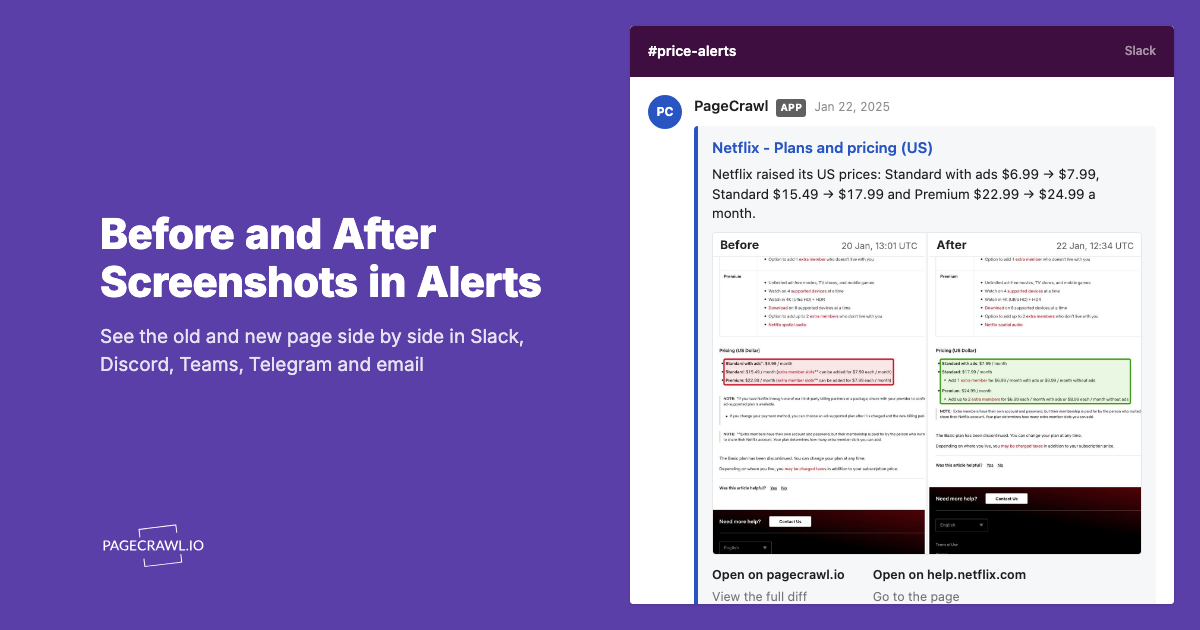
Step 6: Enable screenshots. Screenshots and signed web archives of the page as it appeared provide timestamped evidence of MAP violations. When confronting a dealer about a violation, a screenshot showing the below-MAP price, the date and time, and the URL creates documentation that is difficult to dispute.
For a detailed guide on price monitoring across multiple retailers, see our guide on cross-retailer price comparison.
Monitoring Marketplaces
Amazon, eBay, Walmart Marketplace, and similar platforms present unique MAP monitoring challenges.
Multiple sellers per listing. Amazon product pages often have multiple sellers competing on the same listing. The "Buy Box" price that most customers see can come from any of these sellers. Monitor the product page for the displayed price, which reflects the current Buy Box winner.
Unauthorized sellers. Marketplace platforms allow almost anyone to list products. Unauthorized sellers, who obtained inventory through gray market channels, often undercut MAP because they are not bound by your dealer agreements. Monitoring catches these unauthorized listings.
Dynamic pricing. Marketplace sellers frequently adjust prices using automated repricing tools. A seller might be MAP-compliant in the morning and in violation by afternoon. Frequent monitoring is essential for catching these fluctuations.
Bundle and variation pricing. Sellers sometimes circumvent MAP by bundling products (adding a low-value accessory to justify a different price point) or by listing under a different variation (size, color, model) at a below-MAP price. Monitor these listings alongside standard product pages.
For more comprehensive ecommerce monitoring approaches, see our guide on the best ecommerce monitoring tools.
Monitoring Beyond Price
MAP violations are not always straightforward price reductions. Watch for these indirect violations:
Coupon stacking. A retailer lists the product at MAP but offers a sitewide coupon (10% off everything) that reduces the effective price below MAP. The product page shows MAP, but the cart total is lower.
Cart price reveals. "Add to cart for price" or "See price in cart" tactics hide below-MAP prices from public advertising while technically showing a different price on the product page. Whether this violates MAP depends on your policy definition of "advertised price."
Gift card promotions. "Buy this product and receive a $50 gift card" effectively reduces the price without showing a below-MAP figure on the product page.
Free shipping offers. If competing dealers charge for shipping, a "free shipping" offer on a MAP-priced product creates a price advantage without technically violating the listed price.
Email and social media. Below-MAP prices sent via email newsletters or posted on social media may not appear on the product page. Monitor dealer marketing channels when possible, or include clear definitions of "advertising" in your policy.
Building Enforcement Workflows
Detection without enforcement is meaningless. A systematic enforcement workflow ensures violations are addressed consistently and documented properly.
Violation Documentation
When PageCrawl detects a MAP violation, document it immediately:
- Screenshot of the product page showing the below-MAP price
- URL of the violating page
- Date and time of detection
- The MAP price for that product
- The violated price
- The dealer or seller identity
PageCrawl provides screenshots and timestamps automatically. Store this documentation in a centralized system (spreadsheet, CRM, or dedicated MAP enforcement platform) for tracking patterns and supporting escalation.
Graduated Enforcement Response
First violation notification. Contact the dealer via the channel specified in your MAP policy (typically email). Include the violation evidence, reference the specific MAP policy clause, and request immediate correction. Give a specific deadline (24-48 hours is standard).
Most first violations are corrected quickly. Many result from errors: a staff member set the wrong price, an automated repricing tool malfunctioned, or a promotion was applied incorrectly. A professional, evidence-backed notification resolves these situations.
Second violation warning. If the same dealer violates again, escalate the communication. Reference the prior violation and correction, document the new violation, and outline the next consequence per your policy (suspension of marketing funds, reduced discount tier, temporary supply restriction).
Third violation action. Implement the consequences outlined in your policy. Temporary supply suspension, removal from authorized dealer listings, or termination of the dealer agreement. Consistency is essential: if you threaten consequences and do not follow through, the policy loses credibility.
Handling Unauthorized Sellers
Unauthorized sellers present a different enforcement challenge because they have no dealer agreement to enforce. Options include:
Platform reporting. Most marketplaces have brand registry programs (Amazon Brand Registry, eBay VeRO) that allow brand owners to report unauthorized sellers. This does not enforce MAP directly but can remove listings that also infringe on intellectual property.
Supply chain investigation. Determine how unauthorized sellers obtained inventory. Common sources include dealer diversion (authorized dealers selling to unauthorized parties), liquidation purchases, and international gray market arbitrage. Addressing the supply source is often more effective than fighting individual listings.
Selective distribution. Tighten your distribution to make unauthorized acquisition more difficult. Fewer authorized dealers means fewer potential diversion points.
Automation with Webhooks
For brands with large dealer networks, manual enforcement response does not scale. Use PageCrawl webhooks to automate the first stages of your enforcement workflow.
When a MAP violation is detected, a webhook can:
- Create a ticket in your enforcement tracking system
- Send a templated warning email to the dealer's MAP compliance contact
- Log the violation in your dealer management database
- Alert your brand protection team via Slack or Teams
Automated first-response ensures every violation is documented and addressed, even when your team is not actively monitoring. The help centre article on sending change data to any external service with webhooks covers the payload format and retry behavior. For a broader walkthrough, see our guide on webhook automation for website changes.
What are the best practices for running a MAP program?
Strong MAP programs get three things right: clear communication before dealers ever place an order, a formal process for authorized exceptions, and even-handed enforcement across every seller. Dealers accept the rules when they understand them in advance and see them applied consistently.
Communication
Clear onboarding. Every new dealer should receive and acknowledge the MAP policy before their first order. Include MAP education in your dealer onboarding process.
Regular reminders. Before promotional seasons (Black Friday, holiday, back-to-school), remind dealers of MAP requirements and announce any authorized promotional pricing.
Policy updates. When you change MAP prices, give adequate notice (30 days is common). Clearly communicate which products are affected and what the new MAP levels are.
Exception Management
Manufacturer-authorized promotions. When you authorize a sale that allows below-MAP pricing, communicate it formally. Specify the exact products, the minimum authorized price, the start and end dates, and which channels are included. Formal authorization prevents confusion and protects both the brand and the dealer.
Closeout and discontinuation. Define clear criteria for when MAP no longer applies: once a product is officially discontinued, after a specified period, or when remaining inventory drops below a threshold.
Competitive market adjustments. If market conditions make a MAP price unsustainable (a competitor releases a dramatically better product at a lower price), adjust the MAP formally rather than allowing informal violations.
Dealer Relations
MAP enforcement works best when dealers view it as beneficial, not punitive:
Communicate the benefit. Dealers with MAP protection earn better margins than those competing in unprotected price wars. Make this case explicitly and regularly.
Enforce consistently. Nothing destroys dealer goodwill faster than selective enforcement. If large retailers get a pass on violations that small dealers are penalized for, the policy is perceived as unfair.
Respond to dealer reports. Dealers will report competitors' MAP violations to you. Respond to these reports promptly and let the reporting dealer know the violation is being addressed (without disclosing specific actions taken against the violating dealer).
Scaling MAP Monitoring
As your product catalog and dealer network grow, your monitoring program needs to scale with them.
Prioritizing What to Monitor
Not every product-dealer combination requires the same level of monitoring:
High-priority. New product launches (where initial pricing sets market expectations), top-selling products (where violations have the largest revenue impact), and known problem dealers (history of violations).
Standard priority. Established products with stable pricing, compliant dealers with clean records.
Lower priority. Products approaching end-of-life, low-volume dealers with minimal online presence.
Allocate more frequent monitoring to high-priority combinations and less frequent checks to lower-priority items.
Monitoring Volume and Plans
The number of monitors you need depends on your product catalog and dealer network size:
- A small brand with 10 products across 5 dealers needs roughly 50 monitors
- A mid-size brand with 50 products across 20 dealers needs roughly 1,000 monitors
- A large brand with hundreds of products across hundreds of dealers needs thousands of monitors
PageCrawl's free plan covers 6 monitors, useful for testing the approach on a few key products. The Standard plan at $80/year supports 100 monitors, covering a small brand's critical products. The Enterprise plan at $300/year supports 500 monitors, suitable for mid-size brands. For larger operations, contact PageCrawl about custom plans.
Reporting and Analytics
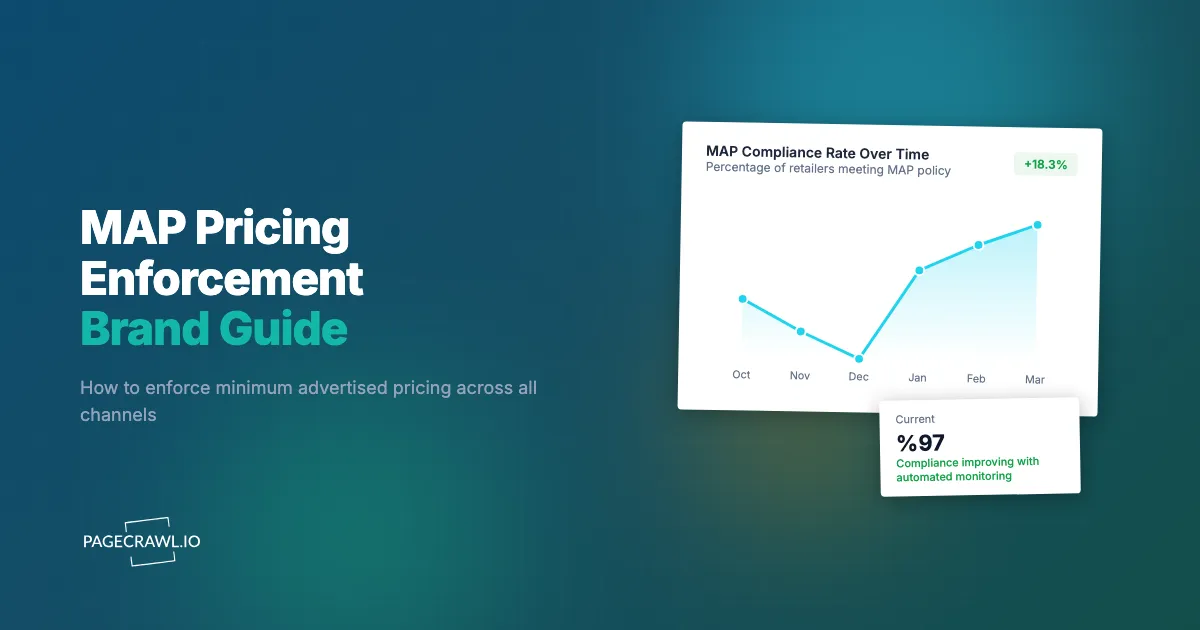
Track MAP compliance metrics over time:
- Violation rate by dealer (violations per month as a percentage of monitored products)
- Average time to correction (how quickly violations are resolved after notification)
- Repeat violation rate (percentage of violations from dealers who have violated before)
- Violation type distribution (direct price cuts vs. coupons vs. bundles)
These metrics identify trends, measure enforcement effectiveness, and justify MAP program investment. For a broader perspective on ecommerce pricing strategy, see our guide on competitor price monitoring for ecommerce.
For building custom analytics dashboards with monitoring data, see our guide on building custom monitoring dashboards with the PageCrawl API.
Choosing your PageCrawl plan
PageCrawl's Free plan lets you monitor 6 pages with 220 checks per month, which is enough to validate the approach on your most critical pages. Most teams graduate to a paid plan once they see the value.
| Plan | Price | Pages | Checks / month | Frequency |
|---|---|---|---|---|
| Free | $0 | 6 | 220 | every 60 min |
| Standard | $8/mo or $80/yr | 100 | 15,000 | every 15 min |
| Enterprise | $30/mo or $300/yr | 500 | 100,000 | every 5 min |
| Ultimate | $99/mo or $999/yr | 1,000 | 100,000 | every 2 min |
Annual billing saves two months across every paid tier. Enterprise and Ultimate scale up to 100x if you need thousands of pages or multi-team access.
A MAP program that cannot detect violations consistently is just a document. Standard at $80/year monitors 100 product-dealer combinations with daily checks and screenshots - enough to cover a small brand's full catalog with the timestamped evidence you need to enforce. If automated monitoring catches even one violation early enough to prevent the dealer cascade effect, it has paid for itself several times over. Enterprise at $300/year handles 500 combinations, which supports mid-size brands with extensive dealer networks and the volume of monitoring needed to enforce a MAP policy credibly and consistently.
Getting Started
Start by monitoring your top five products across your top ten dealers. Create a free account, add product page URLs with price tracking mode, and configure alerts for price drops below your MAP levels. Even a small pilot quickly demonstrates the value of automated MAP monitoring and provides the violation evidence you need to strengthen your enforcement program. PageCrawl's free plan includes 6 monitors, enough to test the approach on your highest-priority product-dealer combinations before scaling up.