A brand spends years building premium positioning, invests in product quality, and cultivates a network of authorized retailers. Then one dealer drops the advertised price by 15% on a marketplace listing, and within 48 hours, three other retailers follow suit. By the end of the week, the product is selling well below the minimum advertised price across half of the brand's distribution network, eroding margins and triggering a cascade of dealer complaints.
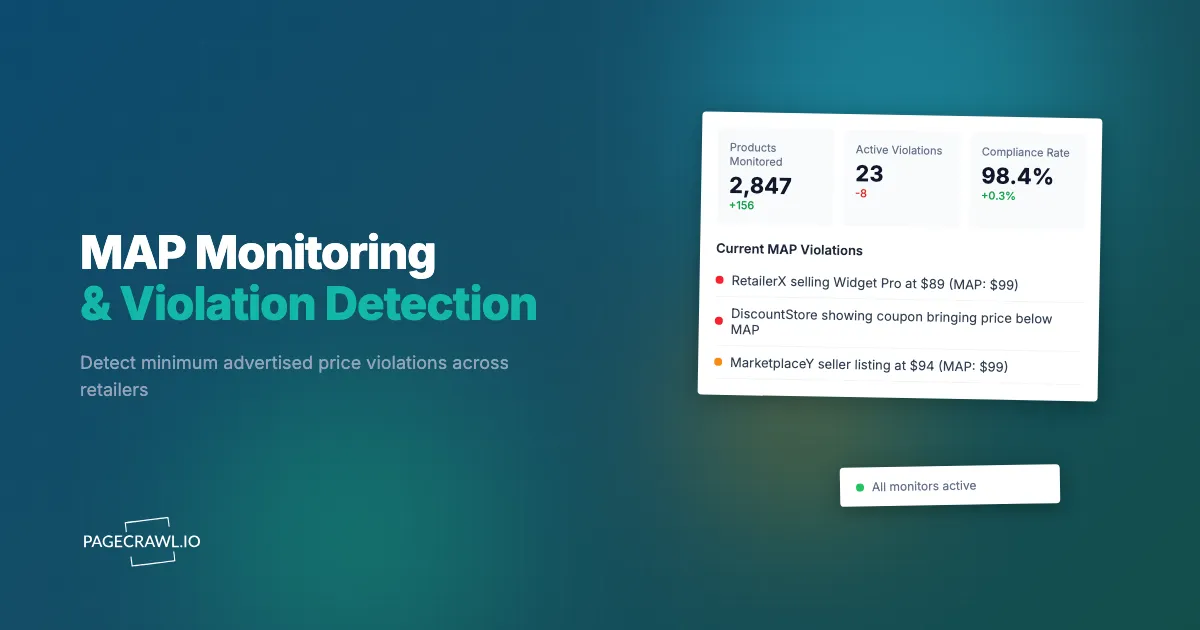
Minimum Advertised Price (MAP) policies exist to prevent exactly this scenario. But MAP enforcement depends on detection, and detection at scale is where most brands struggle. With products listed across dozens of retailers, each with multiple SKUs, variants, and regional listings, manual price checks are hopelessly inadequate. Violations that go undetected for days or weeks cause damage that is difficult to reverse.
This guide covers what MAP pricing is and why it matters, the real cost of undetected violations, how to monitor advertised prices across your retail network automatically, how to set up threshold-based alerts, and how to build a complete MAP enforcement workflow from detection to resolution.
What is MAP pricing?
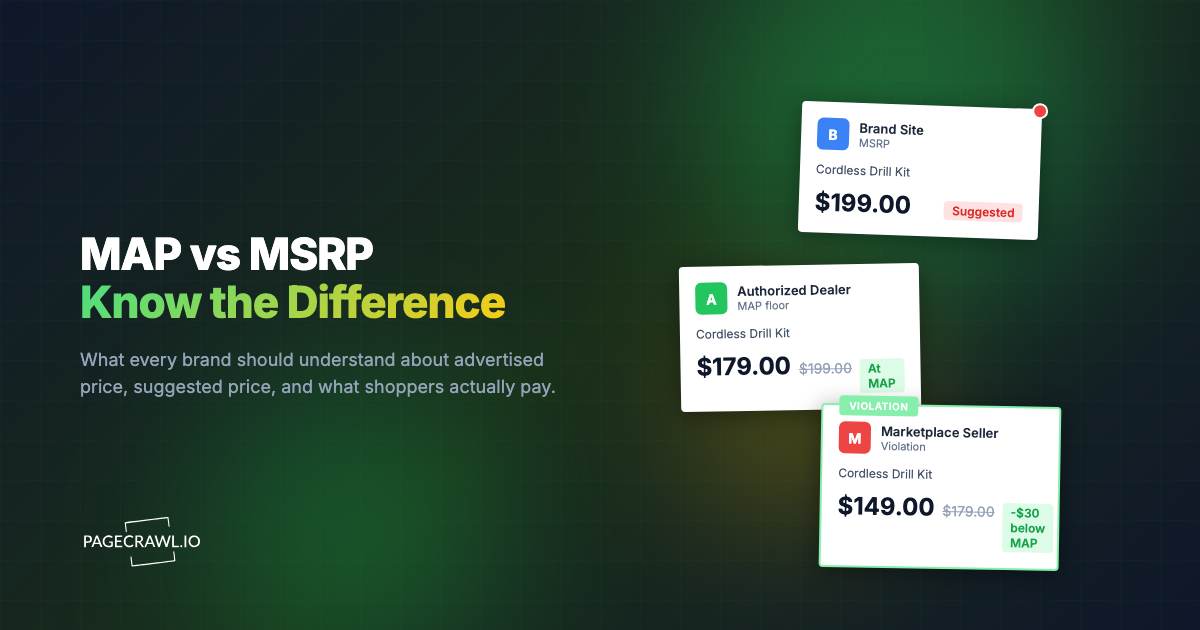
MAP stands for Minimum Advertised Price. It is the lowest price at which a manufacturer permits authorized retailers to advertise a product publicly. MAP applies to the advertised price only, not the actual selling price or the manufacturer's suggested retail price. A retailer can sell below MAP in certain circumstances (such as in-cart pricing or negotiated deals), but they cannot publicly display a price lower than the MAP threshold.
The Legal Framework
MAP policies are legal in the United States and many other jurisdictions because they govern advertising, not the final transaction price. They fall under the manufacturer's right to set the terms of its distribution agreements. Unlike price fixing (which is illegal), MAP policies are unilateral. The manufacturer sets the policy, and retailers agree to it as a condition of distribution. There is no negotiation between competitors about what prices to charge.
This legal distinction is important. MAP policies are enforceable through distribution agreements. A manufacturer can refuse to sell to a retailer who repeatedly violates MAP. This enforcement power gives MAP policies their teeth, but only if violations are actually detected. Rules differ by jurisdiction, so review your policy language with counsel and check the Federal Trade Commission guidance on resale pricing; this article is informational, not legal advice.
Why Brands Enforce MAP
Protecting retailer margins. When one retailer drops below MAP, others must match to stay competitive. This race to the bottom compresses margins for all retailers, making the product less profitable to carry. Eventually, retailers stop stocking the product or stop investing in marketing and customer education for it.
Preserving brand value. Price signals quality. When consumers see a product advertised at steep discounts across multiple retailers, they begin to associate the brand with "discount" or "clearance" rather than premium quality. This perception is difficult and expensive to reverse.
Maintaining distribution relationships. Authorized retailers invest in showrooms, trained staff, and customer service. When an online-only retailer undercuts them on price without providing any of those services, brick-and-mortar partners feel betrayed. MAP ensures a level playing field.
Supporting product launches. New products need consistent market positioning at launch. MAP violations during launch windows undermine the pricing strategy and can permanently anchor customer expectations at the wrong price point.
What Constitutes a Violation
A MAP violation occurs when a retailer advertises a product below the established MAP price in any publicly visible channel. This includes:
- Product listing pages on the retailer's website
- Marketplace listings (Amazon, eBay, Walmart Marketplace)
- Google Shopping ads and product feeds
- Social media posts with pricing
- Email marketing with prices below MAP
- Printed flyers, catalogs, or in-store signage
Some gray areas exist. "Add to cart to see price" features on websites technically hide the advertised price, which some brands allow and others prohibit. Strike-through pricing where the MAP price is shown crossed out alongside a lower price is generally considered a violation. Bundling products to reduce the effective per-unit price can also constitute a violation depending on the MAP policy's language.
What do undetected MAP violations actually cost?
They cost brand equity, dealer loyalty, and channel margin, usually in that order. A below-MAP price resets what shoppers think the product is worth, pushes compliant retailers to match or walk away, and compresses margin all the way up the distribution chain. Undetected violations compound quickly, which is what justifies investment in monitoring.
Brand Erosion
Consistent below-MAP advertising tells consumers the product is worth less than the brand claims. Reference-price effects are well documented in consumer research: shoppers build an internal sense of what a product should cost from the prices they encounter across multiple sources. If four out of ten retailers show the product below MAP, that internal reference price drops, and they begin expecting the lower price everywhere.
This is not a theoretical concern. Brands that lose MAP control commonly see full-price sell-through decline. Consumers who might have purchased at the original price point now wait for the "deal" they know exists somewhere.
The Dealer Conflict Spiral
When one retailer violates MAP, the dominos begin falling. A retailer who invested in a showroom, trained their staff, and provided post-sale support watches an online competitor undercut them with zero overhead. The compliant retailer has two choices: violate MAP themselves or contact the manufacturer to demand enforcement.
If the manufacturer does not enforce quickly, compliant retailers lose faith in the system. Some stop carrying the product. Others stop investing in marketing and merchandising for it. The brand loses its best distribution partners and is left with the discount-oriented retailers it least wants representing its products.
Margin Compression Across the Channel
MAP violations create downward pressure on margins throughout the distribution channel. Retailers demand lower wholesale prices to maintain margins at the lower advertised price. Distributors face pressure from both sides. The manufacturer either absorbs margin loss or loses distribution.
For a brand selling through 50 authorized retailers, a sustained 10% below-MAP average across even half those retailers can translate to a substantial annual margin loss, scaling directly with product volume.
Marketplace Contamination
MAP violations on marketplaces like Amazon are particularly damaging. Amazon's algorithm favors lower prices for the Buy Box, which means a single MAP violator can dominate visibility for the product. Once the price drops on Amazon, every other retailer monitoring Amazon adjusts their price downward. The marketplace becomes the anchor price for the entire distribution network.
Which MAP monitoring approach should you use?
Pick based on catalog size. Manual spot checks work only below roughly ten SKUs and five retailers. Dedicated MAP software adds enforcement workflow but costs enterprise money and covers only its integrated retailers. General web monitoring sits in between: any retailer with a website, your own thresholds, and your own alert routing.
Manual Spot Checks
The simplest approach: assign someone to visit retailer websites periodically and record prices. This works for very small product lines (under 10 SKUs) sold through fewer than five retailers. Beyond that, manual checking becomes impractical.
The problems with manual monitoring are obvious. It is slow, inconsistent, and does not scale. Violations that happen between checks go undetected. And the person doing the checking inevitably prioritizes other work, letting monitoring lapse for days or weeks.
Dedicated MAP Monitoring Software
Specialized MAP monitoring tools exist (TrackStreet, MAP Monitor, PriceSpider). These platforms focus specifically on MAP enforcement and often include features like violation documentation, automated warning emails to retailers, and compliance dashboards.
The disadvantages are cost (often thousands of dollars per month for enterprise plans) and rigidity. These tools work within predefined retailer integrations and may not support all of your authorized dealers, especially smaller or regional retailers.
Web Monitoring for MAP Compliance
A web monitoring tool like PageCrawl provides a flexible middle ground. You monitor each retailer's product page directly with automated price monitoring, tracking the advertised price. When the price drops below your MAP threshold, you get an alert. This approach works with any retailer that has a website, regardless of size or geography.
The advantage of general web monitoring over dedicated MAP tools is flexibility and cost-effectiveness. You monitor exactly the pages you need, set your own thresholds, and integrate alerts into your existing workflows. For brands that sell through a mix of large retailers and smaller dealers, this flexibility matters.
Setting Up MAP Monitoring with PageCrawl
Here is how to build a MAP monitoring system using PageCrawl that covers your entire distribution network.

Step 1: Build Your Monitoring Matrix
Before adding monitors, create a spreadsheet or document listing every product-retailer combination you need to track. For example:
| Product | MAP Price | Retailer | URL |
|---|---|---|---|
| Widget Pro 500 | $299.99 | Amazon | amazon.com/dp/... |
| Widget Pro 500 | $299.99 | Best Buy | bestbuy.com/site/... |
| Widget Pro 500 | $299.99 | Dealer ABC | dealerabc.com/products/... |
| Widget Lite 200 | $149.99 | Amazon | amazon.com/dp/... |
This matrix becomes your monitoring blueprint. For a brand with 30 products and 20 retailers, you could have up to 600 product-retailer combinations, though in practice not every retailer carries every product.
Step 2: Add Product Pages as Monitors
For each product-retailer URL in your matrix, add a monitor to PageCrawl using the "Price" tracking mode. This mode automatically detects the advertised price on the page and tracks changes over time.
Organize monitors using folders or tags. A useful tagging structure for MAP monitoring:
- Tag by product line (e.g., "Widget Pro", "Widget Lite")
- Tag by retailer (e.g., "Amazon", "Best Buy", "Dealer ABC")
- Tag by priority (e.g., "Tier 1 Retailers", "Marketplace", "Regional")
This organization lets you quickly filter and view compliance status by product, by retailer, or by priority level.
When managing dozens or hundreds of product-retailer monitors, individual configuration becomes impractical. PageCrawl's bulk edit for monitored pages lets you select a group of monitors and update their check frequency, notification settings, or tags in one action. For example, if you need to increase monitoring frequency for all Amazon monitors ahead of Prime Day, you can filter by the "Amazon" tag, select all matching monitors, and change the check frequency from daily to every 6 hours in a single step.
Step 3: Configure Price Threshold Alerts
For MAP monitoring, you do not want an alert on every price change. You want an alert specifically when the price drops below MAP. Configure each monitor's alert to trigger when the price falls below your MAP threshold, using notification conditions and filters to set the per-page rule.
For products with different MAP prices (standard vs promotional MAP during approved sale periods), adjust the thresholds accordingly. Some brands set a "hard floor" that should never be breached and a "soft floor" for approved promotional periods.
Step 4: Set Check Frequency
For MAP monitoring, daily checks are sufficient for most brands. MAP violations tend to persist for days or weeks, not minutes. Catching a violation within 24 hours is fast enough for enforcement action.
For high-priority products or retailers with a history of violations, consider twice-daily or hourly checks. For lower-priority monitoring, every few days works fine.
The right frequency depends on your product velocity and how quickly violations spread. In categories where competitors actively monitor each other's prices and adjust quickly, faster detection prevents the cascade effect.
Step 5: Set Up Notification Routing
Route MAP violation alerts to the right people. Typical routing:
- Brand manager or pricing team: All violations, for awareness and trend analysis
- Channel sales team: Violations by specific retailers they manage, for direct follow-up
- Legal/compliance team: Repeat violations or severe violations, for enforcement escalation
PageCrawl supports email, Slack, Discord, Telegram, Microsoft Teams, and webhook notifications. Slack or Teams integration is particularly useful for MAP monitoring because it creates a shared channel where the team can discuss violations and coordinate responses.
Monitoring at Scale
Real MAP monitoring involves tracking hundreds or thousands of product-retailer combinations. Here are strategies for managing complexity.
Prioritization Tiers
Not all violations are equally damaging. Tier your monitoring:
Tier 1: High-visibility, high-volume products on major retailers. These violations cause the most damage because they are seen by the most consumers and copied by the most competitors. Monitor at highest frequency. Respond to violations within hours.
Tier 2: Mid-volume products or smaller retailers. Important but less urgent. Monitor daily. Respond within 1-2 business days.
Tier 3: Low-volume products or minor retailers. Worth monitoring but lowest priority. Monitor every few days. Respond within a week.
This tiered approach concentrates resources where violations matter most.
Handling Marketplace Sellers
Amazon, eBay, and Walmart Marketplace present unique MAP monitoring challenges. Authorized sellers may list alongside unauthorized third-party sellers, and prices can change multiple times per day.
For Amazon specifically, the advertised price is whatever appears on the product detail page (the Buy Box price). Monitor the main product page URL rather than individual seller listings. If the Buy Box price drops below MAP, that is the violation that matters most because that is what the vast majority of customers see.
For eBay, monitor "Buy It Now" prices on authorized seller listings. Auction-style listings are generally not considered MAP violations since the final price is determined by bidding.
Variant and SKU Management
Products with multiple variants (sizes, colors, configurations) each need their own MAP price and monitoring. A product line with 10 base products and 5 variants each creates 50 SKUs to monitor per retailer.
Use PageCrawl's automatic page discovery to find all variant pages on a retailer's site, then add them to your monitoring set. This is faster than manually finding each variant URL.
International MAP Monitoring
If your distribution agreements cover multiple countries, you need to monitor regional pricing as well. A product page on amazon.co.uk may show a different price than amazon.com, and each may have its own MAP threshold.
Set up separate folders or tags for each region so you can manage compliance by geography. Currency differences mean the raw numbers are not directly comparable, so make sure your MAP thresholds account for the local currency.
Building a MAP Enforcement Workflow
Detection is only the first step. What you do with violations determines whether your MAP policy actually works.
Step 1: Document the Violation
When a violation alert comes in, document it immediately. PageCrawl's screenshots and change history provide timestamped evidence of the violation, including what price was advertised and when.
Save this evidence. If the violation escalates to a formal warning or distribution termination, you need documentation showing when the violation occurred, how long it persisted, and what the advertised price was.
Step 2: Classify the Violation
Not all violations warrant the same response. Classify violations by severity:
Minor: Price is 1-3% below MAP. Could be a rounding error, a coupon interaction, or a pricing system glitch. Warrants a friendly notification.
Moderate: Price is 3-10% below MAP. Likely intentional. Requires a formal communication referencing your MAP policy.
Severe: Price is more than 10% below MAP, or is a repeat violation by the same retailer. Requires escalation, possibly including a formal warning with consequences.
Step 3: Contact the Retailer
For first-time violations, a professional email referencing your MAP policy and including the documentation (screenshot with timestamp, current price vs MAP price) is usually sufficient. Most violations are resolved at this stage.
Include a clear deadline for correction (typically 24-48 hours) and a reminder of the consequences outlined in your MAP policy.
Step 4: Escalate If Necessary
If the retailer does not correct the violation, escalate according to your MAP policy's enforcement provisions. Common escalation steps:
- First violation: Warning email with documentation
- Second violation: Formal letter from legal referencing distribution agreement
- Third violation: Temporary suspension of supply
- Continued violations: Termination of authorized dealer status
The key to effective enforcement is consistency. If you enforce against small dealers but not large ones, or if you enforce sporadically, your MAP policy loses credibility. Automated monitoring ensures consistent detection, which enables consistent enforcement.
Step 5: Track Resolution
After contacting a retailer about a violation, continue monitoring to confirm the price is corrected. PageCrawl's ongoing monitoring automatically verifies whether the retailer has adjusted the price back to or above MAP.
Maintain a violation log that tracks each incident: retailer, product, violation date, severity, communication history, and resolution date. This log becomes essential for identifying repeat offenders and supporting enforcement decisions.
Combining MAP Monitoring with Competitive Intelligence
MAP monitoring naturally extends into broader competitive price intelligence. The same monitoring infrastructure that detects MAP violations also reveals:
Promotional Pattern Detection
Track when retailers run sales and promotions on your products. Even if the promoted price is at or above MAP, understanding promotional patterns helps you forecast demand, plan your own marketing calendar, and identify retailers who may be testing the boundaries of your MAP policy.
Competitor Brand Pricing
Monitor not just your own products but competing brands sold through the same retailers, the same way a competitive intelligence monitoring program tracks rival pricing and product changes. If a retailer drops the price on a competitor's product while maintaining MAP on yours, your product is at a relative disadvantage. This intelligence informs both MAP strategy and broader pricing decisions.
PageCrawl's cross-retailer comparison features are a custom capability you can ask us to enable to see how your products are priced relative to competitors across your retail network.
Market Price Positioning
Over time, your monitoring data reveals where your MAP price sits relative to the market. If violations are frequent and widespread, your MAP price may be set too high relative to market expectations. If no one ever approaches your MAP floor, you may have room to increase margins.
This data-driven approach to MAP pricing is far more effective than setting MAP prices based on cost-plus formulas or gut feeling.
Unauthorized Seller Detection
Your monitoring may reveal sellers you did not authorize. A product page appearing on a website that is not in your authorized dealer network is a distribution issue, not just a MAP issue. Monitoring helps you identify gray market sellers and unauthorized distribution that undermines your channel strategy.
What are the most common MAP monitoring challenges?
Four keep coming up: algorithmic pricing engines that create short-lived violations and correct themselves, coupons and cart-level discounts that push the effective price below MAP, bundles that disguise a discount on the core product, and clearance exceptions that look like violations but are not. Each needs a policy answer as well as a monitoring answer.
Dynamic Pricing Engines
Some retailers use algorithmic pricing that adjusts prices automatically based on competitor data, inventory levels, and demand signals. These systems can create brief MAP violations that correct themselves within hours. Your monitoring frequency and enforcement approach should account for this. A violation lasting 30 minutes due to an algorithmic glitch is different from a deliberate price cut lasting three weeks.
Coupon and Discount Interactions
Retailers may list products at MAP but offer site-wide coupons or cart-level discounts that bring the effective price below MAP. Whether this constitutes a violation depends on your MAP policy's language. Some policies explicitly address coupon stacking. Others leave this gray area unresolved.
If coupon-based violations are a concern, consider monitoring the final cart price by adding items to checkout, or adjust your MAP policy to address promotional codes explicitly.
Bundle and Kit Pricing
A retailer might bundle your product with accessories or other items at a total price that implies your product is below MAP. For example, selling a $300 MAP product in a "$350 bundle" with $100 worth of accessories suggests the core product is being offered at $250.
MAP policies should address bundling explicitly. From a monitoring perspective, watch for new bundle listings that appear on retailers' sites, which may indicate an attempt to work around MAP restrictions.
Seasonal and Clearance Exceptions
Most MAP policies include provisions for end-of-life or clearance pricing. When products are discontinued or being replaced by a new model, retailers are typically allowed to advertise below MAP. Your monitoring should account for these exceptions to avoid false alarms.
Maintain a list of products currently in clearance status and adjust or pause monitoring for those SKUs accordingly.
Choosing your PageCrawl plan
PageCrawl's Free plan lets you monitor 6 pages with 220 checks per month, which is enough to validate the approach on your most critical pages. Most teams graduate to a paid plan once they see the value.
| Plan | Price | Pages | Checks / month | Frequency |
|---|---|---|---|---|
| Free | $0 | 6 | 220 | every 60 min |
| Standard | $8/mo or $80/yr | 100 | 15,000 | every 15 min |
| Enterprise | $30/mo or $300/yr | 500 | 100,000 | every 5 min |
| Ultimate | $99/mo or $999/yr | 1,000 | 100,000 | every 2 min |
Annual billing saves two months across every paid tier. Enterprise and Ultimate scale up to 100x if you need thousands of pages or multi-team access.
One caught MAP violation pays for Standard at $80/year many times over. A single retailer selling below MAP for two weeks can compress margins across your entire dealer network, while $80 gives you 100 product-retailer combinations monitored daily with timestamped evidence ready as soon as a check detects a violation. Enterprise at $300/year covers 500 combinations, which handles most mid-size brands across their full SKU catalog and every major retail channel. Catching violations the same day they happen rather than two weeks later is the difference between a quick correction email and a dealer relationship you have to rebuild.
How do you get started with MAP monitoring?
Begin by identifying your five to ten highest-volume products and your ten most important retail partners. Create a monitoring matrix for those product-retailer combinations and set up price tracking with MAP threshold alerts using PageCrawl. This focused starting set lets you validate your workflow before scaling to your full product catalog.
PageCrawl's free tier includes 6 monitors, enough to prove the concept with a handful of product-retailer combinations. For brands with larger distribution networks, the Standard plan ($80/year for 100 monitors) covers a meaningful portion of most product lines, while the Enterprise plan ($300/year for 500 monitors) supports comprehensive monitoring across full product catalogs and extensive retailer networks.
Once your MAP monitoring is running, you will likely want to expand into broader competitive price tracking and e-commerce monitoring. The same tools and workflows that protect your MAP pricing also power competitive intelligence, giving you a complete view of how your products are positioned in the market.
The brands that maintain strong MAP compliance are not the ones with the strictest policies. They are the ones with the best detection. Automated monitoring ensures that violations are caught early, documented thoroughly, and resolved consistently, protecting the brand equity you have worked to build.