Picture a familiar scenario. A contractor budgets $47,000 for materials on a kitchen renovation. By the time purchasing starts three weeks later, lumber prices have shifted, the cabinet line has a new promotional price, and the appliance package deal expired without notice. The final materials cost comes in $4,200 over budget. Nobody tracked the prices between estimate and purchase.
Home Depot is the largest home improvement retailer in the world, with more than two thousand stores across North America and an enormous online catalog. The Home Depot's corporate site publishes the current store count and financial calendar. Unlike Amazon, where prices change algorithmically multiple times per day, Home Depot pricing follows different patterns: seasonal cycles, pro pricing tiers, Special Buy events, bulk material fluctuations tied to commodity markets, and clearance markdowns that vary by store. These patterns create real opportunities for savings, but only if you are watching when the prices move.
This guide covers how Home Depot pricing works, what products benefit most from tracking, and how to set up automated price monitoring so you never miss a drop on the materials, tools, and appliances you need.
How does Home Depot pricing actually work?
Home Depot prices move on five separate layers: a fairly stable standard retail price, Pro Xtra tiered pricing that is often hidden behind a login, daily Special Buy promotions, a predictable seasonal sales calendar, and commodity-linked pricing on building materials. Understanding which layer a product sits on tells you how often to check it.
Standard Retail Pricing
Most Home Depot products have a standard retail price that changes infrequently. Unlike Amazon's constant algorithmic adjustments, a DeWalt drill or a kitchen faucet might hold the same price for weeks or months. When prices do change, they tend to shift meaningfully rather than fluctuating by pennies.
This stability actually makes price monitoring more valuable. When a price does drop, it usually represents a genuine discount rather than normal noise. A 15% drop on a power tool at Home Depot is worth acting on. The same percentage swing on Amazon might reverse by tomorrow.
Pro Pricing and Volume Discounts
Home Depot offers a Pro Xtra loyalty program with tiered pricing for contractors and frequent buyers. Pro pricing is not always visible on the public website. Some products show a "Pro Price" badge, but many pro discounts only appear after logging in with a Pro Xtra account.
For contractors, this creates a monitoring challenge. The price you see on the public product page might differ from the price you actually pay. Monitoring the public page still catches general price changes and sales events, but the actual savings at checkout may be larger.
Volume pricing adds another layer. Home Depot offers bulk discounts on many building materials, but these are often negotiated rather than displayed on product pages. Monitoring the per-unit price helps you decide when to buy, even if the final negotiated price differs.
Special Buy of the Day
Home Depot runs daily "Special Buy" promotions with steep discounts. These rotate daily and are time-limited. The Special Buy section of homedepot.com features a rotating selection, but individual product pages also show Special Buy pricing when active.
Special Buy deals are some of the best discounts Home Depot offers. Monitoring your target products catches when they enter the Special Buy rotation. Since these last only a day, daily or twice-daily monitoring is essential if you want to catch them.
Seasonal Sales Events
Home Depot follows a predictable seasonal sales calendar:
Spring Black Friday (April): Major discounts on outdoor furniture, grills, lawn equipment, and garden supplies. This is one of the biggest sale events of the year.
Memorial Day (May): Appliance sales, outdoor living, and tool promotions.
Fourth of July (July): Grills, outdoor furniture, and patio sets see significant markdowns.
Labor Day (September): Appliances, tools, and end-of-season outdoor clearance.
Black Friday (November): The biggest event. Tool combo kits, appliances, and smart home products see the deepest discounts of the year.
Holiday/Year-End: Clearance on seasonal items, holiday decor, and remaining inventory.
Knowing these windows helps you set up monitoring in advance. Start tracking appliance prices a month before Memorial Day. Begin watching tool combo kits in October before Black Friday.
Clearance and Markdowns
Home Depot clearance follows a markdown schedule. Products start at a modest discount and drop further if they do not sell. In-store clearance pricing often differs from online pricing, and clearance timing varies by location.
Online clearance is easier to monitor. Products in the clearance section can be tracked by URL, and price drops on clearance items are usually final. Once a clearance item sells out, it does not restock at the reduced price.
Commodity-Linked Pricing
Building materials like lumber, concrete, rebar, and copper pipe fluctuate with commodity markets. Lumber prices famously spiked during 2021-2022 and have been volatile since, a cycle the National Association of Home Builders tracks closely. These products do not follow retail promotional calendars. Their prices change based on supply, demand, and market conditions.
For contractors buying large quantities of commodity materials, even small per-unit price differences compound into significant project cost differences. Monitoring lumber prices weekly provides data for timing bulk purchases.
Which Home Depot products are worth tracking?
Track the categories where price movement is both large and predictable: power tools and combo kits, major appliances, lumber and building materials, outdoor and patio furniture, smart home products, and paint. Everyday consumables rarely move enough to justify a monitor slot.
Power Tools and Combo Kits
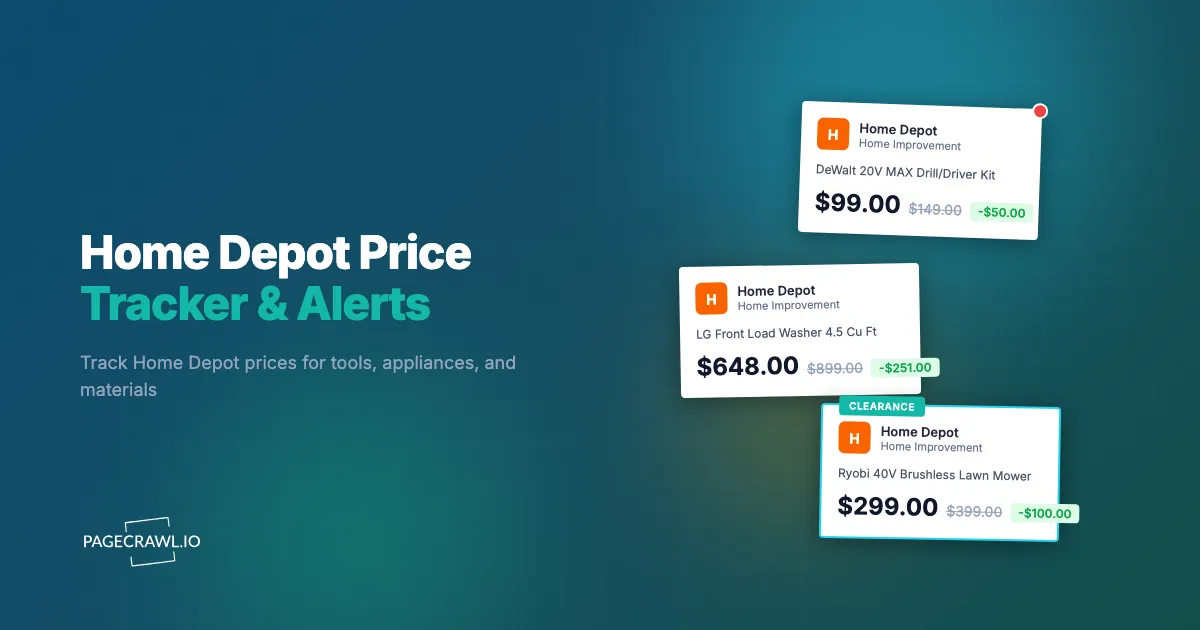
Power tools represent one of the best price tracking opportunities at Home Depot. Major brands (DeWalt, Milwaukee, Makita, Ryobi, Ridgid) run promotional pricing cycles. Tool combo kits, which bundle a drill, impact driver, and batteries, see especially large price swings between promotional and regular pricing.
A Milwaukee M18 combo kit that sells for $399 regularly might drop to $279 during Black Friday. Similar deals appear at other sale events throughout the year. Monitoring these products for months reveals the true price floor so you know whether a current deal is genuinely good or just moderate.
Track specific SKUs rather than category pages. Home Depot carries multiple configurations of popular tools, and pricing varies by exact kit contents.
Appliances
Major appliances (refrigerators, washers, dryers, dishwashers, ranges) are high-ticket items where a 10-20% price drop saves hundreds of dollars. Home Depot regularly discounts appliances around holiday sale events, and manufacturer rebates add additional savings.
Appliance pricing at Home Depot also responds to competitive pressure from Lowe's, Best Buy, and direct manufacturer sales. When competitors run promotions, Home Depot often matches or undercuts.
Monitor the specific model you want, not just the category. Appliance models turn over annually, and outgoing models see deeper discounts than current models. If you are flexible on exact model, monitoring several options increases your chances of catching a deal.
Lumber and Building Materials
Lumber prices deserve ongoing monitoring for anyone doing construction or renovation work. Home Depot's lumber pricing tracks commodity markets with some lag. Monitoring weekly gives you visibility into trends.
Key products to watch:
- 2x4 and 2x6 framing lumber (the most common construction materials)
- Plywood and OSB sheathing
- Pressure-treated lumber for outdoor projects
- Composite decking materials
For large projects, even a 10% price swing on lumber represents thousands of dollars. Monitoring helps you time purchases for budget-sensitive projects.
Outdoor and Patio Furniture
Patio furniture follows a sharp seasonal pricing curve. New inventory arrives in spring at full price. By late summer, discounts begin. After Labor Day, clearance discounts deepen sharply. The best patio furniture deals of the year typically happen in September and October.
If you are flexible on timing, monitoring patio furniture from August through October catches the deepest discounts, and the same seasonal strategy applies to Wayfair furniture price tracking on indoor pieces. Set alerts for specific sets you like and wait for the seasonal markdown.
Smart Home and Electrical
Smart home products (smart thermostats, video doorbells, smart locks, lighting) see promotional pricing around Black Friday, Prime Day (Home Depot often runs competing sales), and seasonal events. These are popular gift items with predictable price cycling.
Monitoring smart home products across both Home Depot and Amazon with cross-retailer price comparison reveals which retailer offers the better deal at any given time.
Paint and Supplies
Home Depot runs paint sales several times per year, typically offering rebates or discounts on popular brands like Behr, Glidden, and PPG. Paint promotions are time-limited and worth catching for large painting projects where you might need 10+ gallons.
What is the best way to track Home Depot prices?
Automated price monitoring on the exact product URL is the only method that catches a one-day Special Buy without you opening a browser. Manual checking misses short promotions, the Home Depot app does not push price-drop alerts on saved items, and general price comparison sites cover building materials and contractor-grade tools poorly.
Manual Checking
The simplest approach: bookmark products and check periodically. This works for one or two items you are casually watching but falls apart quickly. You will miss Special Buy deals that last only a day. You will not notice gradual price reductions. And for contractors managing multiple projects with dozens of material line items, manual checking is impractical.
The Home Depot App
The Home Depot mobile app offers basic price awareness. You can save items to a list, scan products in-store for pricing, and browse current promotions. The app does not send proactive price drop alerts on saved items.
The app is useful for in-store shopping and browsing current sales, but it does not solve the monitoring problem. You still have to open the app and check each product manually.
Price Comparison Websites
General price comparison tools cover some Home Depot products, but coverage is inconsistent. Most price comparison sites focus on electronics and consumer goods. Building materials, bulk supplies, and contractor-grade tools are poorly represented.
For the products they do cover, these sites provide historical price data. But the alert options are usually limited to email, with no webhook or Slack integration for team workflows.
Web Monitoring with PageCrawl
Automated web monitoring provides the most flexible and reliable approach to Home Depot price tracking. You monitor the exact product page and get alerts through the channels your team actually uses.
Step 1: Navigate to the Home Depot product page and copy the URL. Use the specific product URL, not a search results or category page.
Step 2: Add the URL to PageCrawl and select "Price" tracking mode. The system identifies the current price automatically.
Step 3: Set your check frequency. For tools and appliances you are watching casually, daily checks work well. For time-sensitive projects where you need to catch deals quickly, every 6 hours catches most promotions within the same day.
Step 4: Configure notifications. Email works for personal tracking. For contractor teams, Slack or Discord channels keep everyone aware of price changes on project materials.
Step 5: Verify the detected price matches what you see on the product page. PageCrawl shows you the current extracted value so you can confirm accuracy. The help centre explains monitoring numeric values like prices with the number tracker, including the charts and statistics you get once history builds up.
For teams tracking many products, the PageCrawl API allows bulk monitor creation. Upload a list of product URLs and configure monitoring programmatically.
Beyond tracking individual products, PageCrawl's automatic page discovery monitors a website's sitemap and alerts you when new pages are added. This catches new product listings, clearance pages, or seasonal sections on the first check after they appear on the site. For Home Depot tracking, this means you can discover new Special Buy landing pages, new clearance categories, or new seasonal promotional sections without knowing the exact URLs in advance.
Monitoring Bulk Material Prices Over Time
For contractors and project managers, the real value of Home Depot price tracking is understanding price trends over time, not just catching a single deal.

Building a Price History
Set up monitors on your most commonly purchased materials and let them run for weeks or months. PageCrawl stores the historical price data, giving you a record of how prices move.
Over time, you build a dataset that answers questions like:
- What is the lowest price this lumber product has hit in the past 6 months?
- When did the last appliance sale happen, and how deep were the discounts?
- Are concrete prices trending up or down this quarter?
This historical context transforms purchasing decisions. Instead of guessing whether today's price is good, you know based on data.
Timing Large Purchases
Major construction projects involve thousands or tens of thousands of dollars in materials. Timing those purchases even modestly better saves real money.
Example: A deck project requiring $8,000 in composite decking materials. Monitoring shows composite decking prices drop 15% during Home Depot's Labor Day sale. Waiting three weeks saves $1,200.
The monitoring cost is negligible compared to the savings on a single well-timed purchase.
Budget Forecasting
For contractors writing estimates, knowing current material prices is essential. But material prices can shift between estimate and purchase. Monitoring the specific products in your estimate keeps you informed if prices move before purchasing begins.
Set up monitors when you write the estimate. If prices rise before the project starts, you have data to support a change order conversation. If prices drop, you improve your margins.
Contractor Procurement Tracking
Professional contractors and construction companies face procurement challenges that go beyond individual price tracking and closer to supply chain monitoring across suppliers.
Multi-Project Material Management
A contractor running three concurrent projects might need to track 50+ material prices across all of them. Organizing monitors by project using folders in PageCrawl keeps tracking manageable.
Create a folder per project. Add all material monitors for that project to its folder. When a project completes, archive the folder. This structure scales across dozens of active projects.
Team Notifications
On a construction team, the person writing estimates is not always the person purchasing materials. Centralized notifications keep the team aligned.
Configure Slack notifications to a shared procurement channel. When any monitored material changes price, the entire team sees it. The project manager can make informed decisions about when to purchase based on price trends the whole team is tracking.
Webhook Integration for Procurement Systems
Larger construction companies use procurement software to manage purchasing. PageCrawl's webhook automation can feed price changes directly into procurement workflows.
When a monitored product price changes, a webhook fires with the new price data. Your procurement system receives the update, flags materials that have dropped below target prices, and can even auto-generate purchase orders for approval.
Tips for Effective Home Depot Price Tracking
Monitor Specific SKUs
Home Depot often sells similar products under different SKUs with different pricing. A "store exclusive" version of a tool might have different pricing than the standard version. Always monitor the exact SKU you intend to purchase.
Compare with Lowe's
Home Depot and Lowe's compete directly on nearly every product category. Setting up monitors on both retailers for the same products reveals pricing differences and helps you buy from whoever offers the better deal. PageCrawl can group these into one view: see comparing product prices across multiple retailers. The competitor price tracking guide covers strategies for monitoring across competing retailers.
Watch for Bundle Deals
Home Depot frequently creates tool bundles (buy a drill, get a free battery) and appliance packages (buy three kitchen appliances, save 15%). These bundles do not always appear as simple price changes on individual product pages. Monitoring the bundle or package page directly catches these deals.
Track Shipping Thresholds
Home Depot offers free shipping above a minimum order value on most items, and free delivery on large appliances and bulk orders. When tracking prices on items near shipping thresholds, factor delivery cost into your total. A small price increase might actually cost less if it pushes you above the free shipping threshold.
Use Historical Price Data
Do not react to every price change. A $5 drop on a $300 tool is not worth rushing to purchase. Use historical data to understand the product's price range. Wait for prices near the historical low before buying, unless you need the item immediately.
Set Up Monitors Before Sales Events
If you know Black Friday deals matter for your purchasing, set up monitoring in October. You want historical price data before the sale so you can evaluate whether "Black Friday pricing" actually represents the best deal or whether the product was cheaper three months ago.
Common Questions
Does Home Depot price match?
Yes, Home Depot has a price match policy that covers identical items from major competitors including Lowe's, Amazon, and others. Having documented price data from monitoring helps you request price matches with evidence.
Can I track in-store clearance prices?
In-store clearance pricing is not reliably reflected on the Home Depot website. Online monitoring catches online clearance, but in-store markdowns require physical store visits. Some regional clearance information appears on the website, but coverage is inconsistent.
How often do Home Depot prices change?
Standard product prices change infrequently, sometimes holding steady for months. Promotional pricing and Special Buy deals change daily. Commodity-linked products (lumber, concrete) may change weekly or even more frequently during volatile market periods.
Does monitoring work with the Pro Xtra program?
PageCrawl monitors the public product page, which shows standard retail pricing. Pro Xtra discounts may not be visible on the public page. Monitoring still catches general price changes, sales events, and clearance pricing that apply regardless of Pro status.
Choosing your PageCrawl plan
PageCrawl's Free plan lets you monitor 6 pages with 220 checks per month, which is enough to validate the approach on your most critical pages. Most teams graduate to a paid plan once they see the value.
| Plan | Price | Pages | Checks / month | Frequency |
|---|---|---|---|---|
| Free | $0 | 6 | 220 | every 60 min |
| Standard | $8/mo or $80/yr | 100 | 15,000 | every 15 min |
| Enterprise | $30/mo or $300/yr | 500 | 100,000 | every 5 min |
| Ultimate | $99/mo or $999/yr | 1,000 | 100,000 | every 2 min |
Annual billing saves two months across every paid tier. Enterprise and Ultimate scale up to 100x if you need thousands of pages or multi-team access.
Standard at $80/year covers 100 product pages and pays for itself the first time you catch a Home Depot sale before it ends. A single avoided full-price appliance purchase or one well-timed lumber buy during a promotion covers the cost several times over. At 15-minute check frequency, you are notified fast enough to act before popular items sell out or prices revert. Enterprise at $300/year tracks 500 pages, which is enough to monitor materials across an entire project portfolio and compare pricing across multiple home improvement retailers simultaneously.
Getting Started
Pick the products that matter most to your next project or purchase. Start with 3-5 high-value items: the appliance you have been eyeing, the tool combo kit you need for an upcoming job, or the lumber products for your deck project.
Set up monitors in PageCrawl with "Price" tracking mode and configure the notification channel that works for your workflow. For personal projects, email or mobile push notifications through web push alerts keep things simple. For contractor teams, a shared Slack channel provides team-wide visibility.
Run the monitors for a few weeks to build price history context. When you see a price drop, you will know whether it represents a genuine deal compared to historical pricing, or just normal fluctuation.
PageCrawl's free tier includes 6 monitors, enough to track the key products for a single project. Standard plans ($80/year for 100 monitors) cover ongoing contractor procurement needs across multiple projects. Enterprise plans ($300/year for 500 monitors) handle the demands of larger construction companies tracking materials across a full project portfolio.
Stop guessing whether today's price is the right time to buy. Let the data tell you.