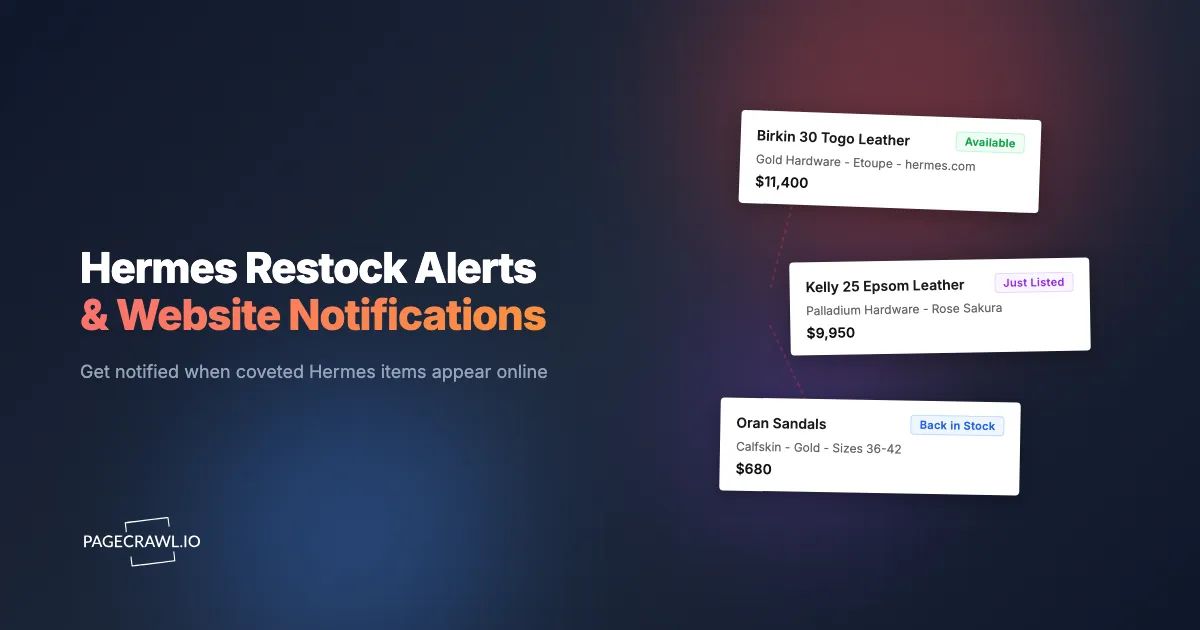
A Hermes Birkin 25 in Gold Togo leather appeared on hermes.com at 2:47 AM on a Tuesday. It was gone by 2:51 AM. No announcement. No newsletter alert. No notification from the site. Four minutes of availability for one of the most sought-after luxury items in the world, visible only to whoever happened to be browsing the site at that exact moment.
This is how Hermes operates online. Unlike brands that announce restocks, run waitlists, or send availability notifications, Hermes adds products to their website quietly and without warning. Items appear and disappear based on what the maisons produce and allocate to the digital channel. For shoppers trying to purchase specific Hermes items, particularly bags and small leather goods, this creates a fundamental problem: you cannot buy what you do not know is available, and availability windows are measured in minutes.
This guide covers how the Hermes online availability model works, which products actually appear on hermes.com, how to set up automated monitoring that alerts you as soon as a check finds an item available, notification strategies optimized for extremely short availability windows, and realistic expectations about what online monitoring can and cannot help you secure.
How does Hermes online availability work?
Hermes releases a small fraction of its production to hermes.com, quietly and without any schedule, waitlist, or notification. Items simply appear, and the most sought-after ones can sell out in minutes. Understanding that distribution model is essential before investing time in monitoring, because it is unlike any other luxury brand.
The Production Model
Hermes produces leather goods in limited quantities at workshops (called ateliers) across France. Each bag is handmade by a single artisan, a process commonly described as taking around 18 to 24 hours for a Birkin and similar times for a Kelly. This production model creates genuine scarcity rather than artificial limitation. Hermes cannot simply increase production to meet demand because the bottleneck is skilled artisan capacity, not materials or factory space.
Annual production numbers for individual bag lines are not published, and outside estimates vary widely. What is not in dispute is the direction: global demand runs far ahead of supply, so the gap between what shoppers want and what is available is enormous.
In-Store vs. Online Allocation
The vast majority of Hermes bags and sought-after small leather goods are sold in physical boutiques. The in-store purchase process is famously opaque: developing a relationship with a Sales Associate (SA), building a purchase history, and being offered the opportunity to purchase a bag when one becomes available. This process can take months or years.
The online channel receives a small fraction of total production. Hermes.com is not a primary sales channel for high-demand items. It is a supplementary channel where items appear sporadically, often at times that suggest automated inventory releases rather than curated merchandising.
This means that the online channel is both an opportunity (no SA relationship required, purely first-come-first-served) and a challenge (extremely limited inventory, unpredictable timing, intense competition from other online shoppers).
No Waitlists, No Notifications
Hermes does not operate a waitlist system for bags, either in-store or online. There is no "notify me when available" button on hermes.com for sold-out items. The brand's position is that part of the Hermes experience is the discovery, the surprise of finding something available.
For buyers, this philosophy translates to a practical problem: you must check the website repeatedly or have a system that checks for you. Manual checking is unrealistic given that items can appear at any hour and sell out within minutes.
What actually appears on Hermes.com?
Not everything Hermes makes appears online. Bags show up rarely and briefly, small leather goods appear regularly, and scarves, belts, shoes, jewellery, and home goods are stocked fairly consistently. Knowing which tier your target sits in sets realistic monitoring expectations before you start.
Bags
The category everyone cares about most. Hermes bags do appear on hermes.com, but with important caveats:
Birkin. Birkin bags appear online rarely. When they do, it is typically in standard leathers (Togo, Epsom, Clemence) and popular colors. Exotic leathers (crocodile, ostrich, lizard) almost never appear online. The Birkin 25 and Birkin 30 are seen more frequently than the Birkin 35 or Birkin 40 online.
Kelly. Kelly bags appear with slightly more frequency than Birkins, though still rarely. The Kelly Sellier tends to appear less often than the Kelly Retourne online. Mini Kellys are particularly hard to find.
Constance. The Constance appears online more frequently than the Birkin or Kelly, though "more frequently" in Hermes terms still means sporadically.
Picotin. The Picotin Lock is one of the more available bags online. It appears with relative regularity compared to the Birkin or Kelly, though popular colors still sell out quickly.
Evelyne. The Evelyne is among the most consistently available bags on hermes.com. It appears frequently and stays in stock longer than other bag models.
Garden Party. Another relatively available model. The Garden Party in canvas and leather combinations is often in stock online.
Bolide, Lindy, Halzan. These models fall in the middle range of availability. They appear periodically and may stay in stock for hours or days rather than minutes.
Small Leather Goods
Small leather goods (SLGs) are more consistently available online and represent the most realistic monitoring target for many buyers:
- Bearn wallet - Popular, moderately available
- Calvi card holder - Appears frequently, good entry-level item
- Bastia coin purse - Often available
- Dogon wallet - Moderately available
- Kelly wallet / Kelly Classique - Available more often than bags but still competitive
- Constance wallet - Periodic availability
- Clic H bracelet - Very popular, sells out in desirable colors
Ready-to-Wear and Accessories
Ready-to-wear clothing, shoes, scarves, ties, and belts are more consistently stocked online. These items have higher production volumes and less intense competition:
- Silk scarves (Carres) - Widely available, new designs release seasonally
- Twilly scarves - Almost always available in multiple designs
- Belts - Consistently stocked, including the H belt
- Shoes - Available in many styles, though limited sizes sell out
- Jewelry - Enamel bracelets and necklaces appear regularly
Home and Lifestyle
Hermes home goods (blankets, tableware, fragrances) are generally available online with less competition. These categories do not require monitoring unless you are looking for a specific limited or discontinued item.
Setting Up Hermes Monitoring with PageCrawl
Note: Hermes uses strict access controls on their website. Monitoring results may be inconsistent, and some product pages may not load for automated checks. Daily monitoring of category pages tends to be more reliable than monitoring individual product URLs.

Here is how to configure monitoring for Hermes products with the goal of catching availability when items appear.
Step 1: Identify Product Pages to Monitor
For specific items you want, navigate to hermes.com and find the product page. If the item is currently in stock, the URL for that specific product is your monitoring target. If the item is not in stock, it may not have a product page at all (Hermes removes sold-out items from the website rather than showing "sold out").
This presents a monitoring challenge. You cannot monitor a page that does not exist. Instead, use these strategies:
Monitor category pages. Navigate to the category you are interested in (e.g., hermes.com/us/en/women/bags-and-small-leather-goods/bags/). Monitor this page for changes. When a new product is added to the category, the page content changes, triggering an alert.
Monitor search results. Some Hermes URLs filter by product type. Monitoring a filtered view of "Birkin" or "Kelly" results catches new additions to those categories.
Monitor known product URLs. If you know the URL structure for a specific product (from a past sighting or from community resources), monitor that URL even if it currently returns a 404 or redirects. When the item becomes available, the page will load with product content, which constitutes a detectable change.
Step 2: Configure the Right Tracking Mode
For category pages that you are monitoring for new product additions, use "Full Page" tracking mode. This captures all content on the page, and any new product listing will appear as a change.
For specific product URLs (if you have them), use "Availability" tracking mode, the same stock availability and restock alert setup used for any sold-out product. This focuses on detecting whether the product is purchasable, specifically looking for "Add to Cart" or equivalent buying actions.
For more precise monitoring of specific elements on the page, you can use CSS selectors to target the product grid area on category pages or the "Add to Cart" button on product pages.
Step 3: Set Check Frequency
For Hermes monitoring, check frequency determines your chance of catching short availability windows.
Daily: Recommended for most Hermes monitoring. For Hermes, daily checks are recommended. More frequent checks are unlikely to succeed consistently due to the site's access restrictions. Daily checks of category pages provide the most reliable results.
Every 2-4 hours: Worth trying for moderately available items (Picotin, Bolide, Lindy, small leather goods) if daily checks are producing consistent results for you. These items tend to stay available longer, giving you a larger window to act.
Every 6-12 hours: A middle ground for items with consistent availability (scarves, belts, ready-to-wear). You are monitoring for new arrivals or specific items rather than racing against scarcity.
The trade-off is straightforward: more frequent checks increase the chance of catching short availability windows, but Hermes's access controls mean very frequent checks may not load successfully every time. Start with daily checks and increase frequency only if you are getting consistent results.
Step 4: Configure Fast Notifications
For Hermes monitoring, notification speed is critical. A 5-minute delay between detection and delivery could mean the difference between purchasing and missing out.
Telegram is the recommended primary channel. A Telegram bot delivers the alert to your phone as soon as a check detects the item, and you can tap a link to go directly to the product page. See our push notification guide for setup details.
Web push notifications serve as a secondary channel. If you are at your computer, a browser push lands on your desktop as soon as the check completes. Combine with Telegram for coverage whether you are on your phone or at your desk.
Discord works well if you use Discord actively. Route alerts to a direct message or a private channel. For Hermes monitoring, Discord and Slack alerts are among the quickest channels once a change is detected.
Email is too slow for Hermes bag monitoring. By the time you check email, the item will be gone. Use email only for items with longer availability windows (ready-to-wear, accessories).
Step 5: Prepare to Act Quickly
Having alerts is only half the equation. When an alert fires, you need to act within minutes. Prepare in advance:
Stay logged in to hermes.com. If your session is active, you skip the login step when an item appears.
Save your shipping and payment information. Hermes.com saves addresses and payment methods in your account. Having these pre-saved eliminates form-filling during checkout.
Know the return policy. Hermes offers returns on most online purchases. If you are uncertain about a color or size but the item is available, purchase first and evaluate later. This is especially relevant for bags where availability is unpredictable.
Have the site bookmarked on your phone. When you receive a mobile notification, you want one tap to reach hermes.com, not manual URL typing.
Use the PageCrawl browser extension. The PageCrawl browser extension lets you add a new monitor directly from any page you are browsing, without switching to the PageCrawl dashboard. If you spot a Hermes product page you want to track, one click in the extension creates the monitor with your saved defaults. This is handy when browsing hermes.com and discovering a product category or specific item you had not considered monitoring before. You can also use the extension to quickly check the status of your existing monitors without leaving the Hermes site.
Timing Patterns for Online Drops
While Hermes does not publish a schedule, community observation has identified some patterns in when items tend to appear online.
Time of Day
Hermes website inventory updates appear to happen throughout the day and night, but there are higher-probability windows. Many community members report seeing items appear between midnight and 6:00 AM local time (relative to the regional site you are browsing). Early morning restocks (between 5:00 AM and 8:00 AM) also show higher activity.
These patterns are not guaranteed and shift over time. What is consistent is that prime browsing hours (mid-day, early evening) are not necessarily the best times for new inventory to appear. This is precisely why automated monitoring is valuable: it checks around the clock when you cannot.
Day of Week
Midweek days (Tuesday through Thursday) tend to show more new inventory than weekends, though weekend drops do occur. Monday mornings are also active, possibly reflecting inventory allocated during the weekend becoming visible on the website.
Again, these are observed tendencies, not rules. Do not reduce monitoring frequency on certain days based on historical patterns, because the one time a Birkin drops on a Sunday afternoon will be the time you are not monitoring.
Seasonal Patterns
Hermes releases new collections twice a year (Spring/Summer and Fall/Winter). Around collection launch times, the volume of new products appearing online increases. This is a good time to monitor more actively, as new colors and materials enter the online inventory.
Between collection launches, inventory tends to be sparser. Items appearing during these periods are often leftover stock from the current season or classic colors that are produced year-round.
Monitoring Specific Categories and Product Types
Different product categories benefit from different monitoring strategies.
Monitoring for Bags
For bags, monitor the following pages at higher frequency:
- The women's bags category page (filtered by new arrivals if possible)
- The men's bags category page (if relevant)
- Specific bag model pages if you know the URL pattern
Because bags appear and sell out so quickly, consider monitoring multiple regional sites (hermes.com/us, hermes.com/gb, hermes.com/fr) to catch items that may appear in one region before another.
Note: Purchasing from a different region may involve different pricing, import duties, and shipping arrangements. Factor these considerations into your strategy.
Monitoring for Small Leather Goods
Small leather goods are the sweet spot for online Hermes monitoring. They appear more frequently than bags, have a larger window of availability, and do not require the multi-year SA relationship that in-store bag purchases demand.
Monitor the SLG category page and set up product page monitoring for the specific items you want. A check frequency of every 2-4 hours is usually sufficient for SLGs, though popular items (Kelly wallet, Clic H) may warrant hourly checks.
Monitoring for Limited Editions and Special Collections
Hermes occasionally releases limited or special edition items exclusively online. These can include collaboration pieces, special colorways, or unique product categories. These drops are typically announced through Hermes social media or editorial content on the website.
Monitor the Hermes editorial/stories section of the website for announcements about upcoming online exclusives. When an exclusive is announced, set up monitoring on the expected product page or category before the release date.
Combining with Resale Market Intelligence
The Hermes resale market is enormous and well-established. Monitoring resale platforms alongside hermes.com provides broader market intelligence.
Understanding Market Values
Resale platforms (The RealReal, Vestiaire Collective, Rebag, Fashionphile, and private consignment shops) show current market prices for specific Hermes items. A Birkin 25 in Gold Togo carries a five-figure retail price at hermes.com and typically resells well above it, with the exact premium depending on condition, hardware, and demand for that colour.
Monitoring resale prices helps you understand:
- Which specific models, sizes, and colors command the highest premiums
- Whether resale values are trending up or down for specific items
- Which items represent the best value at retail (highest resale premium)
- Whether purchasing at retail for personal use saves significantly compared to resale
Price Tracking on Resale Platforms
Use PageCrawl to monitor product listings on resale platforms for specific Hermes items. This alerts you when:
- A specific item you want appears on a resale platform
- Prices drop below your target price
- New listings appear for hard-to-find items
Resale platform monitoring is a practical complement to hermes.com monitoring. If you cannot secure a bag at retail, resale monitoring helps you find the best resale price.
What can Hermes monitoring realistically achieve?
It gives you a system that watches hermes.com around the clock and alerts you on the check after an item appears, which is a large advantage over manual browsing. It cannot guarantee you a Birkin: availability is genuinely rare, windows are short, and competition is intense. Honest expectations prevent frustration.
What Monitoring Can Do
- Alert you on the next check after items appear on hermes.com
- Build a historical record of when different items tend to appear
- Catch items that you would otherwise miss entirely
- Give you a significant advantage over manual browsing
- Work around the clock, including overnight and on weekends
- Track multiple product categories and regional sites simultaneously
What Monitoring Cannot Guarantee
- That you will secure a Birkin or Kelly online (availability is genuinely rare and competition is intense)
- That items will stay available long enough for you to complete checkout
- That hermes.com will not block or throttle access during high-demand periods
- That the specific color, size, or leather you want will appear during any given monitoring period
- That monitoring replaces the value of an in-store SA relationship for the most exclusive items
Realistic Timeframes
If you are monitoring for a specific Birkin or Kelly in a specific color and size, expect to monitor for weeks or months before the right combination appears online. Many configurations never appear online at all.
For less exclusive items (Picotin, Evelyne, small leather goods), monitoring for one to four weeks is usually sufficient to catch available inventory.
For ready-to-wear and accessories, most items can be found within days of setting up monitoring.
The SA Relationship Still Matters
For serious Hermes collectors, online monitoring is a supplement to, not a replacement for, building a relationship at your local boutique. The in-store experience provides access to items that never appear online, personalized guidance on new collections, and the ability to request specific configurations.
Online monitoring fills a different niche: it captures the occasional windfall of an item appearing online without the months-long relationship-building process. Think of it as an additional channel that runs in the background while you pursue the traditional route.
Choosing your PageCrawl plan
PageCrawl's Free plan lets you monitor 6 pages with 220 checks per month, which is enough to validate the approach on your most critical pages. Most teams graduate to a paid plan once they see the value.
| Plan | Price | Pages | Checks / month | Frequency |
|---|---|---|---|---|
| Free | $0 | 6 | 220 | every 60 min |
| Standard | $8/mo or $80/yr | 100 | 15,000 | every 15 min |
| Enterprise | $30/mo or $300/yr | 500 | 100,000 | every 5 min |
| Ultimate | $99/mo or $999/yr | 1,000 | 100,000 | every 2 min |
Annual billing saves two months across every paid tier. Enterprise and Ultimate scale up to 100x if you need thousands of pages or multi-team access.
A single Hermes bag purchased at retail rather than resale saves thousands against secondary market prices, which means Standard at $80/year pays for itself many times over from a single successful purchase. With 100 monitors you can cover every regional Hermes site, the categories you care about, and a few other hard-to-find luxury brands at the same time. The 15-minute check frequency is fast enough to catch most restock events within the window before items disappear again, and fast Telegram or email alerts mean you do not have to keep a browser tab open all day.
Getting Started
Choose the Hermes product category most relevant to you. If you want a bag, monitor the bags category page on hermes.com for your region. If you want specific small leather goods, find the relevant category or product page. Add these URLs to PageCrawl with daily check frequency to start and configure Telegram notifications for speed.
PageCrawl's free tier includes 6 monitors, enough to monitor two to three Hermes product categories on your regional site plus a couple of specific items or an additional regional site. The Standard plan ($80/year for 100 monitors) supports comprehensive monitoring across multiple regions, categories, and individual products. For resellers or committed collectors monitoring hundreds of product pages across regions and resale platforms, the Enterprise plan ($300/year for 500 monitors) provides the scale required.
The fundamental value of monitoring is simple: it watches hermes.com when you cannot. Given that Hermes items appear without announcement at unpredictable times, automated monitoring transforms a near-impossible manual task into a managed system that works around the clock. You may not catch every item, but you will catch items you would have otherwise missed entirely, and for Hermes, that is often the difference between buying at retail and paying a significant premium on the resale market.