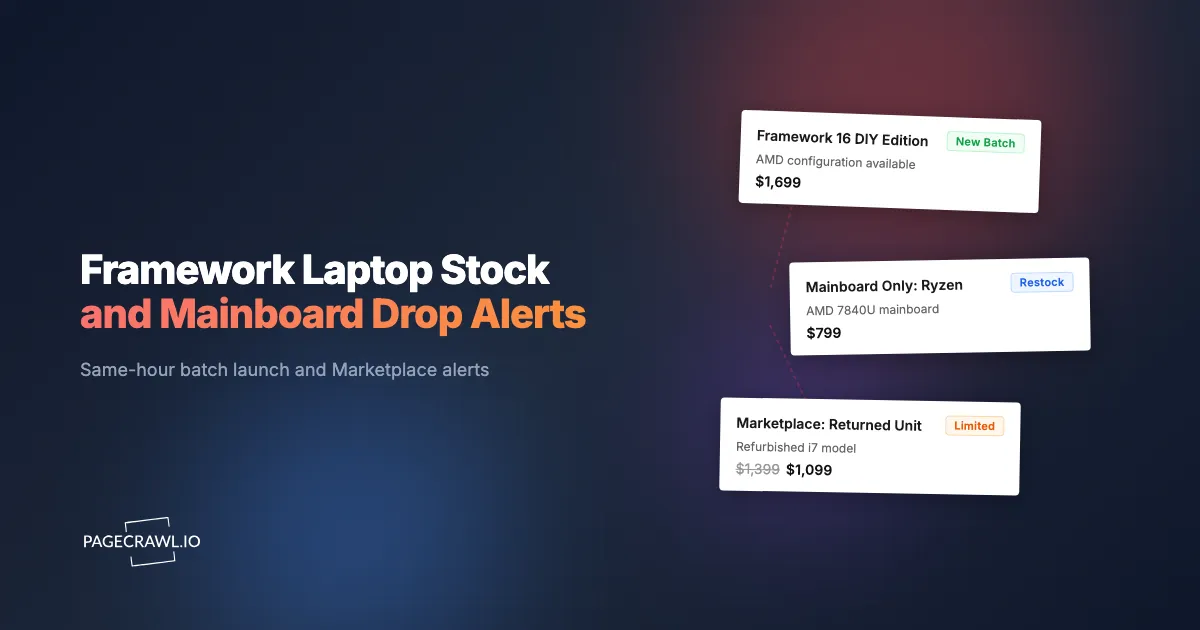
Marketplace mainboard batches on Framework follow a familiar pattern: a discounted previous-generation board appears mid-morning with no announcement, and the batch is gone before lunch. The mainboards are popular for DIY single-board-computer builds (homelab clusters, NAS controllers, custom routers), and the discounted previous-gen pricing makes them genuinely cheap compared to other small-form-factor compute. The buyers who land boards are overwhelmingly the ones running monitors on the Framework Marketplace page. Manual checking on a random Friday morning is not a workable strategy because Framework batches drop without announcement.
Framework's modular laptops and standalone mainboards sell in batches with planned and unplanned restocks. Specific configurations (high-end CPU, top-tier screens, refurbished models) sell out within hours of launch. The Marketplace page in particular carries one-of-one and small-batch listings for limited returns, refurbished units, and standalone mainboards that move quickly. Native notify-me on Framework's store works for some SKUs but does not cover Marketplace listings reliably. For Framework buyers who want specific configurations or mainboards for project builds, a continuous monitor with stock availability and restock alerts is the only practical approach.
This guide covers how Framework publishes stock and Marketplace data, what patterns drive the cheapest acquisitions, and how to set up monitors that surface batch launches and Marketplace listings within hours.
Why are Framework pages worth monitoring continuously?
Because Framework sells in unannounced batches. Laptops, mainboards, and Marketplace units go live without a published schedule and the popular configurations clear within hours, so a page that was sold out at breakfast can be live and gone by mid-morning. Three structural facts about Framework's release and inventory model make continuous monitoring valuable.
Batched Availability Means The Drop Window Matters
Framework manufactures and releases laptops and components in planned batches rather than continuously. When a new batch goes live, the most-requested configurations sell out within hours. Knowing when a batch activates is operationally important.
Marketplace Listings Are One-Of-One Or Small Batch
The Framework Marketplace lists limited returns, refurbished units, and standalone mainboards. Listings are one-of-one for refurbished, small-batch for mainboards. Inventory clears within hours of listing.
Mainboard Drops Are Especially Valuable For Project Builders
Standalone mainboards listed on the Framework Marketplace are among the cheapest paths to high-quality x86 or ARM compute for homelab projects, because previous-generation boards are discounted well below comparable mini-PCs. Monitoring catches mainboard drops in time to buy for project builds.
New Framework 13/16 SKU Launches Reset The Market
When Framework releases a new CPU refresh or display option, the launch window opens with introductory configurations that sell through fast. Monitoring catches launches in time to configure and order.
Module And Accessory Restocks Have Their Own Cycle
Expansion cards, batteries, hinges, and other module stock comes and goes independently of laptop and mainboard stock. Niche modules (LTE, specific port configurations) restock on opaque schedules.
How are Framework stock pages structured?
Framework exposes several URL types worth monitoring: the product catalog, the Marketplace, individual product detail pages, and the standalone mainboards page. Each surfaces a different slice of inventory, so a useful watchlist covers more than one.
https://frame.work/products
https://frame.work/marketplace
https://frame.work/products/laptop13-diy-amd-ai-300
https://frame.work/products/mainboard
The products page renders the full catalog. The Marketplace page renders limited and refurbished listings. Individual product pages render per-configuration stock. The mainboards page renders standalone mainboard listings.
For monitoring, the Marketplace page is the highest-leverage monitor (catches one-of-one listings and small-batch mainboard drops). Product detail pages for specific configurations are the secondary monitors (catch restocks of specific SKUs).
Comparing Approaches
| Approach | Cost | Latency | Coverage | Best For |
|---|---|---|---|---|
| Framework native notify-me | Free | Hours, doesn't cover Marketplace | Per product | Light users |
| Manual page refresh | Free | Variable | Per session | Casual checkers |
| Framework community forum | Free | Hours to days | Crowd-sourced | Community members |
| Subreddit and Discord (r/framework) | Free | Minutes to hours | Crowd-sourced | Community members |
| PageCrawl on Framework pages | Free tier to $80/year | 15 minutes to hours | Any page | Active buyers and project builders |
Native notify-me works for the standard product catalog but does not cover Marketplace listings reliably. Community channels surface most drops but with variable latency. Direct monitoring of the Marketplace page and product pages is the most reliable approach.
Setting Up Framework Monitoring

Step 1: Add the Marketplace page
https://frame.work/marketplaceAdd as a content monitor. The highest-leverage monitor for limited returns, refurbished units, and small-batch mainboard drops.
Step 2: Add the products and mainboards pages
https://frame.work/products
https://frame.work/products/mainboard
Add as content monitors. Catches new product launches and mainboard restocks.
Step 3: Add specific product detail pages
For specific configurations you want (Framework 16 with the high-end GPU, Framework 13 in a specific CPU tier), add the product detail page with the configuration pre-selected.
Step 4: Configure hourly checks
Framework restocks are not minute-sensitive but hourly checks catch most drops within the typical 1-4 hour sell-through window. For Marketplace specifically, every 30 minutes is worth the extra checks. If you only care about drops during your waking hours, the check scheduling options let you restrict checks to specific days and hours.
Step 5: Route alerts to Telegram or web push
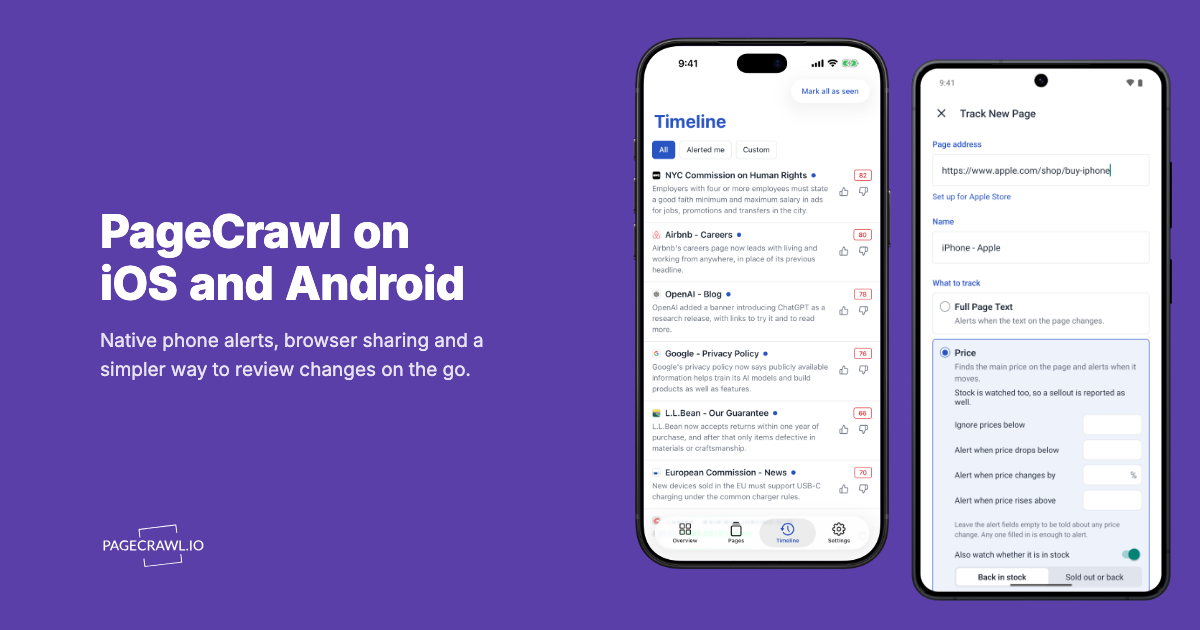
Framework drops are mobile-actionable. Telegram or web push reaches your phone as soon as a check detects the new listing, so you can act from anywhere. The Telegram notification setup guide walks through connecting a bot to a personal chat, group, or channel.
Step 6: Pair with community forum monitoring
Drop schedules are sometimes telegraphed first on the Framework community forum. Add the forum announcements page as a sibling monitor.
Worked Example: Building A Homelab Cluster
A homelab enthusiast wants to build a 4-node compute cluster using Framework 13 mainboards. The setup:
- Add the Framework Marketplace page (1 monitor, every 30 minutes).
- Add the standalone mainboards page (1 monitor, hourly checks).
- Add the Framework community forum announcements page (1 monitor, daily checks).
- Tag everything
homelab-cluster. - Route alerts to Telegram for mobile delivery.
Five weeks in, the Marketplace alert fires: a batch of previous-generation mainboards at a steep discount. The builder buys 4 within the alert window. The batch sells out within 40 minutes. Total cost: free, because the watchlist fits inside the 6-monitor free tier. Net saving versus comparable mini-PC alternatives: several hundred dollars across the four units.
Patterns Worth Watching
New laptop SKU launches. Framework 13 and 16 batch releases on new CPU refreshes or display options. Launches sell through fast in the popular configurations.
Mainboard-only restocks. Standalone mainboards at discount pricing. The highest-leverage drop for project builders.
Marketplace listings. Limited returns and refurbished units. One-of-one inventory that clears within hours.
Module and accessory restocks. Expansion cards, batteries, hinges, niche modules. Restocks on opaque schedules.
Discontinued or legacy SKU clearance. When Framework discontinues a CPU generation, remaining inventory clears at discount. Worth catching.
Community batch announcements. Framework occasionally announces upcoming batches on the community forum before the products page reflects them. Monitoring the forum catches the heads-up.
Combining Framework Alerts With Other Hardware Signals
Pair with Steam Deck monitoring. Adjacent niche hardware with similar inventory dynamics. See the Steam Deck stock tracker and restock notifications guide.
Pair with Meta Quest and Vision Pro monitoring. Other batched-release hardware. The Meta Quest and Vision Pro stock alerts guide covers VR hardware.
Pair with the Framework changelog and blog. Major announcements and product updates appear here first. Add the Framework news page as a sibling.
Pair with subreddit and Discord channels. r/framework and the Framework Discord often surface drops or batch hints. PageCrawl provides the reliable trigger; community is supplemental.
Pair with mini-PC and SBC comparison pricing. For project builders, comparing Framework mainboard pricing against Intel NUC, ASRock, and other small-form-factor options is the buying decision. Monitoring competitor pricing alongside Framework drops makes the comparison continuous.
Use Cases
Buyers. Same-day awareness of new batch launches is the difference between configuring the laptop you want and waiting weeks for the next batch.
Project builders. Mainboard-only restocks support unique projects (homelab clusters, NAS controllers, custom routers, edge compute). The discount pricing on mainboards makes Framework one of the cheapest paths to capable x86 compute for hobbyists.
Repair and refurbishing. Module restock awareness supports repair operations. A repair shop or refurbisher buying replacement modules in volume saves on coordinated restock timing.
Enthusiast media. Restock timing informs review and content cycles. The reviewer who covers a new batch the morning it launches earns the affiliate click before competing creators.
Education and research. Framework's repairability and modularity make it attractive for engineering programs. Bulk procurement around batch launches saves on cohort kits.
Sustainability-focused buyers. Refurbished Framework units have the lowest environmental footprint among consumer laptops. Monitoring the refurbished category captures the rare windows when units are available.
Frequently Asked Questions
How often do mainboard drops happen? Roughly every 1-3 months for standalone mainboards. No published schedule.
Will alerts include which CPU generation restocked? Yes. PageCrawl's AI summary describes the change including which mainboard SKU was added or restocked.
Can I monitor specific configurations? Yes. Build the product detail page URL with the configuration pre-selected. The monitor tracks that configuration's stock state.
What about Framework 16 GPU module restocks? GPU modules have their own stock cycle. Add the GPU module product page as a separate monitor.
Will alerts work for international Framework regions? Yes. Framework's regional stores (EU, AU, UK) have their own inventory and pricing. Monitor international stores for cross-region availability.
Do I need a paid plan? A small watchlist (Marketplace, products, mainboards) fits within the free tier. Active project builders with longer wishlists move to Standard at $80/year for 100 monitors and 15-minute checks.
Choosing your PageCrawl plan
PageCrawl's Free plan lets you monitor 6 pages with 220 checks per month, which is enough to validate the approach on your most critical pages. Most teams graduate to a paid plan once they see the value.
| Plan | Price | Pages | Checks / month | Frequency |
|---|---|---|---|---|
| Free | $0 | 6 | 220 | every 60 min |
| Standard | $8/mo or $80/yr | 100 | 15,000 | every 15 min |
| Enterprise | $30/mo or $300/yr | 500 | 100,000 | every 5 min |
| Ultimate | $99/mo or $999/yr | 1,000 | 100,000 | every 2 min |
Annual billing saves two months across every paid tier. Enterprise and Ultimate scale up to 100x if you need thousands of pages or multi-team access.
If monitoring helps you land one sold-out concert ticket pair, one limited sneaker drop, or one in-demand product at retail instead of resale, Standard at $80/year is already paid for. 100 monitored pages covers every major retailer you care about, and the 15-minute check frequency catches most drops within minutes of going live.
How do you get started with Framework stock alerts?
Add the Framework products and marketplace pages to PageCrawl on an hourly check, then route the alert to Telegram or web push. Create a free account and the next batch launch will reach your channel on the check that detects it, typically within the hour.