A presidential candidate quietly removed a key policy position from their campaign website on a Friday afternoon. No press release, no social media announcement. The page simply changed. A journalist who had been manually checking the site each morning noticed the change four days later, on Tuesday. By then, the weekend news cycle had passed, and the change was treated as old news rather than a story.
Political websites change constantly, and those changes carry meaning. Candidates adjust policy language, add or remove endorsements, update issue pages, and revise biographical details. Government election websites update ballot information, polling locations, and results. Party platforms evolve between conventions. Each of these changes is a data point, and catching them when they happen (rather than days or weeks later) is the difference between timely accountability and after-the-fact observation.
This guide covers why political website monitoring matters, what to track during election cycles, how to set up automated monitoring for campaign and government sites, and how to build an accountability archive that preserves a record of what was said and when it changed.
Why does political website monitoring matter?
Political website monitoring matters because campaign and government pages are primary sources of official positions, yet they are edited silently and treated as less permanent than press statements or speeches. Monitoring preserves the previous wording, so a quiet rewrite becomes a documented, timestamped event instead of a rumour.
The Accountability Gap
When a politician makes a statement on television, it is recorded. When they give a speech, transcripts exist. When they publish a press release, it enters the public record. But when they update their campaign website, the old version often disappears without a trace.
Website changes are the quietest form of political communication. A policy page can be rewritten overnight, and unless someone saved the previous version, there is no record of what it said before. Automated monitoring closes this gap by capturing changes as they happen and preserving both the old and new versions.
This is not a new concern. Organizations like the Sunlight Foundation and individual journalists have long recognized the need to track government and political websites for changes. Tools like Versionista were widely used by journalists and watchdog groups to monitor government websites for policy shifts, deleted pages, and silent edits. For organizations looking for a similar capability today, PageCrawl works as a Versionista alternative for tracking government and political pages, with change tracking and archiving built in. For more on this topic, see our Versionista alternative guide.
Policy Position Tracking
Campaign websites are the canonical source for a candidate's official positions. Unlike interview clips or social media posts (which can be taken out of context), the issues page on a campaign website represents what the candidate wants voters to know about their stance.
When those positions change, it signals strategic decisions: responding to polling data, pivoting for a general election after a primary, adjusting after a policy announcement receives negative coverage, or aligning with a new endorsement. Tracking these changes over time builds a record of a candidate's evolving positions that goes beyond what campaign press materials reveal.
Government Transparency
Government election websites (Secretary of State offices, county election boards, election commissions) publish official information about elections: ballot measures, candidate filings, polling locations, early voting schedules, and results. Changes to these pages directly affect voters.
Monitoring government election pages ensures that official information changes are documented. When a polling location changes, an early voting date shifts, or a ballot measure description is updated, automated monitoring catches it on the next scheduled check rather than whenever someone happens to reload the page.
Research and Analysis
Political scientists, policy researchers, and advocacy organizations study how political communication evolves over time. Automated monitoring creates a structured dataset of website changes that supports longitudinal analysis of campaign messaging, policy development, and government communication patterns.
What should you monitor during an election cycle?
Monitor four source types during an election cycle: candidate campaign websites (issues, about, endorsements, donations, events), party platform pages, government election sites run by Secretary of State offices and county boards, and fact-checking outlets. Each answers a different question, and together they cover both claims and official administration.
Candidate Campaign Websites
Campaign websites are the richest source of official candidate information.
Issues and Policy Pages: The core of any campaign website. These pages outline the candidate's positions on key topics. Monitor each issue page individually to catch changes to specific policy positions without noise from unrelated page updates.
About and Biography Pages: Candidates occasionally revise their biographical narratives, emphasizing different aspects of their background depending on the audience or the stage of the campaign. A candidate might highlight business experience during an economic downturn or military service during a foreign policy crisis.
Endorsement Pages: As campaigns progress, endorsement pages grow. New endorsements are added, and occasionally endorsements are quietly removed if the endorser becomes controversial or withdraws support. Monitoring endorsement pages tracks the public support landscape.
Donation and Fundraising Pages: Changes to fundraising messaging, suggested donation amounts, and campaign finance disclosures reveal strategic priorities and financial health. A sudden push for small-dollar donations or a change in messaging urgency often coincides with campaign milestones or challenges.
Event Pages: Campaign event listings show where candidates are focusing their time and resources. Monitoring event pages reveals campaign strategy: which states they are visiting, which demographics they are targeting through event venues and locations.
Party Platform Pages
National and state party platforms are official documents that articulate the party's positions across all policy areas. Platforms are formally adopted at conventions but may be updated or amended between conventions. Monitoring party platform pages tracks these inter-convention changes.
Government Election Websites
Official government sources publish the authoritative information voters need.
Secretary of State Websites: Most states publish voter registration information, election dates, ballot contents, and certified results through their Secretary of State website. Monitor these pages for official election updates.
County and Local Election Boards: Local election administration handles polling locations, ballot design, provisional ballot policies, and local race information. For local elections, these are the primary sources.
Federal Election Commission (FEC): The Federal Election Commission publishes campaign finance data, advisory opinions, and enforcement actions. Monitoring the FEC website provides insight into campaign spending, donations, and compliance issues.
State Legislature Voting Records: Legislative voting records show how elected officials actually vote, which sometimes diverges from their stated positions. Monitoring voting record pages during legislative sessions creates an accountability record.
Political News and Fact-Checking Sites
While not primary sources, fact-checking sites such as PolitiFact and FactCheck.org and political news organizations publish analysis that complements direct website monitoring. Monitoring news sites and publications for new articles, edits and retractions about candidates or issues you are tracking provides additional context.
Setting Up Political Website Monitoring with PageCrawl
Effective political monitoring combines different monitoring modes for different types of content.

Monitoring Campaign Policy Pages
Step 1: Navigate to the candidate's campaign website and find their issues or policy section. Most campaign sites have a main "Issues" page with links to individual policy area pages (economy, healthcare, education, defense, etc.).
Step 2: Set up a monitor for each individual policy page rather than just the main issues page. This provides granular tracking of changes to specific positions. When the healthcare page changes, you want to know it was the healthcare page specifically, not just that "something on the issues section changed."
Step 3: Select fullpage monitoring mode with screenshots enabled. Screenshots create a visual record of the page's appearance at each check, which is valuable for accountability documentation. Text changes are captured in the diff, while screenshots preserve the visual presentation. For more detail on monitoring approaches, see our guide to monitoring website changes.
Step 4: Set check frequency based on the election timeline. During primary or general election campaigns, daily checks capture most changes. In the weeks immediately before an election, increase to multiple checks per day. During off-cycle periods, weekly checks suffice.
Step 5: Configure notifications. For journalists covering the campaign, push channels such as Telegram or Slack deliver the alert as soon as a check detects the edit. For researchers building a longitudinal dataset, daily digests that bundle changes into one email provide a manageable review cadence.
Monitoring Government Election Pages
Step 1: Identify the official election information pages for the jurisdictions you care about. State Secretary of State websites, county election board pages, and municipal election commission sites each publish different levels of detail.
Step 2: Add each page to PageCrawl using fullpage monitoring mode. Government pages often contain tabular data (polling locations, candidate lists, result tallies) where layout and structure matter for interpretation.
Step 3: Enable screenshots, and contact us to add audit-ready WACZ archiving for your account. Official election information has legal and historical significance. Preserving page snapshots with timestamps creates an auditable record of what was published and when. For comprehensive archiving, see our guide to website archiving.
Step 4: Set check frequency based on the election timeline. In the weeks before an election, daily monitoring catches last-minute changes to polling locations, ballot measures, and official announcements. On election night and the days following, increase check frequency to capture results updates as they are posted.
Using AI Summaries for Change Analysis
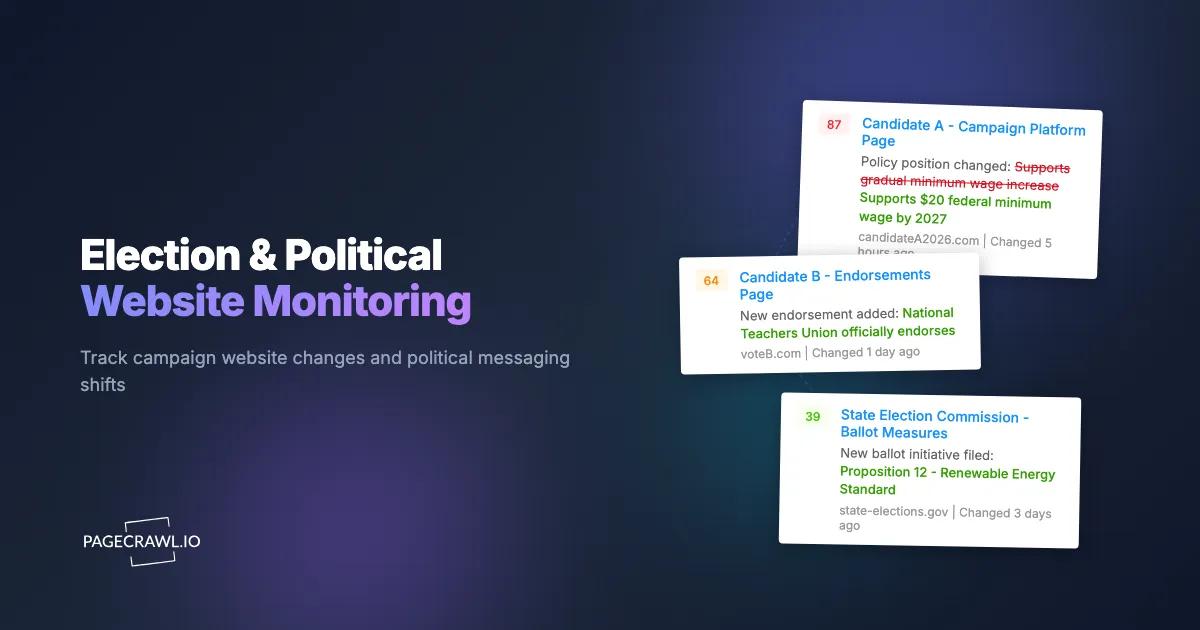
PageCrawl's AI-powered change summaries help interpret the significance of detected changes. When a policy page is updated, the AI summary describes what changed in plain language: "Removed paragraph about supporting minimum wage increase" or "Added section on renewable energy tax credits."
This is particularly valuable when monitoring multiple candidates or jurisdictions simultaneously. Rather than reading raw diffs for every change, the AI summary provides a quick assessment of whether the change warrants closer attention. For a broader overview of AI-enhanced monitoring, see our guide to how to monitor website changes.
Building an Accountability Archive
One of the most valuable applications of political website monitoring is creating a permanent record of what was said and when it changed.
Why Archiving Matters
Political websites are inherently ephemeral. After an election, campaign websites are often taken down entirely. Government websites are redesigned between administrations. Party platforms are replaced at conventions. Without active archiving, the historical record is incomplete.
An accountability archive preserves every version of every monitored page. When a candidate claims they have "always supported" a particular policy, the archive provides evidence of whether that is true. When a government website removes information that was previously public, the archive preserves what was removed.
Creating WACZ Archives
PageCrawl supports WACZ (Web Archive Collection Zipped) format for creating portable, self-contained web archives. Each monitored page can be saved as a WACZ file that preserves the full page content, assets, and metadata in a format that can be replayed in any compatible web archive viewer.
WACZ archiving is especially valuable for political website monitoring because it produces evidence-grade web archives sealed with independent timestamps. Unlike a simple screenshot, a WACZ file contains the complete page as it appeared at a specific moment, including all text, images, links, and styling. When a candidate removes a policy position or a government website deletes voter information, the WACZ archive proves exactly what was there and when. These archives can be shared with other journalists, uploaded to institutional repositories, or presented as evidence in legal proceedings. The format is an open standard supported by tools like ReplayWeb.page, making the archives accessible without any dependency on PageCrawl itself. The help centre explains what is inside a PageCrawl WACZ archive, including the embedded signature and timestamp files.
For details on archiving capabilities, see our website archiving guide.
Organizing the Archive
Structure your monitoring by creating separate folders for each candidate, each party, and each government source. Within each folder, monitors for individual pages (issues, about, endorsements) create a clean organizational hierarchy.
Over time, this structure builds into a searchable archive of political communication. When you need to find when a specific policy position changed, you can navigate directly to the relevant monitor and review its change history.
Sharing Archive Data
For journalists and researchers, the ability to share archive data is critical. PageCrawl's change history includes timestamps, page snapshots, and diff views that can be referenced in reporting. Screenshots and archived pages provide visual evidence that supplements written analysis.
Webhook integrations let you pipe change data into external systems for collaborative analysis. A newsroom monitoring team can feed alerts into a shared database that multiple reporters access. For details on webhook setup, see our guide to webhook automation.
Use Cases by Organization Type
Different organizations use political website monitoring for different purposes.
Journalists and News Organizations
Journalists use political monitoring for:
Accountability Reporting: Tracking what candidates say over time and reporting when positions shift. Automated monitoring provides a factual basis for stories about evolving positions.
Breaking News: Catching campaign announcements, endorsement additions, and policy changes close to when they are published. Because the alert fires on the check that detects the edit, and checks can run as often as every 2 minutes on paid plans, reporters get a head start on covering developments.
Fact-Checking: Comparing current website content against archived versions to verify claims about past positions. The archive provides primary-source evidence.
Government Transparency: Monitoring government websites for deleted pages, revised statistics, or changed official information. This has been a particularly important function in recent years as government website content has become a contested space.
Advocacy Organizations
Advocacy groups monitor political websites to:
Track Alignment: Compare candidate positions on key issues against the organization's priorities. Monitoring catches position changes that affect endorsement decisions.
Mobilize Supporters: When a candidate changes a position on the organization's core issue, an alert on the next check enables rapid response communications to members and media.
Legislative Monitoring: Track voting records and legislative updates that affect the organization's mission. This complements direct lobbying with systematic awareness.
Political Researchers
Academic and policy researchers use monitoring for:
Longitudinal Studies: Analyzing how campaign messaging evolves over the course of an election cycle. Automated monitoring creates structured data for research.
Comparative Analysis: Monitoring multiple candidates or parties simultaneously to compare messaging strategies, policy development, and communication patterns.
Historical Documentation: Building archives that serve as primary sources for future research into electoral politics.
Civic Organizations
Nonpartisan civic groups focused on voter education and engagement monitor election sources to:
Voter Information: Track official election information (polling locations, registration deadlines, ballot measures) and distribute changes to voters. When a polling location changes, rapid detection enables timely voter notification.
Accountability: Monitor elected officials' campaign promises against their actions in office. Website monitoring captures the promises; legislative monitoring tracks the follow-through.
Monitoring at Different Scales
Political monitoring scales from a single race to comprehensive national coverage.
Local Elections
Local elections (city council, school board, county offices) often receive less media attention, making automated monitoring even more valuable. Candidate websites for local races are frequently updated by volunteers and may contain errors or frequent revisions.
Monitor the local government election board page for official candidate information, ballot measures, and results. Supplement with monitors for individual candidate websites if available.
State-Level Monitoring
State-level monitoring covers gubernatorial, legislative, and statewide office races alongside state ballot measures. State Secretary of State websites and state election commission pages are the authoritative sources.
For state legislative races, monitoring the state legislature's website for committee assignments, bill introductions, and voting records provides ongoing accountability between elections.
National and Federal Monitoring
At the national level, monitoring scales to include presidential campaigns, congressional races, party organizations, federal election administration, and national policy organizations.
The volume of content at this scale requires organization. Use folders to separate executive, legislative, and organizational monitoring. Assign team members to specific areas of coverage to ensure comprehensive review of alerts.
What are the common challenges with political website monitoring?
The four recurring challenges are campaign site redesigns that break monitors, announcements that appear only on social media, politically charged interpretation of factual diffs, and alert volume spiking in the final weeks of a race. Each has a practical workaround, covered below.
Campaign Website Redesigns
Campaign websites are frequently redesigned, especially during the transition from primary to general election. URLs change, page structures shift, and content is reorganized. These redesigns can break existing monitors.
Solution: After detecting a major redesign (which PageCrawl will flag as a significant change), review your monitors and update URLs or configurations as needed. Redesigns themselves are newsworthy, as they represent strategic communication decisions worth documenting.
Social Media Cross-Posting
Politicians increasingly communicate through social media rather than their official websites. A policy announcement on Twitter may never appear on the campaign website. Website monitoring captures official, deliberate positioning, which is complementary to but distinct from social media monitoring.
Solution: Combine website monitoring with social media tracking. For social media monitoring approaches, see our guide to monitoring LinkedIn pages, which covers similar techniques applicable to other platforms.
Partisan Interpretation
Changes detected through monitoring are factual (the text changed from X to Y), but the interpretation of those changes can be politically charged. A removed policy position might be interpreted as a strategic pivot by one observer and a routine simplification by another.
Solution: Focus reporting on what changed and when, providing the factual record. Let the interpretation reflect your organization's analytical framework while keeping the underlying data objective.
Volume Management During Peak Periods
During the final weeks of a major election, the volume of website changes across all monitored sources can spike dramatically. Multiple candidates updating daily, government sites posting results, and party organizations publishing responses create a flood of alerts.
Solution: Use PageCrawl's folder organization and notification routing to direct different types of alerts to different team members. Prioritize government election pages (which contain actionable voter information) over candidate messaging changes during the most intense periods.
Choosing your PageCrawl plan
PageCrawl's Free plan lets you monitor 6 pages with 220 checks per month, which is enough to validate the approach on your most critical pages. Most teams graduate to a paid plan once they see the value.
| Plan | Price | Pages | Checks / month | Frequency |
|---|---|---|---|---|
| Free | $0 | 6 | 220 | every 60 min |
| Standard | $8/mo or $80/yr | 100 | 15,000 | every 15 min |
| Enterprise | $30/mo or $300/yr | 500 | 100,000 | every 5 min |
| Ultimate | $99/mo or $999/yr | 1,000 | 100,000 | every 2 min |
Annual billing saves two months across every paid tier. Enterprise and Ultimate scale up to 100x if you need thousands of pages or multi-team access.
For journalists, researchers, and watchdog organizations, the cost of missing a quiet policy update or a scrubbed position statement is far higher than any subscription. Standard at $80/year covers 100 political pages checked every 15 minutes, enough to track the key candidates and government sources in a single election cycle. Enterprise at $300/year monitors 500 pages at 5-minute frequency with timestamped screenshots and SSO.
All plans include the PageCrawl MCP Server, so you can ask Claude to surface every change made to a candidate's platform over the past month and get the exact diffs from your archive, which makes fact-checking and source documentation considerably faster. AI assistants can create monitors through conversation on every plan, including Free.
Getting Started
Start with the election that matters most to you right now. Pick one or two candidates in an upcoming race and set up monitors for their campaign websites, focusing on the issues and policy pages. Add one government election source, such as your state's Secretary of State election page.
Enable fullpage monitoring with screenshots for all political monitors. The visual record is particularly valuable for accountability purposes. Set daily checks and configure email or Slack notifications for your review.
Run these monitors for a few weeks and review the changes detected. You will quickly see patterns: how frequently candidates update their sites, which pages change most often, and what types of changes are most significant for your work.
Then expand based on your needs. Add more candidates, party platform pages, government sources, and legislative voting record pages. Organize monitors by race or jurisdiction for clean reporting.
PageCrawl's free tier includes 6 monitors, enough to track the key pages for one or two candidates plus a government election source. The Standard plan at $80/year provides 100 monitors, supporting comprehensive coverage of a state-level election cycle. The Enterprise plan at $300/year covers 500 monitors, enough for news organizations or research institutions running national-scale election monitoring programs.
Democracy depends on transparency. Set up automated monitoring and build the accountability record that voters and the public deserve.