A cybersecurity vendor pitches your team on dark web monitoring. They show screenshots of shadowy marketplaces and forum posts mentioning your company name. The implication is clear: if you are not monitoring the dark web, you are exposed to threats you cannot see. The annual contract is $15,000 to $50,000.
Meanwhile, your competitor just changed their pricing page, a negative review appeared on a site you did not know about, and a regulatory update affecting your industry was published three days ago. Nobody on your team noticed any of it. These are all things that happened on the regular, publicly accessible internet, and they are all things that directly affect your business right now.
This guide covers what surface web monitoring and dark web monitoring actually do, where each delivers real value, and how to build a monitoring strategy that prioritizes the intelligence sources most likely to drive action for your organization.
Defining the Landscape
Before comparing approaches, it helps to be precise about what we mean by "surface web" and "dark web."
The Surface Web
The surface web is everything you can access through a standard web browser: company websites, news articles, social media profiles, government databases, review sites, forums, regulatory publications, and job postings. Search engines index most of this content, though some pages require navigation to reach.
The surface web contains the vast majority of information relevant to businesses. Competitor intelligence, customer sentiment, regulatory changes, market trends, job market signals, and brand mentions all live here. It is publicly accessible, which means it is both easy to monitor and easy to overlook because of its sheer volume.
The Deep Web
The deep web includes content behind login walls, paywalled databases, private forums, and other content not indexed by search engines. Your email inbox is deep web. So is your company's internal wiki, a paywalled research database, or a members-only professional forum. The deep web is much larger than the surface web, but most of it is benign and mundane.
The Dark Web
The dark web is a small portion of the deep web accessible only through specialized software like the Tor network. It includes marketplaces, forums, and communication channels that deliberately obscure user identities. The dark web hosts legitimate privacy-focused activities alongside illegal marketplaces that sell stolen data, credentials, and other illicit goods.
Dark web monitoring services scan these hidden spaces for mentions of your company, domain, employee credentials, or data that may have been stolen.
What Surface Web Monitoring Covers
Surface web monitoring tracks changes and new content on publicly accessible websites. For businesses, this includes several categories of intelligence.
Competitive Intelligence
Your competitors' websites are a goldmine of strategic information:
- Pricing changes: When a competitor adjusts pricing, adds tiers, or modifies their packaging, the next scheduled check catches it. See our complete guide to website monitoring for details on pricing page tracking
- Product announcements: New feature launches, product line changes, and roadmap updates published on competitor websites
- Hiring signals: Job posting pages reveal where competitors are investing (new engineering roles suggest a product push, sales roles suggest expansion)
- Strategic messaging: Changes to positioning, taglines, and landing pages indicate strategic shifts
- Partnership announcements: Press release pages reveal new partnerships and integrations
This intelligence is actionable immediately. When you know a competitor changed pricing yesterday, your team can analyze the implications and adjust strategy within hours. PageCrawl's automatic page discovery takes this further by finding new pages on competitor websites that you did not know existed. When a competitor publishes a new landing page, launches a new product section, or adds a case study, automatic discovery detects the new page and alerts you without you needing to know the URL in advance. This is especially valuable for surface web monitoring because competitors continuously expand their web presence, and manually checking for new pages across dozens of competitor sites is not practical.
Brand and Reputation Monitoring
Your brand exists across thousands of web pages you do not control, which is the ground brand and reputation monitoring covers:
- Review sites: Google Business, Trustpilot, G2, Capterra, and industry-specific review platforms
- Social media profiles: Public posts and threads on platforms with web-accessible profiles
- News mentions: Online publications, local news sites, trade press
- Forum discussions: Reddit, Stack Overflow, industry forums, community sites
- Complaint sites: Consumer complaint databases and resolution platforms
Online reputation monitoring detects new mentions and reviews as they appear, giving your team the opportunity to respond quickly to both positive and negative sentiment.
Regulatory and Compliance Changes
Governments and regulatory bodies publish changes on their websites:
- New regulations and rules: Federal Register entries, state legislature updates, international regulatory bodies
- Enforcement actions: Published penalties, warnings, and compliance guidance
- Policy changes: Updated guidance documents, FAQs, and interpretive letters
- Deadline announcements: Comment periods, implementation dates, and filing deadlines
Missing a regulatory change can result in compliance violations and fines. Surface web monitoring of regulatory sources catches updates when they publish, not when someone on your team happens to check. Our regulatory compliance monitoring guide covers this in depth.
Market and Industry Intelligence
Industry information scattered across the web affects strategic decisions:
- Industry reports and publications: Trade associations, research firms, and analysts publish on their websites
- Conference and event updates: Schedule changes, speaker announcements, and topic shifts
- Supply chain signals: Supplier websites, logistics company pages, and market data sources
- Technology trends: Documentation changes, API updates, and platform announcements
Domain and Brand Protection
The surface web is where most brand abuse occurs:
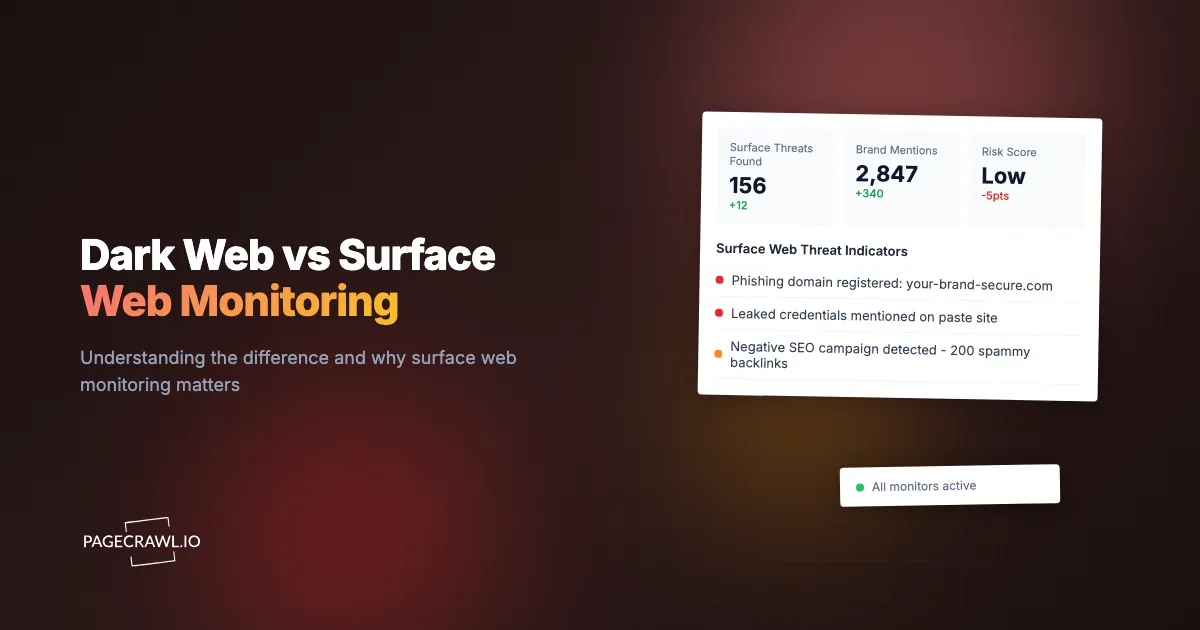
- Lookalike domains: Phishing sites, typosquatting domains, and fraudulent copies of your website
- Unauthorized use: Third parties using your brand name, logos, or content without permission
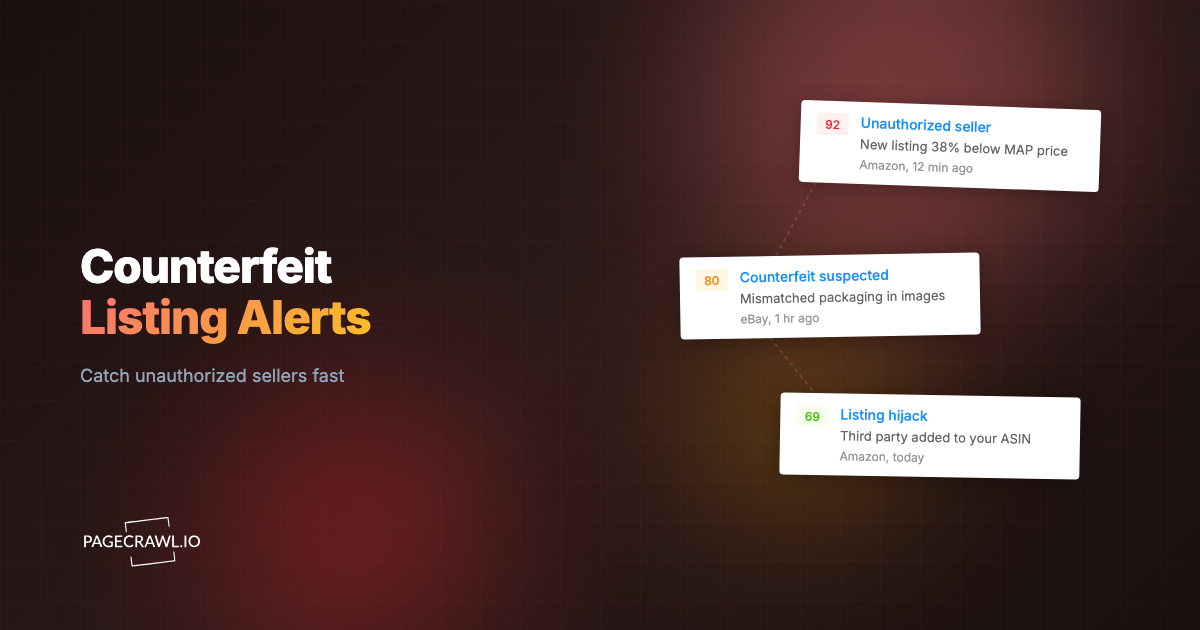
- Counterfeit product listings: Fake products listed on e-commerce platforms using your brand
Domain monitoring catches newly registered domains that resemble your brand before they can be used for phishing or fraud.
What Dark Web Monitoring Covers
Dark web monitoring services scan hidden marketplaces, forums, and communication channels for specific types of threats.
Stolen Credentials
When a data breach occurs, stolen email addresses and passwords often appear on dark web marketplaces or paste sites. Dark web monitoring checks whether credentials associated with your domain (e.g., employee email addresses) appear in these leaked databases.
Leaked Corporate Data
Stolen documents, database dumps, and proprietary information sometimes surface on dark web forums before the breach is publicly known. Monitoring can detect mentions of your company name in connection with data leaks.
Threat Intelligence
Forum discussions on the dark web sometimes reveal planned attacks, vulnerability exploitation techniques, or targeted interest in specific companies or industries. Dark web monitoring aggregates this intelligence.
Marketplace Listings
Stolen credit card numbers, personal data, and access credentials are sold on dark web marketplaces. Monitoring checks whether data associated with your organization or customers appears in these listings.
The Reality of Dark Web Monitoring Services
Dark web monitoring has genuine value, but the marketing around it often overstates what these services deliver. Understanding the limitations helps you evaluate whether the investment is justified for your organization.
Detection Is Usually After the Fact
By the time stolen credentials appear on the dark web, the breach has already happened. The data has been exfiltrated, and in many cases, already used. Dark web monitoring tells you about a breach that occurred days, weeks, or months ago. It does not prevent the breach.
This is still useful: knowing that credentials were compromised lets you force password resets and investigate the breach. But it is reactive, not preventive.
High False Positive Rates
Dark web monitoring services frequently flag mentions that are not actual threats. A forum post mentioning your company name might be a general discussion, not an attack plan. A credential dump containing email addresses from your domain might include old, already-changed passwords. Triaging these false positives requires security team time.
Limited Coverage
The dark web is vast and constantly shifting. Marketplaces open and close. Forums migrate. Communication channels move to encrypted messaging platforms that monitoring services cannot access. No dark web monitoring service covers everything. Coverage gaps are inherent and unavoidable.
Overlap with Existing Tools
Many of the most valuable dark web monitoring capabilities are already available through other, less expensive means:
- Credential breach detection: Services like Have I Been Pwned (free) and built-in browser features flag compromised passwords
- Domain abuse detection: WHOIS monitoring and certificate transparency logs reveal suspicious domain registrations on the surface web
- Threat feeds: Industry ISACs (Information Sharing and Analysis Centers) share threat intelligence among member organizations
Cost Relative to Actionability
Dark web monitoring contracts typically range from $15,000 to $50,000 per year for enterprise plans. When you evaluate the alerts generated, many organizations find that the ratio of actionable intelligence to noise is lower than expected. The question is not whether dark web monitoring can find anything, but whether what it finds justifies the cost relative to other security investments.
Why Surface Web Monitoring Often Delivers More ROI
For most organizations, surface web monitoring provides more actionable intelligence per dollar spent than dark web monitoring. Here is why.
Proactive Rather Than Reactive
Surface web monitoring catches changes as they happen: a competitor changes pricing today, a regulation publishes today, a negative review appears today. This gives your team time to act before the impact compounds. Dark web monitoring is inherently reactive, telling you about events that already occurred.
Directly Tied to Business Outcomes
Competitive intelligence, regulatory compliance, and reputation management directly affect revenue, risk, and customer relationships. When you detect a competitor's pricing change, you can adjust your own strategy. When you catch a regulatory update early, you avoid compliance penalties. When you respond to a negative review within hours, you protect your reputation.
Dark web alerts rarely translate to immediate business actions beyond password resets and incident investigation.
Broader Coverage at Lower Cost
A surface web monitoring tool like PageCrawl covers any publicly accessible website. You can monitor competitor pages, regulatory sites, review platforms, news sources, and industry publications all with one tool. The cost is a fraction of dark web monitoring: PageCrawl's Standard plan at $80/year monitors 100 pages, covering a comprehensive competitive and compliance intelligence program.
Achieving equivalent coverage with dark web monitoring would require multiple specialized vendors at significantly higher cost.
Actionable Intelligence vs. Anxiety Intelligence
Surface web monitoring produces intelligence you can act on: specific changes on specific pages with context about what changed. Dark web monitoring often produces anxiety intelligence: vague mentions, unverified threats, and credentials of uncertain age and relevance. Actionable intelligence drives decisions. Anxiety intelligence drives meetings.
When is dark web monitoring worth the investment?
Dark web monitoring is worth the spend when you have already been breached, handle regulated data, operate in a heavily targeted industry, or run a security team that can triage the alerts. Without one of those factors, the same budget buys far more actionable intelligence on the public web.
Post-Breach Monitoring
If your organization has experienced a data breach, dark web monitoring helps you understand how the stolen data is being distributed and used. This informs incident response, customer notification, and remediation efforts.
Highly Targeted Industries
Financial institutions, defense contractors, government agencies, and large technology companies face disproportionate targeting on the dark web. For these organizations, the volume of genuine threats justifies the investment.
Regulated Data Handling
Organizations handling highly sensitive data (healthcare records, financial data, classified information) face regulatory requirements that may mandate or strongly encourage dark web monitoring as part of a comprehensive security program.
Large Enterprise with Dedicated Security Teams
Dark web monitoring generates alerts that require skilled analysis to triage and act on. Organizations with dedicated security operations centers (SOCs) can absorb this workload productively. Smaller organizations without security teams often find that dark web alerts generate more confusion than clarity.
Building a Practical Monitoring Strategy
The most effective approach combines strong surface web monitoring as a foundation with targeted dark web monitoring where justified by specific risk factors.

Tier 1: Surface Web Monitoring (Every Business)
Start here. Every business benefits from monitoring the public web:
Competitive intelligence. Monitor 5 to 10 competitor websites. Track pricing pages, product pages, blog posts, and job listings. PageCrawl's AI summaries describe what changed, so you do not need to manually compare page versions. See our guide on how to monitor website changes for setup details.
Brand and reputation. Monitor review platforms, social media profiles, and search results for your brand name. Detect new reviews and mentions within hours.
Regulatory compliance. Monitor relevant regulatory body websites. Government agency news pages, Federal Register sections, and state regulatory update pages. Get alerted when new content publishes.
Domain protection. Monitor WHOIS changes and newly registered domains similar to yours. Catch phishing and typosquatting early.
This tier costs under $100/year with PageCrawl's Standard plan and delivers intelligence that directly affects revenue, reputation, and compliance.
Tier 2: Enhanced Surface Web Coverage (Growing Businesses)
Expand your surface web monitoring to cover more sources:
Industry intelligence. Monitor trade publications, analyst report pages, conference schedules, and industry association websites.
Supply chain visibility. Track supplier websites for service changes, pricing updates, and business continuity signals.
Customer intelligence. Monitor community forums, Reddit threads, and Q&A sites where customers discuss your product category.
Content and SEO monitoring. Track search engine result pages for your key terms. Monitor competitor content strategies by watching their blog and resource pages.
This tier uses 50 to 100 monitors and still costs under $100/year. The intelligence informs product, marketing, and operations decisions.
Tier 3: Dark Web Monitoring (When Risk Justifies It)
Add dark web monitoring when your organization meets one or more of these criteria:
- Annual revenue exceeds $50 million and you are a likely target
- You have experienced a data breach in the past 24 months
- You handle highly sensitive data (financial, health, classified)
- You operate in a heavily targeted industry
- You have a security team capable of triaging alerts
Start with a focused scope: monitor your primary domain, executive names, and specific data types relevant to your industry. Avoid the broadest (and most expensive) packages unless your threat profile demands them.
Tier 4: Integrated Threat Intelligence (Enterprise)
Large organizations benefit from integrating surface and dark web monitoring into a unified security intelligence platform. Use webhooks to feed surface web monitoring alerts into your SIEM or security dashboard alongside dark web alerts, following the webhook integration setup guide for payload format and signature verification. This consolidated view helps security teams correlate surface web changes (like website defacement or unauthorized domain registrations) with dark web threats.
How much does dark web monitoring cost compared to surface web monitoring?
Dark web monitoring contracts commonly run from $5,000 a year for small business packages to $200,000 or more for enterprise coverage. Surface web monitoring with PageCrawl costs $80 to $300 a year for 100 to 500 pages. The gap is roughly two orders of magnitude, which is why the sequencing matters.
Surface web monitoring with PageCrawl:
- Free tier: 6 monitors (enough for basic competitive monitoring)
- Standard plan: $80/year for 100 monitors (comprehensive coverage)
- Enterprise plan: $300/year for 500 monitors (large-scale intelligence)
Dark web monitoring services:
- Small business packages: $5,000 to $15,000/year
- Mid-market packages: $15,000 to $50,000/year
- Enterprise packages: $50,000 to $200,000+/year
For the price of one year of mid-market dark web monitoring, you could run PageCrawl's Enterprise plan for over 100 years. The question is not which is cheaper in absolute terms, but which delivers more value relative to your specific risks and needs.
Combining Both for Maximum Coverage
For organizations that invest in both surface and dark web monitoring, integration amplifies the value of each.
Correlating Signals
A domain registration flagged by surface web monitoring combined with a dark web forum post mentioning your brand might indicate an imminent phishing campaign. Neither signal alone is conclusive, but together they justify immediate action.
Unified Alerting
Route both surface web and dark web alerts through the same workflow. PageCrawl's webhook integration sends structured data that can be processed alongside dark web monitoring feeds in your security dashboard or SIEM.
Shared Response Procedures
When either type of monitoring detects a threat, the response workflow should be consistent: assess, escalate if needed, respond, and document. Building unified procedures prevents the common problem where surface web incidents and dark web incidents are handled by different teams with different processes.
How do you measure the ROI of a monitoring program?
Measure ROI as actionable alerts per dollar, not alerts per month. Track how many detections led to a decision, how much earlier you learned about a change than under your old manual process, and what share of alerts required no action at all. Both monitoring types should be judged on the same scale.
Surface Web Monitoring Metrics
- Number of actionable competitive insights per month
- Average time to detect regulatory changes vs. previous manual process
- Number of brand mentions detected and responded to
- Revenue impact of competitive pricing adjustments made based on monitoring data
Dark Web Monitoring Metrics
- Number of genuine credential exposures detected and remediated
- Time to detect a breach via dark web monitoring vs. other means
- False positive rate (alerts investigated that required no action)
- Cost per actionable alert
If surface web monitoring generates 20 actionable insights per month at $7/month and dark web monitoring generates 2 actionable alerts per month at $2,000/month, the ROI comparison is clear, even if the dark web alerts address higher-severity issues.
Choosing your PageCrawl plan
PageCrawl's Free plan lets you monitor 6 pages with 220 checks per month, which is enough to validate the approach on your most critical pages. Most teams graduate to a paid plan once they see the value.
| Plan | Price | Pages | Checks / month | Frequency |
|---|---|---|---|---|
| Free | $0 | 6 | 220 | every 60 min |
| Standard | $8/mo or $80/yr | 100 | 15,000 | every 15 min |
| Enterprise | $30/mo or $300/yr | 500 | 100,000 | every 5 min |
| Ultimate | $99/mo or $999/yr | 1,000 | 100,000 | every 2 min |
Annual billing saves two months across every paid tier. Enterprise and Ultimate scale up to 100x if you need thousands of pages or multi-team access.
Surface web monitoring at $80/year costs less than two hours of a junior analyst's time, yet it runs 24 hours a day across 100 pages covering competitors, regulators, review platforms, and brand mention sources. Catching one regulatory deadline, one defamatory review before it compounds, or one competitor pricing move before your sales team notices it in lost deals makes Standard pay for itself immediately. Enterprise at $300/year covers 500 pages with 5-minute checks for organizations that need near-real-time intelligence.
All plans include the PageCrawl MCP Server, so you can ask Claude to summarize every competitive change and brand mention across your full monitoring footprint over any period, turning your archived monitoring history into a structured intelligence briefing instead of a backlog of alert emails to triage. AI assistants can create monitors through conversation on every plan, including Free.
Getting Started
Most businesses get more value from comprehensive surface web monitoring than from dark web monitoring. The public internet contains the competitive intelligence, regulatory updates, brand mentions, and market signals that directly drive business decisions. Dark web monitoring has its place, but it is a specialized supplement, not a foundation.
Start with surface web monitoring. Set up monitors for your top 5 competitors' pricing and product pages. Add regulatory sources relevant to your industry. Monitor review sites and brand mentions. Configure webhook automations to route intelligence to the right teams.
PageCrawl's free tier gives you 6 monitors to start building your surface web intelligence program. The Standard plan at $80/year covers 100 monitors, which handles comprehensive competitive, regulatory, and reputation monitoring for most businesses. The Enterprise plan at $300/year supports 500 monitors for organizations with extensive monitoring needs.
If your risk profile justifies dark web monitoring, add it as a complement to your surface web program, not a replacement. The combination of proactive surface web intelligence and reactive dark web threat detection builds a monitoring strategy that covers the full threat landscape without overspending on either side.
Create a free PageCrawl account and start building your surface web monitoring foundation today.