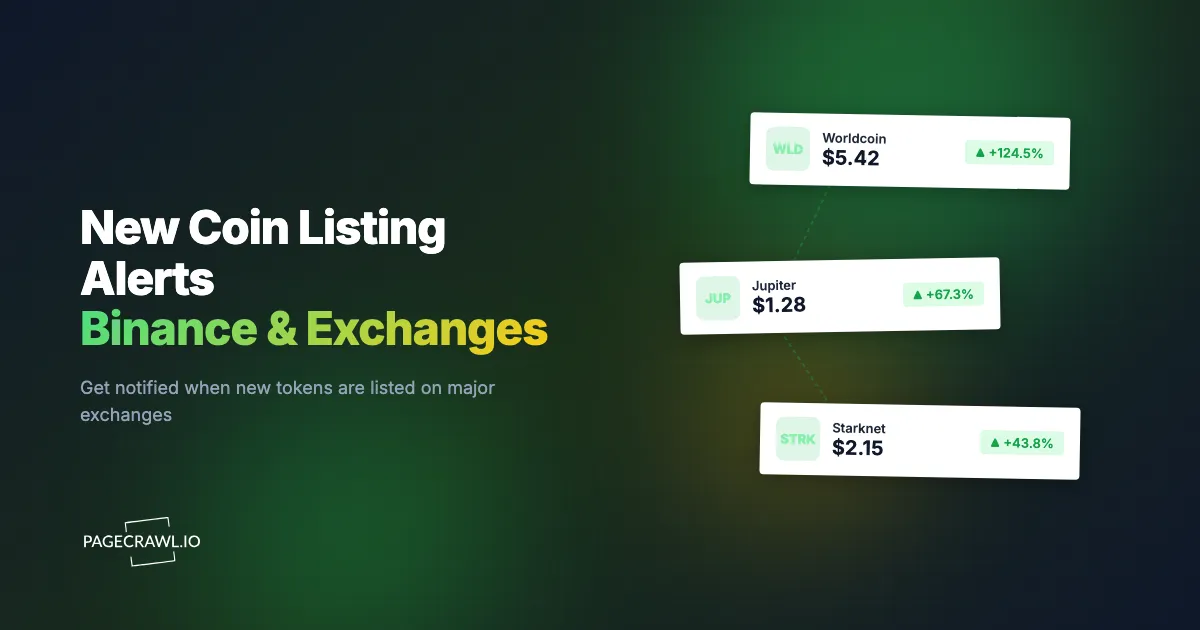
When a token gets listed on a major exchange, it often surges sharply within hours of the announcement. Traders who see the listing announcement early catch the bulk of the move. Those who find out an hour later often buy near the peak. Those who find out the next day watch from the sidelines.
New exchange listings are among the most predictable price catalysts in cryptocurrency. When a token gets listed on a major exchange like Binance or Coinbase, the increased liquidity, visibility, and legitimacy signal drives buying pressure. The pattern repeats across exchanges, across market cycles, and across token types. The challenge is not knowing that listings cause price moves. The challenge is finding out about listings fast enough to act on them.
This guide covers why exchange listings move prices, where to monitor for listing announcements, the methods available for getting fast alerts, and step-by-step instructions for setting up automated monitoring that notifies you as soon as a check detects a new listing announcement.
Why do new listings move prices?
New listings move prices because a major exchange listing expands a token's accessible liquidity, signals that the project passed the exchange's vetting process, and puts the token in front of millions of traders at once. Understanding these mechanics helps you evaluate which listings matter and how to position.
The Liquidity Effect
Before a major exchange listing, a token may only trade on decentralized exchanges or smaller centralized platforms with limited liquidity. A Binance listing instantly exposes the token to millions of active traders. The jump in accessible liquidity creates buying demand that pushes the price up, sometimes dramatically.
The magnitude of the move correlates with the exchange's reach. A Binance listing (the largest crypto exchange by volume) typically produces a bigger price impact than a listing on a smaller exchange. Coinbase listings carry additional weight in the US market because Coinbase is the most regulated and widely used US exchange.
The Legitimacy Signal
Exchange listings involve a vetting process. Binance, Coinbase, and other major exchanges review tokens before listing them, assessing factors like the project's team, technology, community, and compliance profile. A listing on a major exchange signals that the project passed this review, which many traders interpret as a validation of the project's quality.
This legitimacy signal drives buying from traders who track listings specifically as investment signals. Whether this is a rational strategy is debatable, but the pattern is real and consistent enough to trade on for those who manage risk appropriately.
The Announcement Timing
Most exchanges follow a pattern: they announce the listing hours to days before trading actually begins. The price impact often occurs in two phases. The first spike happens when the announcement is published. The second spike (or dump) happens when trading actually opens on the new exchange.
For Binance, the typical pattern is an announcement on their blog or announcements page, followed by trading opening hours later. Coinbase often announces listings through their blog and social media, sometimes with a "Coinbase will list token X" post followed by trading availability the same day or next day.
The first phase (announcement) is where monitoring provides the most value. Detecting the announcement within minutes gives you time to position before the broader market reacts.
Where should you monitor for listing announcements?
The most reliable sources are the exchanges' own announcement pages and blogs: Binance's announcements page, the Coinbase blog, and the equivalent pages on Kraken, OKX, and Bybit. Official pages beat social media for reliability, and each major exchange has specific channels where listing announcements appear.
Binance
Binance Announcements Page: The primary source. Binance posts all new listing announcements in the new cryptocurrency listing category of their official announcements page. This page updates with a new post each time a token listing is confirmed.
Binance Blog: Some major listings get dedicated blog posts with additional details about the token, trading pairs, and deposit/withdrawal schedules.
Binance X (Twitter): The @binance account posts listing announcements, often simultaneously with the announcements page. X posts are fast but mixed in with other content (promotions, events, educational posts), making them harder to monitor automatically.
Binance Telegram Channels: Official Binance channels post announcements. These are fast but extremely noisy with community discussion.
For monitoring purposes, the Binance announcements page is the most reliable and cleanest source. It updates with structured, consistent posts that are easy to detect.
Coinbase
Coinbase Blog: Listing announcements appear on the official Coinbase blog. The "Coinbase Adds" or "Now Available on Coinbase" posts confirm new token availability.
Coinbase Assets Page: The Coinbase assets listing page shows all available tokens. New additions appear here when trading opens.
Coinbase X (Twitter): The @coinbase account posts listing announcements. Like Binance, these posts are mixed with other content.
Coinbase Roadmap Page: Coinbase sometimes previews upcoming listings on a "roadmap" or "recently added" page before formal announcement.
The Coinbase blog is the best monitoring target. It provides the earliest structured announcement for most listings.
Other Major Exchanges
Kraken: Posts listing announcements on the Kraken blog and announcements page. Kraken listings carry less price impact than Binance or Coinbase but still move markets for smaller tokens.
OKX: Uses an announcements section similar to Binance. OKX listings are significant for Asian market tokens.
Bybit: Posts announcements on their support/announcement page. Bybit has grown rapidly and their listings increasingly affect prices.
Upbit: South Korea's largest exchange. An Upbit listing can cause dramatic price movements, particularly for tokens with Korean community interest.
For comprehensive monitoring, track at least Binance and Coinbase. Add Kraken, OKX, or other exchanges based on your trading focus and which markets you access.
Monitoring Methods
Several approaches exist for catching listing announcements, each with different speed and reliability tradeoffs.
Method 1: Social Media Monitoring
Follow exchange accounts on X (Twitter), join official Telegram channels, and monitor crypto news aggregators. This is the simplest approach and requires no technical setup.
Pros: Free, no setup required, community context and discussion. Cons: Noisy (other content mixed in), requires constant attention, easy to miss in a busy feed, no automation, depends on checking frequently. Social media notification settings can suppress or delay alerts.
Social media monitoring works if you are online and checking feeds frequently. For catching listings at 3am or during work hours when you are not watching X, this approach fails.
Method 2: Exchange-Native Alerts
Some exchanges offer notification settings for new listings. Binance's app has notification preferences that include new coin listings. Coinbase's app sends push notifications for new assets.
Pros: Direct from the source, push notifications on mobile, no third-party tools. Cons: Notification reliability varies (some users report missed or delayed alerts), limited to one exchange per app, no webhook or integration options, cannot feed data into trading systems.
Exchange-native alerts are worth enabling as a backup but should not be your sole alerting mechanism. Their reliability is inconsistent.
Method 3: Dedicated Crypto Alert Services
Services like Token Metrics, CoinGecko alerts, and various Telegram bots specifically track exchange listings and send alerts. Some paid services claim listing detection within seconds.
Pros: Specialized for crypto, often fast, some offer trading integration. Cons: Monthly subscription costs, reliance on third-party uptime and reliability, varying quality between services, some sell access to the same alerts (meaning many people act simultaneously, reducing any edge).
These services can be fast and useful. Evaluate them based on demonstrated speed, reliability track record, and cost relative to your trading volume.
Method 4: RSS Feed Monitoring
Some exchange blogs and announcement pages provide RSS feeds. Monitoring these feeds through an RSS reader or automation tool provides structured alerts for new posts.
Pros: Structured data, can be automated, works with many automation platforms. Cons: Not all exchanges offer RSS, feeds may have delays compared to the actual page update, limited notification channel options through basic RSS readers.
For exchanges that offer RSS feeds, monitoring the feed with PageCrawl provides structured change detection. See the RSS feed monitoring guide for detailed setup.
Method 5: Web Monitoring with PageCrawl
PageCrawl monitors exchange announcement and blog pages for new content. When a new listing announcement is published, you receive an alert within your configured check interval. For the fastest detection, use announcement blog pages or RSS feeds rather than the exchange's main trading interface, which uses heavy JavaScript and may not render consistently for automated monitoring.
Note: Exchange websites use dynamic content loading and rate limiting. Monitoring their announcement or blog pages tends to be more reliable than monitoring trading interfaces directly.
How it works:
- Add the exchange's announcement page URL to PageCrawl
- Use content-only mode to track the text content of the page
- Set a frequent check interval to catch new announcements quickly
- Configure notifications through Telegram, Discord, or webhooks
When a new listing announcement appears on the page, PageCrawl detects the content change and sends an alert. The alert includes the detected changes, so you can see which token is being listed without visiting the page.
Setting Up Exchange Listing Monitors
Here is a detailed walkthrough for configuring monitors on the most important exchanges.

Binance Listing Monitor
Step 1: Navigate to Binance's new cryptocurrency listing announcements page. This page shows recent listing announcements in chronological order. Copy the URL.
Step 2: Add this URL to PageCrawl using content-only tracking mode. Content-only mode strips out navigation, footers, and other page elements, focusing on the announcement list content. This reduces false alerts from cosmetic page changes.
Step 3: Verify that PageCrawl captures the current announcement list correctly. You should see the titles and snippets of recent listing announcements.
Step 4: Set check frequency to every 30 minutes or every hour. Binance typically posts listings once or twice per day at most, so 30-minute checks provide near-real-time awareness without excessive resource usage. For more aggressive monitoring, 15-minute checks catch announcements faster.
Step 5: Configure Telegram as your primary notification channel. Telegram delivers push notifications to your phone promptly after a check detects a change. For Slack or Discord alerts, the setup takes minutes.
Coinbase Listing Monitor
Follow the same process using Coinbase's blog or announcements page. Coinbase posts listing announcements less frequently than Binance, so hourly checks are typically sufficient.
Monitor the Coinbase blog's specific category for asset listings rather than the general blog page. This reduces noise from educational posts, company updates, and other non-listing content.
Multi-Exchange Dashboard
Create a PageCrawl folder called "Crypto Listings" and add monitors for each exchange you track, using labels, folders, and workspaces to organize monitored pages. This creates a single view of listing activity across all exchanges.
Within the folder:
- Binance announcements (30-minute checks)
- Coinbase blog/listings (hourly checks)
- Kraken announcements (hourly checks)
- Additional exchanges as needed
Configure the same notification channels for all monitors so that every listing alert, regardless of exchange, reaches you through the same channel.
PageCrawl's AI importance scoring, part of its AI-powered change detection and smart filtering, helps you cut through the noise across these monitors. Exchange announcement pages contain a mix of new listings, maintenance notices, trading pair updates, and promotional posts. AI importance scoring evaluates each detected change and assigns a score based on its significance. A new token listing announcement scores high, while a routine maintenance window notice scores low. This lets you configure alerts to only notify you for high-importance changes, so you are not woken at 3am for a scheduled platform update when what you care about is the next major listing.
Monitoring Listing Requirements and Regulatory Changes
Beyond tracking actual listings, monitoring the pages where exchanges publish their listing criteria and regulatory updates provides strategic value.
Listing Criteria Changes
Exchanges periodically update their listing requirements. A change in Coinbase's listing standards or Binance's listing criteria can signal shifts in what types of tokens will be listed next. Monitoring these policy pages in fullpage mode catches updates that may hint at upcoming listings or category expansions.
Regulatory Announcements
Exchange regulatory updates (delisting notices, geographic restrictions, compliance changes) affect which tokens are tradeable and where. A delisting announcement on one exchange can crash a token's price, while regulatory approval in a new jurisdiction can boost it.
Monitor exchange regulatory and compliance pages to stay ahead of these market-moving changes.
Launchpad and Innovation Zone Pages
Binance Launchpad, Coinbase Ventures, and similar exchange programs often preview tokens before they list on the main exchange. Monitoring launchpad pages catches tokens that are likely to receive a full listing soon, providing an even earlier signal.
Setting Up Fast Notifications
For time-sensitive listing alerts, notification speed after detection is critical.
Telegram for Speed
Telegram delivers push notifications faster than email, and the app stays connected in the background on mobile devices. Set up a Telegram bot for monitoring alerts, connect it to PageCrawl, and enable priority notifications.
Keep Telegram's notification settings configured to override "Do Not Disturb" for your PageCrawl bot. Missing a 3am listing alert because your phone was silenced defeats the purpose of monitoring.
Discord for Team Coordination
If you trade with a group or want shared visibility into listing alerts, Discord channels provide real-time shared alerts. Everyone in the channel sees the alert simultaneously and can discuss strategy.
Webhooks for Automated Trading
For sophisticated traders, webhook integration enables automated response to listing alerts. When PageCrawl detects a new listing announcement, the webhook sends structured data to your system. Your system can then:
- Parse the announcement to identify the token
- Check the token's current price on DEXs or smaller exchanges
- Execute a pre-defined trading strategy
- Log the alert for post-analysis
This level of automation requires careful implementation and risk management, but it removes the human reaction time from the process.
Web Push Notifications
For browser-based alerts when you are at your computer, web push notifications provide fast desktop alerts without requiring a specific messaging app.
What are the risks of trading on listing alerts?
Listing-based trading carries specific risks that automated monitoring does not eliminate: compressed reaction windows, sell-the-news reversals, fake announcements, manipulation, regulatory uncertainty, and thin liquidity. Cryptocurrency is a volatile, speculative asset class, and this article is informational, not financial advice, so always do your own research before trading.
The Listing Premium Is Already Priced In
As listing monitoring has become more common, the announcement-to-price-move window has compressed. In early crypto markets, you might have had hours to react. Now, significant price moves can happen within minutes of an announcement. Even fast monitoring may not provide enough edge if the market has already moved by the time you can execute a trade.
Sell the News
Many tokens that spike on listing announcements give back those gains quickly. The "buy the rumor, sell the news" pattern is well-established in crypto. A token that rises 200% on a Binance listing announcement might drop 50% within 24 hours as initial excitement fades. Monitoring gets you in early, but it does not tell you when to get out.
Fake Announcements and Scams
Fraudulent listing announcements occasionally appear on social media, mimicking exchange branding. Monitoring official exchange pages directly (rather than relying on social media) mitigates this risk. PageCrawl monitors the actual exchange website, so a fake announcement on X would not trigger your alert.
Market Manipulation
Some tokens see coordinated buying ahead of listing announcements, suggesting information leaks. Trading on listing announcements means entering a market where some participants may have advance information. Factor this into your risk management.
Regulatory Risk
Cryptocurrency regulation is evolving. What is legal in your jurisdiction today may not be tomorrow. Listing-based trading strategies operate in a regulatory gray area in some jurisdictions. Understand your local regulations before implementing automated trading based on listing alerts.
Liquidity Risk
If you are buying a token on a smaller exchange before a major exchange listing, liquidity may be thin. Large orders can move the price significantly. If the listing falls through or is delayed, you may face difficulty exiting your position at a reasonable price.
Advanced Monitoring Strategies
Cross-Exchange Listing Patterns
Tokens often list on multiple exchanges in sequence. A listing on a smaller exchange (like KuCoin or Gate.io) sometimes precedes a listing on Binance or Coinbase. Monitoring smaller exchange announcements can provide an earlier signal of tokens that may receive major exchange listings later.
Track listing patterns over time. If a token lists on three mid-tier exchanges within a month, a Binance or Coinbase listing becomes more likely. This pattern recognition requires historical data but can provide earlier positioning than waiting for the major exchange announcement.
Monitoring Token Project Communications
Token projects sometimes hint at upcoming exchange listings through their own communications (blog posts, Discord announcements, X posts). Monitoring a token project's official announcement channels can provide advance signals before the exchange makes its formal announcement.
This approach requires knowing which tokens to monitor, which makes it more speculative. Focus on tokens that have recently met known listing criteria for major exchanges (market cap thresholds, trading volume, community size).
Delisting Monitoring
Delistings are the opposite of listings but equally important for risk management. Exchanges delist tokens for regulatory concerns, low volume, or project issues. A delisting announcement on a major exchange typically crashes the token's price.
Monitor exchange delisting announcement pages with the same urgency as listing pages. Early detection of a delisting announcement lets you exit a position before the broader market reacts.
Building a Complete Crypto Monitoring System
Listing monitoring is most effective as part of a broader crypto intelligence setup.
Exchange Announcements
Monitor listing announcements on Binance, Coinbase, and other exchanges you trade on. This is the core use case covered in this guide.
Regulatory Pages
Monitor the SEC, the CFTC, and international regulatory body pages for cryptocurrency-related announcements. Regulatory actions can override listing-driven price movements, which is why regulatory filing monitoring belongs in the same watchlist as the exchange announcement pages.
Project Announcements
For tokens you hold or are watching, monitor official project communication channels for major announcements (partnerships, technical updates, token economics changes).
On-Chain Data
Combine web monitoring with on-chain analytics. Large token movements to exchange wallets can indicate upcoming selling pressure or liquidity provision ahead of a listing.
Choosing your PageCrawl plan
PageCrawl's Free plan lets you monitor 6 pages with 220 checks per month, which is enough to validate the approach on your most critical pages. Most teams graduate to a paid plan once they see the value.
| Plan | Price | Pages | Checks / month | Frequency |
|---|---|---|---|---|
| Free | $0 | 6 | 220 | every 60 min |
| Standard | $8/mo or $80/yr | 100 | 15,000 | every 15 min |
| Enterprise | $30/mo or $300/yr | 500 | 100,000 | every 5 min |
| Ultimate | $99/mo or $999/yr | 1,000 | 100,000 | every 2 min |
Annual billing saves two months across every paid tier. Enterprise and Ultimate scale up to 100x if you need thousands of pages or multi-team access.
A single listing alert caught 15 minutes before the broader market reacts can return more than a year of subscriptions in one trade. Standard at $80/year covers Binance, Coinbase, Kraken, and a dozen additional sources with 15-minute checks, which is the right cadence for announcement pages that update a few times per day. Enterprise at $300/year adds 5-minute checks and 500 pages, enough to extend coverage to launchpad pages, regulatory filings, and token project communications across the full exchange ecosystem.
All plans include the PageCrawl MCP Server, so you can ask Claude to pull every listing announcement detected across all your monitored exchanges over any time window and get a structured summary drawn directly from your monitoring history. AI assistants can create monitors through conversation on every plan, including Free.
Getting Started
Start with the two exchanges that matter most: Binance and Coinbase. Set up PageCrawl monitors on their announcement pages, configure Telegram notifications, and run the system for two weeks to observe the alert speed and quality.
During those two weeks, compare your monitoring alerts against actual listing announcements. Verify that alerts arrive within your acceptable timeframe. Adjust check frequency if needed (shorter intervals for faster detection, longer intervals to conserve checks).
Once validated, expand to additional exchanges (Kraken, OKX, Bybit) and add monitors for regulatory pages, delisting announcements, and token project communications.
PageCrawl's free tier includes 6 monitors, enough to cover Binance and Coinbase announcement pages plus a few additional sources. The Standard plan ($80/year for 100 pages) provides capacity for comprehensive multi-exchange monitoring with regulatory and project-level tracking. For traders running sophisticated monitoring across many exchanges and token projects, the Enterprise plan ($300/year for 500 pages) covers the full spectrum.
In crypto markets, information speed matters. Knowing about a listing sooner rather than later gives you more time to evaluate and act. Automated monitoring of announcement pages helps you stay informed without manually checking multiple exchange websites throughout the day.