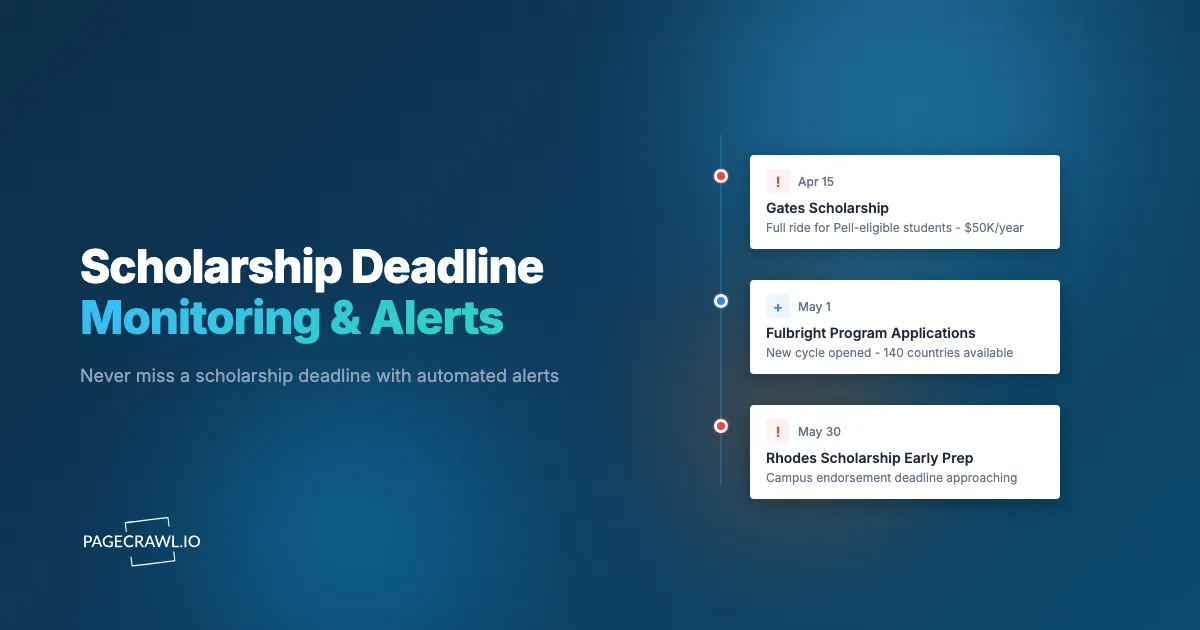
A $10,000 scholarship from a local foundation opened applications on March 1st and closed on March 31st. You discovered it on April 3rd. The foundation did not advertise widely, their website updated once, and nobody in your network mentioned it. That is $10,000 that went to someone else because you were not watching the right page at the right time.
This happens constantly. Headline figures about "billions in unclaimed scholarships" are usually inflated, but the underlying problem is real and easy to observe: small awards routinely draw far fewer applicants than they could, not because qualified students do not exist, but because they never learn about the opportunities in time. University departments post new awards with minimal fanfare. Professional organizations add scholarships to their websites without press releases. Foundation application windows open and close within 30 days.
Scholarship search engines help, but they only index a fraction of available awards and update infrequently. The most valuable scholarships, especially smaller awards from local foundations, professional associations, and academic departments, often exist only on a single web page that changes once a year when applications open.
This guide covers where scholarships actually live online, why existing search tools miss so many opportunities, how to set up automated monitoring that surfaces new scholarships and deadline changes on the next check after they are posted, and strategies tailored to high school students, undergraduates, and graduate students.
Why does scholarship monitoring matter?
Because the scholarship landscape is fragmented, time-sensitive, and poorly indexed. The awards with the best odds live on single pages that change once a year, application windows often run 30 to 60 days, and nobody sends an announcement when a page updates. Watching the page directly is the only reliable signal.
Billions in Unclaimed Aid
The commonly cited figure of "billions in unclaimed scholarships" is often misunderstood. Much of that figure represents employer tuition benefits and institutional aid that students do not apply for. However, the core observation holds: many competitive scholarships receive fewer applications than expected, and many small awards go undersubscribed because eligible students simply never learn about them.
A $2,000 scholarship from a regional professional association might receive 15 applications instead of the 200 it could attract. Those 15 applicants face far better odds than applicants to widely-publicized national awards that attract thousands of entries.
Finding these under-the-radar scholarships requires monitoring sources that scholarship search engines do not index. That means watching specific websites directly.
Changing Deadlines and New Programs
Scholarship deadlines are not fixed in stone. An organization might extend a deadline due to low application volume, shorten one due to high volume, or shift dates from year to year based on their review process. A scholarship that was due April 15th last year might be due March 31st this year.
New scholarship programs launch throughout the year, not just during traditional financial aid season. A company might establish a new memorial scholarship. A professional association might add a diversity-focused award. A university department might receive a donation that funds a new annual scholarship.
These changes and additions are posted on websites, often with no other announcement. If you are not monitoring the page, you do not know.
The Limitations of Scholarship Search Engines
Major scholarship search platforms (Fastweb, Scholarships.com, Bold.org, Going Merry) aggregate thousands of scholarships into searchable databases. They are useful starting points, but they have structural limitations:
Incomplete coverage: These platforms rely on scholarship providers submitting their listings. Many smaller organizations, university departments, and local foundations do not list with these aggregators.
Update lag: Even listed scholarships may have outdated information. A deadline change or amount update on the source website might not propagate to the aggregator for weeks.
Generic matching: Search algorithms match based on demographic and academic criteria, but they cannot know about niche opportunities that match your specific circumstances (your specific major, your hometown, your parent's employer, your religious community).
Not monitoring sources directly: Aggregators snapshot information periodically. They do not watch the provider's own page for you, so nothing tells you when a scholarship opens, closes, or changes its terms.
Automated website monitoring fills the gap between what search engines cover and the full landscape of available scholarships.
Where do you find scholarships worth monitoring?
On the pages least likely to appear in an aggregator database: university financial aid sections, individual academic department pages, professional association award pages, community and local foundations, corporate foundation programs, and state government scholarship listings.
University Financial Aid Pages
Every university maintains a financial aid page listing institutional scholarships, grants, and awards. These pages typically include:
- Incoming student scholarships: Merit awards, departmental scholarships, and need-based grants specific to the institution
- Current student awards: Scholarships available after enrollment, often based on GPA, major declaration, or demonstrated need
- Graduate fellowships: Teaching assistantships, research fellowships, and department-specific funding
- External scholarship lists: Many financial aid offices curate lists of external scholarships they recommend to students
These pages update throughout the year as new awards are added and application windows open. Monitor the financial aid landing page and any subpages listing specific awards, and cross-check federal aid requirements on Federal Student Aid, which publishes the official FAFSA deadlines and eligibility rules.
For universities you are considering attending, monitoring their financial aid pages before you apply gives you a comprehensive view of available funding.
Academic Department Pages
Individual departments often control scholarship funds that do not appear on the main financial aid page. The Computer Science department might have an endowed scholarship for students interested in AI research. The History department might offer a summer research stipend. The Engineering school might have industry-sponsored awards for students in specific concentrations.
These departmental awards tend to be less competitive because they are only publicized within the department. Students who discover them before enrolling or early in their academic career gain an edge.
Monitor department pages for each academic program you are enrolled in or considering. The awards section, news page, or student resources page is where these opportunities appear.
Professional Organization Websites
Nearly every professional association offers scholarships to students entering their field:
- Engineering: ASME, IEEE, ASCE, AIChE, and specialty engineering societies
- Healthcare: AANS, ANA, APHA, specialty medical associations
- Business: NABA, AICPA, various chamber of commerce organizations
- Technology: ACM, CompTIA, ISC2 foundations
- Sciences: ACS, APS, various scientific societies
- Arts and Humanities: NEA, various arts councils and foundations
Professional organizations typically announce scholarship cycles on their websites, often with limited social media promotion. Application windows are short (30-60 days is common) and only publicized on the organization's website and in their member communications.
Community and Local Foundations
Community foundations, Rotary clubs, Kiwanis clubs, Lions clubs, and local charitable organizations fund scholarships that are geographically restricted. These awards are among the most undersubscribed because they serve small applicant pools and rely entirely on local awareness.
Finding these requires identifying the community foundations and service organizations in your area, then monitoring their scholarship or grants pages. Your city or county likely has a community foundation website listing local scholarships.
Corporate Scholarship Programs
Major companies fund scholarships through corporate foundations: Google, Microsoft, Coca-Cola, Taco Bell, Burger King, and hundreds of others. Corporate scholarship programs sometimes change eligibility criteria, adjust award amounts, or create new programs aligned with corporate diversity and social responsibility goals.
Monitoring corporate foundation scholarship pages catches these changes and new program announcements.
Government and Civic Scholarships
State governments, municipalities, and civic organizations offer scholarships that are poorly indexed by national search engines. State higher education agencies publish scholarship information that changes annually. Congressional offices sponsor local scholarships. State legislators fund awards through various programs.
These opportunities are published on government websites that update infrequently, making them ideal candidates for automated monitoring, much like the green card (DV) lottery results and entry deadlines that applicants track on government pages.
Setting Up Scholarship Monitoring with PageCrawl
PageCrawl transforms scholarship hunting from a manual, periodic activity into an automated system that alerts you to new opportunities and changes.

Identifying Pages to Monitor
Start by creating a list of 10-20 web pages most likely to contain relevant scholarship opportunities. Prioritize:
- Financial aid pages for schools you attend or plan to attend
- Department pages for your major or intended major
- Professional organizations in your field of study
- Community foundations in your geographic area
- Corporate foundations at companies in your industry of interest
- Government scholarship pages for your state
Configuring Monitors for Scholarship Pages
Step 1: Add each page URL to PageCrawl. Use "Content Only" tracking mode, which focuses on text changes and ignores design or layout updates. Scholarship pages are content-driven, so text monitoring catches new listings, deadline changes, and amount updates effectively.
Step 2: Set monitoring frequency. Daily monitoring is appropriate for most scholarship pages. These pages do not change hourly. University financial aid pages might update weekly. Foundation pages might update monthly. Daily checks ensure you catch changes within 24 hours.
For pages that aggregate time-sensitive opportunities (like a community foundation listing multiple scholarships with rolling deadlines), increase to twice daily.
Step 3: Configure alert keywords. If a page contains a lot of content beyond scholarships, use keyword-focused monitoring to alert specifically on new content containing terms like "scholarship," "application," "deadline," "award," or "fellowship." This reduces noise from unrelated page updates. The full set of per-page rules is covered in notification conditions and filters.
Step 4: Choose your notification channel. Email is fine for scholarship monitoring since the urgency is measured in days, not minutes. You have time to review opportunities and prepare applications. For students juggling multiple commitments, Slack notifications keep scholarship alerts in a dedicated channel separate from email clutter.
Using Page Discovery for Comprehensive Coverage
Some universities and organizations post individual scholarship pages rather than listing all awards on a single page. PageCrawl's automatic page discovery can identify new pages added to a website, catching scholarships that appear as separate pages rather than additions to an existing listing.
Set up automatic page discovery on financial aid sections and department pages to ensure new scholarship pages are detected even when they are not linked from the main listing straight away. Automatic page discovery works by scanning a domain for newly added URLs, so when a university posts a new scholarship on a separate page rather than updating an existing listing, PageCrawl finds it and adds it to your monitoring automatically. This is particularly valuable for large university sites where new awards can appear deep within department subfolders.
Monitoring Multiple Universities and Foundations
PageCrawl's free tier includes 6 monitors, which covers a focused set of the most important pages. Strategically allocate these to the highest-value sources:
- 2 monitors for your primary university (financial aid page and department page)
- 2 monitors for top professional organizations in your field
- 1 monitor for your local community foundation
- 1 monitor for a curated external scholarship list
As you identify more sources worth tracking, Standard plans ($80/year for 100 pages) support monitoring dozens of scholarship sources. This is especially valuable for students applying to multiple universities who want to monitor financial aid pages across all their target schools.
Building a Scholarship Calendar with Webhooks
For organized scholarship tracking, use webhook integration to push detected changes into a structured system.
Connecting to Spreadsheets
Configure webhooks to send change alerts to a Google Sheets or Airtable document. Each alert creates a new row containing the source page, the detected change, and the date. Review this spreadsheet weekly to identify new opportunities and update your application calendar.
Over time, this creates a historical record of when different organizations open and close applications, helping you anticipate next year's timeline.
Creating a Deadline Tracker
When a monitoring alert reveals a new scholarship with a specific deadline, add it to your calendar immediately. Establish a workflow:
- Receive alert about new or changed scholarship content
- Visit the source page to review full details
- Determine eligibility and interest
- Add the deadline to your calendar with a reminder 2 weeks prior
- Begin application preparation
This systematic approach ensures no opportunity slips through the cracks between discovery and action.
Integrating with Application Tracking
Students applying to many scholarships benefit from a tracking system that records application status (discovered, eligible, in progress, submitted, awarded). Webhook data from PageCrawl feeds the discovery stage of this pipeline.
For more advanced automation, see our guide on building custom monitoring dashboards with the PageCrawl API.
Strategies by Student Type
High School Students
High school juniors and seniors face the most concentrated scholarship season. Most major national awards have deadlines between October and March of senior year, but opportunities exist year-round.
What to monitor:
- Financial aid pages for your top 5-10 target colleges
- Your high school's scholarship page or counseling office resource page
- Local community foundation scholarship listings
- National scholarship aggregator "new listings" pages
- Corporate scholarships (many target high school seniors specifically)
Timing: Begin monitoring in the spring of junior year. Many scholarships for the following academic year open in fall, and early awareness gives you time to prepare strong applications.
Focus: Prioritize local and institutional scholarships where competition is lower. A $1,000 local award with 20 applicants offers better odds than a $10,000 national award with 20,000 applicants. The total value of several smaller awards often exceeds what you would win from a single competitive national scholarship.
Undergraduate Students
Currently enrolled undergrads have access to scholarships that incoming students do not: departmental awards, honors program funding, research stipends, and awards based on academic achievement during college.
What to monitor:
- Your department's student resources and awards pages
- University honors program announcements
- Office of undergraduate research (for funded research opportunities)
- Professional organizations related to your major
- Study abroad office (scholarship and grant opportunities for international programs)
Timing: Monitor year-round. Unlike high school scholarships concentrated in fall and winter, undergraduate awards open throughout the academic year. Summer research stipend applications might open in January. Fall departmental awards might open in August.
Focus: Departmental and university-specific awards are the most under-applied-to opportunities for current students, who can also point the same monitoring at their course registration page to catch open seats in full classes during add/drop. Your advisor and department office may not proactively inform you about every available award.
Graduate Students
Graduate funding is fundamentally different from undergraduate scholarships. Fellowships, research grants, teaching positions, and dissertation funding follow academic and research cycles, which makes them a natural fit for grant and funding opportunity monitoring.
What to monitor:
- Grant announcement pages from the National Science Foundation, the National Institutes of Health, the Department of Energy, and other relevant federal agencies
- Professional society fellowship and grant pages
- Your department's funding announcements
- University graduate school fellowship listings
- Documentation sites for research databases and tools relevant to your field, plus the federal funding database at Grants.gov
Timing: Federal fellowship applications (NSF GRFP, NRSA, etc.) have fixed annual deadlines, but new programs and supplemental funding opportunities appear throughout the year.
Focus: Research-specific funding often has eligibility requirements tied to your research area, advisor, or department. Monitor pages specific to your subfield alongside academic journal and research database alerts, not just broad graduate fellowship listings.
Tips for Effective Scholarship Monitoring
Cast a Wide Net Initially
Start by monitoring more pages than you think you need. After a month or two, you will learn which sources produce relevant updates and which rarely change. Prune inactive monitors and redirect those slots to new sources.
Look Beyond "Scholarship" Pages
Not every financial opportunity is labeled "scholarship." Monitor pages listing:
- Fellowships: Often larger awards with research or service components
- Grants: Especially for graduate students and research-oriented programs
- Stipends: Summer research programs, internship funding, living expense support
- Tuition waivers: Separate from scholarships but equally valuable
- Emergency funds: Many institutions offer emergency grants that are poorly publicized
Verify Directly After Each Alert
When you receive a monitoring alert, visit the source page to verify details before you act on it. Page changes do not always mean a new scholarship. Sometimes a page updates to remove an expired listing or change formatting. Quick verification prevents wasted effort on expired opportunities. Always confirm eligibility, award amounts, and deadlines on the provider's own page; this article is informational, not financial aid advice.
Share Your Monitoring Setup
If you are a parent helping a high school student, a graduate student in a lab group, or part of a scholarship-focused student organization, share your monitoring strategy. Multiple people monitoring different sources and sharing discoveries multiplies everyone's scholarship coverage.
Maintain a Rolling Application Calendar
Scholarship deadlines are distributed throughout the year, not clustered in one season. Maintaining a 12-month rolling calendar of upcoming deadlines, fed by monitoring alerts, ensures you prepare applications consistently rather than scrambling when you happen to notice an opportunity.
What are the most common scholarship monitoring problems?
Three recur: pages that change only once a year, scholarship details published inside PDFs instead of page text, and listings hidden behind a student login portal. Each has a straightforward workaround, and none of them requires checking pages by hand.
Pages with Minimal Changes
Some scholarship pages only update once a year when applications open. Monthly monitoring catches these changes without consuming excessive resources, but you may go months between meaningful alerts. This is normal. The value comes when the page does change, and the alert reaches you on the next check rather than months later.
PDF-Based Scholarship Listings
Some organizations post scholarship information as downloadable PDFs rather than web page content. PageCrawl can monitor pages that link to PDFs, detecting when a new PDF is posted or an existing link is updated. For the PDF content itself, monitor the page that links to the document rather than the PDF URL directly.
Password-Protected University Pages
Some university financial aid information is behind a student login portal. If scholarship listings require authentication, consider monitoring the public-facing financial aid page (which often summarizes available awards) and checking the portal directly when alerts indicate changes.
Choosing your PageCrawl plan
PageCrawl's Free plan lets you monitor 6 pages with 220 checks per month, which is enough to validate the approach on your most critical pages. Most teams graduate to a paid plan once they see the value.
| Plan | Price | Pages | Checks / month | Frequency |
|---|---|---|---|---|
| Free | $0 | 6 | 220 | every 60 min |
| Standard | $8/mo or $80/yr | 100 | 15,000 | every 15 min |
| Enterprise | $30/mo or $300/yr | 500 | 100,000 | every 5 min |
| Ultimate | $99/mo or $999/yr | 1,000 | 100,000 | every 2 min |
Annual billing saves two months across every paid tier. Enterprise and Ultimate scale up to 100x if you need thousands of pages or multi-team access.
Scholarship monitoring pays for itself with a single award you would have otherwise missed. A $1,000 local scholarship that receives 15 applicants instead of 200 represents meaningful odds, and catching that opportunity requires nothing more than knowing when the application page changes. Standard at $80/year gives you 100 monitors with daily checks, enough to cover financial aid pages across every school you are considering, multiple professional organizations, and a set of local foundations. For college counselors, scholarship advisors, or nonprofit organizations helping many students find funding, Enterprise at $300/year scales to 500 pages with 5-minute checks, SSO, and multi-team access.
All plans include the PageCrawl MCP Server, so you can ask Claude to surface every new scholarship or deadline change detected across your full list of monitored sources over any period. AI assistants can create monitors through conversation on every plan, including Free.
Getting Started
Identify 5-6 web pages most relevant to your scholarship search. Start with your school's financial aid page, your department's awards page, one professional organization in your field, and your local community foundation. Add each to PageCrawl with "Content Only" tracking mode and daily monitoring.
Set up email or Slack alerts so you see changes within a day of them appearing. Create a simple spreadsheet to log discoveries and track deadlines. Within a month, you will have a clear picture of how often your monitored pages update and what types of opportunities appear.
PageCrawl's free tier includes 6 monitors, which covers a focused scholarship monitoring setup. As you identify more sources, Standard plans ($80/year for 100 pages) let you monitor financial aid pages across every school you are considering, multiple professional organizations, and a broad set of local foundations. Enterprise plans ($300/year for 500 pages) serve scholarship counselors, college advisors, and organizations helping many students find funding.
Scholarships are a research problem, and the students who find the most funding are the ones who systematically watch the most sources. Automated monitoring ensures you are always looking, even when life gets busy and manual checking falls off. The scholarship you catch because of a timely alert could be the one that changes your financial picture for the year.