The REI Anniversary Sale opened overnight US time on its first Friday in May. By 6 AM, the popular sizes in the Patagonia Down Sweater were gone, the Arc'teryx Beta jackets were down to a handful of XL units, and the Salomon X Ultra hikers in mens 10 were sold out across every color. Anyone who got a member alert overnight US time and acted in the first hour had full color and size selection. Anyone who saw the email at breakfast was choosing from leftovers.
REI's biggest member events (Anniversary Sale in May, 4th of July Sale, Labor Day Sale, Cyber Week) all follow this pattern: a defined opening time, deep discounts on premium brands, and inventory that turns rapidly during the first 12 hours. Layered on top are two near-continuous channels with different dynamics. Re/Supply, REI's used gear program, lists trade-in items at steep discounts to retail with new SKUs landing every day across every category. Garage Sale events happen at individual REI stores roughly monthly, with the event page going live a week or two in advance. None of these channels provide push notifications to non-members, and even members often see the marketing email well after the sale page itself has updated.
This guide covers how each REI sale channel works, what to watch for, and how to set up continuous monitoring that surfaces sale activations, Re/Supply restocks, and Garage Sale events as they go live.
Quick Setup
Pick which REI sale events and gear categories to watch, and preview your alerts.
Why does monitoring REI pages matter?
It matters because the outdoor gear category has unusual price discipline at retail (most premium brands enforce MAP pricing aggressively), which makes the REI sale and used-gear channels some of the only places premium gear is genuinely discounted. Each channel has different dynamics and rewards a different check frequency.
Member Sale Activations Set the Tone for the Quarter
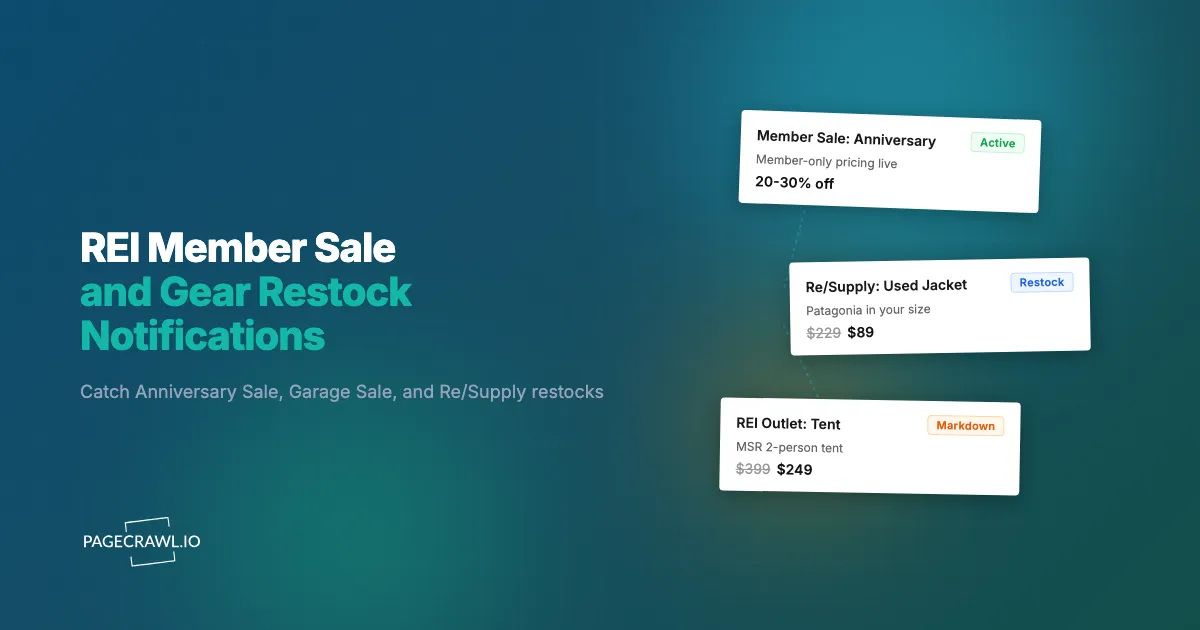
REI's four major member sales each year typically offer 20-30% off one full-price item plus a sale category of 30-60% off select items. The first 12 hours determine whether you get full size and color selection or pick from leftovers. The member emails arrive on REI's marketing schedule, which can be hours after the page itself becomes live.
Re/Supply Is a Continuous, Underused Channel
Re/Supply (the online used-gear program, formerly called Used Gear) is REI's marketplace for member-traded gear, restored to working condition and resold well below retail. New listings land continuously, with high-value pieces (Patagonia Nano Puffs, Arc'teryx shells, Big Agnes tents) typically lasting hours rather than days. The Re/Supply landing page paginates, but the first page (sorted by newest) is the highest-velocity monitoring target.
Local Garage Sale Events Are Member-Only Treasure
In-store Garage Sale events at individual REI locations happen monthly to quarterly, depending on the store. Members line up early for traded gear at deep discount (some pieces marked 50-80% off retail). The event page on the store-specific URL goes live a week or two before the date and contains the start time and any special rules. Catching these announcements early lets you plan attendance.
REI Outlet Pricing Rotates Continuously
REI Garage (rei.com/rei-garage) and the broader REI Outlet experience at rei.com/outlet rotates inventory continuously as REI clears overstock and prior-season inventory. Specific SKUs at outlet pricing sell through quickly, especially shells, sleeping bags, and footwear.
How do REI's sale channels work?
REI runs four monitorable channels: the main sale page, the outlet (REI Garage), the Re/Supply used-gear catalogue, and individual store pages that announce in-person Garage Sale events. The URL structure is consistent across categories, which makes monitoring straightforward.
Sale and outlet landing pages. The main sale page (rei.com/sale) and the outlet page (rei.com/rei-garage) both rotate inventory continuously. During major member sale events, the sale page restructures into an event landing page with category sub-pages.
Re/Supply. The Re/Supply category page (rei.com/used) lists all available used inventory. Sub-category pages for specific gear types (rei.com/used/jackets, rei.com/used/tents) narrow the listing. Sorting by newest concentrates the highest-velocity inventory at the top.
Local store Garage Sale event pages. Each REI store has its own page (rei.com/stores/[store-name]). Garage Sale events appear in the store's event listings ahead of the date.
Brand and category pages with sale filters. The category pages on REI support a sale filter via URL parameter. For example, rei.com/c/mens-jackets?r=sale shows only sale items in the mens jackets category. Adding the sale filter narrows the monitoring scope to discounted inventory only.
A specific Re/Supply SKU URL looks like this:
https://www.rei.com/used/[item-slug]/[item-id]When the SKU sells, the page returns a "no longer available" state, which means the inventory change is detectable as a page-level diff.
Comparing Monitoring Approaches
| Approach | Cost | Latency | Coverage | Best For |
|---|---|---|---|---|
| REI member email | Free with membership | Often hours after page goes live | Headline events only | Casual buyers willing to miss specific sizes |
| REI app push notifications | Free with app | Variable | Curated by REI | Members willing to enable all notifications |
| Reddit r/REI, r/CampingGear | Free | Variable | Crowd-sourced | Browsing community alerts |
| Slickdeals REI tag | Free | Minutes to hours | Crowd-sourced | Generic deal browsing |
| PageCrawl on REI URLs | Free tier to $80/yr | 15-60 minutes | Any URL you choose | Buyers and outdoor pros who want first-look access |
The REI member email is useful but not fast. Even with member status, the marketing send happens after the sale is already live, and the most coveted SKUs in popular sizes can be gone before you read the email. PageCrawl gives you per-page control and alerts you as soon as a check detects that the page itself changed, which on a 15-minute schedule is usually well before the marketing email lands.
Setting Up REI Monitoring in PageCrawl

Step 1: Add the broad sale and outlet pages
Start with these as a baseline:
https://www.rei.com/sale
https://www.rei.com/rei-garage
https://www.rei.com/used
Each goes in as a separate content monitor.
Step 2: Add Re/Supply sub-categories for what you actually want
If you are buying jackets, do not monitor the all-used page; monitor rei.com/used/jackets. If you are after tents, monitor rei.com/used/tents. The narrower the page, the higher the signal-to-noise ratio in the alerts. Repeat for sleeping bags, footwear, packs, and whatever else you care about.
Step 3: Add your local store Garage Sale page
Find your closest REI store at rei.com/stores, click through to the store page, and add it as a monitor. When the next Garage Sale event is announced, the page will change.
Step 4: Pick a sensible check frequency
REI is not a 2-minute-check category. The drops last hours, not minutes. A reasonable layering:
- Sale and outlet landing pages: 60 minutes during active member sale events, daily otherwise.
- Re/Supply category and sub-category pages: 60 minutes. New listings land throughout the day.
- Local store pages: Daily. Event announcements are once-per-week at most.
- Specific Re/Supply SKU pages you are watching: 15-30 minutes if the item is high-demand.
Step 5: Use AI summaries to filter the noise
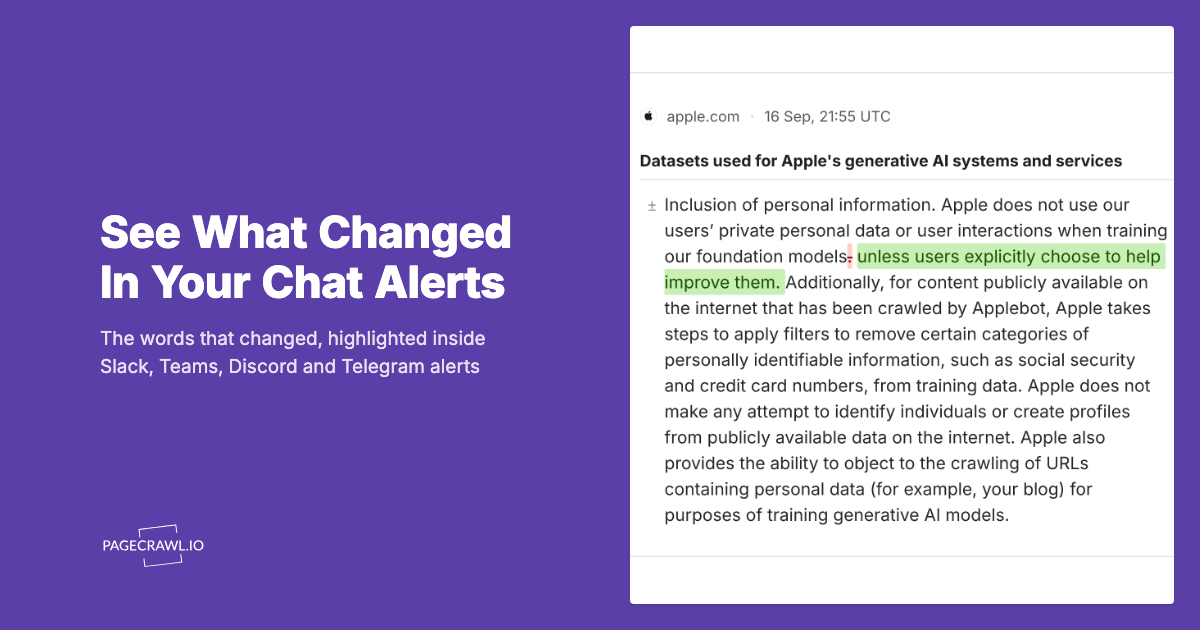
The Re/Supply pages contain dozens of items. A page-diff alert that just says "page changed" is not useful. PageCrawl's AI summary describes which items were added (brand, type, size, price), so you can decide whether to open the page based on the summary alone. The overview of AI-powered change detection and smart filtering explains how to point the summary at the details you care about, such as size and price, and ignore the rest.
Step 6: Route alerts by urgency
Member sale activations and Re/Supply alerts in your size deserve a push notification (web push, Telegram, Discord). General outlet rotation and Garage Sale event announcements work fine via email or daily digest.
Worked Example: A Backcountry Skier's REI Setup
A backcountry skier building out a touring kit over a 6-month off-season window set up the following:
- Re/Supply Backcountry Skis page on 60-minute checks
- Re/Supply Climbing Skins page on 60-minute checks
- Re/Supply Avalanche Safety page on 60-minute checks
- REI Outlet Backcountry category page on daily checks
- REI sale landing page on 60-minute checks during May Anniversary Sale, daily otherwise
- Local Denver REI store page on daily checks for Garage Sale events
- All alerts to a Telegram channel, AI summary enabled
Over the 6 months, the skier sourced touring bindings ($380 retail, $190 on Re/Supply), climbing skins ($210 retail, $90 on Re/Supply), and a probe and shovel kit during the Anniversary Sale. Total savings versus retail: roughly $600. Total monitoring cost: $80 Standard plan.
Patterns Worth Watching
Anniversary Sale opens overnight US time. REI's largest member sale of the year typically goes live overnight US time on the Friday of the sale week. The first few hours are the highest-velocity window for popular sizes in flagship items.
Re/Supply weekend restocks. Re/Supply listings are processed continuously, but volume tends to spike on Mondays and Tuesdays as REI processes the weekend's trade-ins.
Outlet pricing drops on Tuesdays. REI's outlet repricing tends to happen midweek, with the deepest cuts typically appearing on Tuesday afternoons Pacific time.
Garage Sale events on Saturday mornings. Most in-store Garage Sale events run Saturday morning openings, with members lined up early. The event page typically goes live 7-14 days ahead.
End-of-season clearances on technical apparel. April-May for winter gear, September-October for summer gear. The sale page activations during these windows can run 40-60% off prior-season inventory.
Advanced Patterns: Beyond REI.com
A complete outdoor-gear monitoring workflow extends past REI to other gear retailers, including value chains like Decathlon.
Combine with Backcountry.com sale pages. Backcountry runs its own discount programs and overlaps with REI on most premium brands. The Backcountry sale alerts pattern applies similarly.
Combine with Sierra Trading Post. Sierra (TJX's outdoor outlet) lists prior-season premium gear at deep discount continuously. Monitoring category pages catches inventory landings.
Combine with brand-direct sale pages. Patagonia Worn Wear, Arc'teryx ReBird, and The North Face Renewed all sell brand-direct used and refurbished gear. Each has its own monitoring page, and our Patagonia restock alerts guide covers the setup.
When the same jacket or tent shows up at REI, Backcountry, and the brand's own outlet, comparing product prices across multiple retailers puts all three side by side in one view so you can see which channel actually has the better deal before you buy.
Combine with Steep & Cheap and The Clymb. Flash-sale outdoor sites publish a new sale category every 12-24 hours. Monitoring catches the activations.
Who benefits most from REI sale monitoring?
The people who gain the most are the ones buying premium gear on a plan rather than an impulse: enthusiasts assembling a full kit, value-focused buyers working the Re/Supply channel, co-op members timing dividend redemption around a member sale, guides and outdoor educators, camp program directors buying in volume, and resellers sourcing hard-to-find pieces.
Outdoor enthusiasts building a kit. Anyone assembling a serious outdoor setup (backpacking, climbing, backcountry skiing) typically wants 8-15 premium pieces. Catching even 30% of these on member-sale or Re/Supply pricing saves $500-$1,500 across a multi-year buildout.
Budget gear buyers. Re/Supply is often the cheapest legitimate path to specific premium pieces. Buyers focused on value get the most out of continuous Re/Supply monitoring in their categories and sizes.
REI co-op members. Members planning dividend redemption around major sales (stacking dividend with member-sale pricing) benefit from same-day awareness of sale activation.
Outdoor educators and guides. AMGA guides, NOLS instructors, and outdoor educators source personal kit at sale pricing. Some programs also procure shared gear (tents, stoves, group kits) during member sales.
Camp and youth program directors. Summer camps and outdoor youth programs buy in volume during prior-season clearances. Catching the seasonal transitions reduces per-unit cost meaningfully.
Reseller and consignment operators. Some resellers source from Re/Supply and Garage Sale events for high-demand technical pieces (vintage Arc'teryx, hard-to-find sizes), reselling on eBay and dedicated forums at premiums.
Frequently Asked Questions
Do I need REI membership to buy from Re/Supply? Re/Supply is open to anyone but trading in gear (which feeds the inventory) is members-only. Member status also unlocks the largest member-sale discounts.
How fresh is Re/Supply inventory? New listings appear daily. The fastest-moving categories (jackets in popular sizes, ultralight backpacks, sleeping bags) can sell through within hours.
Can I monitor specific Re/Supply items? Yes. Each Re/Supply listing has its own URL. Add the URL as a per-SKU monitor with stock availability and restock alerts; the page will change state when the item sells.
What about REI gift cards during member sales? REI occasionally bundles bonus gift card promotions during major sales. These activations appear on the main sale landing page and are detectable as page changes.
Are Garage Sale events worth attending in person? For deep discounts on specific high-demand items (technical packs, premium tents, specialized footwear), yes. Members typically queue 1-3 hours before opening for the deepest discounts.
Do I need a paid plan? For a 3-4 page setup (sale page, outlet, Re/Supply, local store), the free plan works. For an active outdoor pro with 10-15 monitored pages at hourly frequency, Standard at $80/year is the right tier.
Choosing your PageCrawl plan
PageCrawl's Free plan lets you monitor 6 pages with 220 checks per month, which is enough to validate the approach on your most critical pages. Most teams graduate to a paid plan once they see the value.
| Plan | Price | Pages | Checks / month | Frequency |
|---|---|---|---|---|
| Free | $0 | 6 | 220 | every 60 min |
| Standard | $8/mo or $80/yr | 100 | 15,000 | every 15 min |
| Enterprise | $30/mo or $300/yr | 500 | 100,000 | every 5 min |
| Ultimate | $99/mo or $999/yr | 1,000 | 100,000 | every 2 min |
Annual billing saves two months across every paid tier. Enterprise and Ultimate scale up to 100x if you need thousands of pages or multi-team access.
The math is straightforward. Standard at $80/year covers 100 product pages. If monitoring catches one $20 price drop, one mispriced competitor SKU, or one restock you would otherwise miss each month, the plan has paid for itself roughly four times over in the first year.
Getting Started
Add the REI sale, outlet, and Re/Supply landing pages to PageCrawl. Create a free account, set each to hourly checks during active sale windows and daily checks otherwise, and route alerts to email or Telegram. The next Anniversary Sale activation or Re/Supply restock in your size reaches you on the first check after it goes live.
Once you start catching drops, expand to Re/Supply sub-category pages for the gear types you actually want and add your local store page for Garage Sale event announcements. The Standard plan at $80/year covers a complete outdoor-gear watchlist with room for parallel monitoring on Backcountry, Sierra, and brand-direct used programs.