Puma's collaboration with Rihanna's Fenty line sold out in minutes. The Lamelo Ball MB.04 in limited colorways disappeared from Puma.com before most people finished reading the announcement post. When the Puma Suede VTG "Year of the Snake" dropped as a regional exclusive, resale prices doubled within 48 hours. Limited Puma releases move fast, and the window between availability and sellout is getting shorter.
Puma occupies an interesting position in the sneaker market. The brand balances heritage models (Suede, Clyde, RS-X) with performance lines (basketball with Lamelo Ball, motorsport with Ferrari and BMW partnerships, and Formula 1 collaborations) and fashion-forward drops through designer partnerships. This range means Puma appeals to collectors, athletes, and casual sneaker enthusiasts, each tracking different releases through different channels.
Unlike Nike, which concentrates limited releases through the SNKRS app, Puma distributes releases across its own website, Foot Locker and its family of stores, JD Sports, Champs Sports, Finish Line, and boutique retailers. This distribution creates both opportunity and complexity. There are more chances to buy, but more places to watch.
This guide covers Puma's release strategy, which platforms to monitor, how to set up automated alerts for new releases and restocks, and techniques specific to Puma's drop patterns.
How do Puma releases work?
Puma splits its calendar between everyday general releases and limited drops that come from collaborations: celebrity and designer lines, Lamelo Ball basketball colorways, motorsport and Formula 1 collections, brand crossovers, and archive revivals. The limited tiers are the ones that sell out. Understanding that structure helps you focus your monitoring.
Collaboration Model
Puma's highest-demand releases come from collaborations. The brand's partnership roster includes:
Celebrity and Designer Collaborations: The Fenty by Rihanna line redefined Puma's fashion credibility. More recent collaborations with A$AP Rocky, Dua Lipa, and other cultural figures generate similar demand. These drops are announced through social media, covered by sneaker blogs, and typically sell out quickly.
Sports Partnerships: Lamelo Ball's MB signature basketball line combines on-court performance with streetwear appeal. Limited colorways and special editions within the MB line sell faster than general releases. Ferrari, BMW, and Mercedes-AMG motorsport collaborations appeal to car enthusiasts and collectors, with some models produced in very limited quantities.
Formula 1 Collections: Puma's F1 collaborations have grown significantly as the sport's popularity has surged. Team-specific apparel and shoes (Ferrari, Mercedes, Red Bull Racing) and driver-specific editions create demand tied to race results and seasonal popularity. Championship-winning team products often see demand spikes.
Brand Collaborations: Partnerships with other brands like Kidsuper, Palomo Spain, and Staple create limited crossover products that attract both brands' audiences. These tend to have smaller production runs and higher resale potential.
Retro and Archive Revivals: Puma periodically revives classic models in original colorways or updated materials. Suede, Clyde, RS-X, and Slipstream re-releases appeal to nostalgia and heritage collectors. These are less competitive than celebrity collabs but still limited in specific colorways.
Release Timing Patterns
Puma's release cadence follows observable patterns:
Seasonal Drops: Major collaborations align with fashion seasons (Spring/Summer and Fall/Winter). Expect announcement clusters in January/February and July/August with releases following 2 to 6 weeks later.
Sport-Aligned Releases: Basketball colorways drop around NBA season events (opening night, All-Star Weekend, playoffs). Motorsport releases coincide with F1 season milestones (opening race, Monaco GP, championship clinching). These dates are predictable months in advance.
Anniversary and Cultural Dates: Retro model anniversaries (Suede's various milestone years), cultural holidays, and heritage moments trigger special editions. The "Year of the Snake" Lunar New Year release is an example of a culturally timed drop.
Retailer Exclusives: Some colorways release only through specific retailers. Foot Locker exclusives, JD Sports exclusives, and boutique-only releases create retailer-specific monitoring needs.
Pricing Tiers
Puma's pricing affects demand and resale dynamics:
- Entry/General Release: $70 to $110. Widely available, rarely sells out.
- Mid-Tier/Performance: $100 to $150. Basketball shoes, running shoes, and lifestyle models with better materials.
- Premium Collaboration: $120 to $200. Designer partnerships, limited materials, special packaging.
- Ultra-Limited/Archive: $150 to $250+. Very small production runs, premium materials, or significant collaboration partnerships.
Products in the upper tiers are where monitoring provides the most value. General releases at $80 will be available for weeks. A $180 collaboration shoe might sell out in an hour.
Where should you monitor for Puma releases?
Start with Puma.com, which lists new arrivals and restocks first, then add the authorized retailers that receive their own allocations: Foot Locker, JD Sports, Champs Sports, Finish Line, and boutiques such as Kith, Bodega, Undefeated and End Clothing. Each platform has different strengths for catching Puma drops.
Puma.com
The primary source for all Puma releases. New products appear on puma.com/us/en (or country-specific domains) in the "New" or "New Arrivals" section. Product pages go live before the actual release time, sometimes days in advance in a "Coming Soon" state, then switch to purchasable at the release time.
What to monitor:
- The New Arrivals section for new product listings
- Specific product pages for stock status changes (Coming Soon to Add to Cart)
- The Puma Journal/Blog for collaboration announcements
- Category pages for specific lines (e.g., Lamelo Ball collection page, Motorsport collection page)
Puma.com is also where restocks appear first. When returned inventory or additional production runs become available, the product page switches from "Sold Out" back to showing available sizes. This transition is what restock monitoring catches.
Foot Locker
One of the largest authorized Puma retailers. Foot Locker carries a broad range of Puma products and receives allocation for most limited releases. The Foot Locker website lists new arrivals and provides product pages with clear availability information.
Foot Locker sometimes receives exclusive colorways not available on Puma.com. These retailer-exclusive models are only discoverable by monitoring Foot Locker's Puma section directly.
The Foot Locker family includes Kids Foot Locker and Champs Sports. While inventory sometimes overlaps, exclusive allocations may differ. If a specific shoe is marked as a Foot Locker exclusive, check whether it also appears on Champs Sports.
JD Sports
A major international sneaker retailer with strong Puma relationships. JD Sports carries European-exclusive colorways and often has different inventory availability than US-focused retailers. For Puma releases with international distribution, JD Sports may have stock when US retailers are sold out.
JD Sports product pages display availability clearly, making them straightforward to monitor for stock changes.
Champs Sports and Finish Line
Both carry significant Puma inventory. Champs Sports tends to focus on sport-lifestyle crossover products, while Finish Line (owned by JD Sports Group) serves a broader sneaker audience. Both stock limited Puma releases and have well-structured websites for monitoring.
Boutique Retailers
Independent sneaker boutiques like Kith, Bodega, Undefeated, SNS (Sneakersnstuff), and End Clothing receive allocations for premium Puma collaborations and other limited designer finds. Boutique drops typically have less competition than major retailers because fewer people monitor these smaller stores.
Boutiques often announce their release details (date, time, size run) on the product page itself or through blog posts. Monitoring a boutique's Puma-specific pages or their general new arrivals section catches these announcements.
Setting Up Puma Monitoring with PageCrawl
PageCrawl monitors sneaker product pages in a full browser environment, rendering the same JavaScript-heavy content that you see when visiting these sites. This is essential for modern retailer websites.

Monitoring for New Product Drops
To catch new Puma releases as they are listed:
Step 1: Navigate to the Puma new arrivals page or the specific collection page for your area of interest (e.g., the Lamelo Ball collection, the motorsport collection, or general new arrivals).
Step 2: Add the URL to PageCrawl. Use content-only mode, which strips navigation, ads, and other page elements to focus on the product listings. This reduces noise from layout changes and rotating banners.
Step 3: Set check frequency based on how time-sensitive the information is. For general new product awareness, checking every 6 to 12 hours is sufficient. When a specific collaboration is expected to drop soon, increase to every 1 to 2 hours.
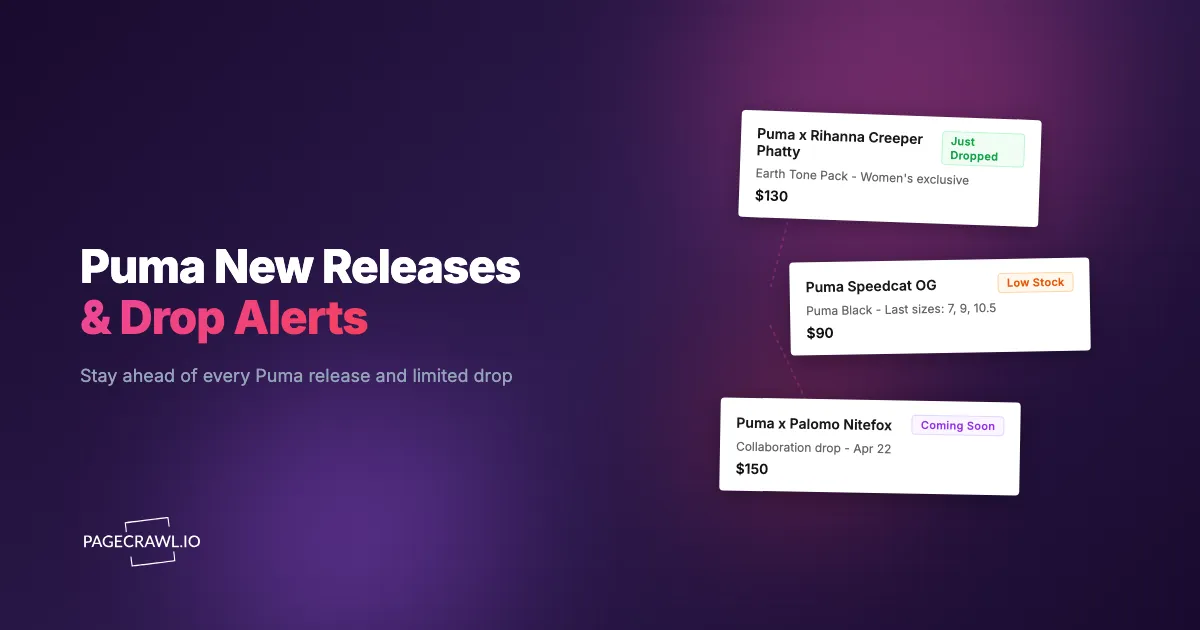
Step 4: Configure notifications. When new products appear on the page, PageCrawl's AI summary describes what was added, typically including the product name, price, and whether it is available or in "Coming Soon" status.
Monitoring for Restocks
Restocks are the highest-value monitoring scenario for Puma products that have already sold out, and the same stock availability and restock alert setup works on any retailer page.
Step 1: Navigate to the sold-out product page. Confirm the page still exists (some retailers remove product pages entirely after sellout, while others display "Sold Out" status).
Step 2: Add the product URL to PageCrawl using availability tracking mode. This mode specifically monitors for stock status changes, from "Sold Out" or "Notify Me" to "Add to Cart" or size availability. The reference on available tracked element types explains how availability tracking differs from plain text or visual comparison.
Step 3: Set check frequency to every 15 to 30 minutes for items you are actively trying to purchase. Restocks can happen at any time, including weekends and evenings, and may sell out again within hours.
Step 4: Use the fastest notification channel available. Browser push notifications or messaging platforms provide the speed needed for restock scenarios where minutes matter.
Step 5: Verify the monitoring works by checking that PageCrawl correctly identifies the current stock status on the page. The AI should report something like "Currently showing Sold Out" or "Currently showing Notify Me When Available."
Monitoring Across Multiple Retailers
For a specific shoe you want, set up product page monitoring on every retailer likely to carry it. A typical setup for a Puma collaboration might include:
- Puma.com product page (or "Coming Soon" page)
- Foot Locker product page
- JD Sports product page
- Champs Sports product page
- 1 to 2 boutique product pages
This multi-retailer approach means you have multiple chances to purchase. If the shoe sells out in seconds on Puma.com, your Foot Locker monitor might catch availability an hour later when that retailer's allocation goes live.
Use PageCrawl folders to organize by release. Create a folder for each shoe you are tracking, containing all retailer monitors for that product. This keeps your dashboard organized and lets you see stock status across retailers at a glance.
For a broader discussion of monitoring products across retailers, see our cross-retailer price comparison guide.
Monitoring for Collaboration Announcements
Knowing about a collaboration before the product drops gives you time to prepare your monitoring setup.
Puma's Announcement Channels
Puma announces collaborations through several channels:
Puma's Blog/Journal: Official announcements with release dates, pricing, and retailer information. Monitor the blog page for new posts.
Sneaker News Sites: Sole Collector, Hypebeast, Sneaker News, and Nice Kicks often report on upcoming Puma collaborations before official announcements. Monitoring these sites' Puma-specific pages catches early information.
Retailer Product Listing Pages: Sometimes a retailer lists a "Coming Soon" product page before the official announcement. Monitoring new arrivals pages catches these early listings.
Setting Up Announcement Monitoring
Add the Puma blog and 2 to 3 sneaker news sites' Puma pages to your monitoring. Use content-only or reader mode to capture article text without layout noise. When a new collaboration is announced, you will receive an alert with a summary of the announcement, giving you time to find product URLs and set up release-day monitoring.
The automatic page discovery feature can help identify new product pages that appear on retailer sites as upcoming releases are listed.
Puma-Specific Drop Strategies
Puma releases have characteristics that differ from Nike and Adidas drops.
Lower Competition, Wider Windows
Puma limited releases generally have wider purchase windows than Nike SNKRS drops. While Nike shoes might sell out in 90 seconds, a Puma collaboration might remain available for 30 minutes to several hours on at least some retailers. This does not mean you have all day, but it does mean your monitoring system has more margin. A 15-minute check frequency that would be too slow for Nike is often adequate for Puma.
The exception is ultra-limited collaborations (Fenty drops, certain archive revivals in small production runs). Treat these like Nike-level competition and use the fastest monitoring and notification setup you can.
Regional and Retailer Timing Differences
Puma releases do not always go live simultaneously across retailers. Puma.com might release at 10:00 AM, while Foot Locker releases at their store opening time, and JD Sports follows European timing. International retailers (End Clothing, SNS) may release a day earlier based on time zones.
Multi-retailer monitoring captures these timing differences. Your first alert might come from an international retailer releasing early, giving you advance notice that the domestic release is imminent.
Size Availability Patterns
Popular sizes (US 8.5 to 11 for men's) sell first. If your size falls in this range, speed matters more. If you wear an uncommon size (US 7 or below, US 13 or above), you often have more time as these sizes sell last and restock first.
Monitoring size-specific availability (where the product page displays individual size stock status) lets you track whether your specific size is available rather than relying on general product availability.
Motorsport and F1 Release Cycles
F1-related Puma products follow the racing calendar. Team products (Ferrari red, Mercedes silver) update seasonally with new designs. Limited editions often coincide with specific races. The Monaco Grand Prix, season finale, and championship celebrations are common release triggers.
If you collect F1 Puma products, monitor the Puma motorsport collection page and the team-specific pages on puma.com. New products appear in these sections before the general new arrivals page.
Multi-Brand Sneaker Monitoring Strategy
Many sneaker enthusiasts track releases across Puma, Nike, Adidas, New Balance, and other brands. A structured approach keeps monitoring manageable.
Organize by Priority
Not every release warrants the same monitoring intensity. Organize your monitors into priority tiers:
Must-Cop: The releases you will make every effort to purchase. Maximum monitoring frequency, fastest notification channels, multiple retailer coverage.
Want-to-Cop: Releases you would like but are not essential. Standard monitoring frequency, email or Slack notifications, 1 to 2 retailers.
Watch: Releases you want to know about but may not purchase. Low-frequency monitoring, email digest, single retailer.
This tiering prevents your most important releases from getting lost in notification noise.
Allocate Monitors Strategically
PageCrawl's free tier includes 6 monitors. For Puma-focused sneaker tracking, allocate these strategically:
- 1 monitor on Puma.com new arrivals or your preferred collection page
- 2 to 3 monitors on specific product pages you are actively targeting
- 1 to 2 monitors on Foot Locker or another retailer's Puma section
- 1 monitor on a sneaker news site's Puma page
When a major collaboration is announced and you need to add monitors across five or six retailers quickly, PageCrawl's bulk editing feature lets you adjust settings on multiple monitors at once. Change check frequencies from daily to every 30 minutes across all your Puma monitors in a single action, then dial them back after the drop. This saves time during the critical setup window before a release.
For enthusiasts tracking across brands, the Standard plan at $80/year provides 100 monitors, enough to cover multiple brands across multiple retailers with dedicated product page monitoring for upcoming releases. The Enterprise plan at $300/year with 500 monitors supports resellers and community operators tracking dozens of releases simultaneously.
For Nike-specific monitoring, see our out-of-stock monitoring guide which covers availability tracking patterns that apply across brands.
Notification Strategy for Sneaker Drops
The best monitoring is useless if the notification does not reach you in time.
Fastest Channels
For restock alerts and release-day monitoring, use the fastest available notification channel. Browser push and messaging platforms (Telegram, Discord) put the alert on your phone as soon as a check detects the stock change. Email adds delivery lag on top of that, so it is too slow for competitive releases, though it works fine for announcement-level monitoring.
See our Telegram alerts setup guide for setup details and how mobile push compares with email across channels.
Different Channels for Different Priorities
Route must-cop alerts to your fastest, most attention-grabbing channel (push notification, Telegram with sound). Route want-to-cop alerts to a less urgent channel (Slack, email). Route watch-level alerts to email digest.
This layering prevents alert fatigue. When your phone makes the push notification sound, you know it is a high-priority release alert. Lower-priority updates come through channels you check at your own pace.
Testing Before Release Day
Before a major drop, verify your monitoring and notification chain. Send a test alert. Confirm it arrives on your phone. Open the retailer's website from the alert notification. Time the process from alert to having the product page open in your browser. Identify and fix bottlenecks before the actual release.
What goes wrong when monitoring Puma pages?
Four issues account for most problems: regional redirects sending your monitor to the wrong country's store, "Coming Soon" pages that show no price yet, rotating carousels and recommendation blocks that trigger false alerts, and a product that is sold out only in your size while other sizes stay available.
Product Pages Redirect to Different Regions
Puma's website may redirect to your regional site based on IP address. If you are monitoring puma.com/us but the page redirects to puma.com/uk (or vice versa), the monitored content may not match your purchasing region. Use the correct regional URL for your location.
"Coming Soon" Pages Show No Price
Some Puma product pages go live in a "Coming Soon" state without displaying the price. This is normal and does not indicate a monitoring problem. The price typically appears when the product transitions to purchasable status, which your monitor will detect as a content change.
Dynamic Content Noise
Sneaker product pages often include rotating images, "You Might Also Like" sections, and other dynamic elements that change between checks. Using availability tracking mode or content-only mode reduces these false alerts by focusing on the relevant content.
Sold Out Size vs Completely Sold Out
A product page might show "Sold Out" in your preferred size while other sizes remain available. General availability monitoring would not flag this as sold out since the product is still partially available. For size-specific tracking, target the specific size selector element on the page using a CSS selector.
Choosing your PageCrawl plan
PageCrawl's Free plan lets you monitor 6 pages with 220 checks per month, which is enough to validate the approach on your most critical pages. Most teams graduate to a paid plan once they see the value.
| Plan | Price | Pages | Checks / month | Frequency |
|---|---|---|---|---|
| Free | $0 | 6 | 220 | every 60 min |
| Standard | $8/mo or $80/yr | 100 | 15,000 | every 15 min |
| Enterprise | $30/mo or $300/yr | 500 | 100,000 | every 5 min |
| Ultimate | $99/mo or $999/yr | 1,000 | 100,000 | every 2 min |
Annual billing saves two months across every paid tier. Enterprise and Ultimate scale up to 100x if you need thousands of pages or multi-team access.
Landing one limited Puma collaboration at retail instead of paying resale typically covers Standard for several years. At $80/year, 100 monitored pages is enough to cover Puma.com, five or six authorized retailers, and sneaker news announcement pages for every release you care about. The 15-minute check frequency keeps pace with Puma drop windows, which are narrow but not as aggressive as Nike SNKRS, giving you a realistic shot at each release.
Getting Started
Start with the Puma release you care about most. Find the product page on Puma.com and one other retailer. Set up monitors with availability tracking mode, configure push notifications for speed, and verify that the monitoring correctly identifies current stock status.
Once you see how the alert flow works, expand to cover multiple retailers for the same product. Add announcement monitoring on Puma's blog or a sneaker news site to get ahead of future drops. Build your monitoring around your release calendar so monitors are in place before drops happen, not scrambled together at the last minute.
PageCrawl's free tier includes 6 monitors, enough to cover one release across several retailers or a few releases on their primary platforms. For sneaker enthusiasts tracking Puma alongside other brands, the Standard plan at $80/year supports 100 monitors for comprehensive multi-brand, multi-retailer coverage.
The combination of availability monitoring, AI-powered change summaries, screenshot verification, and fast notifications across Slack, push, and other channels gives you awareness that manual page-checking cannot match. Set it up before the next drop, and let your monitoring do the watching for you.
Create a free PageCrawl account and start tracking Puma releases before the next collaboration drops.