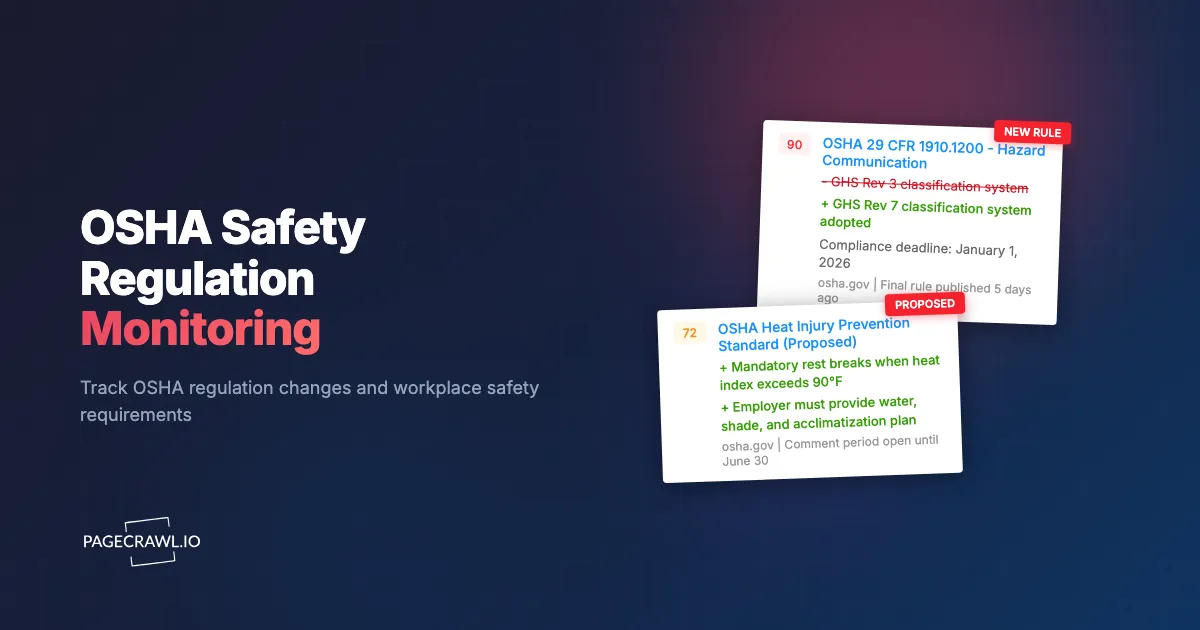
OSHA's expanding enforcement emphasis on heat illness prevention is a good example. Companies that learned about the change through automated monitoring had weeks to update safety programs before inspections increased. Companies that relied on periodic manual reviews of OSHA's website found out when a compliance consultant mentioned it during a quarterly meeting, or worse, when an inspector arrived.
This is not an isolated case. OSHA publishes hundreds of updates annually: new enforcement directives, revised standards, Letters of Interpretation clarifying existing rules, National Emphasis Programs targeting specific hazards, and state plan updates that may exceed federal requirements. Each update can change what your company is required to do, what inspectors will look for, and what penalties you face for non-compliance.
The challenge is not that OSHA hides this information. It is published on osha.gov and in the Federal Register. The challenge is volume, fragmentation, and timing. Updates appear across multiple sections of multiple websites, formatted inconsistently, and often with short implementation timelines. Manual monitoring simply cannot keep pace.
This guide covers what OSHA content to monitor, how to set up automated tracking for safety regulation changes, strategies for filtering updates relevant to your industry, and how to build a compliance calendar from monitoring data.
Why does OSHA monitoring matter now?
OSHA monitoring matters now because penalties have climbed, National Emphasis Programs redirect inspections with little warning, state plans layer extra requirements on top of federal rules, and the rulemaking pipeline keeps moving. Several factors make automated monitoring more important than it was a few years ago.
Increasing Enforcement Activity
OSHA has significantly increased inspection activity and penalty amounts. Maximum penalties for serious violations run into five figures per instance, and willful or repeated violations run roughly ten times higher; OSHA publishes the current maximums and adjusts them annually for inflation. For a facility with multiple violations, total penalties can easily reach six or seven figures.
Higher penalties increase the financial risk of non-compliance. But the operational impact often exceeds the fine itself. An OSHA citation can trigger follow-up inspections, mandatory abatement timelines, increased insurance premiums, and reputational damage with customers and potential employees.
National Emphasis Programs
OSHA periodically launches National Emphasis Programs (NEPs) that target specific hazards or industries for increased inspection activity. Recent NEPs have focused on heat illness prevention, fall protection, trenching and excavation, primary metals, and warehousing. When OSHA announces a new NEP relevant to your industry, inspection probability increases substantially.
Knowing about a new NEP before inspections begin gives you time to audit your own compliance, correct deficiencies, and document improvements. Learning about it during an inspection does not.
State Plan Variations
Twenty-two states and territories operate their own occupational safety programs (state plans) under OSHA approval. These state plans must be at least as effective as federal OSHA but can be more stringent. California's Cal/OSHA, for example, has requirements that exceed federal standards in multiple areas including heat illness prevention, aerosol transmissible diseases, and repetitive motion injuries.
If you operate in multiple states, you need to track both federal OSHA and each relevant state plan. A change to federal standards triggers potential state-level adoption, but state plans may adopt different timelines or add additional requirements. This creates a matrix of compliance obligations that is impossible to track manually across all jurisdictions.
Evolving Standards
OSHA's regulatory agenda continuously advances new or revised standards. Recent rulemaking includes updated silica exposure limits, electronic recordkeeping requirements, workplace violence prevention (in development), and heat illness prevention standards. Each of these proceeds through a rulemaking process with proposed rules, comment periods, and final rules, all of which are published in stages.
Tracking the rulemaking pipeline lets you prepare for upcoming requirements rather than scrambling when final rules take effect. Proposed rules signal the direction of regulation, even if the final version differs from the initial proposal.
What should you monitor on OSHA's website?
Monitor six things: news releases, Federal Register notices, enforcement directives and memoranda, Letters of Interpretation, the standard pages that govern your hazards, and the state plan pages for every state where you operate. OSHA publishes across several sections of osha.gov, each serving a different purpose.
OSHA News Releases
Published at osha.gov/news/newsreleases, these announce enforcement actions, new initiatives, partnerships, and significant penalties. News releases are the most visible form of OSHA communication and often provide the first public indication of new enforcement priorities.
Monitor this page to learn about:
- New National Emphasis Programs
- Major enforcement actions in your industry
- Penalty trends and amounts
- Partnerships and voluntary programs
- Leadership announcements that may signal policy shifts
Federal Register Notices
OSHA publishes proposed rules, final rules, emergency temporary standards, and requests for information in the Federal Register. These are the legally binding documents that create or modify compliance obligations.
The Federal Register publishes at federalregister.gov. Filter for OSHA-specific content by monitoring the OSHA section or searching for "Occupational Safety and Health Administration" within the daily publications.
Monitor the Federal Register for:
- Proposed rules (with comment period deadlines)
- Final rules (with effective dates and compliance timelines)
- Emergency temporary standards
- Requests for information on potential rulemaking
Enforcement Directives and Memoranda
Published at osha.gov/enforcement/directives, these internal documents guide how OSHA inspectors conduct inspections and interpret standards. Directives define inspection procedures, targeting criteria, and enforcement policies. A new directive can change how an existing standard is applied even without changing the standard itself.
For example, a directive updating inspection procedures for fall protection could mean inspectors now check for additional documentation, test additional equipment, or interpret the height threshold differently. The underlying standard has not changed, but the practical compliance requirement has.
Letters of Interpretation
Available at osha.gov/laws-regs/standardinterpretations, Letters of Interpretation respond to specific questions about how standards apply to particular situations. While addressed to the original questioner, they establish precedent for how OSHA interprets its standards.
A Letter of Interpretation relevant to your operations effectively creates a new compliance requirement, or confirms that a common industry practice is acceptable. These are particularly valuable in ambiguous areas where the standard's text is not clear.
Standard-Specific Pages
Each OSHA standard has its own page on osha.gov with the current regulatory text, related documents, guidance materials, and frequently asked questions. When a standard is amended, these pages update to reflect the new requirements.
If specific standards govern your operations (for example, 29 CFR 1926 Subpart M for fall protection in construction, or 29 CFR 1910.134 for respiratory protection), monitoring these standard pages catches updates to the regulatory text and associated guidance.
State Plan Updates
State plan information is published on osha.gov/stateplans, with links to each state plan's own website. Monitoring the federal page catches administrative changes (state plan approvals, modifications, audits), but you also need to monitor each relevant state plan's own website for state-specific rule changes.
For example:
- Cal/OSHA: dir.ca.gov/dosh
- Oregon OSHA: osha.oregon.gov
- Washington L&I: lni.wa.gov/safety-health
- Michigan OSHA: michigan.gov/leo/bureaus-agencies/miosha
Each state agency publishes its own updates, proposed rules, and enforcement information independently from federal OSHA.
Setting Up OSHA Monitoring with PageCrawl
Here is how to build comprehensive OSHA monitoring using automated regulatory intelligence tracking.

Monitoring OSHA News Releases
Add the OSHA news releases page (osha.gov/news/newsreleases) as a monitor in PageCrawl. Use content-only mode to extract the text of news items while filtering out navigation elements, headers, and footers. This ensures you are alerted when new items are published, not when decorative page elements change.
Set the check frequency to once or twice daily. OSHA typically publishes news releases during business hours, and a daily check ensures you see new items within 24 hours.
Configure notifications to reach your safety team. Email notifications work well for a daily review approach, while Slack or Teams integration provides faster awareness for teams that use these tools throughout the day. See our Slack notification setup guide for configuration details.
Monitoring Federal Register OSHA Content
Monitor the Federal Register search page filtered for OSHA content. The URL for OSHA-specific Federal Register entries can be bookmarked after filtering by agency. Use content-only monitoring to capture new entries as they are published.
Daily checks are appropriate since the Federal Register publishes new content each business day. When a new proposed rule or final rule appears, the change alert summarizes the new entry's title and description, letting you assess relevance before reading the full document.
For a broader view of regulatory monitoring techniques, see our regulatory compliance monitoring guide.
Monitoring Enforcement Directives
Add the OSHA directives page (osha.gov/enforcement/directives) as a monitor. New and revised directives appear on this page when published. Content-only mode captures the list of directives while filtering page chrome.
Directive updates are less frequent than news releases, so weekly checks are often sufficient. When a new directive appears, the change summary indicates what was added.
Monitoring State Plan Websites
For each state where you operate under a state plan, add monitors for the state agency's news or updates page. These pages vary in structure and update frequency. Use content-only or reader mode to focus on the substantive content.
State plan monitoring requires more monitors (one per state, sometimes multiple pages per state), so plan your monitoring allocation accordingly. Prioritize states where you have the most employees or the most complex operations.
Setting Up Industry-Specific Keyword Monitoring
Not every OSHA update is relevant to your business. A construction company does not need alerts about maritime standards. A healthcare facility does not need updates on grain handling.
PageCrawl's AI-powered change summaries help filter relevance. When a page changes, the summary describes what was added or modified. You can quickly scan the summary for terms relevant to your industry without reading the full page.
For more targeted filtering, use specific element monitoring to track only sections of OSHA pages relevant to your industry. For example, if your concern is fall protection, monitor the fall protection standard page and its associated guidance documents rather than the entire directives listing.
Building a Safety Compliance Calendar
Monitoring is most valuable when it feeds into an actionable system. A compliance calendar turns monitoring alerts into scheduled activities.
Tracking Compliance Deadlines
Regulatory changes include effective dates and compliance deadlines. When a final rule publishes, note the effective date and any phased implementation schedule. Some rules take effect on publication, others allow months or years for compliance.
A compliance calendar entries might look like:
- May 2026: New electronic recordkeeping submission due
- July 2026: Revised heat illness prevention standard effective
- October 2026: Updated silica exposure monitoring requirements begin
- January 2027: Emergency action plan updates required per revised standard
Each entry traces back to a monitoring alert that identified the change. This connection between automated detection and scheduled action is the core value of compliance monitoring.
Using Webhooks for Compliance Tracking
For organizations with formal compliance management systems, PageCrawl's webhook integration can route monitoring alerts directly into your tracking tool. When a new OSHA update is detected, the webhook sends structured data to your compliance platform, ticketing system, or project management tool.
This eliminates the manual step of transferring information from a monitoring alert to an action item. The change is detected, summarized, and routed automatically. See our webhook automation guide for technical setup details.
Archiving Regulatory Snapshots
When regulations change, the previous version often becomes hard to find. OSHA may update a page without maintaining a publicly accessible version history. PageCrawl captures the content of each monitored page at every check, creating an archive of changes over time.
This archive serves as evidence of when you became aware of a change (the monitoring alert timestamp) and what the previous version looked like. For compliance documentation and audit trails, this historical record is valuable. For organizations that need legally defensible proof of regulatory page states, PageCrawl can enable WACZ archiving on request. This custom capability captures full web archive files that preserve the page exactly as it appeared at the time of the check, including all assets, scripts, and styling. These WACZ files are an accepted web archiving standard and can serve as evidence in regulatory audits or legal proceedings; the help centre explains what a PageCrawl WACZ archive contains. For more on using web monitoring for archiving purposes, see our website archiving guide.
Industry-Specific OSHA Monitoring
Different industries face different OSHA standards and enforcement priorities. Here is what to focus on by sector.
Construction
Construction is consistently OSHA's most-inspected industry. Key standards include fall protection (Subpart M), scaffolding (Subpart L), excavations (Subpart P), and the "Focus Four" hazards (falls, struck-by, caught-in/between, electrocution). OSHA publishes construction-specific guidance frequently.
Monitor:
- osha.gov/construction for industry-specific guidance updates
- Fall protection and scaffolding standard pages for regulatory changes
- National Emphasis Programs targeting construction hazards
- OSHA Training Institute course updates relevant to construction safety
Construction companies operating in multiple states need particular attention to state plan variations. Cal/OSHA's construction requirements, for instance, include provisions not found in federal standards.
Manufacturing
Manufacturing faces a broad range of OSHA standards depending on the processes involved. Machine guarding (1910 Subpart O), lockout/tagout (1910.147), hazard communication (1910.1200), and process safety management (1910.119) are common focus areas.
Monitor:
- osha.gov/manufacturing for industry-specific updates
- Standard pages for your specific hazards (chemical exposure, noise, ergonomics)
- Industry-specific NEPs (primary metals, powered industrial trucks)
- NIOSH research publications that may influence future OSHA standards
Healthcare
Healthcare faces unique OSHA challenges including bloodborne pathogens (1910.1030), tuberculosis guidelines, workplace violence, and ergonomic hazards from patient handling. The COVID-19 pandemic generated extensive OSHA guidance for healthcare settings, much of which continues to evolve.
Monitor:
- osha.gov/healthcare for industry guidance
- Bloodborne pathogen and infectious disease standard pages
- State plan requirements (some states have specific healthcare worker protections)
- CDC and NIOSH publications that influence OSHA guidance
General Industry and Warehousing
Warehousing and distribution centers face growing OSHA attention. Recent emphasis programs have targeted powered industrial truck safety, ergonomic hazards, and heat illness in warehouse environments.
Monitor:
- osha.gov/warehousing for industry-specific content
- Powered industrial truck standard page
- Heat illness prevention guidance and rulemaking
- Ergonomic hazard guidance and enforcement trends
Integrating OSHA Monitoring into Safety Programs
Automated monitoring works best as part of a structured safety management process.
Assigning Monitoring Responsibilities
Designate who reviews monitoring alerts and who acts on them. In smaller organizations, this might be the safety manager. In larger organizations, route construction-related alerts to the construction safety team, chemical hazard updates to the EHS department, and general updates to the safety director.
PageCrawl supports routing different monitors to different notification channels. Set up separate Slack channels or email groups for different categories of OSHA content, ensuring alerts reach the right people.
Assessment and Response Workflow
When a monitoring alert identifies a potentially relevant OSHA change:
- Review the change summary to determine if it applies to your operations.
- Read the full document if the summary suggests relevance.
- Assess impact on current safety programs, training, equipment, and documentation.
- Create action items with deadlines aligned to the regulatory compliance timeline.
- Track completion through your normal project management process.
- Document the process for audit trail purposes, showing that you identified the change, assessed it, and responded.
This workflow turns monitoring alerts into compliance actions. The monitoring system handles detection. Your team handles response. Always confirm the requirement against the official OSHA or state plan page before you act on it; this article is informational, not legal advice.
Training Updates
Many OSHA standard changes affect training requirements. New hazard communication requirements might mean updated training content. Revised fall protection standards might mean retraining competent persons. Heat illness prevention rules might mean new training modules for supervisors.
When monitoring alerts identify training-relevant changes, include training updates in your compliance calendar. Budget for material development, schedule training sessions, and document completion.
Multi-Site Compliance Management
Organizations with multiple facilities face compounded monitoring complexity.
Federal vs State Requirements
A company with facilities in California, Texas, and Oregon faces three different regulatory environments. Texas follows federal OSHA. California and Oregon operate state plans with additional requirements. Each facility needs compliance with the applicable jurisdiction's standards, which may differ from each other and from federal requirements.
Set up monitoring groups in PageCrawl corresponding to each jurisdiction, using labels, folders, and workspaces to keep the jurisdictions separate:
- A "Federal OSHA" folder for updates affecting all facilities
- A "Cal/OSHA" folder for California-specific updates
- An "Oregon OSHA" folder for Oregon-specific updates
This organization ensures that state-specific changes are routed to the right facility managers.
Standardizing Response Across Facilities
When a federal OSHA change affects all facilities, standardize the response. The monitoring alert triggers a corporate-level review that produces updated procedures and distributes them to all sites. This centralized approach prevents inconsistent implementation across locations.
For state-specific changes, the relevant facility takes the lead on response, but corporate safety should be aware and assess whether the change warrants voluntary adoption at other facilities for consistency.
Monitoring OSHA Beyond osha.gov
OSHA's regulatory activity connects to broader government and industry publishing.
NIOSH Research
The National Institute for Occupational Safety and Health (NIOSH) conducts research that often influences future OSHA standards. NIOSH publications, Workplace Safety and Health Topics, and Criteria Documents signal where OSHA may focus next.
Monitoring NIOSH's new publications page provides early warning of emerging safety science that may eventually become regulatory requirements. This is particularly relevant for chemical exposure limits, where NIOSH Recommended Exposure Limits (RELs) often precede OSHA Permissible Exposure Limits (PELs).
Industry Consensus Standards
OSHA frequently references or incorporates industry consensus standards from organizations like ANSI, NFPA, and ASTM. When these standards update, OSHA may adopt the new version by reference. Monitoring the update pages of relevant standard-setting organizations provides advance notice of changes that may eventually carry OSHA enforcement weight.
Congressional and Executive Actions
Executive orders, congressional legislation, and government budget decisions affect OSHA's priorities and capabilities. Monitoring government agency and public records pages helps you anticipate shifts in enforcement focus or regulatory direction.
For a broader view of monitoring government and regulatory content, see our compliance monitoring software guide.
What makes OSHA monitoring hard to get right?
Four things trip teams up: the sheer volume of updates that do not apply to your operations, government site redesigns that break monitored URLs, wide variation in how state plan sites publish, and the gap between checks during a fast-moving rulemaking. Each has a practical fix.
High Volume of Irrelevant Updates
OSHA publishes extensively, and most updates will not apply to your specific operations. The initial monitoring setup may generate alerts that require significant review to assess relevance. Over time, you will learn which page sections produce relevant updates and can narrow your monitoring to focus on those.
PageCrawl's AI summaries help by describing changes in plain language, so you can assess relevance from the alert without visiting the page every time.
Page Structure Changes
Government websites periodically redesign. When OSHA reorganizes its site, monitored URLs may change or page structures may shift. When this happens, PageCrawl alerts you to the structural change, and you can update your monitors to reflect the new layout.
Using PageCrawl's automatic page discovery feature can help identify new pages that appear after a site reorganization.
State Plan Inconsistency
State OSHA plan websites vary dramatically in quality, update frequency, and organization. Some states maintain well-structured websites with clear update notifications. Others publish updates in formats that are harder to monitor. Adjust your monitoring approach by state, using full-page monitoring for less structured sites and targeted element monitoring for well-organized ones.
Staying Current Between Checks
Alerts arrive when the next scheduled check detects a change, so for critical regulatory areas a daily check may not be fast enough. If you need same-hour awareness of OSHA developments (for example, during an active rulemaking comment period), increase check frequency for the specific pages involved. Return to daily checks once the critical period passes.
Choosing your PageCrawl plan
PageCrawl's Free plan lets you monitor 6 pages with 220 checks per month, which is enough to validate the approach on your most critical pages. Most teams graduate to a paid plan once they see the value.
| Plan | Price | Pages | Checks / month | Frequency |
|---|---|---|---|---|
| Free | $0 | 6 | 220 | every 60 min |
| Standard | $8/mo or $80/yr | 100 | 15,000 | every 15 min |
| Enterprise | $30/mo or $300/yr | 500 | 100,000 | every 5 min |
| Ultimate | $99/mo or $999/yr | 1,000 | 100,000 | every 2 min |
Annual billing saves two months across every paid tier. Enterprise and Ultimate scale up to 100x if you need thousands of pages or multi-team access.
A single OSHA citation can run into five figures per violation, and a willful violation runs roughly ten times that. Against that scale, Standard at $80/year covering 100 pages across OSHA standards, enforcement directives, and state plan sources is practically free. Enterprise at $300/year handles 500 pages with full change history and timestamped screenshots, giving you the documentation trail an OSHA inspector or internal auditor expects to see.
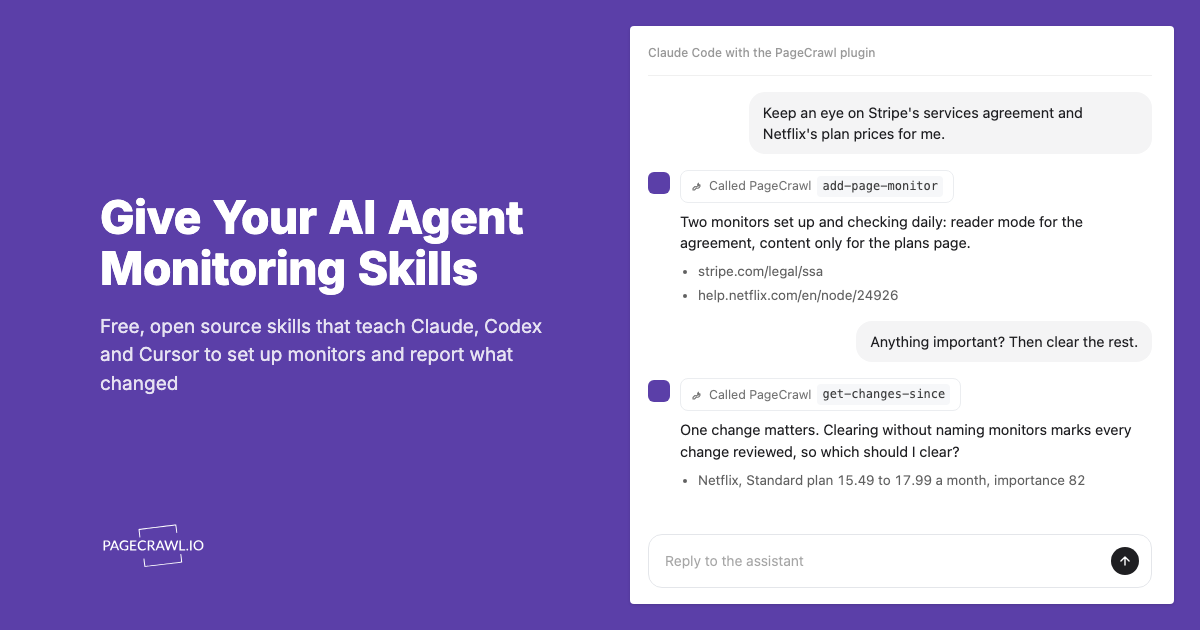
All plans include the PageCrawl MCP Server, so your safety team can ask an AI assistant to pull every change to a specific standard over the past six months and get a plain-language summary of what shifted, without digging through diffs manually. AI assistants can create monitors through conversation on every plan, including Free.
Getting Started
Start with the OSHA sources most relevant to your industry. Add the OSHA news releases page and the one or two standard pages that govern your primary workplace hazards. Configure content-only monitoring, set daily checks, and route alerts to your safety manager or compliance team.
Run this basic setup for a month. You will see the volume and relevance of OSHA publications in your area. From there, expand to include Federal Register monitoring, state plan pages, enforcement directives, and industry-specific sources.
PageCrawl's free tier includes 6 monitors, enough to cover OSHA news releases, your most critical standard pages, and one or two state plan sources. For organizations with multi-state operations or complex regulatory environments, the Standard plan at $80/year provides 100 monitors to cover federal, state, and industry-specific sources comprehensively. The Enterprise plan at $300/year with 500 monitors supports large organizations tracking every relevant regulatory source across all jurisdictions.
Automated OSHA monitoring transforms compliance from a periodic review exercise into continuous awareness. Every change is captured, summarized, and delivered to the right person. The cost of monitoring is a fraction of what a single missed regulatory change can cost in penalties, remediation, and operational disruption.
Create a free PageCrawl account and start monitoring the OSHA standards that affect your workplace.