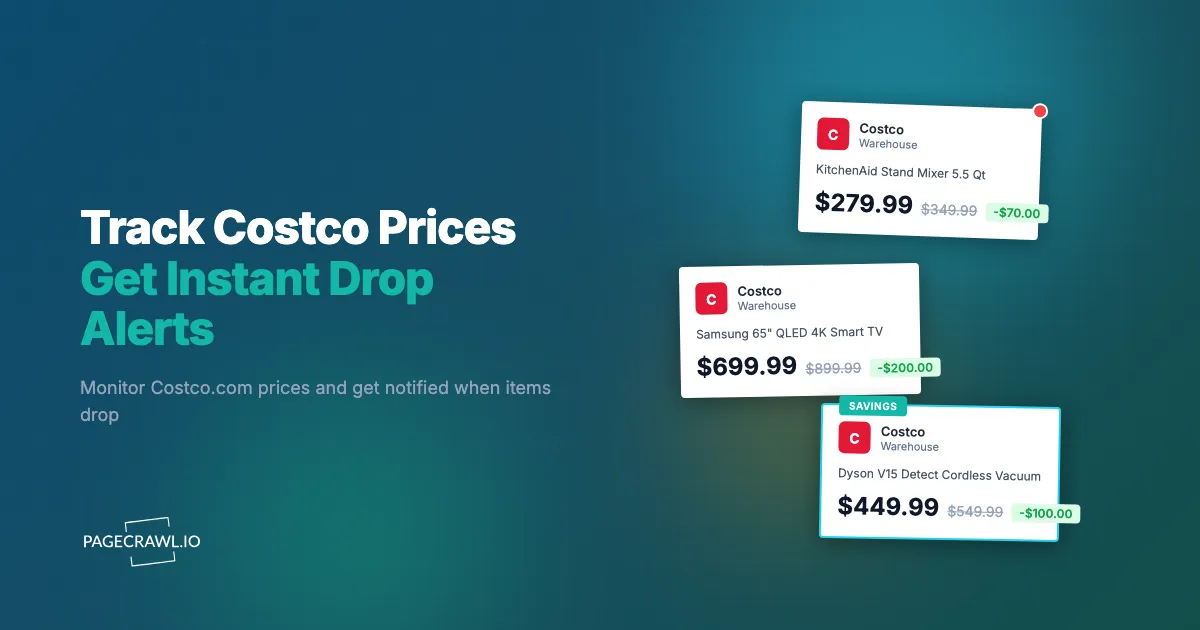
A 65-inch TV at Costco costs $499 one week and $399 the next, with no announcement and no email alert. You find out when a friend mentions the deal three days after it ended. Costco's pricing moves quietly, and their warehouse model makes tracking even harder than typical retailers.
Costco does not run constant flash sales the way Amazon or Walmart do. Instead, they make deliberate price cuts, seasonal markdowns, and member-only promotions that appear without fanfare and disappear just as quietly, while rotating inventory makes manual tracking fail.
This guide covers how Costco pricing works, every method for tracking Costco prices in 2026, and a walkthrough for setting up automated monitoring that alerts you when a check detects a drop.
How does Costco pricing work?
Costco prices stay stable for weeks, then drop meaningfully in deliberate cuts rather than constant algorithmic tweaks. Margins are thin (Costco is widely reported to cap markups at around 14-15%), so a genuine drop is real savings, not an inflated markdown. Costco.com prices often run higher than warehouse prices, and only the online prices can be tracked automatically.
The most useful signal is Costco's price-ending code:
- Prices ending in .99: Regular everyday pricing
- Prices ending in .97: Clearance or manager markdown (store-specific)
- Prices ending in .00 or .88: Manager markdown or manufacturer-sponsored deal
- Asterisk (*) on the price tag: Item will not be reordered after current stock sells
For online monitoring, watch for price endings that shift from .99 to .97 or .00, as these indicate the item has moved to clearance or a promotional price.
What should you track at Costco?
Focus on categories where price swings are largest: electronics, seasonal items, tires, and high-value one-time purchases, plus staples you buy repeatedly. The monitoring payoff is highest where a single caught drop saves $100 or more, or where small savings compound across a year of repeat purchases.
- TVs and electronics: Costco regularly drops TV prices by $100-$300 during holidays, Super Bowl season, and model-year changeovers. A 75-inch Samsung at $1,299 in October might hit $999 in November and $899 in January clearance.
- Furniture and seasonal items: Patio furniture drops through summer and hits clearance by late August, with savings that can exceed 50%. Once Costco clears seasonal stock, it does not come back.
- Grocery and household staples: a $3 drop on bulk detergent or Kirkland Signature staples compounds over a year of repeat purchases, and Costco does not send targeted price drop emails about them.
- Tires: periodic promotions take $80-$150 off a set of four, several times per year. Monitoring the tire pages lets you time the purchase instead of paying full price when your tires wear out.
- High-value one-time purchases: jewelry, premium cookware sets, hot tubs, and playground equipment, where even a 10% drop means hundreds of dollars saved.
Should you track Costco prices manually?
Manual tracking only suits one or two imminent purchases you can check daily. You visit Costco.com periodically, note prices in a spreadsheet, and hope you catch changes. It is free, requires no tools, and lets you verify context on the actual page, but it is easy to forget, misses drops between visits, builds no history on its own, and does not scale beyond a handful of items.
Can deal community sites catch Costco deals for you?
Only passively. Slickdeals, Reddit's r/Costco, and Costco-focused deal blogs surface community-reported deals for free, including in-store markdowns that no online tool can see, with community verification of deal quality. But coverage depends on someone else finding and posting the deal, in-store deals vary by warehouse, and you compete with the entire community for limited inventory. Best for general deal hunting, not for watching specific products.
Do Costco's own emails alert you to price drops?
Not reliably. Costco's promotional emails and app highlight curated, verified deals, including member-exclusive and in-store promotions. But the emails are infrequent and never cover every price drop, you cannot ask Costco to watch a specific product for you, and a promotion may start before the email about it arrives. Fine for casual deal awareness, not for active monitoring.
How do you track Costco prices automatically with PageCrawl?
PageCrawl monitors the Costco.com product pages you choose at your chosen frequency, extracts the price, and sends an alert through your preferred channel when the next check detects a change. Setup takes about ten minutes per product, and it scales to your entire wish list using the same price monitoring and stock alert setup that works on any retailer.

Every monitor builds a price history chart automatically, the same charting described in monitoring numeric values for changes to spot trends. This is a stand mixer tracked over three months: stable at $449.99, a markdown to $399.99, then the .97 clearance signal at $379.97.

Detailed Setup Walkthrough
Step 1: Find the product on Costco.com
Navigate to the individual item page, not a category or search results page. The URL should contain an item number (e.g., costco.com/product-name.product.XXXXXXX.html).
Step 2: Add the monitor in PageCrawl
Copy the product URL and create a new monitor in PageCrawl. Select "Price" as the tracking mode. PageCrawl automatically detects the price element on the Costco product page.
Step 3: Configure check frequency
Costco prices change less frequently than Amazon, so daily checks are usually sufficient. For items you suspect are approaching clearance, increase to every 6-12 hours. During known sale events (Black Friday, holiday season), you might check every 2-4 hours.
Step 4: Set up notifications
Choose where alerts are delivered: email (old price, new price, and percentage change), Slack or Discord for sharing deals with household members, Telegram for mobile push, or webhooks for structured JSON logging.
Step 5: Page actions are handled for you
PageCrawl enables cookie and ad blocking plus overlay removal automatically for Costco pages. This ensures clean page rendering even when Costco shows membership prompts or location selectors that could otherwise interfere with price extraction.
Step 6: Review and verify
After the first check, review the stored screenshot to confirm PageCrawl captured the correct price element. Every check keeps a screenshot for visual verification.
Tracking Multiple Costco Products
Use PageCrawl's bulk import to add multiple Costco URLs at once; all monitors inherit your chosen settings (check frequency, notification channels, tracking mode). Organize monitors into folders like "Costco Electronics" or "Costco Seasonal" to keep the dashboard tidy as your list grows.
AI-Powered Change Summaries
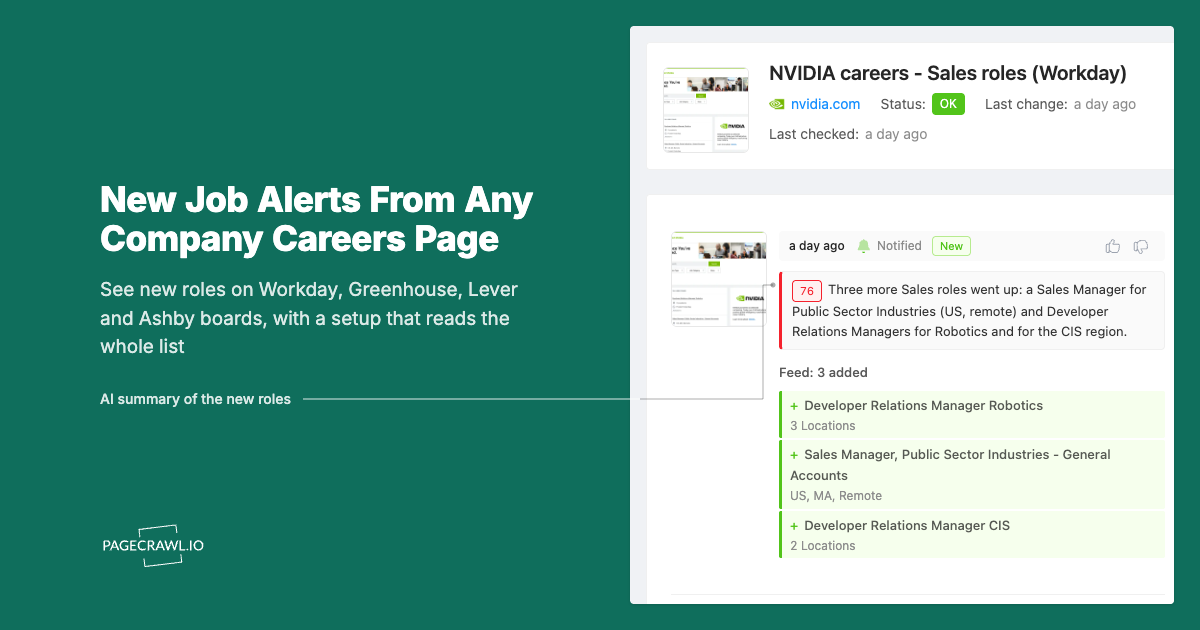
PageCrawl's AI summarizes pricing changes in plain language, like "Price dropped from $1,299.99 to $999.99 (23% decrease)" or "Item now shows 'Out of Stock' instead of 'Add to Cart'."
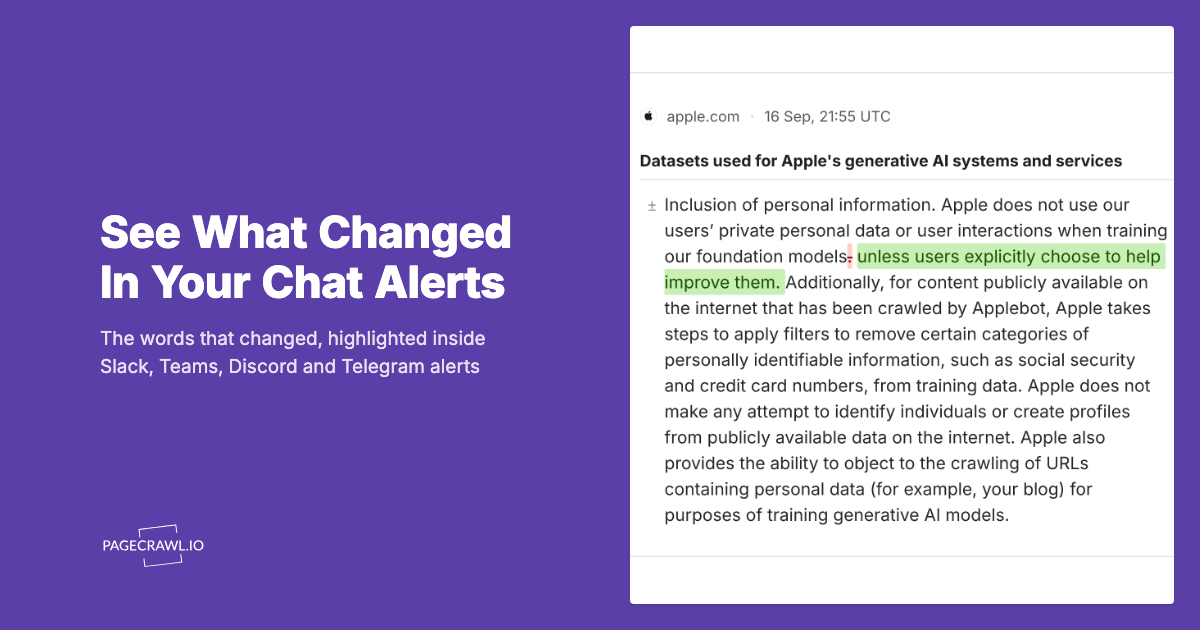
Noise filtering lets you click any detected change to ignore it in future checks, useful on Costco pages where rotating "Members Also Bought" sections and promotional banners change independently of the price you care about.
Webhook Integration for Advanced Tracking
For shoppers building price history databases or automated purchasing workflows, PageCrawl sends structured JSON data via webhooks when prices change. Feed this data into Google Sheets, Airtable, a custom database, or automation tools to build long-term Costco price histories.
Pros
- Monitors specific products you choose
- Custom check frequency
- Multiple notification channels (email, Slack, Discord, Telegram, webhook)
- AI change summaries
- Screenshot verification with every check
- Historical price data
- Works with Costco.com's JavaScript-heavy pages
Cons
- Larger monitoring lists require a paid plan
- Only tracks Costco.com (not in-store pricing)
- Member-exclusive hidden pricing may require additional configuration
Best For
Shoppers tracking specific high-value Costco purchases, families monitoring regular household items, and anyone who wants automated Costco.com price monitoring without manual effort. Works alongside Amazon price tracking and Walmart monitoring for cross-retailer comparison.
Which Costco tracking method works best?
Web monitoring is the only method that watches the specific products you choose and alerts you on every change. Deal communities and Costco's own emails are useful free supplements, especially for in-store pricing that online tools cannot see, while manual checking only suits one or two imminent purchases.
| Feature | Manual | Deal Communities | Costco Emails | Web Monitoring (PageCrawl) |
|---|---|---|---|---|
| Setup time | None | 5 minutes | 2 minutes | 10 minutes per product |
| Cost | Free | Free | Free | Free tier / paid plans |
| Specific product tracking | Yes | No | No | Yes |
| In-store prices | Yes (requires visit) | Yes (community reports) | Sometimes | No (online only) |
| Notification speed | When you check | When posted | When sent | On the next check after a change |
| Notification channels | None | Reddit/forum alerts | Email, Slack, Discord, Telegram, webhook | |
| Historical data | Manual spreadsheet | No | No | Yes (full history) |
| Scales to many products | No | No | No | Yes |
What makes Costco.com hard to monitor?
Costco.com renders prices with JavaScript, hides some pricing behind membership login, varies inventory by delivery region, and removes product pages entirely when items sell through. Simple HTTP-based tools that fetch raw HTML will not see prices at all. PageCrawl renders pages in a full browser environment, executing JavaScript and waiting for dynamic content before extracting data.
Regional Availability and Membership Walls
Costco.com sometimes shows different inventory and pricing based on delivery location, so ensure your location settings match your intended delivery or pickup area. Most product pages display prices publicly, but some deals require a logged-in member session; monitoring the public page will not capture pricing hidden behind a login. Many popular items are also warehouse-only, so for those you are limited to community deal reports or physical visits.
Product Pages That Disappear
Costco rotates products more aggressively than most retailers. A product page that exists today might return a 404 next month. When monitoring seasonal or limited items, be prepared for the monitored page to simply disappear when inventory is exhausted. PageCrawl notifies you when a monitored page becomes unavailable, which itself is useful information (the item is gone, time to look for alternatives). If you are waiting for an item to come back rather than drop in price, pair price tracking with Costco in-stock and restock alerts.
How do you maximize savings with Costco price tracking?
Start monitoring weeks before you plan to buy, so price history tells you whether a deal is genuine. A TV "on sale" at $999 is no deal if it sat at $999 for the past three months. Set realistic targets, too: Costco already runs thin margins, so a 10-15% drop is significant, and 50%-plus discounts only appear during end-of-season clearance.
Costco's calendar is fairly predictable: January clears electronics and holiday stock, patio and summer gear arrives at full price in May-June and hits clearance by August, and November brings multi-day Black Friday events. Combine online monitoring with deal communities for in-store intelligence, and monitor the same products at Amazon, Walmart, Best Buy, and Home Depot to catch whichever store drops first. PageCrawl's cross-retailer price comparison can group the same product across multiple stores, a custom capability we can enable for your account on request.
Which PageCrawl plan do you need for Costco tracking?
The Free plan, with hourly checks, is enough to validate the approach on your most important Costco pages. Most shoppers upgrade once they see the value: a single caught price drop on a TV, major appliance, or tire set easily covers the cost of Standard at $80 per year.
| Plan | Price | Pages | Checks / month | Frequency |
|---|---|---|---|---|
| Standard | $8/mo or $80/yr | 100 | 15,000 | every 15 min |
| Enterprise | $30/mo or $300/yr | 500 | 100,000 | every 5 min |
| Ultimate | $99/mo or $999/yr | 1,000 | 100,000 | every 2 min |
Annual billing saves two months on every paid tier. Standard's 100 pages cover a full Costco wish list plus parallel Amazon or Walmart listings, and because Costco prices stay stable for weeks, daily or 6-hour check intervals catch drops well before inventory clears.
What do Costco price endings like .97 mean?
A Costco price ending in .97 signals clearance or a manager markdown, usually specific to one warehouse. Endings of .00 or .88 indicate a manager markdown or a manufacturer-sponsored deal, while .99 is regular everyday pricing. An asterisk on the warehouse price tag means the item will not be reordered, so current stock is all there is.
Does Costco give price adjustment refunds?
Yes. If an item you purchased drops in price within 30 days, Costco will refund the difference on request: online orders through their price adjustment form, warehouse purchases at the membership counter. A price tracker pairs well with this policy, since monitoring the product after you buy catches any drop that lands inside the refund window.
How fast are Costco price drop alerts?
Alerts arrive when the next scheduled check detects the change. Depending on your PageCrawl plan, checks can run as often as every 2 minutes, though daily or 6-hour intervals suit Costco's slow-moving prices well (Free accounts check hourly). Since Costco changes prices deliberately rather than constantly, aggressive check frequencies are rarely necessary.
Getting Started
Pick 3-5 Costco products you buy regularly or are planning to purchase soon. Set up monitors with PageCrawl's "Price" tracking mode, configure your preferred notification channel, and run them for a couple of weeks to observe normal pricing behavior. Once you have a baseline, a genuine deal stands out the next time a check flags a drop.
Automated monitoring turns Costco shopping from random timing into informed purchasing, ensuring you never miss a meaningful price drop on the products you actually buy.