On June 24, 2022, the Supreme Court published its opinion in Dobbs v. Jackson at 10:10am Eastern. Within minutes, legal teams at healthcare organizations, state attorneys general offices, and advocacy groups were analyzing the 213-page opinion and preparing responses. Some of them had automated monitoring on the Supreme Court's opinion page and caught it on their next scheduled check. Others found out from news alerts minutes or hours later, after the media had already framed the narrative. In high-stakes litigation and regulatory compliance, those minutes matter.
Court opinions shape the legal landscape for every industry. A single appellate ruling can invalidate a business practice, create new compliance obligations, or open the door to litigation that affects thousands of companies. Yet most legal professionals rely on manual checks of court websites, delayed legal research service updates, or word-of-mouth from colleagues. In a profession where timing affects strategy, this reactive approach creates real disadvantages.
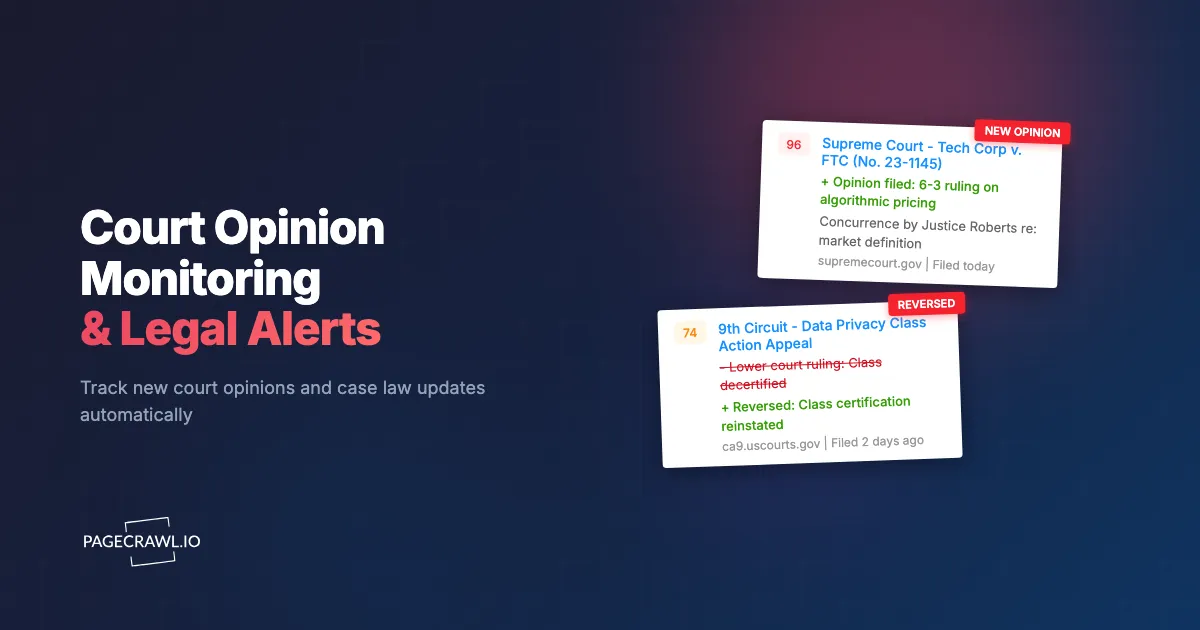
This guide covers which courts to monitor, the limitations of existing legal alerting tools, and how to set up automated monitoring that notifies you as soon as a check detects newly published opinions and orders.
Why does court opinion monitoring matter?
Different legal professionals need court monitoring for different reasons, but the underlying value is the same: knowing about relevant rulings soon after they are published, before opposing counsel, clients, or the press frame them for you.
Litigation Strategy
For attorneys with active cases, monitoring courts where related cases are pending is essential. A ruling in a parallel case can affect your litigation strategy, create new arguments, or eliminate existing ones. An adverse ruling in a related case gives you time to prepare before opposing counsel cites it in a filing.
Appellate courts are particularly important because their rulings create binding precedent. A circuit court opinion on a legal issue in your pending case demands immediate analysis, whether it helps or hurts your position.
Regulatory Compliance
Companies in regulated industries must track court rulings that affect their compliance obligations, and the same rulings double as early risk signals for insurance underwriting. A court striking down a regulation changes your compliance requirements. A court upholding a regulation confirms them. A court interpreting a statute in a novel way may require you to adjust business practices.
Healthcare, financial services, environmental, and technology companies face the most complex regulatory landscapes, where court rulings frequently shift compliance requirements. For a broader view of compliance monitoring strategies, see our guide to compliance monitoring software.
Client Advisory
Law firms advise clients about legal developments. Being the first to inform a client about a relevant ruling demonstrates value and justifies advisory relationships. Waiting until the client asks about a ruling they saw in the news undermines confidence.
Automated monitoring ensures you are always ahead of your clients. When a ruling drops, you already have the opinion, have begun analysis, and can proactively reach out. This article is informational, not legal advice; always confirm rulings on the official court website before advising on them.
Competitive Intelligence
Understanding how courts are ruling on issues relevant to your competitors provides strategic intelligence. If a competitor loses a patent case, that affects their market position and potentially your freedom to operate. If a competitor wins a favorable regulatory interpretation, it may create a precedent you can leverage.
Academic and Policy Research
Legal scholars and policy researchers track court opinions to identify trends, analyze judicial behavior, and inform policy recommendations. Automated monitoring ensures comprehensive coverage without manually checking dozens of court websites.
Which courts are worth monitoring?
Target the courts most relevant to your practice area and pending matters: the Supreme Court, the federal circuits where your cases sit, your state's supreme and appellate courts, and any specialty courts your work touches. The US judicial system includes federal and state courts at multiple levels, so coverage should follow your caseload rather than trying to watch everything.
Supreme Court of the United States
The Supreme Court issues opinions on the most consequential legal questions. The Court's opinion page at supremecourt.gov publishes opinions, orders, and case-related documents.
What to monitor:
- Opinions of the Court (the primary rulings)
- Orders lists (certiorari grants and denials, summary dispositions)
- Slip opinions during active terms (October through June)
Monitoring frequency: During the term, opinions are typically released on designated opinion days (often Mondays, but also other days during the end-of-term rush in June). Daily monitoring during active terms catches opinions within hours of publication. During the most active periods, more frequent monitoring captures opinions faster.
Federal Circuit Courts of Appeals
The thirteen federal circuit courts (First through Eleventh, D.C., and Federal) issue thousands of opinions annually. These opinions create binding precedent within their circuits and often influence other circuits.
Circuit courts publish opinions on their individual websites. Most circuits maintain an opinions page listing recent publications with dates, case names, and downloadable PDFs.
What to monitor:
- Published opinions (binding precedent)
- Unpublished or nonprecedential opinions (can still be informative)
- Orders and summary dispositions
Priority circuits: Focus on the circuit(s) where your clients operate, where your cases are pending, and where your practice area sees the most litigation. For patent law, the Federal Circuit is essential. For securities law, the Second and Ninth Circuits generate significant case law. For environmental law, the D.C. Circuit handles many regulatory challenges.
Federal District Courts
District courts are the trial-level federal courts. They produce orders, memorandum opinions, and rulings on motions. While district court opinions do not create binding precedent, they provide early signals on how judges interpret emerging legal issues.
PACER (Public Access to Court Electronic Records) is the primary system for accessing district court filings and opinions. More on PACER's limitations below.
State Supreme Courts and Appellate Courts
State courts handle the majority of litigation in the US, and state supreme court opinions create binding precedent on state law issues. For practice areas dominated by state law (employment, family, real estate, personal injury), state appellate monitoring is as important as federal monitoring.
Most state supreme courts and appellate courts publish opinions on their court websites. Publication schedules vary by state, from same-day posting to several-day delays.
Specialty Courts
Depending on your practice area, specialty courts may be critical monitoring targets:
- Tax Court: Tax law practitioners must track Tax Court opinions, available on ustaxcourt.gov
- Bankruptcy Courts: Published opinions on bankruptcy law issues
- Court of International Trade: Trade and customs rulings
- Court of Federal Claims: Government contract disputes
- Patent Trial and Appeal Board (PTAB): Patent validity decisions
What are the limitations of existing legal alerting tools?
Several established tools provide court opinion alerts, but each has significant limitations that direct web monitoring addresses: PACER only covers your own cases, research services add processing delay, and Google Scholar indexes opinions days or weeks late.
PACER and CM/ECF Alerts
PACER's email notification system sends alerts for new filings in specific cases. This is useful for tracking your own cases but inadequate for broad monitoring across practice areas or courts.
Limitations:
- Per-case only. You cannot set alerts for all opinions mentioning a specific legal issue or statute.
- No content filtering. Every filing in a tracked case triggers a notification, not just opinions or orders.
- Costly for broad monitoring. PACER charges per page for document access ($0.10/page, capped at $3.00 per document).
- Email-only delivery.
- No integration with other systems.
Legal Research Services (Westlaw, LexisNexis)
Legal research tools like Westlaw and LexisNexis offer opinion alert features that notify you when new opinions match search criteria. These services provide powerful full-text search across comprehensive opinion databases.
Limitations:
- Expensive. Subscription costs range from hundreds to thousands of dollars per month.
- Processing delay. Opinions are not available instantly upon publication. They must be ingested, indexed, and processed by the service, which can take hours or days.
- Rigid search syntax. Constructing effective search queries requires expertise in the service's query language.
- Email-only delivery for most alert types.
- No webhook or API output for integration with other systems.
For firms already subscribing to these services, they provide valuable depth. But for speed of initial notification, direct court website monitoring beats the processing delay.
Google Scholar Alerts
Google Scholar includes a case law database and allows alerts for new results matching search terms. It is free and covers a broad range of courts.
Limitations:
- Significant processing delay. Google Scholar indexes opinions days or weeks after publication.
- Inconsistent coverage. Not all courts and not all opinions are indexed.
- No guaranteed delivery timing.
- Limited to email notifications.
- No filtering by court, jurisdiction, or opinion type.
Google Scholar alerts work as a supplementary tool for broad topic awareness but should not be your primary monitoring method for time-sensitive matters.
Setting Up Court Opinion Monitoring with PageCrawl
Direct monitoring of court dockets, opinions, and enforcement pages provides the earliest practical awareness of new opinions, with flexible notification channels and integration capabilities.

Monitoring a Court Opinion Page
Most courts publish opinions on a dedicated page that lists recent opinions with dates, case names, and links to PDF documents.
Step 1: Identify the opinion page URL. Navigate to the court's website and find the opinions or slip opinions page. For example:
- Supreme Court:
https://www.supremecourt.gov/opinions/slipopinion/24 - Individual circuit courts maintain their own opinion pages
Step 2: Add the URL to PageCrawl. Select "Content Only" or "Reader" tracking mode. These modes extract the text content of the opinion listing page, ignoring navigation and formatting elements. When a new opinion is added to the page, the content changes and PageCrawl detects it.
Step 3: Set check frequency. For courts where opinions are time-sensitive to your practice:
- Supreme Court during term: check every 1-2 hours on opinion days
- Circuit courts: check every 2-4 hours during business days
- State supreme courts: check every 4-6 hours
- Specialty courts: check once or twice daily
Step 4: Configure notifications. Route alerts to the channels your legal team uses:
- Slack or Microsoft Teams: Integrates with firm communication workflows
- Email: Sufficient for daily-check opinions
- Telegram: Fastest mobile push for time-sensitive rulings
- Webhook: Feeds into case management or research systems
Step 5: Verify the initial capture. Review PageCrawl's first check to confirm it correctly captures the opinion listing content. This baseline ensures future change detection is accurate.
Monitoring Multiple Jurisdictions
Most legal professionals need to monitor multiple courts. A federal practitioner might monitor the Supreme Court, their primary circuit, and two or three additional circuits where related issues are being litigated. A state practitioner might monitor the state supreme court, intermediate appellate court, and relevant federal circuits.
Organize monitors by jurisdiction using PageCrawl folders:
- Federal / Supreme Court
- Federal / [Your Circuit]
- Federal / [Other Relevant Circuits]
- State / [Your State] Supreme Court
- State / [Your State] Appellate Courts
- Specialty / [Relevant Specialty Courts]
This organization lets you quickly review recent changes by court level and jurisdiction.
Handling PDF Opinions
Most court opinions are published as PDF documents linked from the court's opinion page. PageCrawl's monitoring captures changes to the listing page (new opinions added), and you can also monitor individual PDF documents directly.
PageCrawl supports tracking text changes in PDF files, detecting when a PDF document changes or when a new PDF appears at a URL. For opinions that are initially published as slip opinions and later revised (corrections, formatting updates), PDF monitoring catches those revisions.
For courts that publish opinions only as PDFs (without an HTML listing page), you can monitor the PDF URL directly. PageCrawl extracts text from PDFs and tracks changes between versions. For more on this capability, see our guide on website archiving, which covers document preservation approaches.
Building a Legal Research Alerting System
Beyond basic opinion monitoring, a comprehensive legal alerting system combines multiple monitoring targets into an integrated research workflow.
Opinion Monitoring Layer
The core layer monitors court opinion pages as described above. This catches every new opinion from your target courts. Organize by court and jurisdiction.
Regulatory Monitoring Layer
Court opinions do not exist in isolation. Monitor regulatory filing pages from agencies like the SEC, FDA, and FCC for proposed rules, final rules, and guidance documents that often become the subject of litigation. When a new regulation is published, you can anticipate the legal challenges that will follow.
Key regulatory sources:
- The Federal Register for proposed and final rules
- Individual agency websites (SEC, FDA, EPA, FCC) for guidance and enforcement actions
- State regulatory agency websites
See our guide to regulatory compliance monitoring for detailed setup instructions.
Legislative Monitoring Layer
New legislation creates new legal questions and new litigation. Monitor legislative tracking pages for bills that affect your practice area. State legislature websites publish bill text, committee schedules, and voting records.
Terms of Service and Policy Changes
For technology law practitioners, monitoring changes to major platforms' terms of service and privacy policies provides early warning of issues that generate litigation and regulatory scrutiny. See our guide to monitoring privacy policy and terms of service changes for specific setup guidance.
Alert Routing and Prioritization
Not all legal monitoring alerts require the same urgency:
Priority (Telegram/Slack push): New Supreme Court opinions, new opinions from your primary circuit on issues in your active cases, regulatory enforcement actions against your clients.
Same-day (email): New opinions from other circuits, new proposed regulations, legislative developments.
Weekly digest (email summary): Specialty court opinions, state regulatory updates, terms of service changes.
Configure different notification channels for different monitor groups to match alert urgency to your response needs.
Webhook Integration for Legal Research Systems
For larger firms and research operations, webhook integration transforms PageCrawl alerts into structured data feeds for internal systems.
Case Management Integration
Route opinion alerts to your case management system. When a new opinion is published in a jurisdiction and practice area relevant to a pending case, the alert automatically links to the case file for attorney review.
Research Database Integration
Build a running log of court opinions detected by monitoring, including publication date, court, case name, and the change summary. This creates a lightweight opinion tracking database that complements your Westlaw or LexisNexis research.
Team Notification Workflows
Use webhook data to trigger team notification workflows. When a new opinion matches criteria relevant to a specific attorney's cases, route the alert directly to that attorney. When a new Supreme Court opinion drops, alert the entire appellate practice group.
For technical details on webhook configuration and integration patterns, see our guide to webhook automation for website changes.
Monitoring Best Practices for Legal Professionals
Start with Active Matters
Begin by monitoring courts where you have pending cases. These are the opinions that require immediate action. Once your monitoring workflow is established, expand to broader practice area monitoring.
Calibrate Check Frequency to Court Schedules
Courts publish opinions on predictable schedules. The Supreme Court announces opinion days in advance. Circuit courts typically publish on business days. Understanding these schedules helps you set appropriate check frequencies without wasting resources.
During periods of anticipated high activity (end of Supreme Court term, post-argument opinion periods in circuit courts), increase check frequency temporarily.
Use AI Summaries for Triage
PageCrawl's AI-powered change summaries describe what changed on the monitored page. For opinion listing pages, this means summaries like "Two new opinions added: Case Name 1 (Judge X) and Case Name 2 (Judge Y)." These summaries let you triage alerts quickly, identifying which new opinions need immediate full-text review.
Maintain an Archive
Court websites occasionally reorganize, removing older opinions from current listing pages. PageCrawl captures page snapshots at each check, creating a historical record of when opinions were published and what the listing page showed at each point in time. This archive has evidentiary value if you need to establish when an opinion became publicly available. For situations requiring forensic-grade preservation, PageCrawl's web archiving with WACZ creates self-contained, standards-compliant web archive files that capture the full page state, including all assets and metadata. WACZ files are an established format for web evidence and can be presented in legal proceedings to demonstrate what a court's opinion page displayed at a specific point in time. PageCrawl seals each of these captures with an independent timestamp, producing web archives that hold up as evidence.
Coordinate Across Practice Groups
In larger firms, different practice groups may monitor overlapping courts. Coordinate monitoring to avoid duplicate monitors and ensure comprehensive coverage. A centralized monitoring setup with alerts routed to relevant practice groups is more efficient than each group independently configuring their own monitors.
Common Challenges
Court Website Redesigns
Courts periodically redesign their websites, changing the structure of opinion listing pages. When this happens, monitors may need reconfiguration to adapt to the new page structure.
PageCrawl handles most minor layout changes automatically. For major redesigns that fundamentally change the page structure, recreating the monitor ensures continued accuracy.
Irregular Publication Schedules
Some courts publish opinions on unpredictable schedules. A court might publish three opinions on Monday and none for the rest of the week. Set monitoring frequency based on the worst case (most frequent publication) to ensure you catch opinions promptly regardless of when they appear.
Large PDF Documents
Major opinions can be hundreds of pages. When monitoring individual PDF documents, large files take longer to process. For listing-page monitoring (the recommended approach), this is not an issue, as you are monitoring the listing page rather than the individual PDFs.
Courts with Limited Web Presence
Some courts, particularly smaller state courts, have minimal web presences with infrequent updates and inconsistent publishing. For these courts, lower-frequency monitoring (daily or every other day) is appropriate, supplemented by traditional legal research service alerts.
Access Restrictions
Most court opinion pages are freely accessible. A few courts require registration or a login before they show opinions, which PageCrawl handles by signing in with credentials you provide once and reusing that signed-in session. PACER, the federal district court system, charges for document access. PageCrawl monitors freely accessible opinion listing pages without charge limitations, but accessing underlying documents through PACER still incurs PACER's per-page fees.
Choosing your PageCrawl plan
PageCrawl's Free plan lets you monitor 6 pages with 220 checks per month, which is enough to validate the approach on your most critical pages. Most teams graduate to a paid plan once they see the value.
| Plan | Price | Pages | Checks / month | Frequency |
|---|---|---|---|---|
| Free | $0 | 6 | 220 | every 60 min |
| Standard | $8/mo or $80/yr | 100 | 15,000 | every 15 min |
| Enterprise | $30/mo or $300/yr | 500 | 100,000 | every 5 min |
| Ultimate | $99/mo or $999/yr | 1,000 | 100,000 | every 2 min |
Annual billing saves two months across every paid tier. Enterprise and Ultimate scale up to 100x if you need thousands of pages or multi-team access.
For solo practitioners and small firms, Standard at $80/year covers 100 monitored pages, enough for the Supreme Court, your primary circuit, several relevant state appellate courts, and a handful of regulatory agency pages running concurrently. Enterprise at $300/year extends that to 500 pages, which handles nationwide multi-circuit monitoring plus the regulatory and legislative sources that feed litigation in your practice area. Every check stores a timestamped screenshot, so you have a verifiable record of when an opinion appeared on the court's website, a detail that occasionally matters in disputes about notice and timing. All plans include the PageCrawl MCP Server, so your research team can ask Claude to list every new opinion detected across all monitored courts within a given date range and pull the change summaries, turning your monitoring history into a searchable research log. AI assistants can create monitors through conversation on every plan, including Free.
Getting Started
Start with the two or three courts most relevant to your current cases or practice area. If you are a federal practitioner, monitor the Supreme Court opinion page and your primary circuit's opinion page. If you are a state practitioner, monitor your state supreme court and the most relevant federal circuit.
Set up content monitoring in PageCrawl, configure Slack or email notifications (matching your team's communication preferences), and run the monitors for a few weeks to understand each court's publication patterns and volume.
PageCrawl's free tier includes 6 monitors, enough to cover the Supreme Court, your primary circuit, and a few additional courts. The Standard plan at $80/year provides 100 monitors for comprehensive multi-jurisdictional monitoring including regulatory and legislative sources. The Enterprise plan at $300/year covers 500 monitors for firms needing nationwide coverage across all federal circuits, relevant state courts, and regulatory agencies.
The next precedent-setting opinion in your practice area will be published on a court website, available to anyone who checks. Make sure you are checking automatically.