When a Fortune 500 program quietly added a new SaaS-acquisition domain to its HackerOne in-scope list on a Friday afternoon last year, the first researcher to spot the change had the entire weekend to fingerprint, recon, and submit findings before the rest of the hunter community noticed. Three critical findings landed before Monday morning. By the following week, the same surface had been hit by hundreds of hunters and the easy bugs were gone.
Bug bounty programs change scope constantly. A new asset added to an in-scope list often goes untested by experienced hunters for hours or days, simply because nobody noticed. The first researcher to systematically test a newly in-scope domain has a real edge: the easy-to-find class of vulnerabilities (subdomain takeover, exposed staging, default credentials, misconfigured S3) is essentially a race. None of the platforms push notifications on scope changes by default. The page updates and the only way to know is to check.
This guide covers how HackerOne, Bugcrowd, Intigriti, and YesWeHack publish program scope, the patterns worth watching, and how to set up a continuous monitor that surfaces scope, payout, and rule changes on the first check after publication.
Quick Setup
Pick HackerOne, Bugcrowd, or Intigriti and enter a program slug to preview a scope-expansion alert.
Why Monitor Bug Bounty Program Pages?
Because scope and payout details on these platforms are public for most programs and update without any notification, and the economics of bug bounty hunting reward early movers disproportionately. The hunter who notices a change first gets the cleanest shot at the new surface.
New In-Scope Assets Are the Highest-Value Alert
A newly in-scope domain, subdomain, mobile app, or API is essentially virgin territory until the rest of the community discovers it. The first 24-48 hours after a scope expansion is where the highest-payout findings tend to land. Same-hour awareness is the difference between catching that window and missing it.
Payout Tier Changes Reshape Priority
A program that doubles its critical-tier bounty can move from "not worth my time" to "drop everything." For hunters managing time across dozens of programs, payout changes are a direct input to where the next hunting day goes.
New CVE or Vuln Class Focus
Programs sometimes announce focus areas (new asset classes, AI-related vulnerabilities, recently-publicized CVE classes) with elevated bounties. These announcements redirect community effort and reward hunters who notice early.
Out-of-Scope Additions Save Time
The inverse signal also matters: knowing that a previously in-scope asset has been removed prevents wasted effort. Out-of-scope expansions are routinely added without fanfare.
How Are Bug Bounty Program Pages Structured?
HackerOne, Bugcrowd, Intigriti, and YesWeHack each publish public program pages at stable URLs:
https://hackerone.com/{program-slug}
https://bugcrowd.com/{program-slug}
https://app.intigriti.com/programs/{org}/{program}
https://yeswehack.com/programs/{program-slug}
The scope, payout table, and policy sections render in the page body. Changes show up in the next page load. Most programs render scope as a structured list or table; payout details typically appear in a separate table per severity tier. Program updates and announcements (where the platform supports them) often appear in a separate "Updates" or "Activity" tab.
For private programs you have been invited to, the page URL is the same but only authenticated sessions see the content. PageCrawl supports monitoring password-protected pages via login authentication or session headers for these cases.
Comparing Monitoring Approaches
| Approach | Cost | Latency | Coverage | Best For |
|---|---|---|---|---|
| Manual program refresh | Free | Variable | Per-program effort | Low-volume hunters |
| Platform email subscriptions | Free | Hours to days | Major updates only | Awareness, not edge |
| Twitter/X following hunters | Free | Variable | Crowd-sourced | Network-driven discovery |
| Bug bounty Discord servers | Free | Variable | Community-shared signals | Community hunters |
| PageCrawl on program pages | Free tier to $80/year | 15-60 minutes | Any program | Serious hunters, security research teams |
Platform-native notifications are improving but remain coarse: you typically get bulk announcements rather than diffs of scope or payout tables. PageCrawl gives you per-program control with diff-level alerts, plus the option to route into Telegram or Discord for fast notification.
Setting Up Bug Bounty Monitoring in PageCrawl

Step 1: List your priority programs
Start with the 10-20 programs you actively hunt or watch. Include both public programs you have permission for and private programs (with auth headers configured).
Step 2: Paste each program page URL into PageCrawl
Add as content monitors. Each program page becomes a single monitor; scope, payout, and policy diffs are detected on the same page.
Step 3: Use reader mode to ignore page chrome
Reader mode strips navigation, ads, and platform UI so the diff focuses on scope, payout, and policy text. This dramatically improves signal in alerts.
Step 4: Check hourly (or 15-minute for top priority)
Scope changes are not minute-sensitive but earlier is better. Hourly checks give you a several-hour edge over researchers who reload manually. For the 3-5 programs you most want to win on, bump to 15-minute checks on Standard plan.
Step 5: Configure fast-channel notifications
Telegram and Discord deliver promptly once a check detects the change, which is the right cadence for scope-expansion alerts. See our Telegram alerts guide and Discord alerts guide for setup.
Step 6: Group by platform in folders
Use PageCrawl's labels, folders, and workspaces to organize programs by platform: HackerOne, Bugcrowd, Intigriti, YesWeHack, plus a "Private" folder for invite-only programs. Per-platform digests can be sent daily to a dedicated channel for review.
Worked Example: A Hunter's Top-25 Program Setup
Take a full-time hunter with a focused list of 25 programs across three platforms. The setup:
- Build the URL list (25 program pages).
- Bulk import into PageCrawl.
- Tag the top 5 with
top-priority. - Set 15-minute checks on the top 5, hourly on the remaining 20.
- Route top-5 alerts to a Telegram chat with
@usernamemention; route the rest to a#bb-scopeDiscord channel. - Configure AI summaries to highlight specifically what changed (scope addition vs payout change vs policy update).
Total cost: Standard plan at $80/year. For a hunter making meaningful income from bug bounty, the cost recovers itself on a single scope-expansion win.
Patterns Worth Watching For
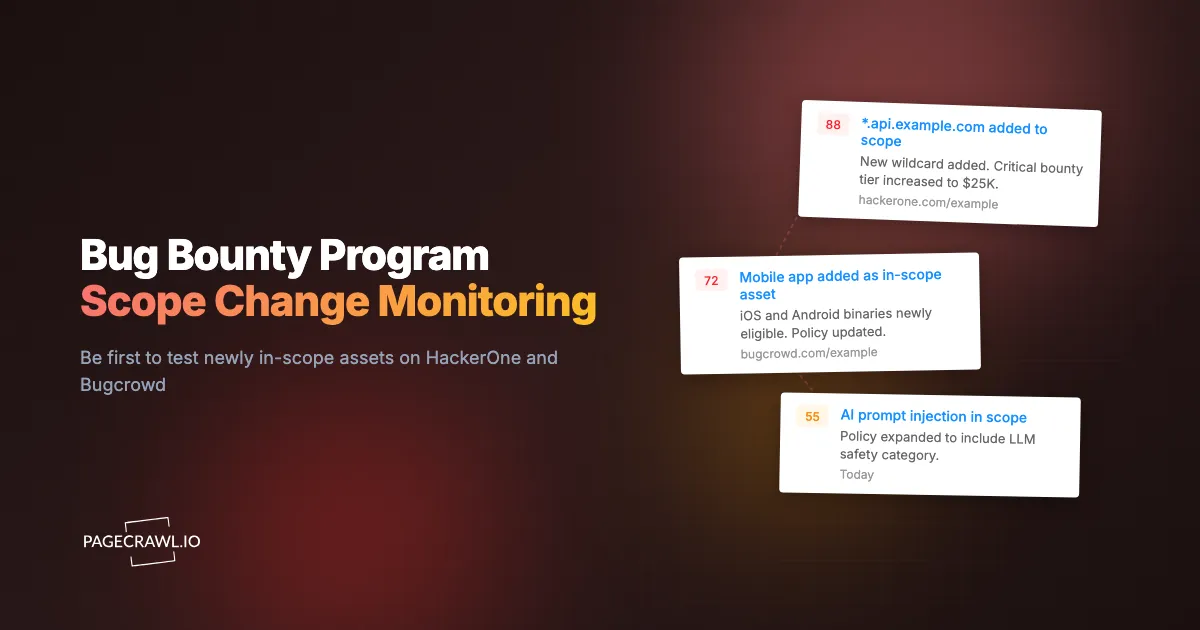
New domains, subdomains, or applications in scope. The highest-value signal. Especially valuable when the addition coincides with a corporate acquisition (newly acquired companies often have weaker security posture).
Payout table updates. New top-tier critical bounties or doubled severity-tier payouts. Often signals the program is actively chasing specific findings.
New asset types. Mobile, API, AI prompts, IoT being added to scope changes the technical surface meaningfully.
Policy clarifications. Test categories that were previously gray-area being explicitly opened or closed. SSRF, account takeover via OAuth, and prompt injection are common areas where program policies evolve.
Program status changes. Private to public, paused to active, or new managed-program announcements. Status transitions often produce a rush of activity.
Promotion announcements. Programs sometimes run time-bounded promotions (double bounties for a week, holiday challenges). These are short windows that reward hunters who notice early.
Out-of-scope additions. Save you wasted time on previously-in-scope assets that have been removed.
Combining Bug Bounty Monitoring With Other Signals
The full value of program monitoring shows up when you pair it with adjacent reconnaissance signals.
Combine with Certificate Transparency. Pair the program monitor with our Certificate Transparency log monitoring guide. New certificates issued against a program's domain are often the first surface to recon when scope expands.
Combine with package release monitoring. Use our PyPI and npm release monitor for the dependencies your target uses publicly. New CVEs in those packages often produce bounty-eligible findings, and broader release notes and changelog monitoring across a target's stack surfaces the same signal earlier.
Combine with CISA KEV. The KEV catalog monitor tracks CISA's Known Exploited Vulnerabilities catalog, a curated list of actively-exploited vulnerabilities; cross-referencing against a target's stack is a fast way to prioritize hunting effort.
Combine with Docker Hub and Kubernetes feeds. For programs that include container infrastructure, our Docker Hub monitor and Kubernetes CVE monitor surface base-image and orchestration patches that often introduce regressions worth probing.
Use Cases
Full-time bug bounty hunters. Same-hour scope alerts let you be the first to fingerprint and recon a newly in-scope asset. For hunters whose income depends on early-mover advantage, this is the cleanest tooling investment.
Security research teams. Internal teams track multiple program scopes and route relevant changes to specific researchers. A central scope-monitor that feeds team Slack supports the same edge at organizational scale.
Program managers and triagers. Tracking your own program plus peers helps benchmark scope and payout decisions. Knowing what competing programs are doing informs your own program design.
Security tooling vendors. Companies building scanners, recon tools, and bug bounty automation benefit from timely scope intelligence to inform product fit and feature prioritization.
OffSec consultancies and pentest firms. Bounty program scope sometimes reveals client testing priorities; for firms running comparable assessments, this is competitive intelligence.
Security education and content creators. Tracking scope and payout evolution across the major platforms generates content opportunities and informs course material.
Frequently Asked Questions
Will PageCrawl work on private programs? Yes, with authenticated session headers configured per monitor. The page URL is the same for private and public programs; only the auth changes.
How quickly do scope changes typically propagate? The platform page reflects the change as soon as the program saves it. PageCrawl detects the diff on the next check.
What about programs hosted on GitHub or company-managed pages? PageCrawl monitors any URL; not all bug bounty programs use the major platforms. Self-hosted programs (Google VRP, Apple Security Research, Mozilla, etc.) all have their own scope pages that can be monitored the same way.
Can I get alerts on payout-table changes only, not scope? PageCrawl alerts on any page change; AI summaries can be configured to highlight the type of change (scope, payout, policy). For absolute precision, you can monitor narrower CSS selectors that target only the payout table.
Do I need a paid plan? The Free plan supports 6 monitors at hourly checks, enough to test the workflow. Standard at $80/year supports 100 monitors, which covers a serious hunter's full program list.
Will I get false-positive alerts on cosmetic changes? Reader mode dramatically reduces these; AI summaries can describe the change so you decide whether to act before clicking through.
Choosing your PageCrawl plan
PageCrawl's Free plan lets you monitor 6 pages with 220 checks per month, which is enough to validate the approach on your most critical pages. Most teams graduate to a paid plan once they see the value.
| Plan | Price | Pages | Checks / month | Frequency |
|---|---|---|---|---|
| Free | $0 | 6 | 220 | every 60 min |
| Standard | $8/mo or $80/yr | 100 | 15,000 | every 15 min |
| Enterprise | $30/mo or $300/yr | 500 | 100,000 | every 5 min |
| Ultimate | $99/mo or $999/yr | 1,000 | 100,000 | every 2 min |
Annual billing saves two months across every paid tier. Enterprise and Ultimate scale up to 100x if you need thousands of pages or multi-team access.
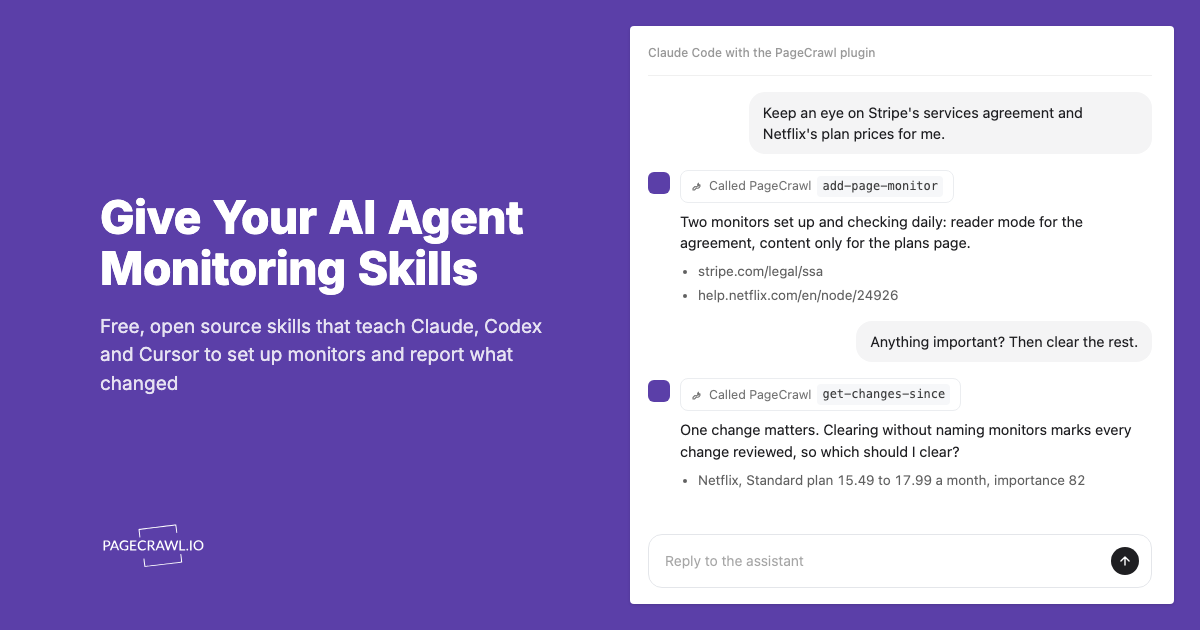
At an engineering hourly rate, Standard at $80/year pays for itself the first time you catch a breaking API change, a deprecated endpoint, or a silent config change before it takes down production. 100 monitored pages is enough to cover the changelogs and docs of every third-party API your stack depends on. Enterprise at $300/year adds 5-minute checks and 500 pages. All plans include the PageCrawl MCP Server, which plugs directly into Claude, Cursor, and other MCP-compatible tools. Developers can ask "what changed in the Stripe API docs this month?" and get a summary pulled from your own monitoring history. AI assistants can create monitors through conversation on every plan, including Free, turning your tracked pages into a living knowledge base instead of a pile of alert emails.
Getting Started
Add 10 program pages to PageCrawl on an hourly schedule. Create a free account, wire alerts to Telegram or Discord, and the next scope addition will land in your channel while other hunters are still asleep.
Once you see the workflow pay off, expand to a 25-50 program watchlist with the top 5 on 15-minute checks. The Standard plan at $80/year covers a serious hunting setup with room for sibling monitors on CT logs and packages. For hunters whose income depends on time-to-recon advantage, this is one of the highest-leverage tooling investments available.