A student applying to six graduate programs spent three months preparing her applications based on requirements listed on each university's website. Two weeks before her first deadline, she discovered that one program had quietly changed its GRE policy, dropping the test requirement entirely, and another had moved its deadline forward by three weeks. She missed the earlier deadline completely. The GRE scores she had spent months preparing for were no longer needed at one school, time she could have spent strengthening other parts of her application.
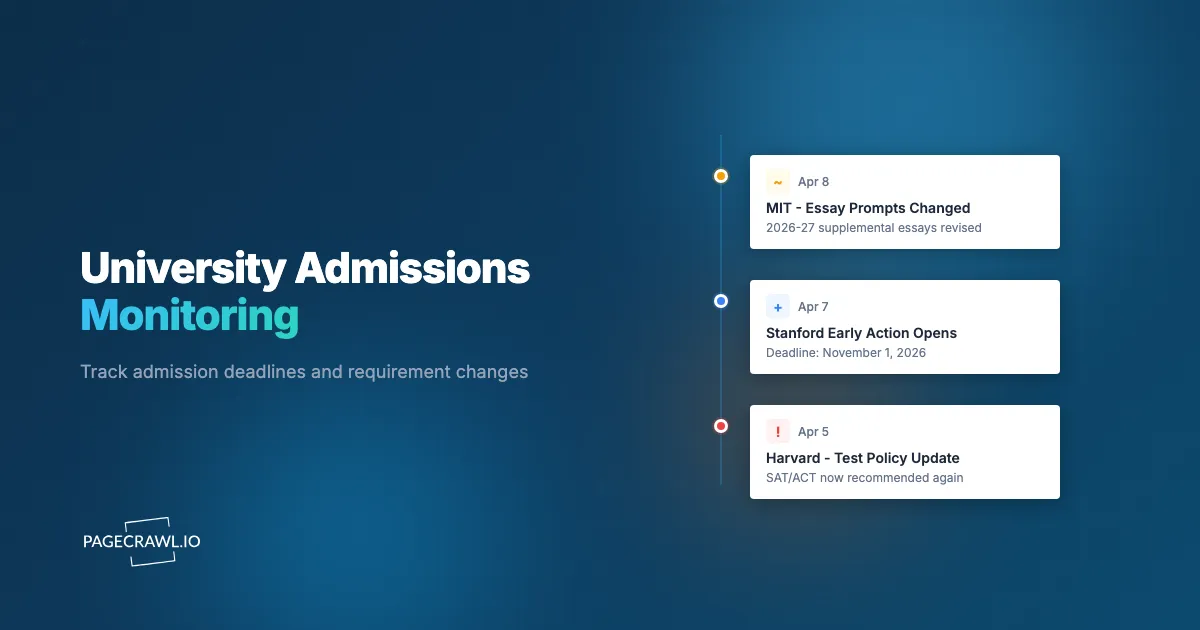
University admissions pages are not static documents. They change throughout the admissions cycle, sometimes in ways that significantly affect applicants. Deadlines shift. Test requirements are added or dropped. New programs launch mid-cycle. Financial aid policies are revised. Tuition rates are updated. These changes are posted on university websites, usually without any direct notification to prospective applicants.
This guide covers why admissions pages change more often than most people expect, which pages are worth monitoring, who benefits most from automated tracking, and how to set up a monitoring system that catches important changes across multiple schools before they catch you off guard.
Why do admissions pages change more than applicants expect?
Admissions pages change throughout the cycle because deadlines get extended or pulled forward, test policies are revised, new programs open applications, and financial aid rules are updated. Most prospective students visit a university's admissions page once or twice, note the deadlines and requirements, and assume that information will remain accurate for the entire application cycle. That assumption is often wrong.
Deadlines Shift Mid-Cycle
Universities regularly adjust application deadlines. A program might extend its deadline because it received fewer applications than expected. Another might move a deadline earlier to accommodate a change in its review process. Rolling admissions programs adjust their "priority" and "final" dates based on how quickly seats fill. Some schools have moved to multiple deadline rounds, adding new rounds in response to applicant demand.
These changes are posted on the admissions website. Unless you happen to revisit the page at the right time, you will not know the deadline has changed until it is too late.
Requirements Update Without Notice
Admissions requirements are particularly prone to mid-cycle changes. Over the past several years, a large share of US institutions have altered their standardized test policies, moving between test-required, test-optional, and test-blind approaches, and FairTest maintains a running list of which schools currently sit in each category. Some have changed these policies multiple times in a single admissions cycle.
Beyond testing, programs update their prerequisite coursework, essay prompts, recommendation letter requirements, and portfolio specifications. A graduate program might add a new writing sample requirement. An undergraduate program might drop its foreign language prerequisite. These changes appear on the admissions page, often with little fanfare.
New Programs Launch Throughout the Year
Universities do not only launch new academic programs in September. New majors, concentrations, certificate programs, and interdisciplinary programs are announced throughout the year. A new data science program might open applications in January. A new joint MBA/public policy degree might be announced in March.
If you are exploring programs in a particular field, monitoring department and admissions pages catches these new options as they appear, not months later when you happen to search again.
Financial Aid Policies Shift
Financial aid and scholarship availability changes from year to year, sometimes within a single cycle. A university might introduce a new merit scholarship, change its need-based aid formula, or adjust its expected family contribution calculations. Tuition rates are typically set months before the academic year begins, and those updates appear on university websites well before official announcements reach prospective students.
For applicants where cost is a deciding factor, knowing about financial aid policy changes early can influence which schools to apply to and how to structure applications.
What should you track on university websites?
Track five page types per school: the admissions requirements page, the application deadline page, the financial aid and scholarship pages, the program or curriculum description, and the tuition and fees page. University websites are large, and not every page is worth monitoring, so focus on the pages that change most frequently and carry the most consequential information.
Admissions Requirements Pages
The core admissions requirements page for each program you are considering is the most important page to monitor. This includes:
- Standardized test requirements and policies (SAT, ACT, GRE, GMAT, LSAT)
- Prerequisite coursework or degree requirements
- Application essay or personal statement prompts
- Recommendation letter requirements
- Portfolio, audition, or writing sample specifications
- English language proficiency requirements for international applicants
These pages are where mid-cycle requirement changes appear first. Monitor them using content-focused tracking to catch text changes without being distracted by layout updates.
Application Deadline Pages
Many universities maintain a dedicated page listing all application deadlines, or include deadlines prominently on their admissions overview page. These pages typically list:
- Early decision and early action deadlines
- Regular decision deadlines
- Transfer application deadlines
- Rolling admissions cutoff dates
- Financial aid application deadlines (FAFSA, CSS Profile, institutional forms)
- Housing application deadlines
Deadline pages tend to change less frequently than requirements pages, but when they do change, the information is time-sensitive, which is exactly what monitoring pages for shifted dates and schedules is built for. Even a one-day delay in noticing a shifted deadline can mean the difference between an on-time and a late application. Cross-check each school's dates against the platform calendars published by the Common App and Federal Student Aid, which run on their own schedules and can move independently of the university.
Financial Aid and Scholarship Pages
Financial aid pages are separate from admissions requirements but equally important for many applicants. Monitor pages covering:
- Institutional scholarship listings and eligibility criteria
- Need-based aid policies and expected family contribution guidelines
- Merit scholarship amounts and renewal requirements
- Graduate assistantship and fellowship availability
- Work-study program details
- Cost of attendance estimates and tuition rate pages
For a deeper approach to scholarship monitoring, consider tracking individual department scholarship pages alongside the main financial aid page.
Program Descriptions and Curriculum Pages
Academic program pages describe the curriculum, faculty, research opportunities, and career outcomes for each major or program. While these change less frequently than admissions pages, the changes can be significant:
- Curriculum restructuring (new required courses, dropped electives)
- Faculty changes (new hires, departures of prominent researchers)
- Research lab openings and funded project descriptions
- Accreditation updates
- Career placement statistics and outcomes data
For graduate applicants, faculty pages are particularly worth watching. A new faculty hire in your research area might mean new funding opportunities. A faculty departure might change the viability of working with a particular lab.
Tuition and Fees Pages
Tuition pages typically update once per year, but the timing varies by institution. Some universities announce tuition changes in the spring, others in the summer. Knowing when tuition increases are posted helps you plan finances before committing to a school.
Monitor the official tuition and fees page, not the cost-of-attendance estimator (which may lag behind actual tuition changes).
Who benefits from admissions monitoring?
Applicants, parents, high school counselors, independent college consultants, and university enrollment teams all benefit, because each of them depends on admissions information that can change without notice. Automated admissions monitoring is not only for applicants. Several groups gain distinct advantages from systematic tracking.
Prospective Students
Students actively applying to universities benefit the most directly. Monitoring admissions pages across your target schools means you find out on the next check after a deadline shifts, a requirement changes, or a new scholarship becomes available. This is especially valuable for students applying to many programs, where manually checking each website every week becomes impractical.
Graduate school applicants, who often apply to programs with very different requirements and timelines, benefit particularly from centralized monitoring. A PhD applicant tracking eight programs across five universities needs to watch dozens of individual pages.
Parents and Families
Parents supporting a student through the admissions process often want to stay informed without constantly asking their student for updates. Monitoring key admissions and financial aid pages provides that visibility. When a tuition page updates or a financial aid deadline changes, the parent knows about it at the same time as the student.
This is particularly useful during the period between acceptance and enrollment, when housing deadlines, orientation registration, course registration seat openings, and financial aid disbursement dates all appear on university websites.
High School Counselors
School counselors managing dozens or hundreds of students applying to different universities cannot manually track admissions changes across every school their students are considering. Automated monitoring lets counselors watch the admissions pages for the 20 or 30 most popular target schools in their student body and proactively alert students to changes.
A counselor who notices that a popular state university has moved its priority deadline forward by two weeks can notify affected students before anyone misses the new deadline.
Education Consultants and College Advisors
Independent college consultants working with multiple clients across multiple admissions cycles need reliable, current information about every program their clients are considering. Monitoring admissions pages provides a competitive advantage, consultants who catch policy changes early can advise clients to adjust their strategies before the changes are widely noticed.
University Staff Monitoring Competitors
Admissions offices at universities frequently monitor peer and competitor institutions. Understanding when a competitor changes its merit scholarship amounts, adjusts its test-optional policy, or launches a new program helps admissions teams make strategic decisions about their own offerings.
Enrollment management professionals can track tuition changes, new program launches, and financial aid adjustments across peer institutions without manually checking dozens of websites each week.
How do you set up automated admissions monitoring?
Collect the URLs for each school, add them to PageCrawl with a content-focused tracking mode, set a frequency that matches the season, and route alerts to email or Slack. Once you have identified the pages worth tracking, setting up automated monitoring takes a few minutes per page.

Start by collecting the URLs for each page you want to monitor. For each university on your list, you typically need three to five URLs: the main admissions requirements page, the deadline page (if separate), the financial aid or scholarship page, and optionally the program description and tuition pages.
Add each URL to PageCrawl and select the tracking mode that matches the content type. For text-heavy admissions pages, "Content Only" mode works well because it focuses on the meaningful text content and ignores navigation, footers, and sidebar changes. For pages with specific data points like tuition amounts or deadline dates, you can track specific elements to get precise alerts about the exact numbers or dates you care about.
Set your monitoring frequency based on how time-sensitive the information is. During active application season (typically September through March for undergraduate admissions), daily monitoring catches changes quickly. During the off-season, weekly monitoring is sufficient and conserves your monitoring allocation.
Configure email or Slack notifications so that changes come to you rather than sitting in a dashboard you might forget to check. Alerts go out when a check detects the change, so for deadline-sensitive pages a tighter check frequency shortens the gap between the edit and your alert. The help centre walkthrough on email notifications for change detection shows how to include the diff and a screenshot in each message.
How do you track several schools at once without losing track?
Group monitors by school, monitor more pages at higher frequency for your top choices, and keep a simple spreadsheet of current deadlines alongside the alerts. Most applicants are monitoring multiple universities at once, typically between four and twelve schools, and organizing your monitors this way prevents important changes from getting lost in the noise.
Use Folders or Tags by School
Group your monitors by university so you can quickly see which school has had changes, using labels, folders, and workspaces to keep each school's pages together. When a monitor triggers, the school-level grouping tells you the context at a glance. A change on MIT's admissions page has different implications than a change on your safety school's page.
Prioritize Your Target Schools
Not all schools on your list require the same level of monitoring. For your top-choice schools, monitor more pages at higher frequency. For safety schools or schools you are less certain about, the admissions requirements page and deadline page may be sufficient.
Create a Tracking Spreadsheet
Pair your automated monitoring with a simple spreadsheet that lists each school, its current deadlines, key requirements, and the date you last verified the information. When PageCrawl sends you an alert about a change, update the spreadsheet. This gives you a single reference document with current information for every school on your list.
Monitor Peer Discussion Pages
Beyond official university pages, consider monitoring admissions-related pages on forums, department blogs, or university news sites where policy changes are sometimes discussed or previewed before the official admissions page updates.
What financial aid and scholarship changes are worth watching?
Watch for new grant and scholarship announcements, eligibility criteria changes, award amount revisions, application process changes, and renewal requirement updates. Financial aid monitoring deserves special attention because the financial implications of missed changes are direct and significant.
Track the main financial aid page for each school, but also look for secondary pages that contain specific information about individual scholarships, grant programs, and aid calculation methods. Institutional forms often sit alongside the College Board CSS Profile and the federal FAFSA, each with its own separate deadline. Many universities have separate pages for merit scholarships, need-based aid, and outside scholarship policies.
Pay particular attention to these types of changes:
- New scholarship announcements: Universities add new scholarship programs throughout the year as donors establish new funds
- Eligibility criteria changes: A scholarship that previously required a 3.5 GPA might lower its threshold to 3.3, making you newly eligible
- Award amount changes: Scholarship amounts increase or decrease based on endowment performance and university budgets
- Application process changes: Some scholarships move from automatic consideration to requiring a separate application, or vice versa
- Renewal requirement changes: A scholarship you have already received might change its renewal GPA or credit hour requirements
For families comparing financial aid packages across schools, monitoring tuition and aid pages through the decision period (typically April for undergraduate admissions) ensures that no late changes affect your cost comparison. Always confirm aid figures and deadlines with the university's financial aid office before making a decision; this article is informational and not financial advice.
What should graduate applicants monitor?
Graduate applicants should watch faculty and research pages, funding and assistantship listings, application portal timelines, and thesis requirement pages. Graduate admissions monitoring has distinct needs compared to undergraduate tracking because graduate programs are smaller, more specialized, and change more frequently.
Faculty and Research Pages
Graduate applicants often choose programs based on specific faculty members. Monitoring faculty pages catches important changes: new hires who expand the program's research areas, departures that might affect your intended advisor, new funded projects that could support your research, and sabbatical announcements that affect availability.
Funding and Assistantship Pages
Graduate funding pages are among the most frequently updated pages on university websites. Teaching assistantship allocations, research assistantship openings, and fellowship deadlines all change throughout the admissions cycle. Some programs post funded positions on a rolling basis as faculty receive new grants.
Application Portal and Status Pages
Some graduate programs maintain public-facing pages that describe the application review timeline, interview schedules, and decision notification dates. Monitoring these pages gives you a sense of where the process stands without repeatedly checking your applicant portal.
Thesis and Dissertation Requirement Pages
For current graduate students, monitoring thesis and dissertation requirement pages catches formatting changes, submission deadline adjustments, and policy updates that affect your timeline. These pages update infrequently, but missing a change to the submission deadline or formatting requirements can delay your graduation.
Choosing your PageCrawl plan
PageCrawl's Free plan lets you monitor 6 pages with 220 checks per month, which is enough to validate the approach on your most critical pages. Most teams graduate to a paid plan once they see the value.
| Plan | Price | Pages | Checks / month | Frequency |
|---|---|---|---|---|
| Free | $0 | 6 | 220 | every 60 min |
| Standard | $8/mo or $80/yr | 100 | 15,000 | every 15 min |
| Enterprise | $30/mo or $300/yr | 500 | 100,000 | every 5 min |
| Ultimate | $99/mo or $999/yr | 1,000 | 100,000 | every 2 min |
Annual billing saves two months across every paid tier. Enterprise and Ultimate scale up to 100x if you need thousands of pages or multi-team access.
Missing a shifted deadline or a new scholarship because you checked a university's website two weeks too late can cost far more than $80. Standard at $80/year gives you 100 monitored pages, enough to track every admissions, financial aid, and program page across a full list of target schools. For counselors and consultants watching dozens of institutions on behalf of many students, Enterprise at $300/year covers 500 pages with daily or more frequent checks across every school your clients are considering.
Getting Started
Identify the five or six universities at the top of your list and collect the admissions requirements URL and financial aid page URL for each one. Add them to PageCrawl with "Content Only" tracking mode and daily monitoring frequency. Set up email alerts so changes arrive in your inbox the same day they appear on the university's website.
Within the first few weeks, you will get a clear picture of how often each school's pages change. Some pages update weekly during peak admissions season. Others remain static for months and then change all at once when the new cycle opens. Use this pattern to adjust your monitoring frequency, increasing it for active pages and reducing it for stable ones.
PageCrawl's free tier includes 6 monitors, enough to cover the admissions and financial aid pages of your top three schools. The Standard plan at $8/month gives you 100 monitors, which is sufficient to comprehensively track every relevant page across a dozen or more universities. The Professional plan at $30/month with 500 monitors serves counselors, consultants, and enrollment management teams tracking changes across large numbers of institutions.
University admissions information is too important and too changeable to rely on a single visit to each school's website. Automated monitoring ensures you are working with current information at every stage of the process, from initial research through final enrollment decisions. The deadline change or new scholarship you catch because of a timely alert could reshape your entire application strategy.