The finance director of a mid-sized packaging firm found out her largest customer was in trouble from a phone call, not from her own data. A factoring company rang to ask whether an invoice was genuine. She checked the customer's Companies House record that afternoon and found a debenture registered six weeks earlier, two directors resigned inside a fortnight, and accounts already past their due date. Every one of those events had been public, free to view, and sitting on a page nobody in her business had looked at since the account was opened in 2019.
Her exposure at that point was £340,000 of unpaid invoices on 60-day terms. None of it was recoverable by the time the administrators were appointed. The information that would have let her tighten terms, ask for a personal guarantee, or simply stop shipping had been published weeks before, in a format anyone could read, on a register that gets updated every working day.
That is the gap at the centre of UK counterparty risk. The register is one of the most open corporate databases in the world, yet almost nobody reads it on a schedule. Companies check it once, at onboarding, and never again, while competitor intelligence teams read press releases and job ads and ignore the filings that reveal a new lender, a new subsidiary or a departing founder months before any announcement.
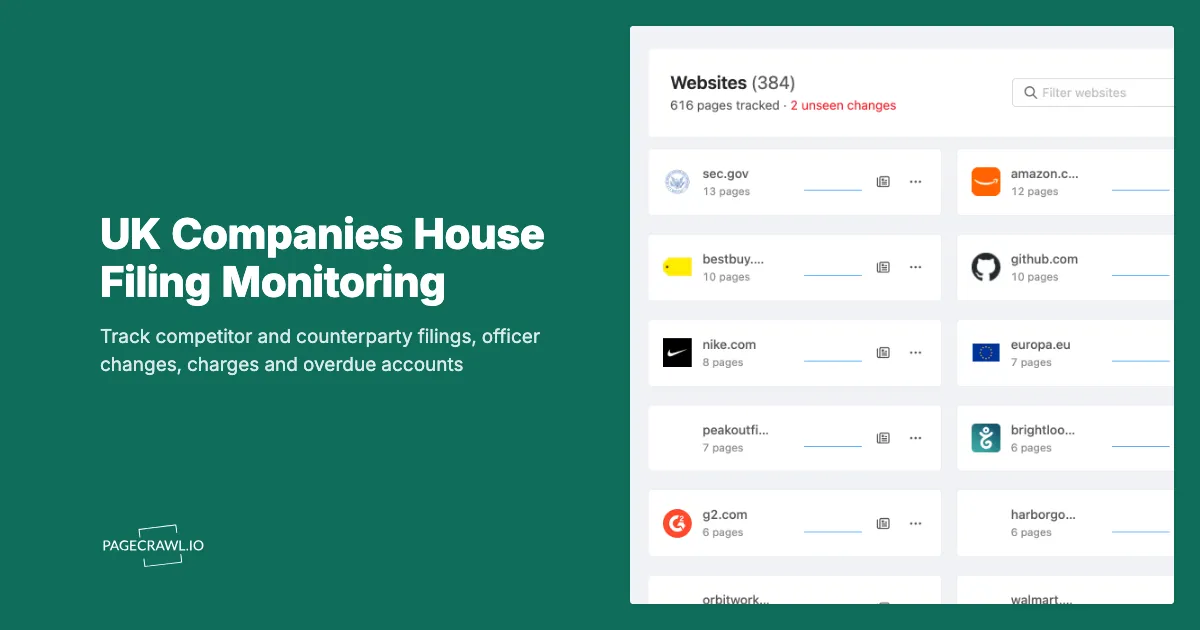
This guide covers what to watch on a Companies House record, which filings carry a signal, how to build a monitored portfolio of competitors and counterparties, and how to set it up so a change on the register reaches your inbox or your Slack channel on the next check.
What is Companies House and what can you actually monitor?
Companies House is the UK's registrar of companies, and its Find and update company information service publishes every registered company's filing history, officers, persons with significant control, registered charges and accounts status for free. Each of those is a separate web page with a stable URL, which makes each of them monitorable.
A single company record breaks into several distinct pages, and they change at very different rates. Understanding which page carries which signal is most of the work.
| Page | What it tells you | Typical change rate |
|---|---|---|
| Overview | Registered office, SIC codes, accounts and confirmation statement due dates, overdue flags | Rarely, but high signal |
| Filing history | Every accepted document, newest first, with type codes and dates | Several times a year |
| Officers | Current and resigned directors and secretaries, appointment and resignation dates | Irregular, clusters before trouble |
| Persons with significant control | Who ultimately owns or controls the company | Rare, very high signal |
| Charges | Registered mortgages and debentures, and whether they are outstanding or satisfied | Rare, very high signal |
The register is large enough that manual checking is hopeless at any real scale. Companies House reported a total register size of 5,479,045 companies at the end of its 2026 financial year in its companies register activities statistical release, with an effective register (excluding companies in dissolution or liquidation) of 4,930,634. Your slice of that is perhaps forty companies, but forty pages checked by hand every week is a job nobody does twice.
What is not on the register
There is no paywall on the core record: filing history, officer lists, PSC data and charge details are all viewable without an account, and document images download free. But small companies file abridged or filleted accounts with no profit and loss account, so revenue and margin are frequently absent. Filings arrive with a lag: annual accounts describe a year that ended up to nine months ago. And the register records what was filed, not whether it was true. Companies House has historically had limited powers to verify submissions, which is precisely why fraudulent filings against real companies happen and why directors are encouraged to watch their own record.
Which Companies House filings actually carry a signal?
Four categories carry most of the value: registered charges (new borrowing or security), officer changes (especially clusters of resignations), accounts status (overdue or a suddenly shortened accounting reference date), and gazette or insolvency notices. Everything else on the filing history is routine administration that will drown you in noise if you alert on it.
New charges and satisfied charges
A newly registered charge tells you a lender has taken security over the company's assets. That is not automatically bad news, growth companies raise debt all the time, but it changes your position as an unsecured creditor. A debenture registered by an invoice financier or an asset-based lender, especially at a company that previously had no secured borrowing, is one of the strongest distress signals available for free anywhere. A charge marked satisfied is the opposite signal, and it is worth noticing too, because it often means a refinancing or an exit.
For competitive intelligence, charges are a window into how a private rival is funded. A new charge in favour of a venture debt provider frequently precedes a hiring push. Track it alongside the funding and acquisition signals covered in our guide to monitoring private competitor funding and acquisitions, and you can often reconstruct a private company's capital position without a single press release.
Officer appointments and resignations
One director resigning is a fact. Three resigning in six weeks is a story. Watch particularly for the departure of a founder, the resignation of a finance director shortly before an accounts deadline, and the appointment of directors whose other appointments are turnaround or restructuring firms. Officer pages also reveal group structure changes when the same individuals appear across newly incorporated entities.
Accounts overdue and changed reference dates
The overview page carries the accounts due date and flags overdue accounts prominently. Late accounts are common and often innocent, but they are also the most visible symptom of a finance function under strain. Companies House notes in its late filing penalties guidance that penalties for private companies range from £150 to £1,500 depending on how late the accounts are, and that penalties double automatically when accounts are filed late in two consecutive financial years. A company willing to absorb a doubled penalty rather than publish is telling you something.
The subtler version is a changed accounting reference date. Extending a year end pushes the filing deadline out, and repeated extensions are a recognised way to delay publishing a difficult set of numbers. That change appears as a filing on the history page and shifts the due date on the overview.
Confirmation statements, PSC changes and registered office moves
A confirmation statement is routine, but the changes bundled around it are not. Share capital changes, new shareholder classes, and PSC changes all indicate ownership movement. A registered office that suddenly relocates to the address of an insolvency practitioner is about as clear a signal as the register ever gives.
Why isn't the Companies House Follow service enough on its own?
Companies House offers a free Follow service that emails you when a document is accepted or removed for a company you follow, described in its guidance on searching the register. It is genuinely useful and you should use it. It is also document-centric, one-channel, and unfiltered, which limits it as the backbone of a monitoring programme.
It tells you a document arrived, not what changed
A Follow email reports that a filing was accepted. Deciding whether an AA (accounts) filing shows deterioration, or whether an AP01 appointment matters, still requires you to open the record and read it. A change monitor that shows a before-and-after diff answers that question in the notification itself, particularly on the overview and officers pages where the delta is short.
Email only, and to one inbox
Follow delivers to the email address on the account. A filing that matters to credit control usually also matters to the account manager, and routing the same signal to Slack, Microsoft Teams, Discord, Telegram or a webhook into your CRM is what turns an alert into an action.
No filtering, no thresholds, no grouping
Every accepted document triggers a message, including the ones you do not care about. There is no way to say "only tell me about charges and officer changes" or "only if the word overdue appears." Across forty followed companies that becomes a stream people mute. Conditional rules, of the kind described in our walkthrough of price, keyword and threshold alert rules, are what keep a portfolio-scale programme quiet enough to be read.
It only covers the register
Your real picture of a counterparty or competitor is the register plus their website, their pricing page, their careers page and the trade press. A charge registered the same week a rival posts fifteen new sales roles reads very differently from a charge registered in isolation, and only a single system covering both puts the filing next to that context.
How do you set up Companies House monitoring in PageCrawl?
You find the company on the register, copy the URL of the specific tab you care about, add it to PageCrawl as a text or content monitor, choose a check frequency that matches the page's change rate, and route alerts to the channels your team actually reads. A first monitor takes about three minutes.
Find the company and copy the right URL. Search the Find and update company information service for the company name or number. Open the tab you want (overview, filing history, officers, charges or persons with significant control) and copy that URL. Each tab has its own address, so monitor them separately rather than trying to watch a whole record as one page.
Add the URL to PageCrawl and pick a tracking mode. For the overview and officers tabs, text or content tracking works well because the meaningful part of the page is short structured text. For the filing history tab, content tracking catches a new row appearing at the top of the list. If you want a plain-language summary of what changed rather than a raw diff, use AI extraction and tell it to report only new filings, officer changes and charge events.
Set the check frequency to match the page. Companies House processes filings on working days, so hourly checking is ample for most records. The free tier checks every 60 minutes, which genuinely suits this use case. Reserve the 15-minute Standard frequency for a handful of high-stakes counterparties where a same-day signal changes a shipping or credit decision.
Choose your notification channels. Email suits a weekly credit review. Slack or Microsoft Teams suits a shared risk channel where the account manager and credit controller both see the alert. Discord and Telegram work for smaller teams and out-of-hours cover. A webhook lets you write the event straight into your CRM or risk system so the filing lands on the customer record rather than in someone's inbox.
Add keyword and threshold rules so only real signals fire. On the filing history page, alert on terms like charge, MR01, appointment, termination, AA, or strike-off. On the overview page, alert on the word overdue. On the charges page, alert on any change at all, since that page is quiet by nature. Suppressing everything else is what makes a forty-company portfolio survivable.
Turn on screenshot capture and keep the history. A timestamped capture of the record as it appeared on a given date is evidence in a credit dispute, an insurance claim or a due diligence file. It shows what you knew and when, which is exactly the question asked after a bad debt.
Group the monitors into folders. Create folders such as Key Customers, Tier 1 Competitors, and Suppliers. When a filing arrives, the folder tells you at a glance who owns the response, and you can tune frequency per folder rather than per monitor.
How do you monitor a whole portfolio of competitors and counterparties?
Tier the list, assign frequency and channel by tier, and accept that most companies deserve one monitor rather than four. A practical programme is 20 to 60 monitors covering 15 to 30 companies, checked hourly, with alerts split between a shared channel for tier one and a weekly digest for the rest.
Tier your list before you add anything
| Tier | Who belongs | Monitors per company | Routing |
|---|---|---|---|
| Tier 1 | Top customers by exposure, direct competitors, sole-source suppliers | 3 to 4 (overview, charges, filing history, officers) | Shared Slack or Teams channel, alert on every hit |
| Tier 2 | Mid-size accounts, secondary competitors, group entities | 2 (overview, filing history) | Email to the owner, daily digest |
| Tier 3 | Long-tail accounts, watchlist prospects, acquisition targets | 1 (filing history) | Weekly digest |
Exposure, not revenue, decides tier one. A £40,000 customer on 90-day terms with no security is a bigger risk than a £400,000 customer who pays by direct debit on delivery.
Watch group structures, not just the trading entity
UK groups routinely put the trade in one company, the property in another and the intellectual property in a third. Monitoring only the entity on your invoice can miss a charge registered against the asset-holding parent or the incorporation of a phoenix entity with familiar directors. When you add a tier one company, spend five minutes on the officers page identifying the related entities and add the parent as a tier two monitor.
Pair the register with the company's own website
Filings are lagging indicators with strong confirmatory power. Website changes are leading indicators with weaker confirmation. A supplier quietly removing a product line from its site, then filing a charge, then extending its accounting reference date is a sequence you can act on. Our guide to tracking competitor websites covers the website half of that picture, and the same tiering logic applies to both.
What problems come up when monitoring Companies House?
The main issues are noise from routine filings, the lag between a company's reality and its published accounts, page elements that change without meaning anything, and the temptation to monitor far more companies than anyone will actually read alerts about. All four are manageable with configuration and discipline.
Routine filings create most of the noise
Confirmation statements, registered office changes and address updates for a director all generate filings that mean nothing on their own. Without keyword rules, a portfolio of thirty companies produces a steady drip of alerts that trains everyone to ignore the channel. Filter aggressively at the start, then loosen. Our guide to reducing monitoring false positives covers teaching a monitor to ignore regions of a page that change without carrying information.
Accounts are historical by the time you see them
A set of small company accounts filed nine months after year end describes a business that may have changed completely. Treat filings as confirmation of a trend rather than news. The events with genuine currency are charges, officer changes and overdue flags, because those are filed within days or weeks of the underlying event.
Dates, counters and dynamic elements
Companies House pages include elements that shift without any underlying change, such as relative date phrasing and next-due-date calculations that tick over. Point your monitor at the section that matters, or use AI extraction and instruct it to report only filing, officer and charge events. Two or three rounds of tuning usually removes the noise permanently.
Scope creep
The most common failure is enthusiasm. Somebody adds 200 companies, the channel fills up, and within a month the alerts are muted. Start with the ten companies where a filing would genuinely change a decision this quarter, then expand only once the alerts are being read and acted on.
Who gets the most value from monitoring UK filings?
Credit control and finance teams protecting receivables, competitive intelligence and corporate development teams tracking private rivals, procurement teams assessing supplier resilience, and directors watching their own record for fraudulent filings. Each uses the same underlying monitors with different tiering and different routing.
Credit control and finance
The clearest return. A new charge or an overdue accounts flag on a large customer is a reason to review terms, request payment on delivery, or tighten a credit limit before the exposure grows. The value is the size of one avoided bad debt, which for most B2B businesses dwarfs the cost of the monitoring.
Competitive and corporate development
Private UK competitors reveal more through the register than through their marketing. Incorporations of new subsidiaries hint at product or geographic expansion. Charges reveal funding. Officer appointments reveal senior hires before anyone announces them.
Procurement and directors watching their own record
Single-source suppliers are a concentration risk that hides until it fails, and the register usually gives months of warning, enough time to qualify a second source. Directors have a separate reason to watch: Companies House itself points to its Follow service as a way to spot fraudulent filings made against your own company. An unexpected officer termination or registered office change against your own record is something you want to see the same day, not at the next annual review.
Choosing your PageCrawl plan
PageCrawl's Free plan lets you monitor 6 pages with 220 checks per month, which is enough to validate the approach on your most critical pages. Most teams graduate to a paid plan once they see the value.
| Plan | Price | Pages | Checks / month | Frequency |
|---|---|---|---|---|
| Free | $0 | 6 | 220 | every 60 min |
| Standard | $8/mo or $80/yr | 100 | 15,000 | every 15 min |
| Enterprise | $30/mo or $300/yr | 500 | 100,000 | every 5 min |
| Ultimate | $99/mo or $999/yr | 1,000 | 100,000 | every 2 min |
Annual billing saves two months across every paid tier. Enterprise and Ultimate scale up to 100x if you need thousands of pages or multi-team access.
One competitive signal caught early can swing a deal worth more than a decade of Enterprise. If you win one additional deal per year because you spotted a pricing change, a product launch, or a messaging shift before your competitors did, $300/year is a rounding error. Standard at $80/year handles 100 monitored pages, enough for a Tier 1 and Tier 2 competitor program. Enterprise adds 500 pages and SSO. All plans include the PageCrawl MCP Server for AI assistants like Claude and Cursor. Your sales and product teams can ask "summarize every change to Competitor X's pricing page over the last quarter" and get an answer pulled straight from your own archive. AI assistants can create monitors through conversation on every plan, including Free, turning the tracked pages into a living competitor database, not just an alert feed.
Getting Started
Pick your three largest credit exposures and your two closest private competitors. For each, open the Companies House record, copy the overview URL and the charges URL, and add them to PageCrawl with hourly checks. That is ten monitors, four of which fit inside the free tier if you want to prove the concept before paying for anything.
Add keyword rules straight away so only charge events, officer changes and the word overdue break the silence. Route the alerts to a shared Slack or Teams channel where both credit control and the account owner can see them, and turn on screenshot capture so you keep a dated record of what the register said.
Run it for a quarter. The first time a charge appears against a customer before your sales team hears anything, you will know what the register is worth.
Your counterparties are publishing their problems. Start reading them on a schedule.