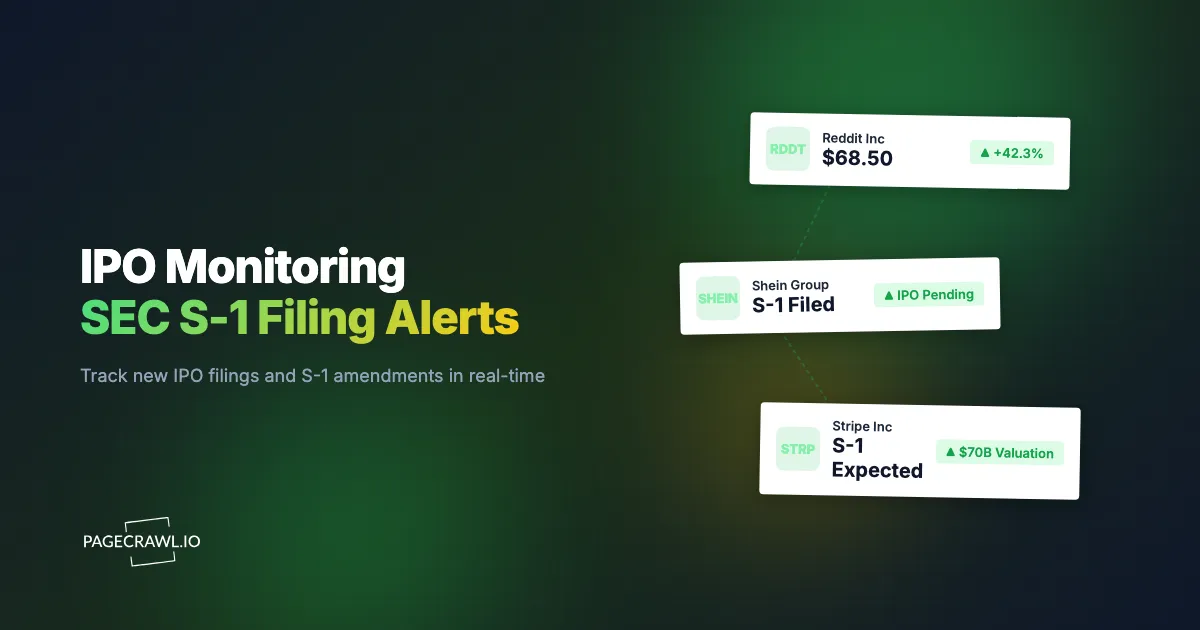
Instacart filed its S-1 registration statement with the SEC on a Friday afternoon in August 2023, where it landed on EDGAR like every other registration statement. By Monday morning, every major financial outlet had published analysis, institutional investors had begun positioning, and the valuation conversation had shifted dramatically from earlier private-market estimates. Anyone tracking EDGAR filing pages closely had a full weekend head start on the rest of the market.
IPO filings are among the most consequential public documents a company produces. An S-1 registration statement reveals revenue figures, growth rates, customer metrics, competitive risks, and executive compensation that were previously locked behind private company walls. For investors, competitors, journalists, and industry analysts, the moment an S-1 appears on EDGAR marks the beginning of a critical information window. But the SEC does not send you a push notification. Companies choose their filing timing strategically, often during low-attention periods. Unless you are actively watching EDGAR, you will discover the filing hours or days after others have already acted on it.
This guide covers how the IPO filing process works on EDGAR, why monitoring S-1 filings and their amendments matters, and how to set up automated alerts that notify you when companies file to go public.
Why does IPO monitoring matter?
Because an S-1 makes a private company's economics public for the first time, and the first few hours of that window are the least crowded. Investors, competitors, VCs, and analysts all read the same document, and the value of IPO monitoring is the same for each of them: knowing about a filing before it becomes widespread news.
Investment Opportunities
IPO filings contain detailed financial data that was previously unavailable. Revenue growth, profitability trends, customer acquisition costs, and unit economics all appear in S-1 documents. Investors who read these filings early can assess the company's value before the broader market forms a consensus, which is why S-1 tracking sits alongside IR pages and earnings releases in an investment intelligence monitoring setup.
Early awareness also matters for related investments. When a major company files to go public, it can affect competitors, suppliers, customers, and the broader sector. A large IPO in the cybersecurity space, for example, may drive investor attention (and capital) toward the entire sector.
Competitive Intelligence
When a competitor files an S-1, you gain access to detailed operating metrics that private companies never disclose. Revenue breakdowns by segment, customer concentration data, gross margin figures, and growth rates all become public. For companies operating in the same market, an S-1 filing from a competitor is one of the most valuable competitive intelligence documents available, and the same disclosures double as sales signals for teams selling into that space.
Beyond direct competitors, IPO filings from adjacent companies reveal market sizing data, trend information, and strategic priorities that inform your own planning.
Industry Trend Signals
The volume and type of IPO activity signals broader market conditions. A wave of S-1 filings in a particular sector suggests investor confidence and capital availability. Conversely, IPO withdrawals or delays indicate market hesitation. Tracking these patterns helps analysts and strategists understand where the market is heading.
Specific S-1 details also reveal trends. If multiple companies filing in the same space all cite the same regulatory risk or competitive dynamic, that pattern provides strategic insight beyond any individual filing.
Venture Capital and Private Equity
For VCs, IPO filings from portfolio companies (or competitors to portfolio companies) create actionable intelligence. An S-1 from a competitor can validate a portfolio company's market position or reveal threats. IPO pricing data informs private company valuations. And the timing of IPO filings influences fund strategy and exit planning.
For PE firms, IPO activity signals which sectors are attracting public market capital, influencing acquisition targets and exit strategies.
How does the IPO filing process work on EDGAR?
It runs in stages, and each stage leaves a document you can monitor: the initial S-1 registration statement, a series of S-1/A amendments that answer SEC comments and add pricing, the effectiveness milestone that clears the company to sell shares, and the final 424B prospectus filed days before trading begins.
The S-1 Registration Statement
The S-1 is the core IPO document. It contains everything the SEC requires a company to disclose before selling shares to the public:
Business description. A comprehensive overview of the company's operations, products, markets, and strategy. This section often contains the most detailed public description of the business ever produced.
Financial statements. Audited financial data covering at least three years. Revenue, expenses, profitability, cash flow, and balance sheet data. For companies that were previously private, this is the first time these numbers become public.
Risk factors. A detailed list of risks facing the business. Companies are legally required to disclose material risks, making this section unusually candid compared to marketing materials or press coverage.
Management and compensation. Executive biographies, compensation structures, equity ownership, and related-party transactions. This reveals the incentive structures driving company leadership.
Use of proceeds. How the company plans to use the money raised in the IPO. This indicates strategic priorities: debt repayment, acquisitions, R&D investment, or general working capital.
S-1 filings are typically hundreds of pages long. The initial filing often contains placeholder information (indicated by blank spaces or ranges) for the number of shares, price range, and underwriter details. These get filled in through subsequent amendments.
S-1 Amendments (S-1/A)
After the initial S-1 filing, companies file amendments as the registration process progresses. Each amendment appears as a separate filing on EDGAR with the form type "S-1/A."
Amendments serve several purposes:
Responding to SEC comments. The SEC reviews S-1 filings and issues comment letters asking for clarification or additional disclosure. Companies respond by filing amended S-1 documents. The back-and-forth between the SEC and the company can span several rounds over weeks or months.
Updating financial data. If a new quarter ends during the registration process, the company updates its financial statements in an amendment. These updates sometimes contain material changes from the original filing.
Adding pricing information. The price range for the IPO (the expected share price) typically appears in a later amendment, not the initial filing. This amendment is a significant event because it establishes the valuation range the company and underwriters expect.
Final pricing. The final amendment before the IPO goes effective includes the actual offering price and number of shares. This is the last document before trading begins.
Tracking amendments is as important as catching the initial S-1. Each amendment can contain material new information that changes the investment thesis.
The Effectiveness Date
After the SEC completes its review and the company addresses all comments, the registration statement becomes "effective." This means the company is cleared to sell shares. Trading typically begins one or two business days after effectiveness.
The transition from filed to effective is a critical milestone. Monitoring for effectiveness notices on EDGAR tells you when trading is imminent.
Form 424B (Prospectus)
After the S-1 becomes effective, the company files a final prospectus (Form 424B, with variants like 424B1 or 424B4). This document contains the final terms of the offering: exact share count, final price, and underwriter allocations. The 424B filing confirms that the IPO is proceeding and provides the definitive deal terms.
Related Filing Types
Several other filing types appear during the IPO process:
DRS (Draft Registration Statements). Under the JOBS Act, emerging growth companies can submit draft S-1 filings confidentially. These are not publicly visible on EDGAR until the company decides to proceed. When a confidentially filed S-1 becomes public, it appears on EDGAR, and that event is worth monitoring.
Form S-11. Real estate investment trusts (REITs) use Form S-11 instead of S-1 for their IPO registrations. If you are tracking real estate sector IPOs, monitor for S-11 filings as well.
Form F-1. Foreign private issuers use Form F-1 (instead of S-1) to register securities for US listing. Many of the largest IPOs on US exchanges come from foreign companies filing F-1 documents.
Monitoring EDGAR for S-1 Filings
EDGAR provides several entry points for IPO monitoring, and the same page-level technique underpins regulatory filing monitoring across the SEC, FDA, and FCC. The right approach depends on whether you are watching for specific companies or scanning for all new filings.
Full-Text Search Filings (EFTS)
The SEC's EDGAR full-text search system (EFTS) allows you to search across all filings. You can filter by form type (S-1, S-1/A, F-1) and date range. This is the most comprehensive approach for finding all recent IPO filings.
The EFTS search page at https://efts.sec.gov/LATEST/search-index?q=%22S-1%22&dateRange=custom&startdt=2026-01-01&enddt=2026-12-31&forms=S-1 returns results for S-1 filings within a date range. Monitoring this page captures every new S-1 filing across all companies.
Company-Specific Filing Pages
If you are tracking a specific company through the IPO process, monitor their EDGAR filing page directly. Once a company files its initial S-1, you know the CIK (Central Index Key) and can monitor their filing page for amendments, pricing supplements, and effectiveness orders.
The company filing page URL follows this pattern:
https://www.sec.gov/cgi-bin/browse-edgar?action=getcompany&CIK=COMPANY_CIK&type=S-1&dateb=&owner=include&count=40This filtered view shows only S-1 and S-1/A filings for that company. When a new amendment appears, the page updates, and PageCrawl detects the change.
For more details on monitoring company-specific EDGAR pages, see our guide on SEC filing alerts.
EDGAR Latest Filings RSS
EDGAR offers RSS feeds that list recent filings by form type. The S-1 feed at https://www.sec.gov/cgi-bin/browse-edgar?action=getcompany&type=S-1&dateb=&owner=include&count=40&search_text=&action=getcompany shows the most recent S-1 filings across all companies.
Monitoring this page catches new S-1 filings as they appear. When a company you have never heard of files an S-1, it shows up here, making this approach valuable for broad IPO discovery rather than tracking specific companies.
Automatic Page Discovery for EDGAR
You do not always know the exact URL for an upcoming S-1 filing. PageCrawl's automatic page discovery monitors a website's sitemap and alerts you when new pages are added. For IPO monitoring, this catches new filing pages on EDGAR on the next check after they appear, without needing to know the exact URL in advance. Point page discovery at a company's EDGAR filing index, and every new document, whether it is the initial S-1, an amendment, or a related 8-K, triggers an alert automatically. This is especially powerful for tracking companies rumored to be considering an IPO, where you know the CIK but not when or what they will file.
Setting Up PageCrawl for IPO Monitoring
PageCrawl automates the process of watching EDGAR pages and alerting you when new filings appear.
Monitoring All New S-1 Filings
To catch every new IPO filing:
Step 1. Navigate to the EDGAR search or latest filings page filtered for S-1 documents. Copy the URL from your browser.
Step 2. Add the URL as a new monitor in PageCrawl. Select content monitoring mode so PageCrawl tracks changes to the filing list content.
Step 3. Set check frequency. For comprehensive IPO monitoring, check every few hours. Companies file S-1 documents throughout the business day, and occasionally after hours. Checking multiple times per day ensures you catch filings the same day they appear.
Step 4. Configure notifications. For investment-related monitoring where timing matters, use fast notification channels: Telegram and Discord push each alert to your phone as soon as a check detects the new filing, so your check frequency, not the channel, sets the delay. For less time-sensitive monitoring (industry analysis, competitive tracking), email or daily digests work well. For details on setting up email-based alerts, see our guide on email alerts for website changes.
Step 5. Enable AI summaries. PageCrawl's AI-powered change descriptions tell you what changed on the page, which in this case means which company filed and what type of filing appeared. This saves you from clicking through to EDGAR for every update.
Tracking a Specific Company Through the IPO Process
When you know a company has filed (or is expected to file) an S-1:
Step 1. Look up the company on EDGAR and find their filing page. If they have already filed an S-1, the company CIK is available on the filing itself.
Step 2. Add the company's EDGAR filing page to PageCrawl, filtered to S-1 and S-1/A form types.
Step 3. Set a higher check frequency than broad monitoring. During active registration periods, companies may file amendments at any time. Checking every hour ensures you catch amendments quickly.
Step 4. Add a second monitor for the company's general filing page (not filtered by form type). This catches related filings like Form 8-A (exchange registration) and 424B (final prospectus) that signal the IPO is moving toward trading.
Monitoring Pre-IPO Signals
Some companies signal IPO intentions before filing an S-1. You can monitor for these signals:
Confidential filing announcements. Companies often issue press releases announcing that they have confidentially submitted a draft registration statement. Monitor the company's press room or news page for this announcement.
Underwriter appointment news. Hiring investment banks (Goldman Sachs, Morgan Stanley, JPMorgan) as underwriters typically precedes an S-1 filing by weeks or months. Financial news pages and the company's own announcements reveal this.
Board changes. Companies preparing for IPO often add directors with public company experience. Monitoring leadership pages can reveal IPO preparation activity.
For automation-driven workflows that combine IPO monitoring with downstream actions, see our guide on webhook automation.
Monitoring Roadshow Pages and Pricing Updates
The roadshow is the marketing phase between the initial S-1 filing and the IPO pricing. Companies present to institutional investors, and the roadshow website contains presentation materials, financial highlights, and management commentary.
Roadshow Websites
Companies create dedicated roadshow websites (often hosted on platforms like retailroadshow.com or netroadshow.com) that contain video presentations and slides. These pages sometimes update during the roadshow period as the company responds to investor feedback.
Monitor the roadshow page for updates to presentation materials or new content additions. Changes during the roadshow period can signal shifting narrative or updated metrics.
Pricing Updates
The IPO price range typically appears in an S-1/A amendment and gets reported by financial media. The final pricing happens after the roadshow closes, usually the evening before trading begins.
Monitor:
- The company's EDGAR filing page for the pricing amendment
- Major financial news sites for pricing coverage
- The exchange listing page (NYSE or Nasdaq) for the new listing to appear
Lock-Up Expiration
After the IPO, insiders are typically subject to a lock-up period (usually 90-180 days) during which they cannot sell shares. Lock-up expiration often triggers selling pressure and price volatility.
The lock-up terms are disclosed in the S-1. Track the expiration date and monitor for any early lock-up release announcements, which sometimes appear in Form 8-K filings.
Combining IPO Monitoring with Financial News
EDGAR monitoring catches the official filings, but financial news coverage provides context, analysis, and unofficial information that complements your monitoring.
News Sources to Monitor
Financial media. Reuters, Bloomberg (where accessible), and the Wall Street Journal frequently break IPO news before or alongside EDGAR filings. Monitor the IPO or deals section of these publications.
Industry publications. Sector-specific publications often cover IPOs relevant to their audience. TechCrunch for tech IPOs, BioPharma Dive for biotech, and similar outlets add context that generic financial media may miss.
SEC comment letters. The SEC publishes correspondence between the agency and the filing company. These comment letters reveal what the SEC questioned and how the company responded. Comment letters appear on EDGAR on the company's filing page after the registration becomes effective. Monitoring the company's full filing page (not just S-1 filtered) catches these.
Building a Multi-Source Dashboard
For serious IPO monitoring, combine multiple information sources:
- EDGAR broad S-1 feed for new filing discovery
- Company-specific EDGAR pages for companies in active registration
- Financial news section monitors for IPO coverage
- Company press pages for pre-filing announcements
Organize these monitors using folders in PageCrawl. Create an "IPO Pipeline" folder with subfolders for each stage: Pre-Filing, S-1 Filed, In Registration, and Approaching Trading. The help article on organizing monitored pages with labels, folders, and workspaces covers nesting and how labels let you slice the same pipeline by sector.
For building more sophisticated monitoring dashboards with the PageCrawl API, see our guide on custom monitoring dashboards.
Who benefits from IPO monitoring?
Individual investors, venture and growth equity funds, sector analysts, competitive intelligence teams, and financial journalists. Each reads the same S-1 for a different reason: a valuation, a benchmark, a market-sizing figure, a rival's unit economics, or a story that beats the wire.
Individual Investors
Retail investors who want to participate in IPOs or buy shares shortly after listing benefit from early filing awareness. Reading the S-1 before the roadshow gives you time to evaluate the company's fundamentals, compare it to public peers, and decide whether to invest.
Early awareness also helps with related trades. If a major company in your portfolio's sector files an S-1, the competitive dynamics described in the filing may affect your existing positions. Always verify any figure against the filing itself on the SEC's own site; this article is informational and not investment advice.
Venture Capital and Growth Equity
VCs track IPO filings for multiple reasons:
- Portfolio company exits: tracking competing companies' IPO timelines helps predict when the market window will open for your own portfolio companies
- Valuation benchmarks: IPO pricing establishes public market valuations that inform private market valuation discussions
- Market signal: IPO activity indicates the appetite of public markets for new listings in specific sectors
Industry Analysts
Analysts covering specific sectors use S-1 filings as primary research sources, alongside the equity research tools they rely on every day. The depth of disclosure in an S-1 exceeds quarterly earnings reports. Market sizing data, competitive landscape descriptions, and customer metrics in S-1 filings often become foundational data points in industry research.
Competitive Intelligence Teams
When a competitor files an S-1, you gain access to operating metrics they have never disclosed before. Revenue breakdowns, customer counts, retention rates, R&D spending, and sales efficiency metrics all become available. Competitive intelligence teams that catch these filings early can produce analysis while the information is fresh.
For broader approaches to investment-focused web monitoring, see our guide on investment research website monitoring.
Journalists and Media
Financial journalists cover IPOs as major business events. Early awareness of filings means you can start working on coverage before competitors. The detailed disclosures in S-1 filings provide source material for deep investigative pieces that go beyond the press release narrative.
Building an IPO Monitoring Workflow
A structured workflow ensures you extract maximum value from your monitoring.
Filing Detection Phase
When your PageCrawl monitor detects a new S-1 filing:
- Identify the company and sector from the alert or EDGAR listing
- Determine if the company is relevant to your interests (investment sector, competitive overlap, industry coverage area)
- If relevant, create company-specific monitoring (EDGAR filing page, company press page, financial news)
- Download and save the S-1 for detailed review
Analysis Phase
Read the S-1 with a structured approach:
- Start with the prospectus summary for a high-level overview
- Review financial statements for revenue, growth, and profitability trends
- Read risk factors for material threats and industry dynamics
- Examine the use of proceeds for strategic priorities
- Check management and ownership for insider incentive alignment
Tracking Phase
Once a company enters the registration process:
- Monitor for S-1/A amendments (SEC response filings, financial updates, pricing range)
- Track financial news for analyst commentary and roadshow coverage
- Watch for the pricing amendment that establishes the share price range
- Monitor for effectiveness and the final 424B prospectus filing
Post-IPO Phase
After trading begins:
- Monitor for lock-up expiration (noted in the S-1, typically 90-180 days)
- Track quarterly filings (10-Q) for post-IPO performance
- Watch for insider selling disclosures (Form 4 filings)
Practical Monitoring Configurations
Here are specific setups for common IPO monitoring scenarios.
Broad IPO Discovery
Monitor the EDGAR latest filings page filtered to S-1, F-1, and S-11 form types. Check every 4-6 hours. Route alerts to email for daily review. This catches all new IPO filings across all sectors.
PageCrawl's free plan includes 6 monitors, which is enough to cover the main EDGAR filing type feeds (S-1, F-1) plus a few company-specific pages. For broader coverage, the Standard plan at $80/year supports up to 100 monitors, enough for tracking dozens of companies through the IPO pipeline simultaneously. The Enterprise plan at $300/year supports 500 monitors for institutional-grade coverage.
Sector-Focused Monitoring
For sector analysts, combine the broad EDGAR feed with sector-specific news sources:
- EDGAR S-1 feed (all filings, filtered during review by sector)
- Sector publication IPO coverage page (e.g., TechCrunch for tech, Endpoints News for biotech)
- Industry conference announcement pages (IPOs are often announced around major conferences)
Company-Specific Deep Tracking
When a high-priority company enters the IPO process:
- Company EDGAR filing page (all form types)
- Company press/news page
- Roadshow website (when available)
- Two or three financial news pages covering the specific IPO
Set all monitors to frequent checks (every 1-2 hours) and route alerts to fast notification channels like Telegram or Discord.
For regulatory monitoring beyond SEC filings, see our guide on regulatory compliance monitoring.
Choosing your PageCrawl plan
PageCrawl's Free plan lets you monitor 6 pages with 220 checks per month, which is enough to validate the approach on your most critical pages. Most teams graduate to a paid plan once they see the value.
| Plan | Price | Pages | Checks / month | Frequency |
|---|---|---|---|---|
| Free | $0 | 6 | 220 | every 60 min |
| Standard | $8/mo or $80/yr | 100 | 15,000 | every 15 min |
| Enterprise | $30/mo or $300/yr | 500 | 100,000 | every 5 min |
| Ultimate | $99/mo or $999/yr | 1,000 | 100,000 | every 2 min |
Annual billing saves two months across every paid tier. Enterprise and Ultimate scale up to 100x if you need thousands of pages or multi-team access.
IPO filings move markets. A single S-1 discovery that gives you a weekend head start on analysis can justify a year of monitoring costs many times over. Standard at $80/year covers 100 pages, which is enough to track the main EDGAR filing feeds plus a dozen companies in active registration. Enterprise at $300/year scales to 500 pages for institutional-grade pipeline coverage with 5-minute checks. Ultimate at $999/year adds 2-minute checks and full web archiving, which matters when you need provable timestamps for a thesis or a compliance record.
All plans include the PageCrawl MCP Server, so you can ask Claude to pull every material change across a company's filings, press page, and IR calendar over any period and get the evidence straight from your monitoring archive. AI assistants can create monitors through conversation on every plan, including Free.
Getting Started
Start with a single EDGAR filing page. If you have a specific company you want to track, find their EDGAR filing page and add it to PageCrawl. If you want broad IPO discovery, monitor the latest S-1 filings feed. Create a free account, paste the EDGAR URL, set your notification preferences, and you will be alerted the next time a filing appears. PageCrawl's free plan includes 6 monitors, enough to cover the main filing feeds and a few companies of particular interest.