The iPhone 17 Pro Max in Natural Titanium sold out within minutes of pre-orders opening. MacBook Pro configurations with higher-end specs regularly show shipping delays stretching several weeks at launch. Apple Watch Ultra models disappear within hours during holiday shopping. If you are refreshing Apple.com manually, you are competing against automated systems and people with faster fingers.
Apple product launches follow a predictable pattern: overwhelming demand meets limited initial supply. Whether it is a new iPhone, a refreshed MacBook, a redesigned Apple Watch, or even popular accessories like AirPods Max, the gap between what Apple can produce and what customers want creates weeks or months of stock shortages. The situation gets worse with specific configurations, colors, or storage sizes that Apple produces in smaller quantities.
This guide covers why Apple products sell out, which products and retailers to monitor, how to set up automated stock alerts across Apple.com and authorized retailers, and notification strategies that give you the best chance of securing the product you want.
Why do Apple products sell out so quickly?
Apple products sell out because launch demand consistently exceeds initial supply. Apple ships new products in waves, allocates stock by region, and produces popular configurations in limited quantities. Holiday demand spikes and periodic supply chain constraints extend shortages well past the launch window, especially for high-storage and Pro models.
Controlled Supply at Launch
Apple deliberately manages launch supply to create urgency and ensure quality control. New products ship in waves, with initial allocation going to pre-orders placed in the first minutes. Once pre-order allocation fills, shipping estimates push to weeks, then months.
This is not a bug in Apple's system. It is their launch strategy. But for buyers, it means the window to secure launch-day delivery is extremely narrow.
Configuration-Specific Shortages
Not all configurations sell out equally. High-storage models (512GB, 1TB), popular colors, and Pro/Max variants consistently face the longest delays. The base model iPhone in the least popular color might ship within a week while the top-tier configuration stays backordered for two months.
If you want a specific configuration, monitoring stock for that exact variant matters more than monitoring the general product page.
Seasonal Demand Spikes
Holiday shopping creates a second wave of shortages after initial launch demand subsides. Products that returned to regular availability in October might sell out again by late November. Apple Watch, AirPods, and iPad are particularly affected since they are popular gift items.
Supply Chain Constraints
Component shortages, manufacturing disruptions, and logistics issues periodically affect Apple's ability to meet demand. These constraints are unpredictable and can extend shortages well beyond the normal launch window. In recent years, certain Mac configurations have remained supply-constrained for months after launch.
Geographic Allocation
Apple allocates stock by country and region. A product might be available in the US but sold out in Europe, or available at one retailer but not another. Monitoring multiple sources increases your chances of catching restocks, and regional storefronts that redirect or block foreign visitors can be watched with residential proxies for geo-restricted pages.
Which Apple products and retailers should you monitor?
Monitor the exact configuration you want on Apple.com first, then add authorized retailers like Best Buy, Amazon, B&H Photo, and carrier stores. Pro-tier iPhones, high-spec MacBook Pros, Apple Watch Ultra, and AirPods Max sell out most often, so those product pages deserve the closest attention from stock availability monitoring and restock alerts.
Products That Sell Out Most Frequently
iPhone (new launches). The Pro and Pro Max models sell out fastest, especially in limited colors and high-storage configurations. Standard iPhone models generally return to stock sooner. Pre-order monitoring is critical for launch-day delivery.
MacBook Pro. Higher-end configurations (M-series Pro/Max chips, 36GB+ RAM, 1TB+ storage) face the longest delays. Base model MacBook Pros are easier to find. Custom configurations ordered through Apple's build-to-order system can take weeks regardless of general availability.
Apple Watch Ultra. The premium watch model targets a smaller audience but also has lower production volume. New colorways and band combinations sell out quickly.
AirPods Pro and AirPods Max. AirPods Pro restocks are generally frequent, but new generation launches create temporary shortages. AirPods Max, with their higher price point and lower production volume, can be harder to find in specific colors.
iPad Pro. High-end iPad Pro configurations mirror MacBook Pro patterns. The M-series chip upgrades create launch demand that exceeds supply for the first few weeks.
Mac Studio and Mac Pro. Professional Mac hardware has a smaller buyer base but also lower production volume. Wait times for custom configurations can stretch to several weeks.
Retailers to Monitor
Apple.com (apple.com)
The primary source. Apple.com gets the most stock allocation and the freshest inventory. Monitor specific product pages for the exact configuration you want. Apple's product pages show real-time availability, shipping estimates, and in-store pickup options.
Note: Apple.com product pages are JavaScript-heavy and require a monitoring tool that renders pages in a full browser environment.
Best Buy (bestbuy.com)
Best Buy is Apple's largest authorized third-party retailer. They carry most iPhone, iPad, Mac, Apple Watch, and AirPods models. Stock appears and disappears independently from Apple.com. A product sold out at Apple might be available at Best Buy, and vice versa. For more on tracking Best Buy inventory, see our Best Buy price tracker guide.
Amazon (amazon.com)
Amazon carries Apple products both directly and through third-party sellers. Stock availability fluctuates more on Amazon than at Apple.com or Best Buy. Pricing can vary depending on the seller. Monitor the specific Amazon listing for the Apple product you want, but verify the seller is Amazon or an authorized dealer. For Amazon-specific setup, see our Amazon stock alert guide.
Carrier Stores (for iPhone)
Verizon, AT&T, and T-Mobile often have independent iPhone inventory that differs from Apple.com allocation. If you are buying with a carrier plan, monitoring the carrier's product page directly can reveal availability before it appears at Apple.
B&H Photo (bhphotovideo.com)
B&H is an authorized Apple reseller with independent stock allocation. They occasionally have Mac and iPad models available when Apple.com is backordered.
Apple Store App
Apple sometimes releases stock through the Apple Store app before updating the website. While you cannot monitor an app with web monitoring, knowing this pattern helps you check the app when you receive alerts about related stock movement on the website.
Setting Up Stock Alerts with PageCrawl
Here is a detailed walkthrough for configuring automated Apple product stock monitoring.

Step 1: Find the Exact Product Page
Navigate to the specific product configuration you want. On Apple.com, this means selecting the model, color, storage, and any other options. The URL updates to reflect your selection. Copy this URL, as it points to the exact configuration you want to monitor.
For example, if you want the iPhone 17 Pro Max, 256GB, Natural Titanium, navigate through Apple's selection process until the page shows that configuration with its availability status. The URL in your browser now targets that specific variant.
For retailers like Best Buy or Amazon, navigate to the specific product listing page for the model and configuration you want.
Step 2: Create the Monitor
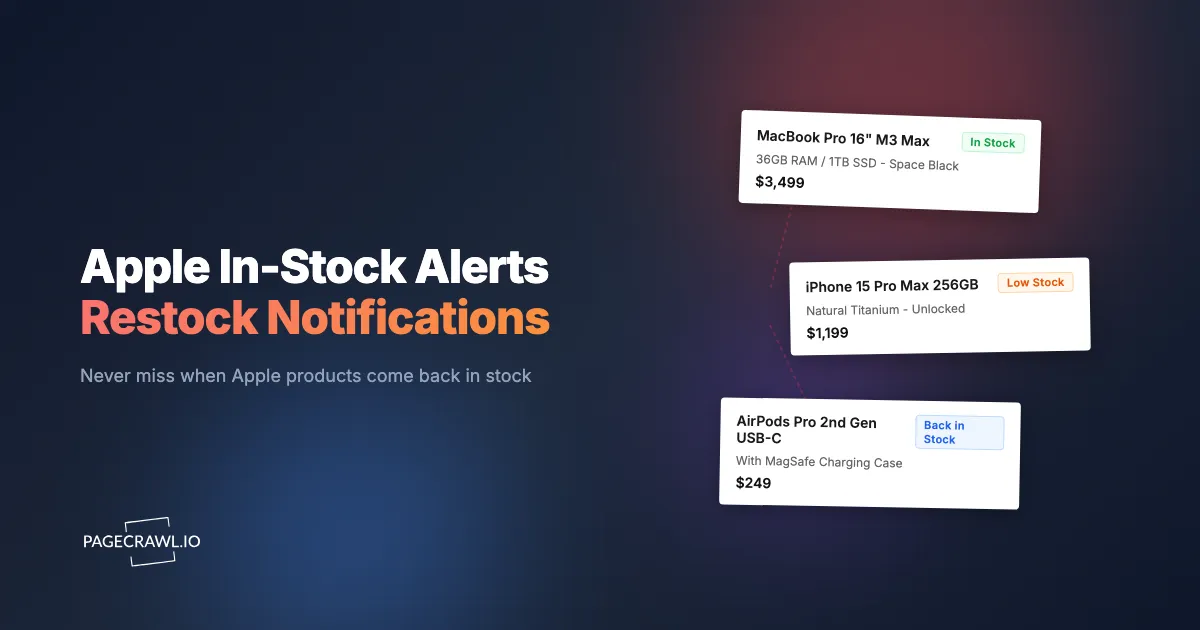
Add the product URL to PageCrawl. Select "Availability" as the tracking mode, one of the tracked element types PageCrawl supports. This mode focuses on detecting stock status changes: out of stock becoming in stock, shipping estimates changing, and "Add to Bag" buttons appearing.
If "Availability" mode does not capture the specific element you need, switch to "Specific Text" mode and use a CSS selector to target the availability indicator on the page. Apple uses different availability elements across product categories.
Step 3: Set Check Frequency
For active launches and high-demand products, set the check frequency to every 1-2 hours. Apple restocks can happen at any time, including overnight and on weekends. Frequent checking increases your chance of catching brief availability windows.
For products that have been out for a while and where you are waiting for a specific configuration to come back in stock, every 4-6 hours is sufficient. Stock tends to remain available for longer periods once initial demand subsides.
During pre-order windows (typically 5:00 AM Pacific on pre-order day), monitoring will not be fast enough. Pre-orders require manual refresh and fast action. Use monitoring for restocks after the initial pre-order wave.
Step 4: Configure Notifications for Speed
For stock alerts, notification speed matters. Every minute counts when competing with other buyers.
Telegram provides the fastest mobile push notifications. Messages deliver promptly once a check detects the change. Set up a Telegram bot and connect it to PageCrawl for fast delivery to your phone whenever a restock is detected.
Discord is ideal if you are coordinating with others (friends, family, a community group) who all want the same product. Create a Discord channel for stock alerts and everyone gets notified simultaneously.
Email works but is slower. Email delivery can take minutes, and notifications might land in promotions or spam folders. Use email as a backup channel, not your primary alert method.
Webhook output enables advanced automation. If you are technically inclined, a webhook can trigger a script that opens the purchase page in your browser or sends you an alert through a custom channel. See our webhook automation guide for setup details.
Slack works well for teams (business purchasing, IT departments) monitoring Apple product availability for company orders.
Set up at least two notification channels for redundancy. If Telegram is your primary, add email as backup. Missing a restock because of a single notification failure is preventable.
Step 5: Enable Screenshot Verification
Turn on screenshot capture for every check. Screenshots serve two purposes:
- Verification: Confirm that the availability status shown in the screenshot matches the alert. False positives happen (page layout changes, temporary glitches).
- Context: See the full page state, including shipping estimates, pickup availability, and pricing. Sometimes "in stock" means "ships in 3-4 weeks," which may or may not be useful to you.
Step 6: Set Up Multi-Retailer Monitoring
Create separate monitors for the same product across Apple.com, Best Buy, Amazon, and any other retailers you are willing to buy from. Organize these monitors into a folder (e.g., "iPhone 17 Pro Max Hunt") to keep your dashboard clean, and lean on scheduled reports once you are watching enough variants that change alerts start to pile up.
Each retailer's stock is independent. Monitoring all of them maximizes your chances of catching a restock at any source.
PageCrawl's browser extension lets you add any page as a monitor directly from your browser. Right-click on any element to set up element-specific tracking without needing to find CSS selectors manually. When you are browsing Apple.com or a retailer site and spot the product page you want to track, you can start monitoring it in seconds without switching to the PageCrawl dashboard.
Monitoring Strategies by Product
Different Apple products require different monitoring approaches.
iPhone Launch Monitoring
Pre-launch phase (1-2 weeks before pre-orders): Set up monitors on Apple.com, carrier sites, and authorized retailers for the models you want. Set frequency to daily. These monitors will establish a baseline and begin tracking the pages before they change to pre-order status.
Pre-order day: Monitoring alone will not secure a pre-order. Pre-orders sell out in minutes. Be ready at 5:00 AM Pacific with Apple.com, the Apple Store app, and your carrier site all loaded. Your monitors serve as backup confirmation.
Post-launch restocks: After initial pre-orders ship, Apple restocks periodically. This is where monitoring pays off. Set frequency to every 1-2 hours and wait. Restocks often happen in small batches, so quick action on alerts is essential.
Configuration patience: If your preferred color or storage is persistently unavailable, monitor less popular configurations as well. Having the phone in a different color is better than waiting indefinitely.
MacBook and Mac Monitoring
MacBook restocks follow a different pattern than iPhone. Once initial launch demand stabilizes, restocks tend to be more consistent but build-to-order configurations still take weeks.
Monitor both Apple.com and authorized resellers like B&H Photo and Best Buy, the same stores that handle Microsoft Surface and Copilot+ PC stock launches. Resellers sometimes receive independent stock allocation. Also check the Apple Refurbished store. Refurbished Macs are essentially new products with Apple warranty, and specific configurations appear unpredictably.
Set check frequency to every 4-6 hours for Mac monitoring. Stock changes less frequently than iPhone.
Apple Watch Monitoring
Apple Watch availability varies by case material and band combination. If you want a specific band, monitor the exact configuration. Apple sometimes sells out of specific bands while the watch itself remains available.
For Apple Watch Ultra, monitor the product page for the overall model. Ultra stock tends to fluctuate as a whole rather than by band option.
AirPods Monitoring
AirPods Pro restocks are frequent enough that intensive monitoring is rarely necessary except during the first week after a new generation launch. Set daily checks and adjust to more frequent monitoring if you notice persistent unavailability.
AirPods Max are different. Lower production volume and periodic color introductions create genuine scarcity. If you want a specific AirPods Max color, set monitoring to every 4-6 hours across multiple retailers.
Tips for Securing Apple Products When Alerted
Getting a stock alert is only step one. Converting that alert into a successful purchase requires preparation.
Pre-Save Your Payment and Shipping
On every retailer you are monitoring, ensure your account is logged in, your payment method is saved, and your shipping address is current. When the alert arrives, you want to go directly to checkout without entering information.
For Apple.com, save your Apple ID payment method and enable Face ID or Touch ID for Apple Pay if purchasing on your phone. The fastest checkout path on Apple.com is Apple Pay.
Have the Product Page Bookmarked
When you receive an alert, you need to reach the product page in seconds. Bookmark the exact product configuration URL in your browser and on your phone. Do not rely on navigating through Apple's product selection when time matters.
Act Within Minutes
Apple restocks during high-demand periods can sell out quickly, often within the hour. For extremely popular configurations (iPhone Pro Max, specific colors), restocks might sell out in minutes. When your alert arrives, stop what you are doing and complete the purchase.
If you cannot act immediately, forward the alert to someone who can buy on your behalf (especially for gift purchases).
Check In-Store Pickup
Apple.com often restocks for in-store pickup before shipping becomes available. When you reach the product page after an alert, check both shipping and in-store pickup options. Pickup availability varies by store location, much like the store-by-store restock alerts shoppers rely on for furniture retailers, and smaller Apple Stores sometimes have stock that flagship locations do not.
Have a Backup Plan
If your preferred configuration is persistently unavailable, decide in advance what compromises you will accept. Different color? Lower storage? Different retailer? Having a backup plan prevents you from hesitating during a restock window.
Common Challenges and Solutions
Apple.com JavaScript Rendering
Apple's product pages rely heavily on JavaScript. Tools that simply fetch HTML without executing JavaScript will not see availability information. PageCrawl renders pages in a full browser environment, ensuring dynamic content loads correctly before extracting availability data.
Availability Varies by Configuration
A product page might show "Available" for the base configuration while your preferred variant is backordered. Make sure your monitor targets the specific configuration URL, not the general product page. After selecting your options on Apple.com, the URL should reflect those choices.
In-Store Availability is Separate
Apple.com availability and Apple Store (physical) availability are different inventory pools. Web monitoring covers online availability. For in-store availability, Apple's website and app show pickup availability by store location after you select a product. You can monitor the in-store pickup page for your preferred store.
Pre-Order Pages Change Structure
Before pre-orders open, Apple's product pages show "Coming soon" messaging. When pre-orders launch, the page structure changes to include pricing, configuration options, and checkout. This structural change may trigger alerts. Consider this expected behavior during launch periods rather than a false positive.
Rate Limiting Concerns
Monitoring Apple.com at very high frequencies (every few minutes) is unnecessary and may result in being temporarily blocked. Every 1-2 hours provides a good balance between timely detection and responsible monitoring. Apple restocks typically remain available for a short window, so quick action on alerts still matters when demand is extreme.
Which community resources help you track Apple restocks?
The MacRumors Buyer's Guide, Apple-focused subreddits, and stock-tracking Discord servers are the most useful community resources for Apple restock hunting. They add human context that automated monitoring cannot capture, such as in-store sightings, shipping estimate changes, and firsthand restock timing reports.
MacRumors Buyer's Guide. The MacRumors Buyer's Guide tracks the product cycle for every Apple product and recommends whether to buy now or wait. Useful for deciding whether to monitor current products or wait for the next generation.
Apple subreddits. Communities like r/apple and product-specific subreddits share restock sightings, shipping estimate changes, and purchasing strategies.
Stock tracking communities on Discord. Several Discord servers focus on Apple product stock tracking. Members share alerts and coordinate monitoring across retailers.
These community resources complement automated monitoring by providing human context that automated tools do not capture (in-store sightings, insider information about restocks, experience reports).
Choosing your PageCrawl plan
PageCrawl's Free plan lets you monitor 6 pages with 220 checks per month, which is enough to validate the approach on your most critical pages. Most teams graduate to a paid plan once they see the value.
| Plan | Price | Pages | Checks / month | Frequency |
|---|---|---|---|---|
| Free | $0 | 6 | 220 | every 60 min |
| Standard | $8/mo or $80/yr | 100 | 15,000 | every 15 min |
| Enterprise | $30/mo or $300/yr | 500 | 100,000 | every 5 min |
| Ultimate | $99/mo or $999/yr | 1,000 | 100,000 | every 2 min |
Annual billing saves two months across every paid tier. Enterprise and Ultimate scale up to 100x if you need thousands of pages or multi-team access.
For Apple product hunters, Standard at $80/year pays for itself the first time monitoring catches a restock on an iPhone Pro Max or MacBook configuration that would otherwise sell out before your next manual check. 100 pages covers the specific variants you want across Apple.com, Best Buy, Amazon, and authorized resellers simultaneously, with 15-minute checks running overnight and on weekends when restocks frequently appear. Enterprise at $300/year adds 5-minute checks and 500 pages, which suits IT departments sourcing dozens of Mac configurations, resellers tracking Apple hardware inventory across multiple retailers, or households monitoring every launch product and color option at once.
Getting Started
Identify the specific Apple product and configuration you want. Set up monitors on Apple.com and at least one authorized retailer (Best Buy, Amazon) using PageCrawl's availability tracking mode. Configure Telegram or Discord notifications for speed, and enable screenshot verification.
PageCrawl's free tier includes 6 monitors, enough to track one product across multiple retailers or a few different products you are watching. Standard plans ($80/year for 100 pages) support comprehensive multi-product, multi-retailer monitoring for households or businesses purchasing Apple hardware.
For ongoing Apple product monitoring beyond launches (tracking refurbished deals, waiting for price drops on previous-generation products), explore our out-of-stock monitoring guide and web push notification strategies.
The difference between getting the product you want and waiting months for a backorder is often a matter of minutes. Automated stock alerts remove the need for constant manual checking and notify you as soon as a check detects that your product is available.