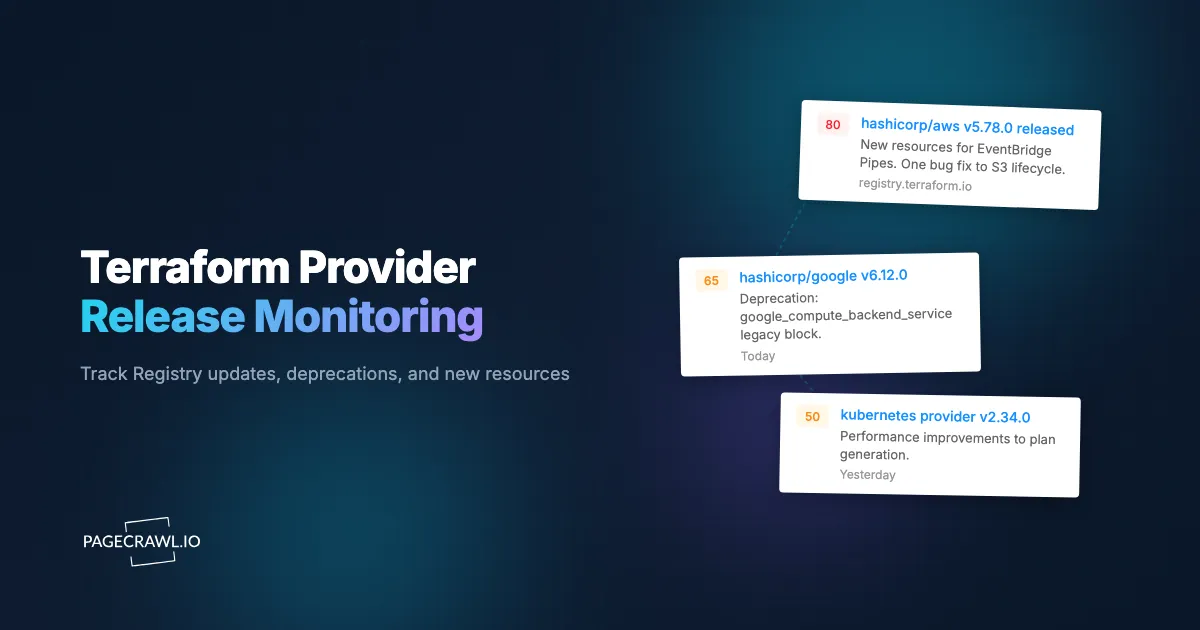
The hashicorp/aws provider ships new minor and patch releases most weeks, as the tag history on the hashicorp/terraform-provider-aws repository shows. Each one introduces new resources, modifies plan behavior, or deprecates attributes. Most teams find out about a relevant provider release when CI complains: a plan run starts producing diffs that have nothing to do with their committed changes, or an apply fails on an attribute that was silently renamed in the latest version. The fix is usually quick once you spot the cause, but the lost cycle is real and recurring.
Terraform providers move fast. The major cloud providers (aws, google, azurerm) ship weekly or near-weekly. Specialty providers (datadog, cloudflare, kubernetes) ship monthly. Every release-notes file documents new resources, deprecations, and behavior changes that can affect your next plan. The Terraform Registry does not push notifications. The provider GitHub repo does, and the Watch menu's Custom option can narrow it to releases, so the issue and pull request volume on a provider like AWS stays out of your inbox. Those notifications still reach each engineer's GitHub inbox or email one person at a time, though, not the channel where your platform team plans upgrades.
This guide covers how the Terraform Registry publishes provider versions, what to watch in CHANGELOGs, and how to set up a continuous monitor that surfaces new releases the day they land, paired with diff-level alerts on the CHANGELOG so you know exactly what changed.
Quick Setup
Enter a provider (or pick a popular one) to preview release and deprecation alerts.
Why should you monitor Terraform provider releases?
Because provider releases change your infrastructure code's behavior without you touching it. A new version that lands while your CI uses loose version constraints can change plan output in unexpected ways, and it can quietly deprecate attributes you depend on. Tighter constraints help, but they also strand you on old versions if you do not actively upgrade.
New Resource Types Unlock Capabilities
New resource types unlock infrastructure you previously could not manage as code. When AWS launches a new service, the corresponding resource type often arrives in the provider within weeks. Same-day awareness of new resources lets you adopt them sooner.
Deprecations Give You a Warning Window
Deprecation announcements give you a warning window (typically several minor versions) to migrate before resources actually break. Teams that catch deprecations at release time have the full window; teams that find out when the resource is removed have a much harder migration.
Plan-Behavior Bug Fixes Change Diff Output
Bug fixes in plan and apply behavior can change diff output without underlying infrastructure changing. A plan that suddenly produces large diffs after a provider upgrade is often a behavior fix, not a real configuration drift.
Behavior Changes in Default Values
Default-value changes and lifecycle handling changes documented in CHANGELOG can affect how resources are created and managed. These are subtle and easy to miss without active monitoring.
Performance Fixes Affect Plan Times
Provider performance fixes can dramatically speed up plan times on large state files. Worth picking up promptly when they land.
How does the Terraform Registry publish provider versions?
Every provider gets a permanent Registry page whose /latest URL always renders the newest published version, and the Registry updates that page within minutes of a release. The release detail itself lives in the provider's CHANGELOG on GitHub, so the two surfaces together give you both the event and the substance.
Each provider has a Registry page at a stable URL:
https://registry.terraform.io/providers/{namespace}/{provider}/latest
https://registry.terraform.io/providers/hashicorp/aws/latest
https://registry.terraform.io/providers/hashicorp/google/latest
https://registry.terraform.io/providers/integrations/github/latest
Each release has notes published on the corresponding GitHub repository's CHANGELOG file. For the major HashiCorp providers, the CHANGELOG file is the authoritative source of release detail:
https://raw.githubusercontent.com/hashicorp/terraform-provider-aws/main/CHANGELOG.md
https://raw.githubusercontent.com/hashicorp/terraform-provider-google/main/CHANGELOG.md
The Registry page is updated within minutes of a new release being published. The CHANGELOG diff gives you the actionable detail.
Which provider-release monitoring approach should you choose?
Pick by what you want the alert to do. Renovate and Dependabot are best when you want an automatic upgrade PR on a schedule. Registry and CHANGELOG monitoring is best when you want an early, human-readable heads-up with the diff attached so you can plan the upgrade. Most platform teams run both.
| Approach | Cost | Latency | Coverage | Best For |
|---|---|---|---|---|
| Renovate / Dependabot for Terraform | Free / paid | After registry update | Per-repo PR | Routine update PRs |
| GitHub releases watching | Free | On publish | Per-repo, per person | Power users |
| Terraform Enterprise / Cloud notifications | Subscription | Real-time | Workspace-scoped | TFE/TFC customers |
| Terraform mailing lists | Free | Variable | Major releases | Awareness only |
| PageCrawl on Registry + CHANGELOG | Free tier to $80/year | Hours | Configurable per provider | Platform teams, module authors, infra engineers |
Renovate is the right tool for opening update PRs on a schedule. PageCrawl complements it by giving you publish-event alerts with CHANGELOG diffs, which is useful for planning the upgrade before the Renovate PR arrives.
Setting Up Terraform Provider Monitoring in PageCrawl

Step 1: List the providers your modules use
Grep your Terraform code for required_providers blocks across all repos and build a list of every provider and version constraint you depend on. Most organizations end up with 10-20 unique providers.
Step 2: Add the Registry "latest" page for each
For each provider, add the Registry /latest URL to PageCrawl as a content monitor. The page renders the current latest version; new releases produce a version change in the page content.
Step 3: Add the CHANGELOG as a sibling monitor
For the providers you care most about (the 3-5 that affect your infrastructure most), add the raw CHANGELOG file URL from GitHub, such as https://raw.githubusercontent.com/hashicorp/terraform-provider-aws/main/CHANGELOG.md, with Full Page Text, the same release notes and changelog monitoring pattern that works for any dependency in your stack. You can also paste the file's GitHub page (its blob address): PageCrawl monitors the raw text. For very large files PageCrawl keeps only the beginning, which is where these changelogs put the newest entries. Each diff lands directly in your alert channel, giving you the actionable detail without manual lookup.
Expect more than one alert per release from the AWS provider's CHANGELOG: entries land under an "(Unreleased)" heading as changes merge, so the diff previews the next version before it ships. If you would rather get one alert per published version, follow the provider's release feed, github.com/hashicorp/terraform-provider-aws/releases.atom, with Feed mode, where each release is an item with its version, link and the start of its release notes. The guide to tracking commits, branches, and file changes on GitHub and GitLab covers raw files and commit feeds in more depth.
Step 4: Daily checks
Provider releases are not minute-sensitive. Daily checks catch them in time for the next planned upgrade window. For very high-velocity providers (AWS, Google), hourly checks may produce faster awareness without much added cost.
Step 5: Configure webhooks for CI integration
PageCrawl webhooks can pre-stage a test upgrade PR as soon as a check detects the new version. A GitHub Actions workflow triggered by the webhook can bump the version constraint, run terraform plan against a sandbox state, and post the result for review. The webhook integration guide covers the payload shape and retry behavior.
Step 6: Use AI summaries for change context
PageCrawl's AI-powered change detection describes CHANGELOG diffs in plain language: "AWS provider 5.50.0 adds 4 new resources (3x EC2, 1x VPC); deprecates aws_redshift_* cluster attribute; fixes plan-time panic on KMS keys." This is the input to most upgrade-evaluation workflows.
Worked Example: A Platform-Team Provider Pipeline
Take a platform team supporting 30 Terraform repos that share a common provider set. The setup:
- Grep all
required_providersblocks and identify 14 unique providers. - Add 14 Registry monitors plus CHANGELOG monitors for the top 5.
- Set daily checks on most; hourly on AWS and Google.
- Configure webhooks into a sandbox-plan pipeline that runs against a reference state.
- Route alerts to
#platform-terraformSlack with AI summaries describing the changes. - Pair with our Kubernetes CVE monitor for full IaC and orchestration coverage.
Total cost: Standard plan at $80/year covers all 19 monitors. For a platform team that owns shared infrastructure modules, this is the cheapest credible automation for keeping provider versions current and safe.
Patterns Worth Watching For
Breaking changes noted explicitly in Major/Breaking sections of CHANGELOG. The clearest signal; warrants careful upgrade planning.
Deprecation notices for resources or attributes you currently use. Easy to miss without active monitoring. Same-day awareness gives the full deprecation window for migration.
New resources matching an internal request. A new resource type that matches a long-standing internal "we should manage this in Terraform" request becomes actionable immediately.
Performance fixes. Often called out in CHANGELOG. May speed up plan times meaningfully on large state files.
Provider major version bumps. Major version transitions (3.x to 4.x) usually require migration. Same-day awareness of the major-release date gives full planning lead time.
New required_providers constraint conventions. HashiCorp occasionally updates the conventions in ways that affect module authors.
Authentication and credential handling changes. Sometimes affect CI/CD pipelines; worth flagging to platform-engineering.
Combining Provider Monitoring With Other Signals
The full value of provider release monitoring shows up when you pair it with adjacent infrastructure signals.
Combine with cloud status pages. Pair the provider monitor with our cloud status page monitor. Provider behavior changes sometimes correlate with provider-side service changes.
Combine with cloud pricing changes. Use our AWS and GCP pricing monitor. New provider resources for new services often coincide with service-launch pricing.
Combine with Kubernetes release feeds. Our Kubernetes monitor covers the orchestration layer; the Terraform Kubernetes provider tracks resource-type evolution.
Combine with Docker Hub tag releases. Our Docker Hub monitor covers the image layer. Together they give a full IaC + container picture.
Use Cases
Platform and infra teams. Centralized monitoring of provider releases supports a weekly upgrade triage. Catches breaking changes before they reach module consumers.
Module authors. Provider release awareness keeps shared modules current and reliable. For organizations publishing internal Terraform modules, this is part of standard module hygiene.
DevSecOps. New resource types sometimes enable previously-unenforceable security policies (new audit logging settings, new IAM resource controls, new key-rotation attributes).
CI engineers. Webhook integration can pre-stage a test upgrade PR as soon as a check picks up the new version, with sandbox-plan results attached for review.
Cloud architects. New provider resources often signal upstream service launches or feature expansions; same-day awareness informs architecture decisions.
Compliance teams. Provider releases sometimes bundle changes affecting audit logging or access controls. Same-day awareness supports compliance-evidence updates.
Frequently Asked Questions
How does this compare to Renovate or Dependabot? Renovate reacts after the release is in the registry and opens a PR on its own polling schedule. PageCrawl gives you a publish-event alert with a CHANGELOG diff before the next Renovate poll, which is useful for upgrade planning ahead of the routine PR.
Can I monitor private providers in Terraform Cloud / Enterprise? Yes, with appropriate auth headers for private registries. The Registry page URL pattern is the same one documented in HashiCorp's Terraform documentation.
What about Pulumi or CDKTF? Pulumi providers and CDKTF constructs both have GitHub release pages that can be monitored the same way. The approach generalizes to any IaC tool with a release surface.
Will I get noise from very-high-velocity providers? AWS and Google providers release weekly or more often. AI summaries help triage; for the very-high-velocity providers, route alerts to a digest channel and review weekly.
Can webhooks trigger sandbox plans? Yes. A GitHub Actions workflow triggered by the PageCrawl webhook can bump the version, run plan against a sandbox state, and post results for review. This automates the upgrade-evaluation loop.
Do I need a paid plan? Not to start. With daily checks, which suit provider releases, the Free plan covers a small provider set. Standard at $80/year supports 100 pages, which covers a serious provider catalog with CHANGELOG sibling monitors and leaves room for hourly checks on the high-velocity providers.
Choosing your PageCrawl plan
PageCrawl's Free plan lets you monitor 6 pages with 220 checks per month, which is enough to validate the approach on your most critical pages. Most teams graduate to a paid plan once they see the value.
| Plan | Price | Pages | Checks / month | Frequency |
|---|---|---|---|---|
| Free | $0 | 6 | 220 | every 60 min |
| Standard | $8/mo or $80/yr | 100 | 15,000 | every 15 min |
| Enterprise | $30/mo or $300/yr | 500 | 100,000 | every 5 min |
| Ultimate | $99/mo or $999/yr | 1,000 | 100,000 | every 2 min |
Annual billing saves two months across every paid tier. Enterprise and Ultimate scale up to 100x if you need thousands of pages or multi-team access.
At an engineering hourly rate, Standard at $80/year pays for itself the first time you catch a breaking API change, a deprecated endpoint, or a silent config change before it takes down production. 100 monitored pages is enough to cover API and documentation change monitoring across every third-party API your stack depends on. Enterprise at $300/year adds 5-minute checks and 500 pages. All plans include the PageCrawl MCP Server, which plugs directly into Claude, Cursor, and other MCP-compatible tools. Developers can ask "what changed in the Stripe API docs this month?" and get a summary pulled from your own monitoring history. AI assistants can create monitors through conversation on every plan, including Free, turning your tracked pages into a living knowledge base instead of a pile of alert emails.
Getting Started
List every provider in your required_providers blocks and add their Registry pages to PageCrawl on a daily check. Create a free account and the next provider release will arrive in your platform channel the day it ships.
Once basic coverage is in place, add CHANGELOG sibling monitors for the top 5 providers and configure webhook integration with a sandbox-plan pipeline. The Standard plan at $80/year covers a mature platform-team provider catalog. For organizations that have been bitten by surprise upgrades or deprecation breakage, this is one of the cheapest IaC reliability investments available.