
PageCrawl lets you track multiple parts of the same page independently. Each tracked element gets its own comparison method, selector, label, and threshold, so you can monitor different sections of a page with the settings that make the most sense for each one.
Why Track Multiple Elements
Different parts of a page often change in different ways. For example, on a product page you might want to:
- Track the price using the Price element type so you are alerted when it goes up or down
- Track the stock status using the Availability element type so you know when an item is back in stock
- Track the product description as text so you catch content updates
Each of these uses a dedicated element type designed for that kind of data, giving you more precise alerts and fewer false positives than tracking the entire page as a single unit.
Supported Element Types
Each tracked element can use one of these comparison types:
| Type | Description |
|---|---|
| Full Page | Tracks the entire visible page content |
| Parse | Uses an AI prompt to extract a specific value from the page in the format you ask for |
| Text | Extracts and compares text content from a CSS/XPath selector |
| Number | Extracts a numeric value for threshold-based comparison |
| Price | Specialized number extraction that handles currency symbols and formatting |
| Availability | Detects in-stock/out-of-stock status from common patterns |
| Visual | Compares screenshots of a specific element for visual changes |
| HTML | Compares the raw HTML of a selected element |
| Boolean | Checks whether an element exists or is visible on the page |
| Links | Extracts and compares all links within a selected area |
| JavaScript | Evaluates a custom JavaScript expression and tracks the return value |
| Text (All Matches) | Extracts text from all elements matching a selector |
| Text (All Matches Sorted) | Same as above, but sorted alphabetically for order-independent comparison |
| HTML (All Matches) | Extracts HTML from all elements matching a selector |
How to Add Multiple Elements
- Open the page you want to monitor and click Edit
- Switch to Advanced Mode using the toggle at the top of the editor
- You will see your current tracked element listed
- Click Add Element to add another tracked element
- Configure each element with its own selector, type, label, and threshold
- Save your changes
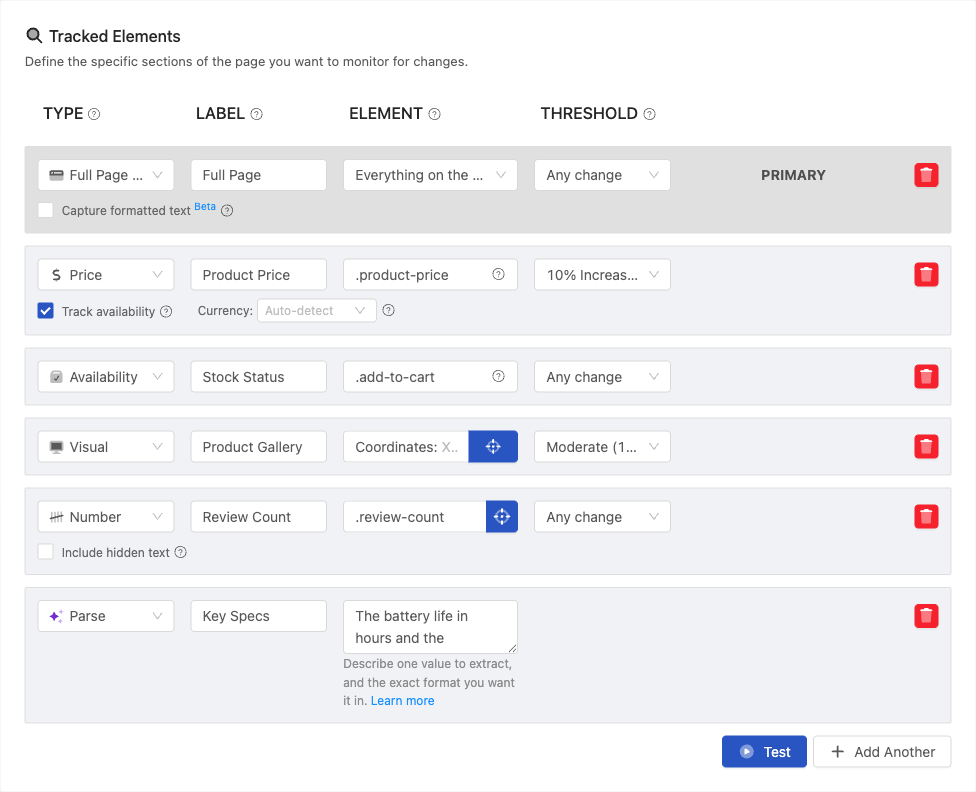
The example above shows a single product page configured with six tracked elements, each a different type: the whole page as Full Page Text, the Price (with availability tracking), the Availability state from the Add to Cart button, the Visual product gallery, the Number of reviews, and a Parse element that uses an AI prompt to extract the battery life and connectivity spec. Each one compares independently and triggers its own alert.
Quick Setup vs Advanced Mode
- Quick Setup tracks a single element on the page. This is the default for new monitors and is the easiest way to get started.
- Advanced Mode unlocks the ability to track multiple elements. Switch to Advanced Mode using the toggle in the page editor.
Once you add more than one tracked element, the monitor stays in Advanced Mode. To return to Quick Setup, remove the extra elements first so only one remains.
Per-Element Settings
Each tracked element has its own independent settings:
- Label - A descriptive name for the element (e.g., "Product Price", "Stock Status")
- Selector - A CSS selector or XPath expression that identifies the element on the page
- Type - The comparison method to use (text, number, visual, etc.)
- Threshold - How much the value needs to change before triggering a notification
- Include hidden text - Whether to include text from elements hidden via CSS
Click-to-Select
You do not need to write CSS selectors or XPath expressions manually. Use the visual selector tool to click on elements directly on the page. PageCrawl generates the appropriate selector for you automatically.
Use Cases
Product page monitoring - Use the Price element type for the product price, the Availability element type for stock status, and a Text element for the product description. Each triggers its own alert so you know exactly what changed.
Content sections and sidebar tracking - Monitor the main article content as text and the sidebar navigation as HTML. Catch content updates without being distracted by layout changes.
Multi-section compliance monitoring - Track terms of service, privacy policy sections, and legal disclaimers as separate elements on the same page. Each section triggers its own alert when updated.